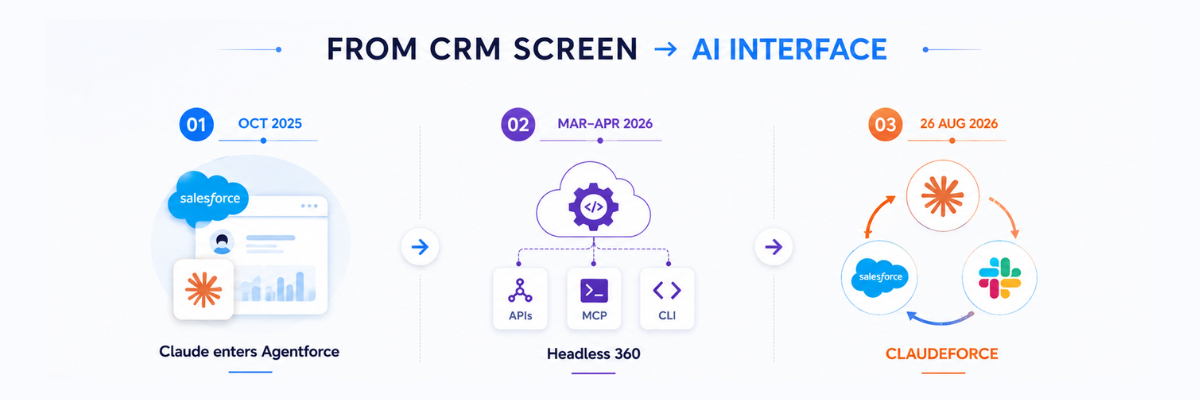
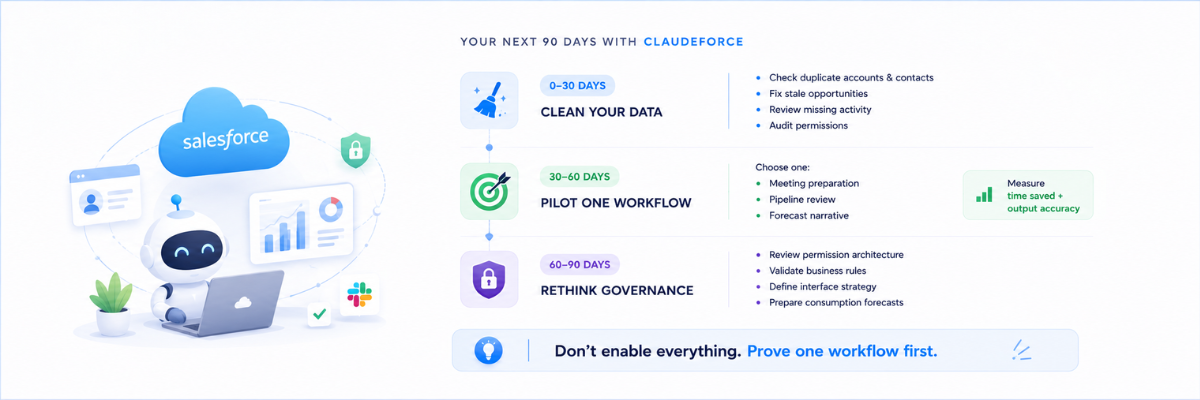
Salesforce Koa is Salesforce’s first CRM reasoning model. It is NVIDIA Nemotron 3 Super, post-trained by Salesforce on synthetic CRM scenarios, and it runs inside Salesforce’s own trust boundary. Koa is built to help Agentforce agents pick the right action on multistep work like qualifying a lead or routing a case. Today it is limited to pilot customers. General availability is expected in winter 2026 in US regions, and pricing has not been announced.
Salesforce announced a lot at Dreamforce ’26, and Koa got less attention than Claudeforce or Agentforce Coworker. For admins and architects, though, it may be the announcement with the most day-to-day impact. Koa changes a question most teams never had to ask: which model should sit behind each of our agents?
This guide covers what Salesforce Koa is, how it was built, what Salesforce claims it does better, the three places it will show up in your org, and a practical checklist for getting ready before general availability. Where Salesforce has not published something yet, such as pricing, we say so instead of guessing.
What is Salesforce Koa?
Koa is a large language model that Salesforce trained specifically for CRM work. Salesforce describes it as a “CRM reasoning model” for Agentforce agents. Its job is not to write marketing copy or summarize long documents. It is meant to reason through tasks that involve several steps and several tool calls, such as updating an opportunity, routing a case to the right queue or scheduling a follow-up after a call.
Salesforce first showed Koa on 15 September 2026 at Dreamforce, as part of a wider announcement with NVIDIA. On 13 October 2026, Salesforce’s Chief Data Officer Michael Andrew gave more detail on how it was trained in a Salesforce newsroom interview.
Salesforce Koa at a glance
Item
What we know (October 2026)
Announced
15 September 2026, Dreamforce ’26
Base model
NVIDIA Nemotron 3 Super (120B total parameters, 12B active, up to 1M token context)
Training data
Synthetic scenarios modeled on Salesforce CRM deployments across 14+ industries. Salesforce says no customer data was used.
Where it runs
Salesforce infrastructure. Salesforce controls the model weights.
Status
Pilot customers only, inside Agentforce
General availability
Expected winter 2026, US regions, with an open beta planned shortly after
Pilot customers named
1-800Accountant, Baxter Credit Union, Engine, Formula 1, UChicago Medicine, Xero
Pricing
Not announced
How Salesforce Koa was built
Salesforce did not train Koa from scratch. It started with NVIDIA Nemotron 3 Super, an open model NVIDIA released in March 2026. Nemotron 3 Super is a hybrid design that mixes Mamba-2 layers, mixture-of-experts layers and a small number of attention layers. Only about 12 billion of its 120 billion parameters are active for any one request, which keeps it cheaper to run than a dense model of the same size.
Salesforce then post-trained it in two stages:
Supervised fine-tuning. The model learned from worked examples of CRM tasks done correctly.
Reinforcement learning with GRPO. The model practised tasks in simulated environments and was rewarded for choosing the right tools and actions. Salesforce used NVIDIA’s NeMo RL, NeMo Gym and NeMo AutoModel tooling for this.
The training scenarios are synthetic. Salesforce built them from what it has learned running CRM deployments for close to three decades, across manufacturing, financial services, healthcare, travel and other industries. That matters for two reasons. First, it is why Salesforce can say no customer data went into training. Second, it is the main open question: synthetic scenarios are only as good as how closely they match messy real orgs, with their custom objects, half-used fields and years of validation rules.
What Salesforce Koa does better, according to Salesforce
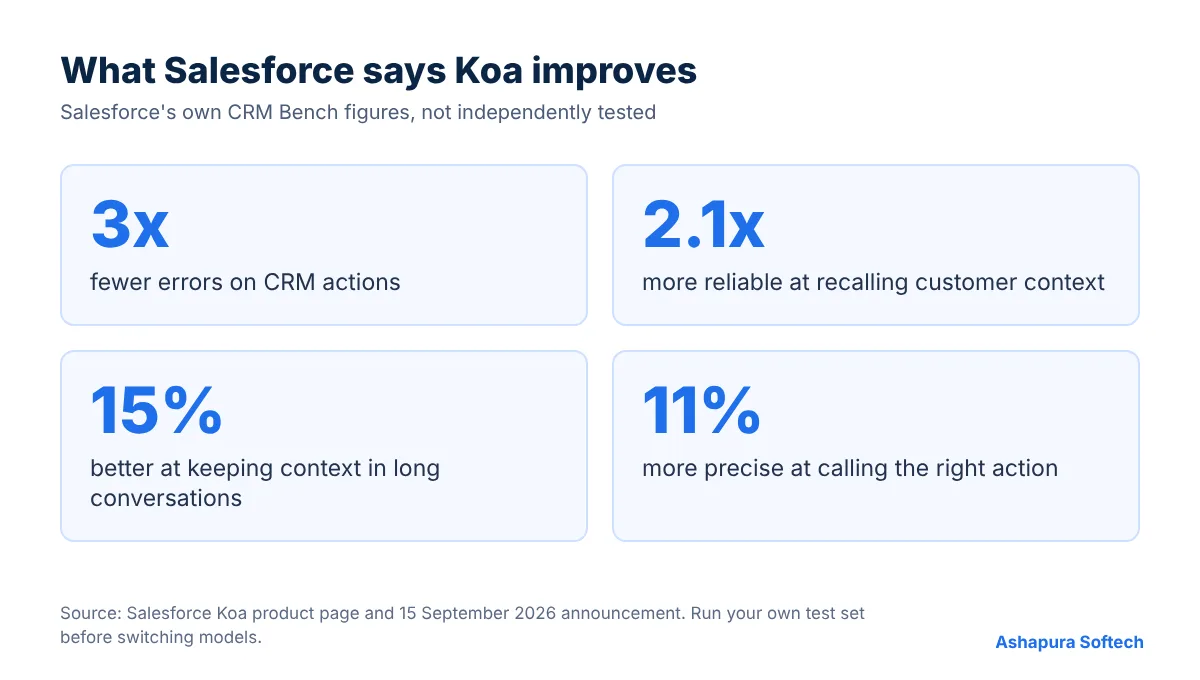
Salesforce tested Koa on its own CRM benchmark, which it calls CRM Bench. The tasks are everyday CRM actions: updating an opportunity, routing a case, scheduling a follow-up. Here is what Salesforce reports.
Salesforce’s published Koa figures. These are vendor numbers, not independent tests.
3x fewer errors on CRM actions, while matching or beating leading models
11% more precise at calling the right action, compared with default general-purpose models
2.1x more reliable at recalling customer context
15% better at keeping context across long back-and-forth conversations
Treat these as a reason to test Salesforce Koa, not as proof. Salesforce has not published the full benchmark, named the models it compared against for the “3x” figure, or shared independent results. Koa also runs at temperature 0, which means it gives the same answer to the same input. That is good for audit and repeatability, and it is one reason a model can look more reliable on structured tasks.
What we find most useful in these numbers is where the gains are. They are all about choosing actions and holding onto context. That lines up with the failures we see most often when teams pilot agents: the agent picks the wrong flow, updates the wrong record, or forgets what the customer said three turns earlier.
How to access Salesforce Koa in your org
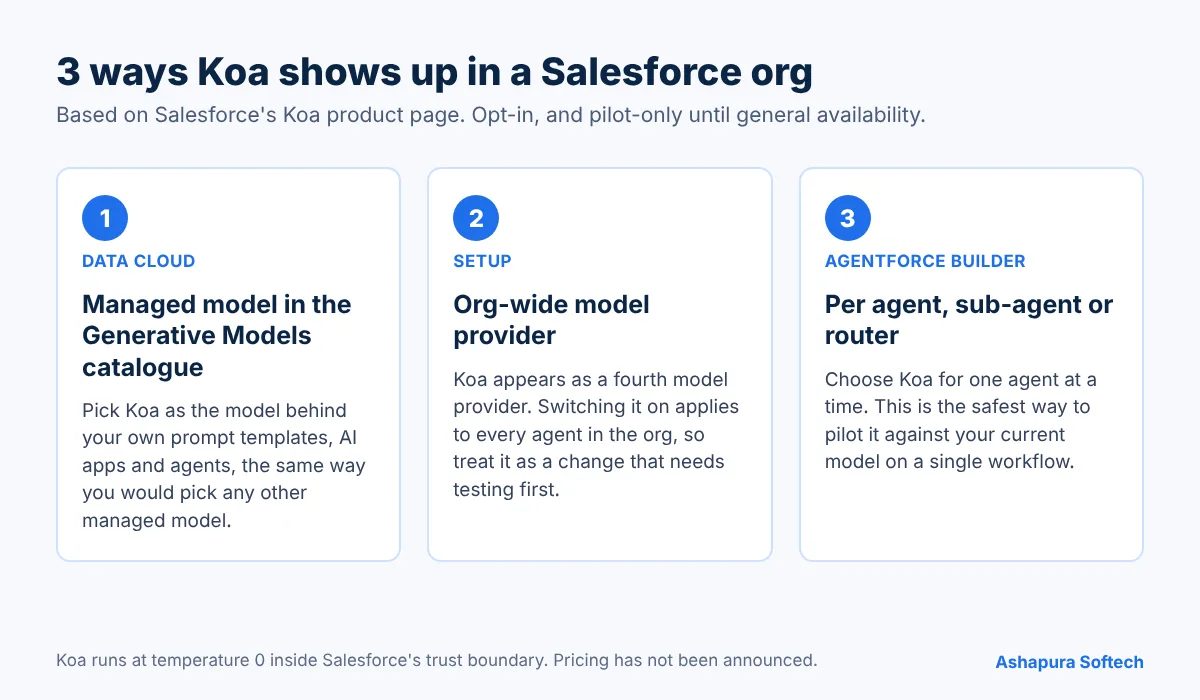
According to the Koa product page, Salesforce Koa will be available in three places. All three are opt-in.
The three access points Salesforce lists for Salesforce Koa.
Data Cloud Generative Models catalogue. Koa is listed as a managed model you can choose for prompt templates, AI apps and agents.
Org-wide, in Setup. Koa appears as a fourth model provider. Turning it on here affects every agent in the org.
Per agent, in Agentforce Builder. You can choose Koa for a single agent, sub-agent or agent router.
Our advice is to start with option 3. Switching the whole org to a new model in one step makes it hard to tell which change caused a problem. Running Salesforce Koa on one agent, next to an unchanged copy on your current model, gives you a clean comparison.
One note of caution: the product page also describes Koa as available “out of the box” in the Data Cloud catalogue, while the same page and the press release say it is pilot-only until general availability. If you do not see Koa in your org yet, that is expected. Check with your Salesforce account team if you want to join the pilot.
Salesforce Koa vs Claudeforce vs your current Agentforce model
Salesforce Koa arrives at the same time as Claudeforce, and the two are easy to confuse. They solve different problems.
Salesforce Koa
Claudeforce
Default Agentforce models
What it is
Salesforce’s own CRM reasoning model
Salesforce and Anthropic partnership: Salesforce in Claude, plus Claude inside Salesforce
General-purpose models from partner providers
Best at
Picking the right CRM action on multistep tasks
Working with Salesforce data from Claude, broad reasoning and writing
Anthropic models through the Salesforce trust layer
Provider models through the trust layer
Status
Pilot, GA expected winter 2026 (US)
Salesforce in Claude in beta
Generally available
Pricing
Not announced
Depends on Claude plan and Salesforce usage
Through your Agentforce and Flex Credits agreement
In practice, many orgs will end up using more than one. A service agent that routes and updates cases might run on Koa, while a sales rep drafts emails and reviews pipeline in Claude. Our Claudeforce vs Agentforce comparison explains how those two layers fit together.
Should you switch your agents to Salesforce Koa?
Not yet, for most orgs, simply because you cannot until general availability. The better question is which agents are good candidates once you can. Based on what Salesforce has published, Salesforce Koa looks like a strong fit when:
The agent’s main job is taking actions in Salesforce, not writing long text
Each task needs two or more tool calls in the right order, such as look up the account, check entitlements, then route the case
Wrong actions are costly, for example a case sent to the wrong queue or an opportunity stage changed by mistake
Conversations run long and the agent keeps losing earlier details
Your security team prefers a model whose weights stay inside Salesforce
It is a weaker fit, or at least unproven, for open-ended writing, analytics questions across large datasets, and work outside the CRM. For those, a frontier model such as Claude may still be the better choice.
How to get your org ready for Salesforce Koa: a 6-step checklist
None of these steps depends on Koa pricing or release dates, so you can start now. They also improve your current agents, whichever model you use.
List every agent and the model behind it. Include Agentforce agents, prompt templates, any Einstein features and any Claude or OpenAI connections. Many teams have never written this down.
Pick two or three action-heavy workflows. Lead qualification, case routing and opportunity updates are the obvious ones. These are where Koa’s claimed gains apply.
Build a test set from real cases. Collect 30 to 50 real examples per workflow, with the correct outcome for each. Strip out personal data. This is the only way to check Salesforce’s benchmark against your own org.
Tighten permissions before you add any model. Review the permission sets, sharing rules and field-level security your agents run under. A more capable model with over-broad access is a bigger risk, not a smaller one. Our Agentforce readiness checklist covers this in detail.
Set your pass and fail rules. Decide in advance what error rate is acceptable, when the agent must hand over to a person and what you need logged for audit.
Plan for cost uncertainty. Salesforce has not said whether Koa will cost more or less than current models. If you are on Flex Credits, track credit use per agent now so you can compare once Koa pricing is public. Agent calls from outside Salesforce are also getting a new meter, which we explain in our guide to AIforce (now SIForce) and your implementation.
Salesforce Koa timeline
11 March 2026: NVIDIA releases Nemotron 3 Super, the base model for Koa
15 September 2026: Salesforce announces Koa at Dreamforce ’26
October 2026: Post-trained NVIDIA models reach select Missionforce customers. Salesforce shares more training detail on 13 October.
Now: Koa available to select pilot customers in Agentforce
Winter 2026: General availability expected in US regions, followed by an open beta
Planning an Agentforce rollout? We help US teams pick the right workflows, set up permissions and test agents before they go live. Book a free 30-minute consultation and we will review your current agents with you.
Koa is Salesforce’s first CRM reasoning model. It is NVIDIA Nemotron 3 Super, post-trained by Salesforce on synthetic CRM scenarios, and it is designed to help Agentforce agents choose the right actions on multistep CRM tasks.
When will Salesforce Koa be generally available?
Salesforce expects general availability in winter 2026 in US regions, with an open beta to follow. Until then it is limited to select pilot customers.
Is Koa trained on customer data?
No, according to Salesforce. Koa was trained on synthetic scenarios built from Salesforce’s experience with CRM deployments, and Salesforce says no customer data crosses its trust boundary during training or inference.
How much does Salesforce Koa cost?
Salesforce has not announced Koa pricing. If you use Flex Credits today, track credit use per agent so you can compare costs once pricing is published.
Is Salesforce Koa the same as Claudeforce?
No. Koa is Salesforce’s own model, running on Salesforce infrastructure. Claudeforce is Salesforce’s partnership with Anthropic that brings Salesforce data into Claude and Claude into Salesforce. Many orgs may use both for different jobs.
How do I turn on Koa in Agentforce?
Once it is available to your org, you will be able to choose Koa per agent in Agentforce Builder, set it as an org-wide model provider in Setup, or pick it from the Data Cloud Generative Models catalogue. We recommend testing on one agent first.
The bottom line
Salesforce Koa is the company’s bet that a smaller model trained on CRM work can beat general models at the jobs agents actually do inside Salesforce. The claims are promising but come only from Salesforce so far, and there is no price yet. The smart move now is not to wait. Map your agents, pick the action-heavy workflows, build a real test set and fix permissions. When Salesforce Koa reaches general availability, you will be able to test it in days instead of months.
How we put this guide together
Product facts in this guide come from Salesforce’s 15 September 2026 Koa press release and its Koa product page, with base model details from NVIDIA’s Nemotron 3 Super model card. Benchmark figures are Salesforce’s own and are labeled that way. Pricing, Koa’s exact place in Agentforce packaging and independent test results were not public at the time of writing, so we have not guessed at them. We will update this page when Koa reaches general availability.
Ankur Pandey is Marketing Manager at Ashapura Softech, a certified Salesforce and Odoo partner with offices in Irving, Texas and Ahmedabad, India. He writes about Salesforce, Zoho and ERP planning for US mid-market businesses.
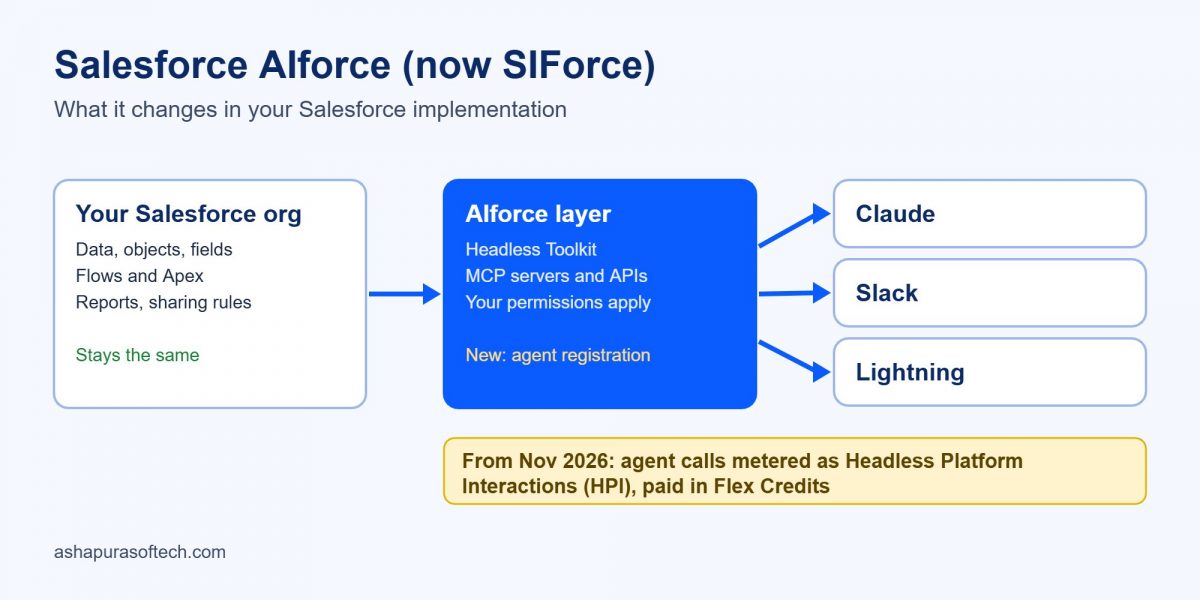
Salesforce AIforce does not move your data or replace your org. It is a layer that lets people and AI agents use Salesforce from Claude, Slack and Lightning, under the permissions you already have. What does change is how agents connect: each agent that calls Salesforce over MCP or API will need its own registered identity, and those calls get a new usage meter paid in Flex Credits. Salesforce is targeting November 2026 for these changes, and existing customers with API-based agents move over at renewal.
Three names in two months. Headless 360 in spring, AIforce at Dreamforce, and SIForce last week. If you look after a Salesforce org, the obvious worry is that one of these quietly turns into a migration project nobody budgeted for.
We read Salesforce’s own impact notes so you don’t have to, and the honest answer is: it’s smaller than it sounds, but it isn’t nothing. This guide walks through the AIforce impact on your Salesforce implementation, what stays exactly as it is, the dates that matter, and the checklist we’d work through before the new rules switch on. If you want the background on the announcement itself, start with our explainer What Is AIforce?
What is Salesforce AIforce?
AIforce is Salesforce’s interface layer for AI. It brings Salesforce data, workflows and permissions into the tools people already work in, so a rep can ask Claude or Slack about an account instead of opening Salesforce. Salesforce first showed the idea at TDX 2026 under the name Headless 360 and launched it as AIforce at Dreamforce on 15 September 2026.
It arrives in three forms, all running on the same foundation:
Claudeforce (Salesforce in Claude): a prebuilt MCP server with 37 sales skills that lets Claude read and act on Salesforce records. It launched in beta for Salesforce customers. Our guide to Claudeforce covers it in detail.
Slackforce: Salesforce context and actions inside Slack, such as creating accounts or logging notes from a prompt.
Agentforce Coworker: an AI teammate inside the Lightning interface that works within existing permissions and can call the Agentforce agents you have built. See our Agentforce Coworker guide.
Under all three sits the Headless Toolkit: the MCP servers, APIs, skills and plug-ins that expose the platform to outside AI tools. That toolkit is where the implementation impact comes from.
AIforce is now SIForce: what the rename means
On 9 October 2026, Marc Benioff posted on X: “AIForce is officially SIForce.” The rename followed a US executive order that asks federal agencies to say “super intelligence” instead of “artificial intelligence”.
For your org, the rename changes nothing yet. No features, prices or availability were announced with it, and Salesforce’s help documentation still uses the name AIforce. Our advice is the same as for the Agentforce product names Salesforce reversed in September: keep contracts, order forms and internal documents on the current names until your account team confirms how they will appear at renewal. In this guide we use “AIforce”, because that is the name in Salesforce’s own documentation today.
Do you need to migrate to AIforce?
No, not in the usual sense. There is no data migration, no new object model and no rebuild of your flows, reports or page layouts. AIforce reads from the org you already have. We already give every integration a dedicated, least-privilege user on the Salesforce CRM integration work we do, and agent identities follow the same idea.
The “migration” is narrower and more technical. It applies to agents: any AI tool, script or MCP client that connects to Salesforce on its own. Salesforce’s help article Understand AIforce Impact sets out two changes for them.
What Salesforce AIforce changes in your implementation
1. Salesforce agent registration: every agent gets its own identity
Right now, a lot of AI tools get into Salesforce by borrowing someone’s login or a shared integration user. Under the new model, admins register each agent through a feature called Agentic Identity. The agent gets its own identity on the platform, and you can give it a narrower permission set than any human user has.
Security-wise, this is a good change. An agent with its own identity can be limited, watched and switched off without touching a person’s account. The catch is the work behind it: someone has to find every agent, register it, and swap its OAuth credentials so Salesforce knows it’s talking to an agent and not a human.
2. Headless Platform Interactions: a new meter for agent calls
Each successful call a registered agent makes to Salesforce, over MCP or direct API, is metered as a Headless Platform Interaction (HPI). HPIs are tracked in Digital Wallet and paid for with Flex Credits, under the Customer 360 Platform section of the Flex Credits rate card.
Two details matter for budgeting:
The price isn’t set yet. The HPI multiplier is listed as “TBA”, and Salesforce says it will give 30 days’ notice before metering begins.
Your org must be on Flex Credit billing. Salesforce names Salesforce Foundations (listed at $0) or another SKU that enables Flex Credits. If Flex Credits are new to you, our guide to Agentforce pricing and Flex Credits explains how they work.
3. The deadline depends on how you buy and connect
Your situation
What you must do
Deadline
New purchase on or after 17 Sep 2026
Register all agents that use Salesforce APIs
Within 3 months of Salesforce’s notice that Agentic Identity is available
Existing customer with API-based agents
Register all agents and move them to the new billing model
At your renewal
Any customer using a Salesforce MCP server
Register the agents that use it
Within 3 months of the Agentic Identity notice
Traditional (non-agent) integrations
Nothing: pricing and security options are unchanged
None
Salesforce is targeting November 2026 for agent registration, the new security controls and the billing model.
Our take: the rename gets the headlines, but the meter is what will show up in budgets. If your renewal falls in the next six months, it’s worth getting the agent inventory done now, while the multiplier is still “TBA” and nothing is being charged.
4. Sandboxes stay free
HPIs are only charged in active production orgs. Sandboxes, scratch orgs and Developer Edition orgs aren’t metered, so your team can build and test agents without using credits.
What stays the same
Most of your implementation doesn’t change at all. This is the part teams worry about most, so here it is side by side.
Area
Changes with AIforce?
Your data, objects and fields
No
Flows, Apex, validation rules
No
Reports and dashboards
No
Lightning UI and page layouts
No: Lightning stays, and Agentforce Coworker runs inside it
Sharing rules and field-level security
No, but they now control what AI can see (see below)
Traditional integrations (ERP sync, middleware)
No: pricing and security options are unchanged
AI agents and MCP clients that call Salesforce
Yes: registration, new credentials and HPI billing
Contracts and product names
Possibly, at renewal: confirm with your account team
Where your current setup will show its gaps
AIforce doesn’t create new problems in an org. It makes the existing ones visible faster, because an AI answer is only as good as the data and permissions behind it.
Over-wide permissions. Every AIforce request runs as the user who makes it. If a profile has collected extra access over years of quick fixes, Claude or Slack will show that data to anyone who asks the right question. Permission sets that were “fine because nobody looks there” stop being fine.
Duplicate and stale data. An agent asked to brief a rep on an account reads whatever is in the org. Duplicate accounts and opportunities stuck in old stages produce answers that sound confident and are wrong. Approval steps catch bad writes, not bad reads.
Agents nobody listed. Scripts, browser extensions and MCP clients set up by individual teams are easy to miss. Under the new rules, an unregistered agent is both a security gap and an unplanned bill once metering starts.
Integrations running on a person’s login. If an integration or AI tool uses a named employee’s account, it breaks when that person leaves, and it hides what the tool is actually doing. Registration is the right moment to fix this.
If you want to measure these gaps before the November changes, our free CRM health-check template covers permissions, data quality and integrations in 30 checks.
AIforce readiness checklist for existing Salesforce orgs
Here’s the order we’d tackle it in. For most mid-sized orgs this is a few days of admin time, not a project. Start with the inventory; everything else depends on knowing what’s actually connected.
Inventory every agent. List each AI tool, script and MCP client that connects to Salesforce, who owns it, and which user it runs as today.
Split production from sandbox. Only production calls will be metered, so note which connections touch production.
Design one permission set per agent. Give each agent the least access it needs. Don’t reuse an admin or a sales manager’s profile.
Confirm Flex Credit billing. Check whether your org already has Salesforce Foundations or another SKU that enables Flex Credits.
Note your renewal date. Existing API-based agents move to the new billing model at renewal, so that date sets your timeline.
Plan the credential switch. Each agent will need new OAuth credentials tied to its registered identity. Schedule the reconnection so nothing breaks mid-quarter.
Clean the data your first use case touches. Merge duplicate accounts and close out stale opportunities on the objects your pilot will read.
Pilot read-only first. Start one team on Salesforce in Claude or Agentforce Coworker with read access, check the answers, then allow writes with approval.
Watch for Salesforce’s notices. The Agentic Identity announcement starts the three-month clock, and the 30-day HPI notice tells you when billing begins.
Free: Salesforce implementation checklist
A step-by-step list covering permissions, data and integrations. Use it alongside this AIforce checklist before the November changes.
No. Agentforce is the set of AI agents that do work inside Salesforce. AIforce is the layer that lets people and agents reach Salesforce from Claude, Slack and Lightning. Agentforce Coworker is where the two meet. Our comparison of Claudeforce vs Agentforce goes deeper.
Is SIForce a different product from AIforce?
No. SIForce is the new name Marc Benioff announced on 9 October 2026 for the same product. No feature or pricing change came with it.
Do we have to pay extra for AIforce?
Salesforce hasn’t published a single AIforce price. What is confirmed is that registered agent calls to production orgs will be metered as Headless Platform Interactions and paid in Flex Credits, at a rate still listed as “TBA”. Confirm your entitlements with your account executive.
Will our existing integrations be billed as HPIs?
Traditional integrations keep their current pricing. The new meter applies to AI agents and MCP clients that are registered under Agentic Identity.
Which Claude plan does Salesforce in Claude need?
Published sources disagree, so check the current admin setup guide on AgentExchange or ask your Salesforce account team before you budget for it.
When do the new rules start?
Salesforce is targeting November 2026. New purchases from 17 September 2026 and anyone using a Salesforce MCP server have three months from Salesforce’s Agentic Identity notice to register agents. Existing customers with API-based agents move over at renewal.
The bottom line
AIforce, now SIForce, is not a migration of your Salesforce org. It is a new front door, and the house behind it stays the same. The work is in the doorway: knowing which agents come in, giving each one its own key, and budgeting for the new meter before it starts.
Ashapura Softech can run an AIforce readiness review for your org, covering an agent inventory, a permission audit and a Flex Credit estimate. Our Salesforce Agentforce consulting team handles agent setup and permissions, or you can talk to our Salesforce team directly.
How we put this guide together
Everything about registration, billing and deadlines here comes from Salesforce’s own help article on AIforce impact, dated 17 September 2026. Product details come from Salesforce’s Dreamforce announcements, and the rename from Marc Benioff’s post on 9 October. A few things are still open (the HPI price, final packaging), and we’ve said so where they come up rather than guessing. We’ll update this page when Agentic Identity goes live.
About the author
Ankur Pandey is Marketing Manager at Ashapura Softech, a certified Salesforce and Odoo partner with offices in Irving, Texas and Ahmedabad, India. He writes about Salesforce, Zoho and ERP planning for US mid-market businesses.
Of everything Salesforce announced under AIforce at Dreamforce 2026, Agentforce Coworker is the piece most admins will meet first. It is not a pilot you apply for. In many orgs it is already switched on, because Salesforce began turning it on automatically from 10 August 2026. This guide explains what Agentforce Coworker is, what it can and cannot touch, what it costs, how to turn it on or keep it off, and how to fix the errors admins run into during setup.
Related: Coworker works with your existing Agentforce agents, and from winter 2026 those agents can run on Salesforce Koa, Salesforce’s new CRM reasoning model.
Agentforce Coworker is an AI assistant that sits in the Salesforce search bar inside Lightning. A user types a question in plain language, and instead of a list of matching records they get one written answer built from the data they are allowed to see. Salesforce’s own Coworker FAQ describes it as a teammate that can reason over complex requests, build a multi step plan and call backend tools to finish the task.
The simplest way to think about it: Coworker replaces “search, open five records, read, piece it together” with “ask once, get the summary”. It does not replace your agents, your flows or your reports. It sits in front of them and becomes the single entry point to them.
Agentforce Coworker timeline
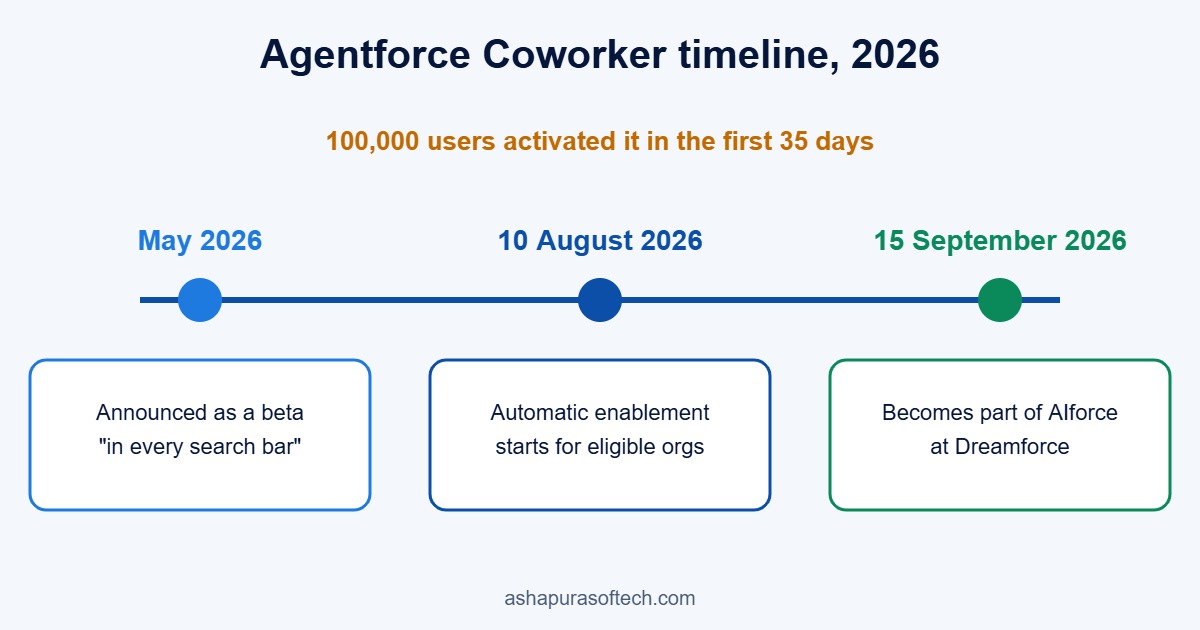
May 2026: Marc Benioff announced Coworker as an AI teammate “inside every Salesforce search bar”, and it opened as a beta for Agentforce customers.
10 August 2026: Salesforce started enabling it automatically for eligible orgs, on a rolling basis.
Agentforce Coworker vs traditional Salesforce search
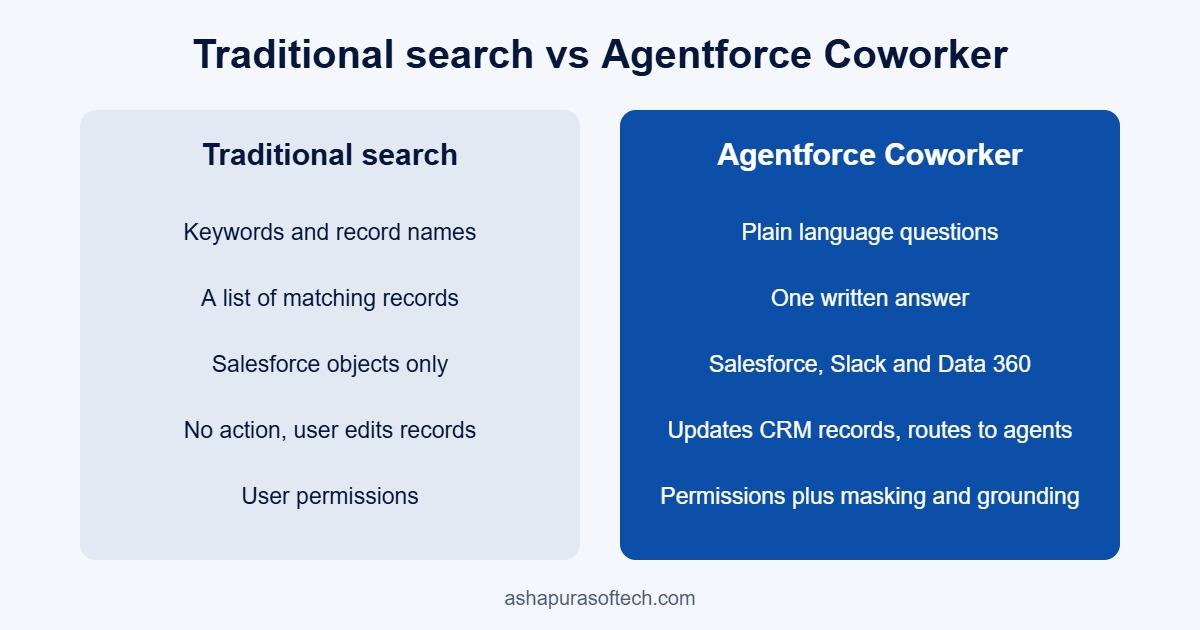
Classic global search is good at one thing: finding a record when you already know roughly what it is called. Coworker is built for the questions that sit between records.
Traditional Salesforce search
Agentforce Coworker
Input
Keywords and record names
Plain language questions
Output
A list of matching records
One written answer with the records behind it
Sources
Salesforce objects
Salesforce, Slack and Data 360 sources
Action
None, the user opens and edits records
Creates or updates CRM records after confirmation, routes work to agents
Security
User permissions
User permissions plus Data 360 governance, masking and grounding
Agentforce Coworker compared with traditional Salesforce search.
Where Agentforce Coworker works
The Lightning search bar is where most users first see it, but Salesforce’s Agentforce Coworker page lists more surfaces: Slack, Microsoft Teams, Claude, ChatGPT and mobile. The point is that the same assistant, with the same permissions, follows the user into whichever tool they already have open. That is the idea behind AIforce as a whole, and it is why Coworker pairs naturally with Claudeforce for teams that already work in Claude.
What Agentforce Coworker can search and do
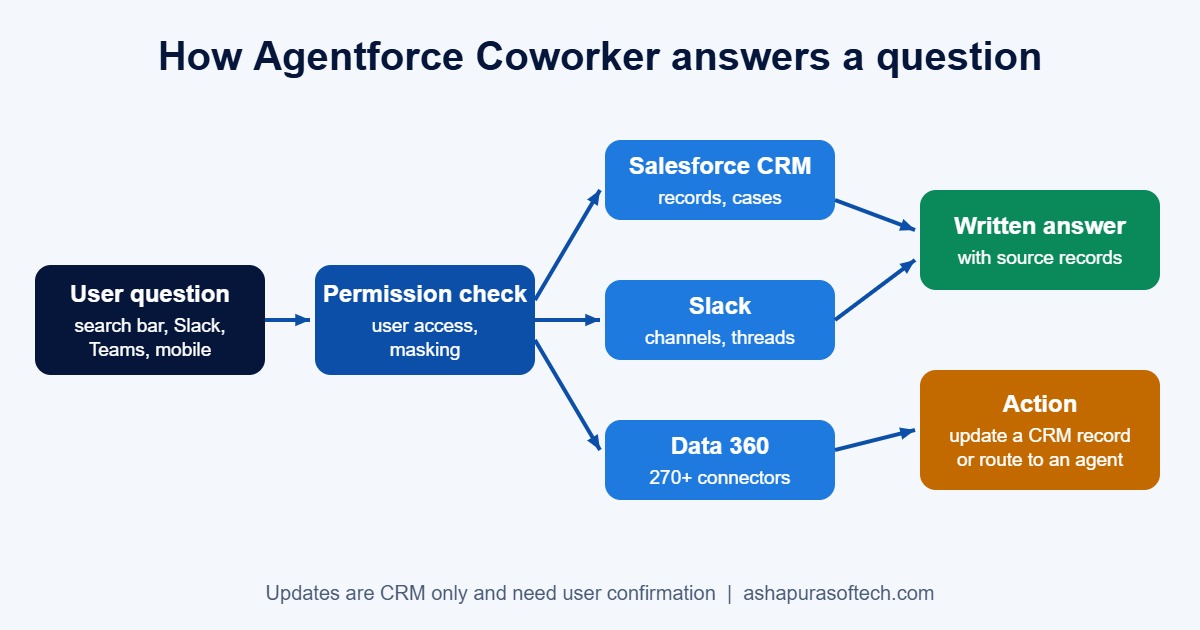
According to the Salesforce developer guide and the help FAQ, Coworker reads across three kinds of source:
Salesforce CRM data: accounts, contacts, opportunities, cases, custom objects, knowledge articles and past case history.
Slack: messages, channels and conversations the user can already access.
Data 360 sources: Salesforce says more than 270 external sources connect through Data 360 connectors, including data lakes, knowledge bases and enterprise apps such as Jira.
On top of search, it does three things that matter in daily work:
Create or update records. It checks permissions and validation first, and asks the user to confirm before it saves anything. Today this works only on Salesforce CRM records, not on Slack or external data.
Route the request. If a question belongs to a specialised agent, for example a service agent or one of the named agents like Casey or Piper, Coworker hands it over rather than guessing.
Summarise across sources. A sales rep can ask what is putting a deal at risk and get the open cases, the Slack thread about pricing and the stalled approval in one answer.
How Agentforce Coworker turns one question into an answer or an action, inside the user’s own permissions.
Agentforce Coworker use cases and example prompts
The value shows up when people ask the questions they currently answer by opening several tabs. These are the kinds of prompts that fit each team.
Sales
“What should I know before my call with this account tomorrow?”
“Which of my opportunities closing this quarter have had no activity in two weeks?”
“Log a note on this opportunity: pricing approved, legal review next week.”
Service
“Has this customer reported this issue before, and how was it fixed?”
“Why are cases about login errors spiking this week?”
“Find the knowledge article that answers this case.”
Customer success and leadership
“Summarise open cases, renewal date and recent Slack discussion for this account.”
“Which strategic accounts have an open escalation and a renewal in the next 90 days?”
For the wider picture of where agents earn their keep, see our Agentforce use cases guide.
How it handles security and permissions
Salesforce says Coworker “fully honors the existing Salesforce access model”. It runs with the permissions of the person using it, so if a user cannot open a record, Coworker cannot read it for them. Behind that sit attribute based access control, PII masking, toxicity detection and result grounding through Data 360, and the AIforce announcement repeats the zero data retention model for the underlying language models.
External sources need more thought. Permission aware sources carry their access rules across automatically, and federated sources enforce permissions in real time at the source. For other connectors, an admin has to create governance policies in Data 360 by hand. Data from sources that are not zero copy is ingested and stored in Data 360, which matters for data residency reviews.
The practical catch is that “respects your permissions” is only as good as the permissions themselves. Many orgs have years of broad sharing rules, public read on objects that should be private, and profiles that were cloned instead of designed. Search used to hide that problem because nobody scrolled through everything. A good AI answer surfaces it in seconds. If you have not reviewed sharing in a while, do that before you roll Coworker out widely. Our Agentforce readiness checklist covers the same ground.
Automatic enablement: is Coworker already on in your org?
Salesforce’s automatic enablement FAQ says the rollout began on 10 August 2026 on a rolling basis. Your org is in scope if it has Unmetered User Based AI seats and Einstein is active.
Some orgs are left out of automatic enablement:
Orgs that have opted out of generative AI.
Multi dataspace or multi org setups.
HIPAA, health and life sciences, and government orgs.
Flex Foundation seats without Unmetered entitlements.
If your org is in scope and you would rather roll it out on your own schedule, there are two ways to opt out: the link in the notification email Salesforce sends, or Setup > Agentforce Coworker > Opt Out of Auto Activation. Users who gain an eligible seat after the automatic switch on still need an admin to give them access by hand.
Coworker rollout review
Coworker may already be switched on. Is your data ready for it?
Coworker answers from whatever your users can already see. We review permissions and data quality first, so it gives the right answers to the right people.
Check whether Coworker is enabled in your org today
Find profiles and sharing rules that expose more than they should
Certified Salesforce partner · 30-minute call, no obligation
Agentforce Coworker pricing: what does it cost?
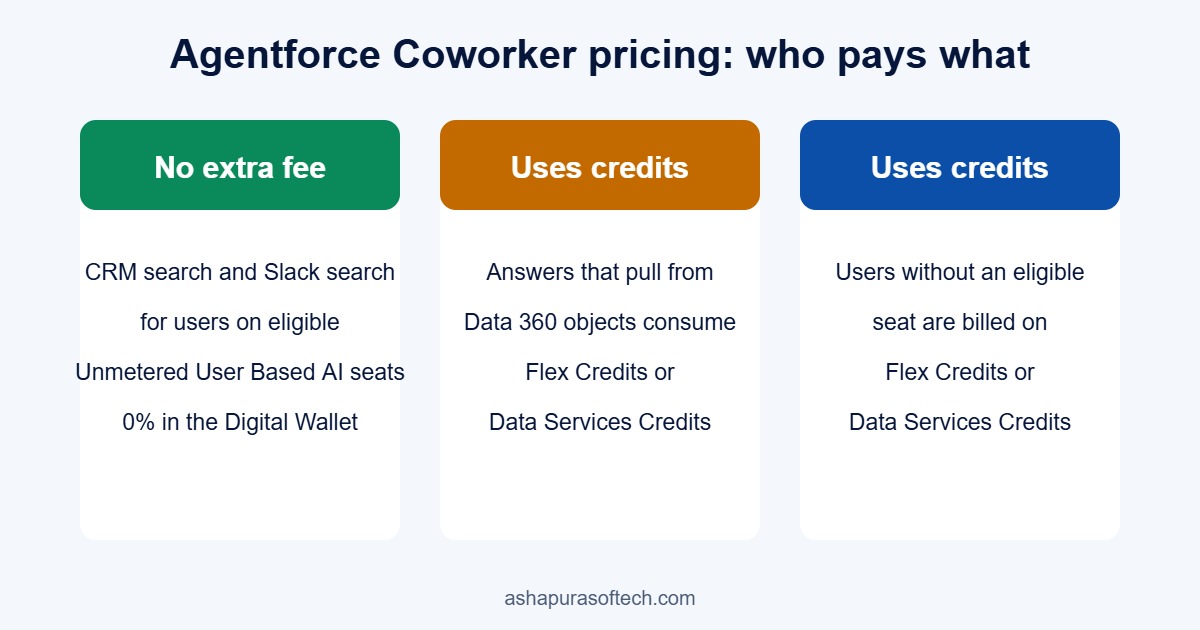
For most seat based customers, the search itself is included. Salesforce states that searching CRM data and Slack carries no extra fee for users on eligible Unmetered seats, and that their usage shows as zero consumption in the Digital Wallet.
Costs appear in two places:
Data 360 objects. Answers that pull from connected Data 360 objects consume Flex Credits or Data Services Credits.
Users without an eligible seat. Anyone who loses an Unmetered seat moves back to normal Flex Credit or Data Services Credit billing.
So the budget question is not “what does Coworker cost” but “which users are on metered seats, and how much Data 360 do we plan to expose”. If you are still working out how Flex Credits are counted, start with our Flex Credits explainer, and read the Core, Advanced and Max editions change alongside it, since the new editions bundle credits differently.
Who pays what for Agentforce Coworker.
Requirements to turn on Agentforce Coworker
If your org was not switched on automatically, you can turn it on yourself. The setup guide and the help FAQ list these requirements.
Requirement
What you need
Edition
Enterprise, Unlimited or Agentforce 1
Usage based licensing
Data Cloud or Data 360, a Foundations or Flex Foundations licence, and Flex Credits
Seat based licensing
Data Cloud or Data 360, plus Agentforce 1 Edition or Agentforce for Sales, Service and Industries
Admin access
Salesforce admin role, the Agentforce Coworker Admin permission set and the AI Search Setup permission set licence
User access
The Access_Ai_Search permission set group
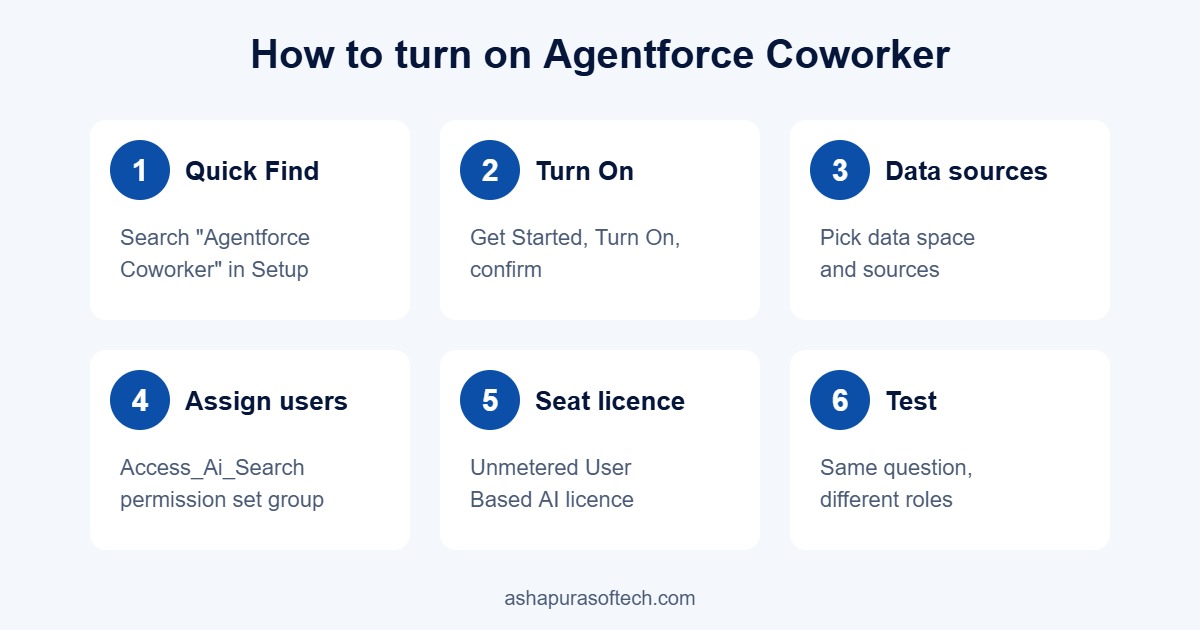
How to turn on Agentforce Coworker, step by step
In Setup, type Agentforce Coworker in the Quick Find box.
Select Get Started with Agentforce Coworker, click Turn On and confirm. Einstein turns on automatically at this point. Setup takes a few minutes, and Salesforce shows a warning if any prerequisite is missing.
If your org has more than one data space, choose the data space, then select the data sources Coworker should use.
In the Manage Users section, click Manage and assign the Access_Ai_Search permission set group to the users who should have it.
For seat based access, open each user in Setup, go to Permission Set License Assignments, tick Unmetered User-Based AI and save.
Test with two or three users from different roles before you widen access. Ask each the same question and check that the answers differ in the way their permissions say they should.
The six steps to turn on Agentforce Coworker.
Troubleshooting common Agentforce Coworker errors
These are the errors Salesforce lists in its troubleshooting FAQ, with the fix for each.
Error
Likely cause
Fix
Coworker does not appear, or “Not Enabled”
User is missing the licence or the Access_Ai_Search group
Check the permission set licence and group assignment for that user
401 Unauthorized
Connected App or OrgJWT set up incorrectly
Confirm the Connected App definitions and OrgJWT certificates match
400 Invalid ID
Agent ID is truncated or in the wrong format
Copy the full 18 character Agent ID from the setup URL
500 Server Error or engine lookup failure
Backend or model gateway interruption
Hard refresh the browser, then turn Coworker off and on again
Invalid Token
The session failed OAuth or JWT validation
Check client credentials and the gateway network path
Limits worth knowing before rollout
30 language model calls per minute per user. Salesforce notes this is not technically enforced yet, but one question can trigger several calls, so heavy users will reach it sooner than the number suggests.
Record updates are CRM only. Coworker can read Slack and Data 360, but it can only write to Salesforce records.
Files over 75 MB are not indexed, so very large documents will never show up in answers.
English only during the beta. Salesforce says other languages follow at general availability.
Not yet available in GovCloud. It does work for authenticated Experience Cloud users.
Answers are only as good as the data. Duplicate accounts, empty close dates and stale opportunity stages all show up in the answer. An AI summary of messy data is still messy data, just faster.
A sensible Agentforce Coworker rollout plan for admins
Before rollout, it helps to have your core Salesforce Sales Cloud workflows documented, because Coworker surfaces whatever your automation writes to records, good or bad.
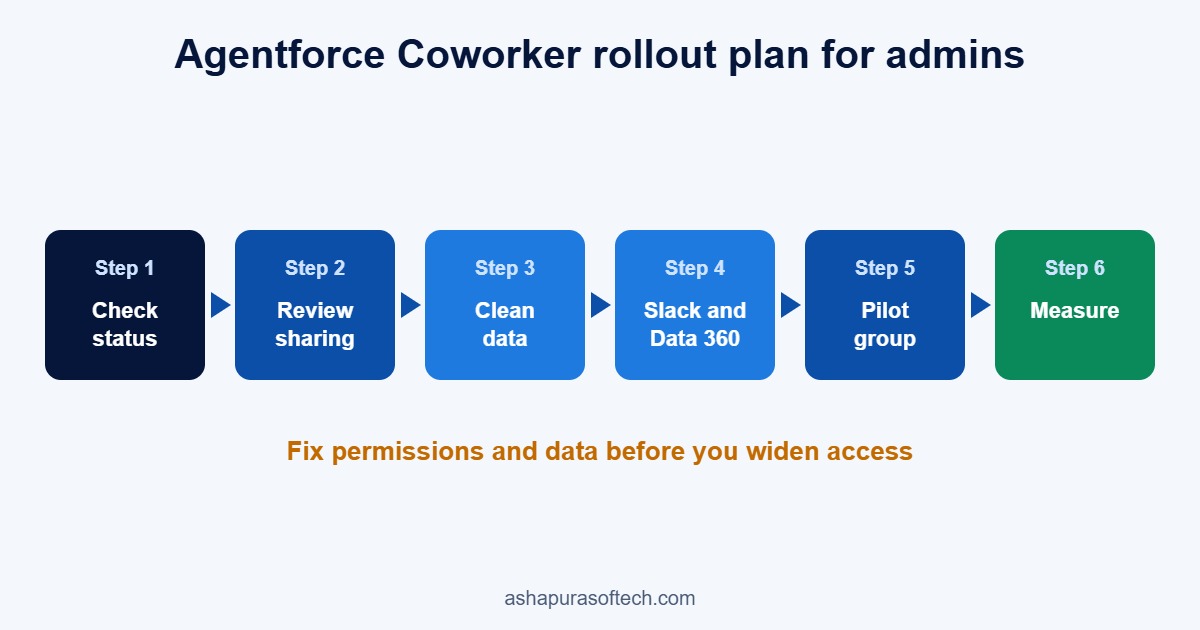
Whether Coworker is already on or you are about to switch it on, the order of work is the same:
Check the status. Open Setup and see whether Coworker is active and who has the Access_Ai_Search group.
Review sharing. Look at organisation wide defaults, sharing rules and the objects with public read. Fix what you would not want a quick question to reveal.
Clean the high use objects. Merge duplicate accounts and contacts and fill the fields reps rely on, such as stage, close date and next step.
Decide on Slack and Data 360. Connect Slack if your teams live there. Connect Data 360 sources only where the value is clear, set governance policies for any source that is not permission aware, and remember those answers consume credits.
Start with a pilot group. Pick one sales team and one service team, collect the questions they actually ask, and write short guidance on what Coworker is good at.
Measure. Track adoption, the questions that return weak answers and credit consumption for the first month before you expand.
A six step Agentforce Coworker rollout plan for admins.
Coworker may already be switched on. Is your data ready for it?
Coworker answers from whatever your users can already see. We review permissions and data quality first, so it gives the right answers to the right people.
Check whether Coworker is enabled in your org today
Find profiles and sharing rules that expose more than they should
Certified Salesforce partner · 30-minute call, no obligation
Frequently asked questions about Agentforce Coworker
Is Agentforce Coworker part of AIforce?
Yes. At Dreamforce 2026 Salesforce grouped Agentforce Coworker, Claudeforce and Slackforce under AIforce, its new interface layer for reaching Salesforce data from any screen.
Is Agentforce Coworker free?
Searching CRM data and Slack carries no extra fee for users on eligible Unmetered User Based AI seats. Answers that use Data 360 objects consume Flex Credits or Data Services Credits, and users without an eligible seat are billed on credits.
Was Agentforce Coworker turned on automatically?
Possibly. Salesforce began automatic enablement on 10 August 2026 for orgs with Unmetered User Based AI seats and Einstein active. HIPAA, health, government and multi org setups were excluded.
How do I opt out of automatic activation?
Use the opt out link in the Salesforce notification email, or go to Setup, Agentforce Coworker, and turn on Opt Out of Auto Activation.
Can Agentforce Coworker see data a user cannot see?
No. It runs with the permissions of the person using it, so it can only read and change what that user can already read and change.
Does Agentforce Coworker work in Slack and Microsoft Teams?
Yes. Salesforce lists Slack, Microsoft Teams, Claude, ChatGPT and mobile as surfaces alongside the Salesforce search bar.
Which editions support Agentforce Coworker?
Enterprise, Unlimited and Agentforce 1 editions, with Data Cloud or Data 360 in place.
Why can’t I see Agentforce Coworker in my org?
Usually the user is missing the required permission set licence or the Access_Ai_Search permission set group. Check both in Setup before looking for anything else.
The bottom line
Agentforce Coworker is the most visible part of AIforce because it lives where every user already clicks: the search bar. It costs little or nothing for most seat based orgs, and it may already be running in yours. The real work is not switching it on. It is making sure your permissions and data are in a state where a fast, confident answer is also a correct one. Start there, pilot small, and expand once the answers hold up.
For two years Agentforce was something you built. You picked a topic, wrote instructions, wired up actions, tested it, and hoped the thing behaved in production. At Dreamforce in September 2026 Salesforce changed the starting point: seven named agents that arrive already configured for a specific job, six of them generally available on day one.
That shift is bigger than the names suggest. A prebuilt agent is an opinion about how a job should be done, baked into software. It will fit some orgs closely and fight others. This guide goes through all seven, what each one is actually scoped to do, which cloud it needs, what is shipping today versus later, and where we would not use it.
The seven Agentforce named agents at a glance
Agent
Job it does
Where it lives
Status
Casey
Customer service resolution across voice, SMS, WhatsApp and web chat
Service Cloud
GA now
Paige
IT and HR service requests through Slack and employee portals
Employee Experience
GA now
Carter
Product discovery, comparison and checkout help for shoppers
Commerce Cloud
GA now
Piper
Inbound lead engagement and qualification across web and email
Back office process orchestration with deterministic execution
Back Office
GA now
Hunter
Outbound pipeline, from research through to outreach
Sales Cloud
Pilot now, GA expected November 2026
1. Casey: the service agent that finally covers voice
Casey handles customer service issues end to end across voice, SMS, WhatsApp and web chat. The channel spread is the part worth noticing. Most deflection projects we see start and stop at web chat, because chat is where the transcript is clean and the integration is easy. Voice is where the volume and the cost actually sit, and voice is where a handover to a human has always been ugly.
What Casey is good at: repeat, policy driven questions where the answer exists in a knowledge article or a record. Order status, appointment changes, password and access issues, returns inside policy.
What it does not remove: the need for a clean knowledge base. An agent that reads bad articles gives confident bad answers faster than a human would. If your knowledge base has not been audited in a year, that audit is the first project, not the agent.
2. Paige: employee service, where the ROI case is easiest
Paige answers IT and HR service requests inside Slack and employee portals. Of the seven, this is the one with the least risk attached, because the audience is internal. A wrong answer to an employee costs a follow up ticket. A wrong answer to a customer costs the customer.
That makes Paige a sensible first deployment even for an organisation whose real target is customer facing automation. You get the operating experience, the prompt tuning habits and the escalation design without putting revenue on the line while you learn.
3. Carter: commerce assistance, not a storefront replacement
Carter works inside Commerce Cloud on product discovery, comparison and checkout assistance. It is the agent most often confused with something it is not. Carter does not replace your storefront, your catalogue structure or your merchandising rules. It sits on top of them, and it inherits their quality.
If product data is thin, if attributes are inconsistent between categories, or if the same item appears three times under different SKUs, Carter surfaces those problems to shoppers rather than hiding them. Catalogue hygiene is the prerequisite. We cover how that data flows in our guide to Salesforce ecommerce integrations.
4. Piper: inbound lead qualification
Piper engages and qualifies inbound leads across websites and email. The job is speed to lead and consistency of questioning, two things humans are reliably bad at on a Friday afternoon.
The caution here is qualification criteria. Piper applies whatever definition of a qualified lead you give it, at scale, without the quiet human correction that normally happens in the background. If your MQL definition has drifted from what sales will actually accept, an agent will expose that gap within a week. Fix the definition before you automate it.
5. Fin: the cross channel workflow agent
Fin is scoped to complex customer experience workflows that span channels, which is the vaguest brief of the seven and also the most interesting. Think of the cases that start in chat, move to email, require a back office action and end with an outbound confirmation. Those are the ones that fall through today, because no single team owns them end to end.
Fin is worth evaluating if your complaint volume is driven by process breakage rather than by product problems. It is not worth evaluating if your handoffs are undocumented, because there is nothing for it to follow.
6. Marshall: deterministic back office execution
Marshall orchestrates back office processes with what Salesforce calls deterministic execution. That word matters. Most of the anxiety around agents in finance and operations comes from non determinism: the same input producing a different sequence of steps on different days. Marshall is positioned as the answer to that, running defined processes in a defined order rather than reasoning its way to an outcome.
Where this fits: invoice handling, order processing, fulfilment exceptions, reconciliation steps that today sit in a spreadsheet and a person’s head. Where it does not: anything where the process itself is undefined. Marshall executes a process, it does not design one for you.
7. Hunter: outbound pipeline, and the one that is not GA yet
Hunter covers outbound sales pipeline from account research through to outreach, and it is the only one of the seven still in pilot, with general availability expected in November 2026. It is also the agent that debuts long horizon runtime, which is the genuinely new platform capability in this release.
Long horizon runtime means an agent can pursue a goal across days and weeks rather than inside a single session. It preserves memory between runs, survives interruption through durable execution, and can be steered mid flight without being restarted. For outbound that is the difference between a sequence and a campaign that adapts.
It is also the capability that deserves the most governance attention. An agent working a goal for three weeks accumulates three weeks of decisions nobody reviewed individually. Decide in advance what it is allowed to send, to whom, and what it must escalate.
What shipped alongside the agents
Three platform pieces came with the agent portfolio and change how the seven are used together.
Multi agent orchestration is generally available now, and routes work across the specialised agents so they operate as a team rather than seven separate deployments. This is what stops Casey and Fin from both claiming the same case.
AI Skills in Agentforce Coworker lets an employee teach a task once and have it reused across the workforce. It is in pilot now with general availability expected in October 2026.
Agent Optimizer covers building, refining, testing and analysing agent performance across the lifecycle, with general availability expected in October 2026. Until it lands, measurement of agent quality is still something you assemble yourself.
Four situations where we would tell a client to wait.
The underlying data is not trustworthy. Every one of these agents reads your records and your content. Duplicate accounts, stale knowledge articles and half migrated product data do not get smoothed over by an agent, they get amplified and put in front of a customer.
The process is undocumented. Marshall and Fin in particular assume a process exists. If the answer to “what happens next” depends on which person picks it up, an agent has nothing to follow.
Your volume is low. An agent earns its keep on repetition. A team handling forty cases a week will spend more effort tuning than it saves.
The job is judgement, not throughput. Complaint escalations that involve goodwill decisions, a renewal conversation with an unhappy account, anything with a legal or clinical dimension. Those stay human, with the agent doing preparation rather than resolution.
How to choose which one to turn on first
The order we recommend, and the reasoning behind it.
Start with Paige if you have an internal service desk. Lowest blast radius, fastest feedback loop, and the operating habits transfer directly to the customer facing agents afterwards.
Start with Casey if service cost is the board level number. It is the only one of the seven that touches voice, which is usually where the cost sits.
Start with Piper if speed to lead is the bottleneck. Measure current first response time before you deploy, because this is the one agent whose effect shows up in a single clean metric.
Wait on Hunter unless you are comfortable in a pilot. General availability is expected in November 2026, and long horizon runtime is new enough that early deployments are learning exercises as much as productivity ones.
Whichever you pick, scope one job, instrument it, and run it for a month before adding a second. Teams that switch on four agents at once cannot tell which one caused the change in their numbers.
What this means for existing Agentforce builds
If you already built custom agents, the named agents do not obsolete them, but they should prompt a review. Anything you built that maps closely to one of the seven jobs is now maintenance you may not need to carry. Anything you built that is specific to your business, your products or your regulatory position is exactly what should stay custom.
The practical exercise is to list your current agent topics against the seven and mark each as replace, keep or merge. Our Agentforce readiness checklist covers the questions to ask before either path, and the implementation partner guide covers how the delivery work is usually split.
The named agents are not the only way users reach Agentforce. Agentforce Coworker in the Lightning search bar routes a question to the right specialised agent on its own, and our Agentforce Coworker guide explains how that works and what it costs.
The named agents arrive alongside a busy platform release. See the Salesforce Winter ’27 release guide for the 15 changes to test in your org, including the new Agent Skills registry.
Frequently asked questions
Are all seven Agentforce named agents available now?
Six are generally available: Casey, Paige, Carter, Piper, Fin and Marshall. Hunter is in pilot, with general availability expected in November 2026.
Do the named agents replace custom built Agentforce agents?
No. They cover common, well defined jobs. Anything specific to your products, your industry rules or your internal processes still needs to be built, and the two run alongside each other under multi agent orchestration.
Which licences do the named agents need?
Each sits inside a product area, so Casey needs Service Cloud, Carter needs Commerce Cloud and so on. Consumption is drawn from the Flex Credit allowance that comes with your edition, which means two organisations on the same edition can see very different usage. Confirm current entitlements with Salesforce or your account executive before budgeting.
What is long horizon runtime?
It lets an agent pursue a goal across days and weeks instead of within one session, by preserving memory between runs, surviving interruptions and accepting steering mid task. Hunter is the first agent to use it.
Where do we start if we have never deployed an agent?
With an internal use case, a documented process and a single measurable metric. Paige on an IT or HR service desk is the usual low risk starting point.
Talk to us about which agent fits
Ashapura Softech is a certified Salesforce partner working with teams in the United States on Service Cloud, Sales Cloud, Commerce Cloud and Agentforce delivery. If you want a view on which of the seven fits your org, and what would have to be cleaned up first, get in touch.
Update, 14 October 2026: Marc Benioff renamed AIforce to SIForce on 9 October 2026; no feature or pricing change was announced, and Salesforce’s help pages still say AIforce. Salesforce has also published new rules for agents that connect to Salesforce: each agent using MCP or the API must be registered with its own identity (Agentic Identity), and its calls will be metered as Headless Platform Interactions paid in Flex Credits, targeted for November 2026. See Salesforce’s Understand AIforce Impact article, and our guide to what AIforce changes in your Salesforce implementation.
On 15 September 2026, at Dreamforce in San Francisco, Salesforce announced AIforce. The framing Salesforce used for it is blunt: AI replaces the UI. Instead of asking people to open Salesforce to get work done, AIforce lets AI agents read and act on Salesforce data from wherever the person already is, whether that is Claude, Slack, Lightning or a tool your own team has built.
If you run a Salesforce org, this is the announcement from this Dreamforce that actually changes how your users will touch the system. Here is what was announced, what is available today, and what it is reasonable to do about it this quarter.
What is AIforce?
AIforce is a layer on top of Salesforce’s existing Agentic Enterprise architecture, not a replacement for Agentforce. It takes what already sits in your org, Customer 360 records, Data 360 context and the Agentforce agents you have configured, and exposes them to AI interfaces outside the Salesforce UI.
The practical effect is that a rep can update an opportunity, log a call, pull pipeline or ask for account research without opening a Salesforce tab. Marc Benioff described the idea as combining model intelligence with the context customers have already built inside Salesforce to create a composable system.
The word composable is doing real work in that sentence. AIforce is built on the Headless 360 toolkit Salesforce shipped in March 2026, which exposes platform capability through APIs, Model Context Protocol servers and developer tooling. Agents are assembled from those pieces rather than bought whole.
The three products inside AIforce
Claudeforce
Claudeforce is the extended Anthropic partnership. It puts Salesforce inside Claude, shipping with 37 prebuilt sales skills covering work like prospecting and pipeline management, with analytics and further skills for service, marketing, commerce and industries on the roadmap. There is also a Salesforce Development plug in for Claude Code carrying more than 40 skills for developers.
Salesforce in Claude is in beta and open to all customers now. If your team already uses Claude, this is the lowest friction way to see what the interface revolution actually feels like on your own data.
We covered the Salesforce and Anthropic partnership in detail in What is Claudeforce.
Slackforce
Slackforce brings Salesforce into Slack as an interactive surface rather than a notification feed. It includes a Slackbot assistant and Slack CRM, which lets a user create an account, log call notes and update records from a prompt without leaving the channel. Slack Code covers collaborative AI development in the same place.
For teams whose real working day happens in Slack, this closes the gap that CRM adoption programmes have been fighting for a decade. Data quality problems are usually a data entry friction problem, and this removes a large part of that friction.
Agentforce Coworker
Agentforce Coworker is an AI teammate inside the Lightning interface, working across devices and operating strictly inside your existing business rules, permissions and security model, with zero data retention. Salesforce has described it as instantly available to customers.
Coworker is the part of AIforce most admins will meet first, because Salesforce began switching it on automatically in August. We cover eligibility, cost, the opt out setting and the setup steps in our Agentforce Coworker guide.
Coworker is the one to test first if your objection to agents so far has been governance. It inherits the permission set of the person it is working for, so it cannot see what that person cannot see. Our guide to Agentforce use cases covers where agents have actually been shipped in practice.
The Headless Toolkit and AgentExchange
Underneath the three products sits the Headless Toolkit, which exposes platform elements through MCPs, APIs, plug ins and skills so you can build your own AI experience rather than take one off the shelf. AgentExchange is where partners publish integrations, with Anthropic, AWS, Google, OpenAI, DocuSign and Vercel already named in that ecosystem.
This matters for anyone with a non standard process. The interesting AIforce work in 2027 will not be turning on Coworker, it will be exposing your own objects, validation rules and approval flows as skills an agent can call safely.
Salesforce Core, Advanced and Max: the edition change to read alongside it
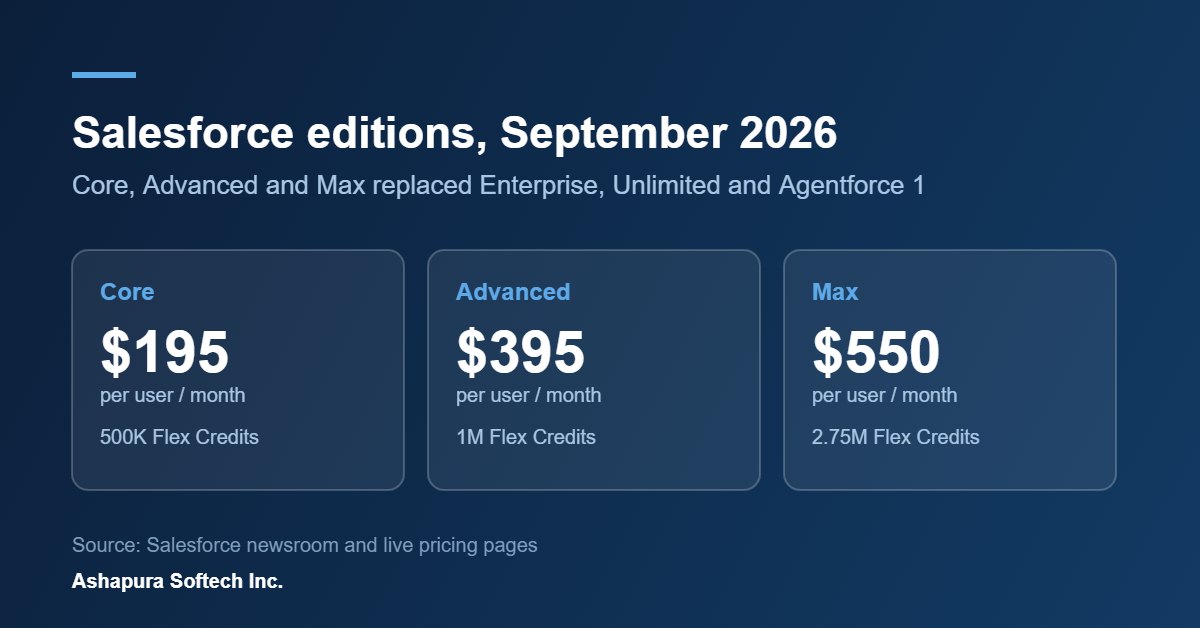
Salesforce also simplified its editions, effective September 2026, into Core, Advanced and Max across Sales Cloud, Service Cloud and the industry clouds (briefly branded Agentforce Sales, Agentforce Service and Agentforce Industries). Every edition now bundles Agentforce capabilities such as Account Research and Service Rep Assistant, Slack and Slackbot, embedded agentic analytics powered by Tableau Next, enterprise grade data security and Premier Success Plans, along with Flex Credits: 500K on Core, 1M on Advanced and 2.75M on Max.
List pricing is 195 dollars per user per month for Core, 395 for Advanced and 550 for Max. Salesforce has said existing Agentforce 1 Edition customers can move to Max at no extra cost, legacy edition pricing is unchanged for current customers, and Industry Edition pricing is still to come this autumn.
Confirm your own numbers with your account executive before you budget against these. Published list pricing and what lands on a renewal quote are rarely the same thing, and consumption based Flex Credits change the shape of the bill.
What this actually changes for your org
Your interface strategy is now a real decision. Until this announcement, “where do users work” had one answer. Now there are four plausible answers and you should pick deliberately per team rather than let it happen by accident.
Permissions and sharing rules become the control surface. An agent that inherits a user’s permissions is only as safe as those permissions are tidy. If your profiles and permission sets have drifted over years of ad hoc requests, that debt is about to become visible in a new way.
Data quality gets more exposed, not less. An agent asked to research an account will answer from what is in your org. Duplicate accounts, stale contacts and half filled custom fields have been survivable while a human was reading the record and mentally correcting it. They are less survivable when the answer arrives as a confident sentence.
Automation you already have may be duplicated. Before you build an agent for a task, check whether a Flow already does it. Agents are the right tool for judgement and language, not for deterministic steps a Flow handles cheaply.
A sensible order of work
Turn on Salesforce in Claude for a small group, in a sandbox or with a limited permission set, and watch what people actually ask it.
Run a permissions audit before you widen access. Profiles, permission sets, field level security, sharing rules.
Run a duplicate and data completeness pass on accounts and contacts, since that is what agent answers are built from.
Pilot Agentforce Coworker with one team and one measurable task rather than across the org.
Model your edition options against actual usage before renewal, including what Flex Credit consumption looks like at your volume.
Steps two and three are unglamorous and they are where most of the value is. Agent quality is downstream of org hygiene, which is the bulk of what our Salesforce managed services team spends its time on.
Why AIforce became SIforce, and what the rename changes
On October 9, 2026, Marc Benioff posted on X: “The era of Super Intelligence is here. AIForce is officially SIForce.” That was the whole announcement. Salesforce has not published a release note, a pricing change or a new feature list alongside it, and when we last checked, its help pages still used the AIforce name.
The rename did not come out of nowhere. Coverage, including Salesforce Ben, linked the timing to a recent executive order from President Trump that directs federal agencies to replace “artificial intelligence” and “AI” with “Super Intelligence” and “SI”. Salesforce has not given an official reason, and it sells heavily to US government agencies, so the connection is a reasonable reading rather than a confirmed one.
It is also the third name for the same layer in a little over six months. It debuted as Headless 360 at TrailblazerDX, became AIforce at Dreamforce in September, and is now SIforce. Even Patrick Stokes, Salesforce President of Applications and Marketing, admitted at Dreamforce that the constant renaming “drives us nuts too.”
The name changed, the planning work did not: decide which agents connect, under which identity, and who owns them.
What the SIforce rename changes for your team
In practical terms, very little has changed under the hood. The products inside the layer, the Headless Toolkit, AgentExchange and the edition structure described above are the same as they were before October 9. What does change is paperwork and search:
Contracts and quotes. Order forms and statements of work written in September may say AIforce. That is fine, but ask your account executive to confirm in writing that SIforce and AIforce refer to the same entitlements so nobody argues about it at renewal.
Internal documentation. Update your runbooks, training decks and architecture diagrams, or at least add “SIforce (formerly AIforce)” the first time the name appears, so new admins can find both.
Help and release notes. Search for both names when you look for documentation. Salesforce usually updates help pages in waves, so expect a period where the two names coexist.
Security reviews. If your security or procurement team approved “AIforce”, the rename does not change the underlying service, but note the new name in the approval record to keep your audit trail clean.
What does not change is the work that decides whether agents succeed: permissions, data quality and clear ownership of automations. That is where we would put the effort, whatever the layer is called next quarter.
SIforce naming history at a glance
When
Name
Where it was announced
Spring 2026
Headless 360
TrailblazerDX
September 2026
AIforce
Dreamforce 2026
October 9, 2026
SIforce
Marc Benioff on X
Ask about entitlements in writing: contracts from September may still say AIforce.
Questions to ask your Salesforce account team about SIforce
If SIforce, or AIforce as your contract may still call it, is on your roadmap, these questions are worth raising at your next account review. They cost nothing to ask and they save surprises at renewal.
Which SIforce capabilities are included in our current edition, and which need Flex Credits or a separate SKU?
Do the agents we connect through SIforce need to be registered with their own identity, and who in our team owns that registration?
How are agent actions logged, and can we see which agent changed which record in our audit trail?
Will SIforce agents respect our existing sharing rules and permission sets, or do they run under a separate integration user?
Is there a sandbox or pilot option so we can test one agent on one process before committing budget?
Ask for the answers in writing. Salesforce product names and packaging have changed several times this year, and a short email from your account executive is the simplest way to keep everyone working from the same understanding.
Most SIforce questions are about paperwork and permissions, not new features.
Frequently asked questions about AIforce
Is AIforce the same as Agentforce?
No. Agentforce is the agent platform inside Salesforce. AIforce is the layer that lets those agents and your Salesforce data be reached from outside the Salesforce interface, through Claude, Slack, Lightning or your own build.
Is AIforce available now?
Salesforce in Claude is in beta and open to all customers. Agentforce Coworker has been described as instantly available. Other components, including further Claudeforce skills for service, marketing, commerce and industries, are on the roadmap rather than shipped.
What does AIforce cost?
Salesforce has not published separate AIforce pricing. The related edition pricing effective September 2026 is 195, 395 and 550 dollars per user per month for Core, Advanced and Max respectively, with Flex Credits included at each tier. Check current pricing with Salesforce directly.
What are Salesforce Flex Credits?
Flex Credits are the consumption units bundled with the new editions, 500K with Core, 1M with Advanced and 2.75M with Max. Because agent usage draws on them, two orgs on the same edition can see very different bills depending on how heavily agents are used.
Do we need Data Cloud for this to work well?
You do not strictly need it, but the quality of agent answers depends on the context available to them. If your customer data is spread across systems Salesforce cannot see, that is the gap to close first. Our Salesforce Data Cloud and Data 360 consulting page covers what that work involves.
Where should a mid sized team start?
With one team, one task, and a permissions audit first. Agent quality follows org hygiene, so the groundwork matters more than the agent configuration.
Why did Salesforce rename AIforce to SIforce?
Marc Benioff announced the change on X on October 9, 2026. Salesforce has not given an official reason. Coverage linked the timing to a recent executive order directing US federal agencies to use “Super Intelligence” and “SI” instead of “artificial intelligence” and “AI”.
Does the SIforce rename change pricing or contracts?
No feature or pricing change was announced with the rename. Existing quotes and contracts that say AIforce refer to the same layer, but it is sensible to ask your account executive to confirm that in writing before renewal.
Where AIforce lands
We are a certified Salesforce partner working with teams in the United States from Irving, Texas, with our development centre in Ahmedabad. The work we expect to matter most over the next two quarters is not agent configuration, it is the permission, data and automation groundwork that decides whether an agent gives a useful answer or a confidently wrong one.
If you want a second opinion on where your org stands before you widen agent access, get in touch.
About the author. Ankur Pandey is Marketing Manager at Ashapura Softech, a Salesforce and Odoo consulting partner based in Irving, Texas, with a delivery center in Ahmedabad, India. He works with the company’s Salesforce delivery teams on CRM, Agentforce and integration projects for US businesses and writes about what Salesforce product changes mean in practice.
Salesforce editions for Sales Cloud and Service Cloud now run from Starter Suite at $25 per user per month up to Max at $550, according to Salesforce’s Sales Cloud pricing page. The three new top tiers are Core ($195), Advanced ($395) and Max ($550), announced on 3 September 2026.
Each of the three includes Agentforce, Slack and Flex Credits: 500,000 on Core, 1 million on Advanced and 2.75 million on Max, per org per year (Salesforce newsroom). Enterprise and Unlimited are now called legacy editions. If you are on one, your current pricing does not change.
Salesforce Core, Advanced and Max editions are the packages Salesforce now sells above Pro Suite, sitting where Enterprise, Unlimited and Agentforce 1 used to be. Salesforce announced them on 3 September 2026, and they apply across Sales Cloud, Service Cloud and the industry clouds (at the time branded Agentforce Sales, Agentforce Service and Agentforce Industries; Salesforce restored the original names in September 2026). If you are mid way through a Salesforce evaluation, or you renew in the next two quarters, this changes the quote in front of you.
This article covers what each edition costs, what moved into the bundle, what happens to existing contracts, and the questions Salesforce has not answered yet. Every figure here comes from Salesforce’s own announcement and its live pricing pages, both linked at the end.
The Salesforce Core Advanced Max editions are the three new tiers that replaced Enterprise, Unlimited and Agentforce 1, and this guide breaks down what changed, what each one costs, and what it means at your next renewal.
The three new Salesforce editions at a glance
The old ladder of Essentials, Professional, Enterprise and Unlimited is gone at the top end. What remains is Starter Suite and Pro Suite for small teams, and then three agentic editions above them.
Edition
Price per user per month
Flex Credits included
Who it fits
Core
$195
500,000
Teams moving off legacy Enterprise who want AI included rather than bolted on
Advanced
$395
1,000,000
Organisations that need stronger security, structured sales programs and autonomous service agents
Max
$550
2,750,000
Businesses running agents across sales and service at scale, including workforce engagement and IT service
Two details matter more than the headline numbers. Core and Advanced carry new pricing, because Salesforce has moved a lot of separately sold products inside them. Max costs the same as Agentforce 1 did, so for anyone already on that SKU the packaging changed and the invoice did not.
Free Salesforce implementation checklist
The steps we check on every Salesforce rollout, from scoping and data to go-live and adoption.
Here is how the Salesforce editions line up today for Sales Cloud. Prices are list prices per user per month, billed annually, from the Sales Cloud pricing page as of 21 October 2026. Your quote can differ by region, term and discount.
Everything in Starter, plus customization, quoting, forecasting and AgentExchange access
$100
Core
Teams on legacy Enterprise, or outgrowing Pro, that want AI included
Built-in AI and Agentforce, Slack Business+, Tableau Next, Momentum, Premier Success, 500,000 Flex Credits per org per year
$195
Advanced
Security-heavy or regulated teams, and orgs running sales programs
Everything in Core, plus Sales Programs, Backup and Recover, Archive, Data Detect, Security Center, 1 million Flex Credits
$395
Max
Orgs running agents across sales and service at scale, and Agentforce 1 customers
Everything in Advanced, plus Agentforce for Sales, Agentforce Coworker, Spiff, Sales Planning, Maps, Slack Enterprise+, 2.75 million Flex Credits
$550
A few things the table does not show:
Flex Credits are per org, not per seat. At Salesforce’s list rate of $500 per 100,000 credits (Agentforce pricing), the included allowance is worth about $2,500 a year on Core, $5,000 on Advanced and $13,750 on Max. A 200-seat org and a 20-seat org on Core get the same 500,000 credits.
Service Cloud splits differently. On the Service Cloud pricing page, Help Agent is an add-on for Core and included from Advanced up. Service Rep Assistant and Workforce and Quality Management are included only in Max.
The old Agentforce 1 page is still up. Salesforce’s Agentforce pricing page still lists Agentforce 1 Editions at $550 with 2.5 million credits. Max costs the same and includes 2.75 million, so make sure your quote is for Max.
Industries editions are still unpriced. Salesforce said new Industries pricing would take effect “later this fall” (Salesforce newsroom). We had not seen it published as of 21 October 2026.
How the new Salesforce editions map to the old ones
This is the question most buyers are actually asking, so here it is plainly.
Legacy edition
New equivalent
What Salesforce claims
Enterprise Edition
Core
70% more value than legacy Enterprise
Unlimited Edition
Advanced
More than 50% more value than legacy Unlimited
Agentforce 1 Edition
Max
Nearly 60% more value, with no price change
Treat the value percentages as vendor framing, not as a measurement. What is verifiable is the list of products that used to be separate line items and now sit inside the edition. That list is where the real comparison lives, and it is the next section.
What is now bundled that you used to buy separately
Every one of the three tiers now includes five things that were previously priced or contracted on their own:
Agentforce, with capabilities such as Account Research, Service Rep Assistant and Agentforce Coworker built into the daily flow of work rather than sold as an add on.
Slack and Slackbot, so deal and case work happens in one conversational surface alongside agents.
Embedded agentic analytics, delivered through prebuilt apps and semantic models rather than a separate analytics purchase.
Data security, covering sensitive data protection and permission change management as the AI footprint grows.
Premier Success Plan, which on the old ladder was an extra percentage on top of the licence bill for most editions.
If your current budget already carries lines for Slack, an analytics product, Premier Support and Agentforce credits, compare the total of those lines against the new edition price before you conclude that Salesforce got more expensive. For some accounts it is a repackaging of spend that already existed. For others, particularly teams that never bought Slack or Premier, it is a genuine increase.
What differs between the tiers
The tier specific features are where the $195 to $550 gap gets decided:
Capability
Core
Advanced
Max
Momentum, automatic CRM record capture
Yes
Yes
Yes
Sales programs, repeatable playbooks and incentives
No
Yes
Yes
Agentforce Help Agent, autonomous customer resolution
No
Yes
Yes
Service Rep Assistant with unmetered Coworker access
No
No
Yes
Workforce Engagement (listed as Workforce and Quality Management on the Service Cloud pricing page), AI workforce management and coaching
No
No
Yes
Agentforce IT Service, employee request automation
No
No
Yes
One pricing mechanic inside this table is worth pausing on. Agentforce Help Agent carries outcome based pricing, which means the charge lands when an issue is actually resolved rather than per conversation. That is a different budgeting model from per user licensing and it needs its own forecast.
If you are already on Enterprise, Unlimited or Agentforce 1
Salesforce has been explicit that existing customer pricing on legacy editions remains unchanged. Nobody is being repriced mid contract.
Agentforce 1 customers get the clearest deal: an upgrade to Max at no extra cost, which Salesforce describes as up to $500 in added value. If you hold that SKU, this is a call worth booking rather than waiting for renewal.
For Enterprise and Unlimited customers the practical consequence is quieter. Your current agreement holds. Salesforce has not said how renewals and added seats on legacy editions will be quoted, so ask your account executive and get the answer in writing. So the planning question is not whether your bill changed today. It is what your renewal looks like at $195 or $395 per seat, and whether the bundled products replace things you are already paying for elsewhere.
If you are buying Salesforce for the first time
Start by separating what you need from what is included. Core at $195 already carries AI, Slack, analytics, security and Premier Success, which is a wide floor. The honest test for moving up a tier is whether you will use the tier specific features within the first year.
Advanced earns its price when two conditions are true together: you run a service operation with enough volume that autonomous resolution changes headcount maths, and your sales motion is repeatable enough that structured programs are worth configuring. One of the two on its own rarely justifies the jump.
Max earns its price when agents are the operating model rather than an experiment, and when workforce management and IT service are problems you were going to solve with other software anyway.
What none of this decides is implementation. Licensing is a subscription. Configuration, data migration, integration and training are a separate project with a separate budget, and a bundled edition does not reduce that work. If anything, more included capability means more decisions to make during configuration.
Which Salesforce Core Advanced Max edition should you pick?
Start with the work your team does every week, not the feature list. The higher Salesforce editions only pay off if you will use what they add in the first year.
Stay on Starter Suite or Pro Suite if
Your sales team is small and your process is a standard pipeline.
You have no plan to run AI agents in the next 12 months.
You do not need Slack Business+ or Tableau Next yet.
Pro Suite at $100 is often the right ceiling for a team that mainly needs customization and forecasting.
Pick Core if
You are buying new and would otherwise have bought Enterprise.
You want Slack, embedded analytics and a first Agentforce pilot in one contract.
Your expected agent volume fits inside 500,000 Flex Credits a year. At 20 credits per standard action, that is about 25,000 actions.
If you expect to run agents beyond your included allowance, read our breakdown of how Flex Credits are priced and spent before you size the edition.
Pick Advanced if
You are in a regulated industry or your security team needs backup, archiving and data detection included.
You run structured sales programs.
You want Help Agent for service included instead of buying it as an add-on.
Pick Max if
You plan to run agents across both sales and service, not a single pilot.
You need Spiff, Sales Planning, Maps, Service Rep Assistant or workforce management.
You are on Agentforce 1 today. Salesforce says you can move to Max at no extra cost.
Analysts at TD Cowen have also reported that Salesforce in Claude is included in Max (CRN Asia). Salesforce’s own edition pages do not say so, so get it confirmed in writing.
Every edition from Core up includes Agentforce Coworker, so read our Agentforce Coworker guide before you pay for a higher tier just to get AI.
If you are on Enterprise or Unlimited today
You do not have to move. Salesforce says existing pricing on legacy editions is unchanged. Before your renewal, list what you pay separately for Slack, analytics, security add-ons and Premier Success. If that total is close to the Core or Advanced price, ask for a side-by-side quote.
A note on names: Salesforce has dropped the “Agentforce” prefix from most cloud names, so “Agentforce Sales” is Sales Cloud again. The Headless 360 capacity promised for Max has also been renamed, first to AIforce and then SIforce (SF Ben). Your contract may use any of these names.
Before you pay for a bigger edition, score the one you have
Our free 30-point CRM health check shows where your org is underused, overbuilt or overpaying. It takes about an hour with your admin and one sales manager.
Download the free CRM health check In short, the Salesforce Core Advanced Max editions simply repackage what you were already buying, so the real work is matching a tier to how your team actually uses Salesforce.
The Flex Credits question
Each edition ships with Flex Credits: 500,000 on Core, 1 million on Advanced, 2.75 million on Max. Credits are the consumption currency behind agent actions, so the allocation is what lets a team experiment without a second purchase order.
The mistake we see teams make is treating the included allocation as a capacity plan. It is a starting balance. What consumes it is the number of agent actions your workflows trigger, and that number is decided by design choices made during implementation, not by the edition you bought. A chatty agent placed in a high volume workflow will burn through an allocation that a carefully scoped one would not touch.
Before signing, ask for a consumption estimate tied to your actual use cases. If nobody can produce one, the honest position is that the first year is a measurement exercise, and the budget should say so.
What Salesforce has not answered yet
Three things are genuinely open, and it is better to name them than to guess:
Industry Editions pricing. Salesforce has said new pricing for Agentforce Industry Editions takes effect later this fall. Anyone in financial services, healthcare or public sector planning a purchase this quarter is quoting against a moving target.
Headless 360 capacity. Salesforce says Max editions will include an allocation in the future. Future is not a date, so it should not appear in a business case today.
Migration mechanics for large estates. The announcement covers packaging and price. It does not describe what a multi org, multi cloud customer does at renewal, and that is where the real work sits.
What the new editions change about an implementation project
Whichever edition you land on, the first wins usually come from the basics. These seven Sales Cloud workflows are where most teams start.
A licensing change is usually invisible to a delivery team. This one is not, for three reasons.
First, scope grows quietly. When Slack, analytics and agent capability arrive inside the edition, stakeholders assume they are in scope for the rollout. Somebody has to decide whether Slack workflows and agentic analytics belong in phase one or phase two, and that decision belongs in the project plan before kickoff, not in week six.
Second, agent design becomes part of configuration. On the old ladder, buying Salesforce and deploying agents were two projects separated by months. With Agentforce inside every tier, teams reasonably expect at least one working agent at go live. That means agent scoping, guardrails and testing sit next to the usual object model and automation work. Our Agentforce readiness checklist covers what has to be true before an agent is worth deploying at all.
Third, consumption needs an owner. Credits are a shared resource that any automation can spend. Someone has to watch the balance and know which workflow is consuming it, the same way someone watches API limits and storage. We wrote about how the credit model behaves in practice in our guide to Agentforce pricing and Flex Credits.
These are the questions we put to clients evaluating a quote on the new structure. None of them require a partner to answer, so run them yourself first.
List what you already pay for separately. Slack, an analytics tool, Premier Support, any Agentforce credits. Total those lines, then compare against the edition price. That comparison, not the sticker, tells you whether your cost went up.
Name the tier specific feature you will actually use. If you cannot name a use case for sales programs or Help Agent, Advanced is not yet justified.
Ask for a credit consumption estimate against your workflows. Not an industry average. Your cases, your volumes.
Check whether outcome based pricing applies. Help Agent charges on resolution, which behaves differently in a budget than per seat licensing does.
Confirm what happens at renewal, in writing. Legacy pricing holds today. Get the renewal position stated rather than assumed.
Separate licence budget from implementation budget. They are different money with different approval paths, and mixing them is how projects stall at month three.
If you are on Agentforce 1, ask about the Max upgrade now. It is offered at no extra cost, so there is no reason to wait for a renewal cycle to have that conversation.
How this fits with the rest of the Salesforce AI stack
The editions change is packaging. It sits alongside two other moves worth understanding together, because buyers keep conflating them.
Agentforce is the agent platform, and it is now inside every tier rather than an add on. Claudeforce is the separate arrangement bringing Anthropic’s models into Salesforce, which we compared against Agentforce in Claudeforce vs Agentforce. Headless 360 is the route for using Salesforce capability outside the Salesforce interface, and Max editions are due an allocation of it at a date Salesforce has not named.
Three different things, three different decisions. An edition upgrade does not settle which models you use, and a model choice does not settle how agents reach your other applications. If you are choosing an implementation partner for any of this, our guide to picking an Agentforce implementation partner sets out what to ask. If Salesforce pricing is the sticking point, compare it with Zoho in our Zoho vs Salesforce breakdown. If you are planning an edition change, also check the Salesforce Winter ’27 release changes, which go live on October 12, 2026 and include security updates that can affect integrations.
Frequently asked questions
Did Core replace Enterprise Edition?
Not formally. Salesforce calls Enterprise a legacy edition and no longer shows it on its Sales Cloud pricing page, so Core is what new buyers are offered at that level. If you are on Enterprise today, Salesforce says your existing pricing is unchanged.
What do the new Salesforce editions cost?
Core is $195 per user per month, Advanced is $395 and Max is $550, billed annually, per Salesforce’s pricing page as of 21 October 2026. Starter Suite ($25) and Pro Suite ($100) are still sold below them.
What happens to my Agentforce 1 Edition?
Agentforce 1 customers can move to Max at no extra cost. Salesforce puts the added value at up to $500, and the price of Max matches what Agentforce 1 cost.
Will my existing Salesforce pricing change?
No. Salesforce has stated that existing customer pricing on legacy editions remains unchanged. The new structure applies to new purchases and, in practice, to what gets quoted at renewal.
How many Flex Credits come with each edition?
Core includes 500,000, Advanced includes 1 million and Max includes 2.75 million. Consumption depends on how many agent actions your workflows trigger, so the allocation is a starting balance rather than a capacity plan.
When did the new editions take effect?
Salesforce announced them on 3 September 2026. Pricing for Agentforce Industry Editions is scheduled for later this fall, and availability can vary by region.
Which Salesforce edition is best for a small business?
For most small teams, Starter Suite or Pro Suite is enough. Core makes sense once you want Slack, embedded analytics and AI agents included in one contract.
Is Salesforce in Claude included in the Max edition?
TD Cowen analysts reported that it is, according to CRN Asia. Salesforce’s own edition pages do not say so as of 21 October 2026, so confirm it in writing with your account executive.
Are Flex Credits per user or per org?
Per org, per year. Core includes 500,000, Advanced 1 million and Max 2.75 million, no matter how many seats you buy.
Where this leaves a buying decision
The packaging is simpler than what it replaced, and that is a real improvement for anyone who has ever assembled a Salesforce quote out of six SKUs. The cost question is less tidy. Whether Core at $195 is more expensive than Enterprise was depends entirely on what you were already buying alongside Enterprise.
The work that decides your total spend has not changed. It is scope, data quality, integrations and adoption. A bundle does not configure itself, and credits do not spend themselves carefully.
Ashapura Softech Inc. is a certified Salesforce implementation partner based in Irving, Texas, delivering Salesforce cloud services and Salesforce CRM development for US teams. If you are working out which edition your requirements actually need, we will walk the requirement list with you before anyone talks about a quote.
Sources
Salesforce’s announcement of the new editions is published on its newsroom as Salesforce Simplifies Editions, dated 3 September 2026. Per user prices were verified against the live Sales pricing page and Service pricing page. Salesforce notes that pricing and packaging are subject to change and availability varies by region.
These three editions were not announced on their own. They arrived as the commercial half of AIforce, alongside the prebuilt sales skills and the Headless Toolkit. Read what else shipped with them before you settle on a tier.
Many teams on Core or Advanced have no full-time admin to adopt what each release adds. Managed Salesforce services cover release updates, user support and small enhancements on a fixed monthly plan.
Update (14 Sep 2026): On 11 Sep 2026 Salesforce announced a new portfolio of named, job-ready Agentforce agents built for specific high-value work: Casey (customer service), Paige (IT and HR service), Carter (shopper agent for e-commerce), Marshall (supply chain orchestration), Piper (inbound lead generation) and Fin (complex customer experience), all generally available now, plus Hunter (outbound sales), in pilot with general availability expected November 2026. The release also adds long-horizon runtime so agents can pursue goals over days or weeks rather than single interactions, AI Skills for teaching agents new tasks (pilot now, GA October 2026), multi-agent orchestration across workflows, and an Agent Optimizer for continuous performance tuning (GA October 2026). This sits on top of the Core, Advanced and Max editions Salesforce introduced in early September.
Claude Commerce Agents is the open blueprint Anthropic released on 2 September 2026: a working shopping agent and a working merchant agent, forkable, Apache 2.0. Almost every write up since has covered the storefront half. This article covers the half the blueprint deliberately leaves to you, which is what your ERP, your CRM and your permission model actually have to provide before either agent can answer a real customer question.
If your commerce runs on a CRM, an ERP and a warehouse system that disagree with each other on a good day, this is the work that decides whether a Claude Commerce Agents project ships or stalls. What follows is the requirement list we walk clients through, in the order it tends to bite.
There’s a specific moment in these projects that I’ve come to expect.
You demo the agent to the client. It’s fast, it understands a messy question, it builds a sensible cart, everyone in the room is pleased. Then somebody from operations asks what happens when a customer asks about an order that was partially returned, and the room goes quiet, because the answer is that nobody has decided which of the three systems holding pieces of that order is allowed to be the one the agent believes.
That question has nothing to do with the AI. It’s an integration question, and it was there before anyone mentioned agents.
Almost all the coverage in the days since has been about the storefront: what the agent can do for a shopper, what it means for product data, how it fits Shopify. Reasonable, as far as it goes. But it skips the part that decides whether the thing works, which is what happens behind the tool call.
What Anthropic released, briefly
Claude Commerce Agents is an Apache 2.0 reference blueprint, published 2 September 2026. Two agents. The shopping agent lives in your app or storefront and handles search, comparison, multi-item requests, cart building, and customer-service questions like order status and returns. The merchant agent faces your own staff and covers sales analysis, inventory monitoring, pricing and promotion recommendations, and campaign drafting.
Four runnable examples ship with it (retail, travel, telecom and ticketing) plus a Claude Code plugin that will scaffold an agent against your systems or review one you’ve already built.
The line I’d point any client to isn’t on the announcement page, though. It’s at the bottom of the repository README, where Anthropic states plainly that this is a reference implementation, that it is not maintained, and that it does not accept contributions.
That’s not a criticism. It’s a scoping fact, and it’s the most important one in the whole release. You are not adopting a product with a roadmap. You are forking a set of patterns that become your code, your maintenance burden and your security surface from the moment you clone it. Budget accordingly, and don’t let anyone put “Anthropic supports it” in a slide deck.
The blueprint deliberately stops at your systems
Here’s the part I think most readers have glossed over.
The repository ships no MCP connectors. If you have been following the agentic CRM architecture debate, this is the same boundary we described in What Is Salesforce Headless 360. None. Both agents reach the outside world through two Python interfaces, StorefrontBackend on the shopping side and MerchantBackend on the merchant side. Every method on those interfaces is a function your team writes, calling your service, server-side, with a credential your host application holds for the session. The model never sees the credential. It only sees what your method returns.
That design decision carries a commercial consequence that is easy to read past: every capability the agent appears to have is a method your team has to build, own and maintain.
The agent needs, at minimum: catalog search, product detail, cart operations, order lookup, returns and policy answers, customer preferences, sales analytics, inventory positions, pricing rules, promotion state and campaign data. On a mid-market stack, look at where those actually live. Order history is in the CRM. Inventory and cost are in the ERP. Contract pricing is in the ERP or a CPQ layer. Campaign state is in the marketing platform. Product attributes are wherever your PIM is, assuming you have one, which about half the businesses we talk to don’t.
Almost none of it is in the storefront.
So the honest name for a commerce agent project is systems integration project with a conversational front end. That’s a different budget line, a different team and a different risk register than “add an AI assistant to the website,” and if the proposal your client is looking at doesn’t say so, the proposal is wrong.
The ERP and CRM readiness checklist for Claude Commerce Agents
Before any of the agent code matters, twelve things have to be true of your systems. Nine of the twelve are data and process questions that have nothing to do with AI. This is the list we work through with a client before we quote anything.
What your CRM has to give it
Session identity resolved by your host application. The agent inherits an authenticated shopper; it never decides who the user is. Guest checkout, duplicate email addresses on one account and B2B users buying for several ship-to locations all have to resolve to one answer.
Order and returns state readable live. Not last night’s extract. Partial returns, exchanges and in-flight refunds included, because those are the questions customers actually ask.
Account and contract pricing resolvable per customer. If the agent can only see list price, it will quote list price to a customer on a negotiated rate.
Memory scoped, with a written retention rule. What the agent is allowed to remember between sessions, for how long, and how a customer gets it deleted.
What your ERP has to give it
Revenue, margin and returns defined the same way everywhere. Two systems that disagree on margin will produce an agent that confidently reports the wrong number.
On-hand and committed stock, current. Committed matters as much as on-hand; an agent that only sees on-hand will promise stock that is already allocated.
Cost data to reason against, and price floors it cannot cross. The floor belongs in your system, enforced server-side, not in a prompt.
Product attributes as structured fields. Size, material, compatibility and voltage as fields, not buried in a paragraph of marketing prose.
A campaign calendar queryable by product. Otherwise the agent will recommend a discount on something already promoted.
What has to be true across both
Every merchant write staged for human approval. The blueprint is built this way; keep it that way when you extend it.
Credentials held server-side in the host application. The agent calls your backend methods, it does not hold keys to your ERP.
A test set of real edge cases before pilot. Partial returns, price exceptions, shared logins, discontinued SKUs. This is the part that gets cut, and it is the part that decides whether the pilot survives.
If you cannot tick nine of these twelve today, the honest answer is that the first phase of a Claude Commerce Agents project is a data and integration project, not an AI project.
Which ERPs and CRMs best connect with Claude in 2026
The readiness checklist above assumes a connection exists. That assumption is worth testing, because the connector estate is uneven, and the gaps are not where most buyers expect them. We checked Anthropic’s own connector directory on 10 September 2026, which lists 796 connectors in total. Here is what it actually holds for the systems commerce teams run.
System
In Anthropic’s connector directory
What that means in practice
Salesforce
Yes, listed as Salesforce, Beta
First party listing, still marked beta, so treat scope and limits as moving
Zoho
Yes, the widest coverage of any vendor with nine listings including Zoho CRM, Books, Desk, Projects and Analytics
The most complete suite level coverage on the directory today
HubSpot
Yes, one listing
Straightforward CRM connection
Oracle NetSuite
Yes, one listing
The only mainstream ERP with a first party listing
Microsoft
Microsoft 365 and Microsoft Dataverse are listed, Dynamics 365 is not listed by name
Dynamics data is reachable through Dataverse rather than a Dynamics connector
Shopify
Yes
Storefront and order data on the commerce side
QuickBooks
Yes, two listings
Covers the finance side for smaller operations
SAP
Four listings, but all four are developer tooling for SAPUI5, Fiori, MDK and CAP
Nothing here reads business data. An SAP commerce agent needs a custom MCP server or middleware
Odoo
No listing
Custom MCP server, community module or middleware
Sage, Acumatica, Pipedrive
No listing
Middleware or custom build
Two things in that table are easy to misread, so we will say them plainly.
The SAP row is the one that trips people. Search the directory for SAP and four results come back, which looks like coverage. Open them and they are tooling for people building SAP front ends, not connectors that read orders, stock or pricing. If your commerce data lives in SAP, budget for a custom MCP server or an integration layer, and do not let a screenshot of four search results become a line in a project plan.
The Zoho row is the surprise in the other direction. Nine listings across CRM, Books, Desk, Projects and Analytics is broader than any other vendor on the directory, including Salesforce. For a mid market retailer already on Zoho One, that is a shorter path to a working agent than the platform’s reputation would suggest.
A missing listing is not a blocker either. The Model Context Protocol is open, so any system with a decent API can be exposed to Claude through a custom MCP server. It is a build, not a purchase, and it belongs in the project estimate as one.
What we would check before trusting any connector
A listing tells you a connection exists. It does not tell you the connection is enough for a commerce agent. Four questions settle that:
Read or write. A read only connector supports a shopping agent answering questions. A merchant agent that updates orders or stock needs write access, and write access needs a permission model behind it.
Which objects. Access to accounts and contacts is not access to orders, entitlements, price books and stock positions. Ask for the object list before the demo.
Rate limits. An agent asks more questions than a human does. Connector limits that never mattered for reporting start mattering here.
Beta status. The Salesforce listing is marked beta. Beta is fine for a pilot and a poor foundation for a customer facing commitment.
What each agent needs, by system
The two agents in the blueprint pull on different systems. Splitting the requirement this way makes the scoping conversation faster.
Requirement
Shopping agent
Merchant agent
Primary system
CRM and catalogue
ERP and order management
Access needed
Mostly read
Read and write
Data that decides success
Product attributes, availability, customer history
Stock positions, order status, pricing rules, fulfilment
The usual blocker
Catalogue attributes are marketing copy, not structured data
Nobody owns the rule for when the agent may change an order
Cheapest honest start
Read only answers on a narrow product set
Draft actions that a human approves before they commit
What the Claude shopping agent wants from your CRM
Four things. Most mid-market CRMs supply two of them cleanly and struggle with the other two.
Identity, resolved per session. Before the agent can say anything account-specific it has to know who’s asking. Your host application authenticates the shopper and the agent inherits that context; it doesn’t get to decide who the user is. Straightforward in principle, and in practice this is where guest checkout, multiple email addresses on one account, and B2B users buying on behalf of three different ship-to locations all come and find you.
Order and returns state. Anthropic’s shopping agent is designed to answer service questions inside the same conversation as shopping ones (where the order is, how to return something, what the refund policy actually says) rather than dumping the customer on a support page. That’s genuinely the best feature in the release, and it’s also the one that exposes your data model fastest. Full orders are easy. Partial returns, split shipments, exchanges against a replacement SKU, and anything involving a third-party fulfilment partner are where teams discover their order record was never designed to answer a question in natural language.
Account and contract pricing. The repository’s guidance is that the price quoted is the session account’s price. If you sell B2B at all, that single sentence routes your pricing call out of the catalog and into the ERP or CPQ system, and it has to return within a latency budget a person will tolerate mid-conversation.
Memory that survives the session, and doesn’t become a liability. The agent is designed to remember what a customer tells it. Anthropic’s engineering guide treats this as a data-handling problem rather than a storage one, and the recommendations are worth reading in full, but the four that matter: decide up front which categories of fact you’re willing to hold and enforce that with a validator on the write path rather than an instruction in the prompt; give users a way to see, correct and delete what’s stored; wire that deletion into your existing account-deletion and data-request flows; and set a retention period, because a preference from two years ago is probably wrong now.
There’s a fifth recommendation in there that I’d have missed if I hadn’t read the guide carefully, and it applies to the merchant side. Merchant logins get shared between operators constantly: one account, four people on the floor. So memory should be keyed to the person, not the login, and reads have to respect that person’s permissions. A store manager’s agent shouldn’t be able to recall something a district manager said. That’s a small design decision that becomes an expensive retrofit.
What the Claude merchant agent wants from your ERP
The merchant agent’s capabilities ship as five named skills: performance-insights, catalog-listings, inventory-operations, pricing-promotions and marketing-campaigns. Each maps onto a back-office system, and each has a precondition that isn’t about AI at all.
Capability
System that answers
What has to be true
Sales performance questions
ERP or warehouse
Revenue, margin and returns defined the same way everywhere
Inventory alerts
ERP or WMS
On-hand and committed stock, current, not last night’s extract
Pricing and promotion recommendations
ERP, CPQ or pricing engine
Cost data to reason against and floors it cannot cross
Campaign drafting
Marketing platform
Campaign calendar queryable by product
Listing maintenance
PIM or catalog
Attributes as structured fields, not prose
If your ERP cannot answer these questions cleanly today, that is usually a data and integration problem rather than an AI one. Our custom ERP development page covers what fixing it typically costs and how the work runs.
Now the design detail that has the biggest operational consequence, and I don’t think anyone has written about it yet.
No merchant write goes live directly in the reference implementation. Every write produces a staged change with a server-generated ID, and applying it requires that ID to have been approved through a real surface, a button in the operator’s portal, a confirmation in the CLI. Fine, that’s the sensible pattern. But the guardrails are re-checked at apply time, against the limits in force then, not the limits that applied when the change was staged.
Think about what that requires of your ERP. Not “can you produce a report.” It’s: can you answer what is true right now, on demand, in the second the approver clicks the button. If your inventory or pricing data lands in the reporting layer on a nightly batch, you cannot support that, and closing the gap is your first sprint, before a single prompt gets written.
I’d rate that as the most common blocker we’ll see in mid-market Odoo and Dynamics estates over the next year. It isn’t glamorous and it doesn’t demo well, but it’s the thing.
The failure nobody plans for
This one I’d put money on.
The shopping agent reads availability from the storefront. The merchant agent reads availability from the ERP. A customer is told an item is in stock. The operations team, looking at the same SKU, sees that stock committed against a wholesale order. Both agents are behaving correctly. They’re reading two systems that have never agreed on what “available” means, and nobody noticed, because until now no two consumers of that number were ever quoted in the same conversation.
The agent didn’t create that contradiction. It made it legible.
That’s why I’d argue hard against building both agents at once, even when the budget exists and the client is enthusiastic. Two conversational surfaces reading through separate data logic will contradict each other in front of a customer within weeks, and when they do, the blame lands on “the AI” rather than on a definition mismatch that predates it by five years. The project gets cancelled for the wrong reason.
Before funding both, five things need one owner and one definition each: product and catalog data, customer identity, commercial rules, action authority, and how you’ll evaluate correctness. If your team can’t name the system of record for all five inside an hour, that reconciliation is the project. The agent comes after.
A trap for integrators specifically
There’s a warning in Anthropic’s engineering guide that I think is aimed squarely at people who do the kind of work we do, and it’s easy to walk straight into.
The rule is that the agent’s tools should call the systems you already run, not reimplement their logic. Your search ranking, your promotion engine, your inventory allocation, those encode years of tuning and see signals a model never will. The tool is where their logic ends and the model’s judgment starts. When the agent calls search_products, results should arrive already ranked; the agent’s job is deciding which of them serve the goal and how to present them.
Where it goes wrong is subtle. The guide describes an availability check that calls the catalog for the SKU, then the inventory service per store, then fulfilment for cutoffs, then applies substitution rules and pickup eligibility, all inside the tool’s own code. Every one of those steps looks reasonable while you’re writing it. What you’ve actually built is a tool carrying domain knowledge that belongs upstream, which will drift out of correctness the moment the business changes a rule, and which nobody will think to update because it doesn’t look like a business system.
The fix is boring and correct: one backend endpoint that answers the question, called by one agent tool.
I’m flagging this because the pressure to stitch missing logic into the tool layer is enormous on integration projects. It’s always the fastest path in the sprint you’re in. It’s also how you end up owning a shadow pricing engine written in a tool wrapper.
A related, smaller point from the same guide: tool results are context, so return the fields the model reasons with and drop the rest. Image URLs on every search row are named as the usual offender. That’s a token cost on every single turn for data the model does nothing with.
Claude Commerce Agents, Agentforce, Claudeforce
Clients ask this as though it’s a choice between three products. It mostly isn’t, and framing it that way leads to bad scoping.
Agentforce is native. Agents run inside Salesforce, on Salesforce data, under Salesforce permissions and governance, and the readiness questions there are different again, which we set out in our guide to choosing an Agentforce implementation partner. If your commerce operation genuinely lives in Salesforce Commerce Cloud end to end, most of the integration work described in this article is already done for you, and the trade is that you work within that ecosystem’s boundaries and its pricing model.
Claudeforce, the expanded Salesforce, Anthropic partnership announced in August 2026, is a different shape again: Claude supplies reasoning, Salesforce supplies the business context and governs the action. We wrote about the distinction separately in Claudeforce vs Agentforce, and it’s worth reading before you assume one replaces the other, because they don’t.
Claude Commerce Agents sits at the far end of that spectrum. You get the harness, the prompts, the skills, the tool contracts and the safety gates; you supply every connection to every system. Maximum control, maximum integration work, no platform lock-in. The same code runs on the Claude API, Amazon Bedrock, Microsoft Foundry or Google Cloud Vertex AI, which matters more than it sounds if you have a cloud commitment or a data-residency requirement.
My honest read: if you’re Salesforce end-to-end, look hard at the native options first and only fork the blueprint if you hit a wall. If you’re running Odoo for ERP and Zoho for CRM behind a custom storefront, which describes a lot of the North American mid-market we work with, there is no native path, and the backend-interface model is genuinely the shorter route, not just the more flexible one.
Where the safety design actually is
Worth understanding before you promise a client this is safe, because the guarantees are real but specific.
Enforcement lives in the harness, in code, not in the prompt. Anthropic’s reasoning is that in commerce the failures are financial and often irreversible, and a prompt rule is one injection away from being skipped. Three mechanisms do most of the work:
Server-issued IDs only. The harness keeps a per-session record of every ID it has handed the model, and that record is the only key any write or render will accept. The cart takes only product IDs the server returned in this session. An ID that arrived any other way, hallucinated, pasted in by a user, planted inside a product review, is refused before your backend ever sees it.
Caps enforced on the resulting state. Limits are checked against what the state would be after the write, so a shopper saying “add two more” three times can’t stack past a per-customer cap, and cart writes within a session are serialised so parallel tool calls can’t combine to exceed it. Merchant changes are checked the same way against caps on price movement, discount depth, restock size and campaign budget, plus a list of protected fields that no change may touch.
Third-party text is sanitised and fenced. In commerce most of your context is written by people who aren’t you, sellers, reviewers, competitors. Every backend read authored by a third party goes through one sanitiser before the model sees it, wrapped in a fence with a fixed label, with control and bidirectional characters stripped and anything imitating a conversation turn or a tool call defused. The prompt carries the other half of the contract: fenced text is material to report on, never to act on.
If you’re presenting this internally to a security or risk function, those three are the answer to “what stops the AI from doing something stupid with money.” The answer is that structurally it can’t, because the checkout interface has no charge method and the write path only accepts approved IDs.
What Claude Commerce Agents cost to run
The code is free. The inference isn’t, and it’s billed however you access Claude. If you are comparing this against a Salesforce-native route, the Agentforce Flex Credits pricing model works on a completely different unit and the two numbers are not directly comparable.
Two things from Anthropic’s engineering guidance belong in front of whoever signs the budget.
First: prompt caching is the dominant cost variable, not model choice. The guide reports that the strongest commerce deployments run at 90, 99% cache hit rates and that this is the range to design for from the start. Cached input reads cost roughly a tenth of fresh ones; cache writes carry about a 1.25x premium, so a cached prefix pays for itself on its second use.
Caching is prefix-based, which means order matters as much as content. Structure the request in three segments by how often they change: global (system prompt, tool definitions, identical every session, your warmest cache), then session (user context and conversation history), then volatile (current time, current page) at the very end. The most common mistake named in the guide is putting a timestamp or the current page at the top of the system prompt, which silently breaks the cache on every single request.
That is a fifteen-minute architecture decision in week one with an order-of-magnitude cost consequence in month six. It’s also invisible in testing, because with low volume nobody looks at the bill.
Second: measure cost per completed task, not per model call. A cheaper model that needs more turns, or fails more often, isn’t cheaper. Anthropic’s starting point is Opus-class for merchant agents, where the work is analysis-heavy, and Sonnet-class for consumer-facing agents, where latency weighs more, then run your eval suite across every model and effort level you’d consider and let the numbers decide. Current rates are at claude.com/pricing.
Testing Claude Commerce Agents, the part that gets cut
Every agent project I’ve seen under time pressure cuts evaluation first, and it’s the wrong cut.
The useful shift in Anthropic’s approach is to evaluate snapshots, not conversations. The API is stateless, so any state a conversation can reach can be constructed directly: build the test state, append the test message, let the agent run, then grade the final state and the rendered response, including the arguments of the last write. They explicitly recommend against grading the path the agent took, because those tests are brittle and over-constraining.
Two things I’d hold teams to:
Most suites are far too heavy on clean-state cases. If a bug only appears after a busy first turn or a contradiction earlier in the session, a test starting from a blank state will pass on every configuration and tell you nothing. Some meaningful share of your cases should start from long, messy, contradictory histories.
And write the negative for every positive. A “should refuse” for every “should serve,” a “should just do it” for every “should ask.” Missing negatives are named as the most common gap in real suites, and it matches what we see, teams test that the agent does the thing, never that it declines to do the thing it shouldn’t.
Fifty to a hundred cases per user flow is the suggested starting point. That sounds like a lot until the first regression ships.
How I’d actually start
Read-only, one workflow, one real system boundary.
The repository supports this directly and it’s the most underrated thing in it. A shopping pilot can implement search and product detail and stub everything else, a stubbed method returns unavailable and changes no prompt bytes. A merchant pilot can implement the read methods and have every write refuse, so digests and analysis run with no write path in existence. And any capability your business simply doesn’t have gets switched off through an enable_* flag, which strips its tools, prompt lines and grounding rules rather than leaving the agent to reason about a system you don’t operate.
That’s enough to answer the only question a first pilot needs to answer, which is whether your data, permissions and definitions can support the workflow at all.
Questions we’re getting
Which ERPs and CRMs connect to Claude today?
On Anthropic’s connector directory, checked 10 September 2026, Salesforce (beta), HubSpot, Oracle NetSuite, Shopify, QuickBooks, Microsoft 365 and Microsoft Dataverse are listed, and Zoho has the widest coverage with nine listings. Dynamics 365 is not listed by name and is reached through Dataverse. Odoo, Sage, Acumatica and Pipedrive have no first party listing, so they need a custom MCP server or middleware.
Does SAP work with Claude Commerce Agents?
Not through the directory as it stands. Searching SAP returns four listings and all four are developer tooling for SAPUI5, Fiori, MDK and CAP rather than connectors that read orders, stock or pricing. An SAP based commerce agent needs a custom MCP server or an integration layer, and that is a build to budget for.
Can I connect a system that has no Claude connector?
Yes. The Model Context Protocol is open, so any system with a usable API can be exposed to Claude through a custom MCP server. Treat it as development work with its own scope, security review and maintenance, not as configuration.
Is it free?
The repository is, under Apache 2.0. Running the agents consumes Claude model usage, billed through whichever platform you access Claude on, the Claude API, Amazon Bedrock, Microsoft Foundry or Google Cloud Vertex AI. Free code, metered inference.
Does it work with Salesforce Commerce Cloud?
Yes, but not out of the box, no platform connectors ship. Commerce Cloud connects through the backend interfaces the same way any other catalog, order or pricing system does, with credentials held server-side by your host application.
Can the agent place an order or charge a card?
No, and not by policy, by structure. In the reference implementation the checkout tool renders the cart for your own checkout to complete, and the backend interface the agent calls has no charge method at all. Every merchant write is staged until a person approves it. Payment is left entirely to your existing checkout or an agentic payments provider.
Do we need Shopify?
No. Shopify announced a reference storefront connecting the blueprint to Shopify stores through Catalog, the Universal Commerce Protocol and Shop Sign-in, but the blueprint itself is platform-agnostic.
Odoo, Zoho, Dynamics?
No prebuilt connector for any of them, and none needed. Each backend method is code your team writes that calls your service server-side, so they integrate exactly like any other system of record.
How long does it take?
The demo runs in an afternoon. A narrow read-only pilot against real systems is weeks, and the timeline is set almost entirely by the state of your product, inventory and customer data, not by the agent code. I’d be sceptical of any estimate that doesn’t start with a data assessment.
What about the results Anthropic published?
Anthropic reports that retailers running shopping agents on Claude have seen carts up to 35% larger and shoppers 60% more likely to complete a purchase. Those are Anthropic’s own figures. The announcement doesn’t publish sample size, test design, retailer mix or attribution method, so treat them as directional vendor evidence and build your own baseline before you commit to a number internally.
Ashapura Softech is a certified Salesforce, Zoho, Microsoft and Odoo implementation partner, based in Irving, Texas with a development centre in Ahmedabad. We’ve been doing CRM and ERP integration work for North American businesses since 2012. If you’re scoping a commerce agent and want a straight answer on whether your data is ready for one, talk to us, the assessment is usually a short conversation.
Claudeforce vs Agentforce is not an either/or choice. Agentforce is Salesforce’s platform for building and running AI agents inside Salesforce. Claudeforce is the Salesforce and Anthropic partnership announced on 26 August 2026, and its main product, Salesforce in Claude, lets your team work with Salesforce data from inside Claude using 37 prebuilt sales skills. Since Dreamforce 2026, both sit under Salesforce AIforce (now SIForce): Agentforce agents do the work, and Claude is one of the places your team reaches them from.
Update (14 Sep 2026): On 11 Sep 2026 Salesforce announced a new portfolio of named, job-ready Agentforce agents built for specific high-value work: Casey (customer service), Paige (IT and HR service), Carter (shopper agent for e-commerce), Marshall (supply chain orchestration), Piper (inbound lead generation) and Fin (complex customer experience), all generally available now, plus Hunter (outbound sales), in pilot with general availability expected November 2026. The release also adds long-horizon runtime so agents can pursue goals over days or weeks rather than single interactions, AI Skills for teaching agents new tasks (pilot now, GA October 2026), multi-agent orchestration across workflows, and an Agent Optimizer for continuous performance tuning (GA October 2026). This sits on top of the Core, Advanced and Max editions Salesforce introduced in early September.
Claudeforce vs Agentforce is the question we now get on almost every Salesforce AI call, and the reason is simple: the two names sound like variations of the same product, and they are not. One brings Salesforce data into Claude. The other runs autonomous agents inside Salesforce. They point in opposite directions, they serve different people, they are bought differently, and only one of them has published pricing.
This is the long version, including the part that trips up most teams, a worked example of what Agentforce actually costs, and the governance question nobody asks until it is late.
Claudeforce vs Agentforce, in one line each
Agentforce is Salesforce’s AI agent platform. You build agents that act on your behalf inside Salesforce surfaces: resolving service cases, qualifying leads, answering employee requests, scheduling appointments, handling IT tickets. The work happens in your org, and the people it serves are usually your customers or your employees. Salesforce describes it as the platform for 24/7 autonomous support at enterprise scale.
Claudeforce is the Salesforce and Anthropic partnership. Its first deliverable, Salesforce in Claude, puts your CRM data inside Claude with 37 pre-built sales skills covering prospecting through close. The work happens in Claude, and the person it serves is your seller. Salesforce sets this out on the official Claudeforce page.
So the cleanest way to hold the difference: Agentforce sends an agent to your customer, Claudeforce brings your CRM to your employee. Everything else in this article follows from that one sentence.
The comparison table
This is the Claudeforce vs Agentforce comparison as it stands on 21 October 2026. Prices come from Salesforce’s own pages unless marked as reported.
Claudeforce (Salesforce in Claude)
Agentforce
What it is
A partnership between Salesforce and Anthropic. Its first product is a plugin that lets Claude work with live Salesforce data.
Salesforce’s platform for building and running AI agents inside Salesforce.
Who builds it
Salesforce and Anthropic jointly. Salesforce prebuilt the 37 sales skills, and an admin connects it once.
Salesforce builds the platform. Your admins or a partner build the agents in Agent Builder.
Where the work happens
In Claude, plus Slack and other connected tools.
Inside Salesforce, Slack and customer channels such as web chat and voice.
Who it serves
Sellers and sales managers.
Customers and employees, across sales, service and IT.
Pricing model
No published price. Anthropic bills for Claude separately. TD Cowen reports Salesforce in Claude is included in the Max edition (CRN Asia).
Included in Core, Advanced and Max editions. Otherwise Flex Credits at $500 per 100,000, $2 per conversation, or $125 per user per month add-ons (Salesforce).
Data access
Reads live Salesforce data through MCP, plus Slack, email and other Claude connectors. Runs under each user’s existing Salesforce permissions. Writes route back through Salesforce.
Grounded in Salesforce and Data 360 data inside the Salesforce Trust Boundary. Claude models run through Amazon Bedrock inside that boundary.
Autonomous?
No. A seller asks, Claude helps, and Claude can ask for approval before acting.
Yes. Agents can act on their own within the guardrails you set.
Availability
Open beta since 15 September 2026. Sales only. Other clouds coming soon.
Generally available.
Best use
Sellers who avoid the CRM and want answers and updates where they already work.
High volumes you cannot staff, such as service queues and repeat employee requests.
Where Claude actually appears in the Salesforce stack
Before comparing the two, it helps to know that Claude now shows up in three separate places. Most of the confusion in the Claudeforce vs Agentforce debate comes from collapsing these into one.
Claude as the default model in Slack. Claude powers Slackbot and is the default model there
Claude as the reasoning model inside Agentforce. Claude is integrated as the reasoning model for the Atlas Reasoning Engine and is available in Agent Builder. Your agent still lives in Salesforce, it just thinks with Claude
Salesforce in Claude. The new one. Your CRM data, permissions and workflows become available inside Claude itself
Only the third is what people mean when they say Claudeforce as a product. The first two have existed alongside it.
Inside Salesforce, Claude is now a reasoning model for the Atlas Reasoning Engine and the default model behind Agentforce Vibes and Agentforce Coworker (Salesforce newsroom). That is still Agentforce, not Claudeforce. The agent runs in Salesforce and is priced like any other Agentforce work.
The part that confuses everyone: Claude in Agentforce is not Claudeforce
This is where most of the Claudeforce vs Agentforce confusion actually comes from, and it is worth slowing down on.
Claude as the reasoning model inside Agentforce is a model choice. Your agent reasons using Claude instead of another model, but the agent still lives in Salesforce, still runs in your channels, and still serves your customer. Nothing about who uses it changes.
Salesforce in Claude is the reverse. Nothing runs in Salesforce. Your seller opens Claude, and Salesforce data, permissions and workflows are available to them there. The user changes from your customer to your employee, and the surface changes from your org to a third party application.
If someone tells you “we already have Claudeforce, we switched our agent to Claude,” they have almost certainly done the first thing, not the second. Worth checking before you plan a budget around it.
What Salesforce in Claude actually does, day to day
The 37 skills at launch cover the sales cycle from prospecting through close. Salesforce names meeting prep, deal health review and pipeline review among them. In practice the seller is doing three kinds of thing:
Reading. Reasoning over live revenue context rather than pulling a report. Asking what changed on an account, which deals slipped, what a call should cover
Writing back. Automating pipeline updates without opening the CRM, which is where most CRM hygiene problems start
Acting. Taking governed action from inside Claude, with the action routed back through Salesforce so business rules still apply
Two details matter more than the skill count. First, onboarding reads your enterprise context and builds a tailored dashboard of accounts, pipeline and live data, so the seller is not starting from a blank prompt. Second, and this is the one admins care about, an admin connects it once. Authentication and permissions are managed centrally, every seller on the team gets access from day one, and there is no per-user setup and no new permissions model to build.
That last point is worth reading twice if you have ever rolled out a Salesforce tool user by user.
What Agentforce actually does, day to day
Agentforce is the opposite shape of work. Instead of assisting one person, it removes a person from a queue. The published use cases are:
Resolving customer service cases and answering questions across self-service portals and messaging channels
Processing employee requests such as leave approvals and HR queries
Scheduling appointments and managing field service
Qualifying leads and managing opportunities
Handling IT help desk tickets and system administration
Underneath, the Atlas Reasoning Engine breaks a prompt into smaller tasks, evaluates at each step, and proposes a plan for how to proceed. You assemble the agent in Agent Builder, which is low code, and drop to flows, prompts, Apex or MuleSoft APIs where configuration cannot reach.
The design decision that costs people money later is how much of that they build in code. Configuration survives platform upgrades. Custom code becomes your maintenance bill.
Flex Credits: $500 per 100,000 credits. A standard action uses 20 credits, about $0.10.
Conversations: $2 per conversation.
Per-user add-ons: $125 per user per month for Sales, Service and Field Service, $150 for Industries. A $5 per user license is also available, with Flex Credits bought on top.
Editions: Core ($195), Advanced ($395) and Max ($550) include Agentforce and 500,000, 1 million or 2.75 million Flex Credits per org per year (Salesforce newsroom).
Here is why the design matters. If 5,000 conversations a month each trigger 4 standard actions, Flex Credits cost about $2,000. At 25 actions each, they cost about $12,500. The same 5,000 conversations on conversation pricing cost $10,000 flat. For the full rate card, see our Agentforce pricing guide.
Claudeforce still has no published price. Marc Benioff has said customers need Salesforce’s premium edition (SF Ben), and TD Cowen reports Salesforce in Claude is included in Max. You will also pay Anthropic for Claude. Budget for both bills until Salesforce publishes packaging.
What a Flex Credit actually buys
A Flex Credit works out at half a cent. Salesforce meters each agent action rather than each interaction, and it publishes the action rates: a standard Agentforce action is 20 Flex Credits, an Agentforce Voice action is 30. So a standard action costs ten cents and a voice action fifteen.
Salesforce puts its own worked examples on the same page, and they are worth reading because they show how the shape of the workload matters more than the rate itself.
An employee agent answering 20 requests a day at 40 credits each comes to about $120 a month
A service agent handling 3 cases a day at 60 credits, across 100 users, comes to about $1,800 a month
A field service agent booking 3 appointments a day at 100 credits, across 10 reps, comes to about $300 a month
An onboarding agent answering 5 questions each for 20 new employees at 20 credits comes to about $10 a month
Agentforce Voice at 120 credits across 300 calls a month comes to about $180 a month
A worked example, so the numbers mean something
Take a service desk handling 5,000 customer conversations a month. What it costs depends entirely on how many actions each conversation triggers, and this is the part teams underestimate. At the published rate of 20 credits per action:
Actions per conversation
Credits per month
Cost per month
4 (a simple lookup and reply)
400,000
$2,000
8 (a lookup, a check, an update)
800,000
$4,000
15 (multi-step reasoning, several systems)
1,500,000
$7,500
25 (long chains across several systems)
2,500,000
$12,500
The action counts are ours for illustration, not Salesforce figures. The rates are published. The point is that the same 5,000 conversations can cost $2,000 or $12,500 depending on how the agent is designed. That is an architecture decision your team controls, not a discount you negotiate.
This is also why we tell clients to pilot with a small cohort and measure real consumption for a few weeks before signing anything org wide. We have written the full arithmetic up in our Agentforce pricing and Flex Credits breakdown.
Claudeforce has no published price. That is the honest answer, and it is worth saying plainly because a lot of the guides circulating right now quietly guess around it. There is no price list, no packaging and no per-seat figure. What we would expect to matter commercially is that Anthropic is a separate vendor, so the inference is not obviously something Salesforce resells inside your existing licence. Treat that as a reasonable question to put to your account team, not as a published fact.
Free CRM health check: 30 checks in 5 pages
Score your CRM in about an hour across data quality, pipeline, adoption, automation, integrations, reporting and security. Free PDF, no signup.
Claudeforce vs Agentforce governance: why it differs for each
Security review is where these two diverge most sharply, and it is usually the last thing anyone looks at.
For Agentforce the question is what the agent can see and act on, and on whose behalf. An agent inherits a permission model you designed for humans, and it will use every bit of access you leave open. The work is a proper permission and sharing review before the agent goes near production data, plus a named owner for the kill switch when it answers something wrongly. Not if. When.
For Salesforce in Claude the shape is different. Setup is centralised: the admin connects once, authentication and permissions are managed centrally, and actions route back through Salesforce so business rules are enforced when an action is taken. That removes a lot of per-user risk. What it does not remove is the question your security team will ask, which is what happens to data displayed in a surface that sits outside Salesforce, and how you audit it. Salesforce has not published that detail at the level a regulated buyer will want.
If you work in healthcare, financial services or anything with a data residency clause, put that question on the pilot call rather than after it.
Claudeforce vs Agentforce: which one do you actually need
Choose Agentforce if the problem is volume you cannot staff: a service queue that never clears, repetitive employee requests, lead qualification that nobody gets to. You want work done without a person in the loop, and you are prepared to own the permission model and watch consumption after go live. Our Agentforce readiness checklist covers what to test before you commit, and what to ask an implementation partner before you sign.
Wait for Claudeforce if the problem is that your sellers avoid the CRM. You are not trying to remove the human, you are trying to remove the interface friction. There is nothing to buy yet, so the sensible move is to get into the beta and measure with your own data rather than plan a rollout around a product with no commercial terms.
Look at Einstein first if you have not turned on what you already pay for. Einstein is natively embedded in the platform and provides insights, predictions and generated content from CRM and external data. Plenty of the “can AI do this?” questions we get are answered by embedded features sitting unused in the org. That is the cheapest win available and it costs a configuration session, not a new contract.
These are not mutually exclusive. For most organisations the end state is all three, and the order matters more than the choice.
Five mistakes we see teams make on this decision
Treating Claudeforce as an Agentforce replacement. They solve different problems for different people. Nothing in Salesforce’s material positions one as retiring the other
Budgeting for one pricing mechanism. Teams model Flex Credits, then get billed on conversations, or the reverse. Model both against your own agent design
Automating the whole service desk as phase one. Platform wide rollouts as a first project are how pilots become write-offs. One workflow, one user group, measured
Skipping the permission audit because the demo worked. A demo runs on clean data with a generous profile. Production does not
Waiting for Claudeforce instead of fixing the data. Whatever you eventually run, it reads your CRM. Bad data produces a confident wrong answer faster than a human would
What is still unknown about Claudeforce
We would rather list the gaps than paper over them:
Price. Nothing published, and the launch material notes pricing is subject to change
Packaging. Whether it lands as an add-on, an edition, or a separate Anthropic contract
Scope beyond sales. Service, Marketing, Commerce, Revenue, Field Service, Tableau, MuleSoft, Data 360, Headless 360 and Industries are listed as coming, without dates. More prebuilt skills are expected late 2026
Governance detail. How audit and monitoring work when the surface your data is used in sits outside Salesforce
What happens at renewal. Whether adoption inside Claude changes how your Salesforce seats are counted
Name the problem first. Queue volume points at Agentforce. CRM avoidance points at Claudeforce. Unused platform features point at Einstein
Join the Salesforce in Claude beta through your account team if sales adoption is your issue. It costs nothing to be in the queue
Run one Agentforce workflow, not a department. A defined user group, a metric agreed before the build, consumption tracked from day one
Do the permission and data quality review now. It is required for either path and it is the work that does not depend on a pricing announcement
Model both pricing mechanisms against your own expected action counts before any commercial conversation
Where our view comes from
We are a certified Salesforce implementation partner, based in Irving, Texas with a delivery team in Ahmedabad, working since 2012. We are also certified for Zoho, Microsoft Dynamics and Odoo, which is usually why clients ask us this question in the first place: they want someone who is not obliged to answer “Agentforce” every time.
Our most recent Agentforce delivery embedded an agent directly into the quote workflow for a custom furniture retailer, grounded on Data Cloud, checking live production timelines from their Odoo ERP before committing a date. Quote build time went from 45 minutes to under 10, a 78 per cent improvement, across a migration of more than 120,000 contacts and 85,000 custom orders with zero data loss. The full write up is here: Salesforce CPQ and Agentforce for a custom furniture retailer. We have also covered where Agentforce helps with sustainability reporting and where it stops.
On Claudeforce we have no delivery experience, because nobody has. It is in pilot. Everything written above about it is drawn from Salesforce’s own published material, and we have said plainly where the gaps are. If you want a reference before you talk to us, ask on the call and we will tell you straight where we are.
Ashapura Softech 2201 W Royal Ln, Irving, Texas 75063 +1 214-935-9893 Certified Salesforce implementation partner. Founded 2012.
Frequently asked questions
Is Claudeforce replacing Agentforce? No. Salesforce positions Claudeforce as a partnership framework, not a replacement, and continues to ship Agentforce. They solve different problems: autonomous work for your customers versus CRM access for your sellers.
Can we use both? Yes, and for most organisations that is the likely end state. Agents handling volume inside Salesforce, sellers working with CRM data inside Claude, Einstein doing the embedded predictive work underneath both.
Which is cheaper, Claudeforce vs Agentforce? It is too early to say. Agentforce has published prices: Flex Credits at $500 per 100,000, $2 per conversation, or add-ons from $125 per user per month. Claudeforce has no published price, and you also pay Anthropic for Claude.
Do we need Data Cloud for either? Grounding quality is what separates a useful agent from a confident wrong one, and in practice that is where Data Cloud earns its place on Agentforce projects. Whether it is strictly required depends on your build, so treat it as a design question rather than a fixed prerequisite.
Is Einstein being retired? There has been no such announcement. Salesforce describes Einstein as natively embedded in the platform, providing insights, predictions and generated content from CRM and external application data.
How do we get into the Claudeforce beta? Salesforce in Claude has been in open beta since 15 September 2026. Salesforce customers can request access through the beta page linked from Salesforce’s Claudeforce site on Agentforce Exchange.
Does Salesforce in Claude need a new permissions model? No. Salesforce states that an admin connects it once, authentication and permissions are managed centrally, and every seller on the team gets access from day one with no per-user setup.
What happens to our agents if we change partners? Agent definitions built in Agent Builder stay in your org. Custom code and undocumented prompt logic are the parts that travel badly, which is a good argument for configuring rather than coding wherever you can.
Can you work alongside our existing Salesforce partner? Yes. We are often brought in for a specific layer, such as the integration or the readiness work, alongside an incumbent.
Is Claudeforce included in any Salesforce edition? TD Cowen analysts reported that Salesforce in Claude is included in the Max edition. Salesforce has not confirmed this on its pricing pages as of 21 October 2026.
Is Claude inside Agentforce the same as Claudeforce? No. When Claude powers an Agentforce agent, Agentforce Coworker or Agentforce Vibes, the work runs inside Salesforce and is priced as Agentforce. Claudeforce is when the work happens in Claude itself.
Do I need Agentforce to use Claudeforce? Salesforce has not said Agentforce is required. Salesforce in Claude needs a Salesforce org and a Claude plan. Confirm edition requirements with your account executive, since Marc Benioff has said a premium edition is needed.
Both products now sit under a wider banner. Salesforce grouped Claudeforce, Slackforce and the Agentforce Coworker together as AIforce at Dreamforce 2026, which changes how you choose between them rather than what each one does. Here is what AIforce covers and where each piece fits.
Claudeforce is the Salesforce and Anthropic partnership announced on 26 August 2026. Its main product, Salesforce in Claude, lets Claude read and act on Salesforce data through a prebuilt MCP server with 37 Claudeforce skills for sellers, using the permissions each user already has. It went into beta for Salesforce customers at Dreamforce on 15 September 2026 and is now one of the three interfaces in Salesforce AIforce (renamed SIForce in October 2026). Claudeforce pricing has not been published: customers pay Salesforce for platform access and Anthropic for Claude separately.
Not to be confused with Koa: at the same Dreamforce, Salesforce also announced Koa, its own CRM reasoning model built on NVIDIA Nemotron. Claudeforce brings Anthropic’s Claude to Salesforce data; Koa is a Salesforce-run model you can pick for individual Agentforce agents. Our guide to Salesforce Koa compares the two.
Update (18 Sep 2026): At Dreamforce on 15 Sep 2026 Salesforce gave this whole direction a name, AIforce, and put Claudeforce inside it alongside Slackforce and Agentforce Coworker. Salesforce also repackaged its editions into Core, Advanced and Max, at 195, 395 and 550 dollars per user per month, each bundling Flex Credits. Full breakdown in What is AIforce.
Update (14 Sep 2026): On 11 Sep 2026 Salesforce announced a new portfolio of named, job-ready Agentforce agents built for specific high-value work: Casey (customer service), Paige (IT and HR service), Carter (shopper agent for e-commerce), Marshall (supply chain orchestration), Piper (inbound lead generation) and Fin (complex customer experience), all generally available now, plus Hunter (outbound sales), in pilot with general availability expected November 2026. The release also adds long-horizon runtime so agents can pursue goals over days or weeks rather than single interactions, AI Skills for teaching agents new tasks (pilot now, GA October 2026), multi-agent orchestration across workflows, and an Agent Optimizer for continuous performance tuning (GA October 2026). This sits on top of the Core, Advanced and Max editions Salesforce introduced in early September.
On 26 August 2026, alongside its Q2 FY27 earnings, Salesforce announced Claudeforce, an expanded partnership with Anthropic that puts Salesforce data inside Claude and puts Claude inside Salesforce. The headline Salesforce chose for the official press release was “The #1 AI Meets the #1 AI CRM.” Marc Benioff’s framing around the launch was blunter: “The UI is the AI.”
Dario Amodei, Anthropic’s CEO and co-founder, described the value differently, and his version is the more useful one for anyone evaluating this: “Through this partnership, companies can point Claude at the customer information and business context that they’ve been building in Salesforce for decades.” The asset is the decades of context. The model is the new way to reach it.
Most coverage so far has re-typed the press release. This piece does something different. We break down what is actually shipping, what is still a slide, how Claudeforce differs from the Anthropic partnership Salesforce announced in October 2025, what it does to your licensing, and what a Salesforce customer should do about it in the next 90 days.
If you have been following the platform’s direction through 2026, this will slot straight onto what we covered in our Dreamforce 2026 breakdown of what Salesforce actually shipped. Claudeforce is the next move in the same strategy, not a departure from it.
The four components of Claudeforce, announced 26 August 2026.
What is Claudeforce, in one paragraph
Claudeforce is the brand name for an expanded Salesforce and Anthropic partnership announced on 26 August 2026. It has four parts: a Salesforce plugin inside Claude with 37 prebuilt sales skills, Claude as the reasoning model inside Agentforce, Claude as the default model across Slack, and a mutual customer arrangement where Salesforce runs on Claude and Anthropic runs on Salesforce. The plugin went into beta for Salesforce customers at Dreamforce on 15 September 2026.
Free CRM health check: 30 checks in 5 pages
Score your CRM in about an hour across data quality, pipeline, adoption, automation, reporting and security. Free PDF, no signup.
Part 1: The four components of Claudeforce, decoded
Component
What it means in practice
Status as of 27 Aug 2026
Salesforce in Claude
A plugin that exposes CRM data, workflows and governance rules inside the Claude interface. Ships with 37 prebuilt sales skills.
Beta for Salesforce customers since 15 September 2026. In beta since 15 September 2026.
Claude in Salesforce
Claude serves as a reasoning model for the Atlas Reasoning Engine, powers Agentforce Vibes and Agentforce Coworker by default, and is selectable in Agent Builder via Amazon Bedrock inside the Salesforce Trust Boundary.
Shipping.
Claude in Slack
Claude becomes the default model for Slack, powering Slackbot, Claude Tag and Slack Code.
Shipping.
Mutual adoption
Salesforce adopts Claude as its preferred AI assistant; Anthropic adopts Salesforce as its preferred CRM.
In force.
1. Salesforce in Claude, and the 37 sales skills
This is the piece that got the attention, and it deserves it. Instead of asking a seller to open Salesforce, Salesforce is handing the seller’s workflow to Claude and keeping the data, permissions and audit trail on its own side.
The 37 skills are not features in the CRM sense. They are prewritten instructions that tell Claude how a competent seller handles a specific job, and Salesforce describes them as grounded in 27 years of its own sales experience. On the Claudeforce product page they group into six areas:
Daily and weekly workflows: daily briefing, pipeline review, forecast narrative
Deal strategy: stakeholder mapping, close planning, objection handling
Customer management: account planning, lead triage, customer health
Growth: expansion, renewal and new-prospect outreach
Actions and governance: win-loss review, activity logging, CRM hygiene
Anyone who has run a Salesforce Sales Cloud rollout will recognise that list. It is the same set of jobs that dashboards, list views and reports were built to serve, delivered through conversation instead of navigation.
Two design decisions matter more than the skill list itself.
One admin connects it, once. Salesforce’s framing is that an admin connects Salesforce in Claude a single time and the whole team has it from day one. Anyone who has tried to roll out per-user MCP server configuration across a 200-seat sales org will recognise why that sentence exists. Setup friction is what killed most 2025-era agent pilots before they reached a second sprint.
There is no new permissions model. The connection inherits each user’s existing Salesforce permissions. A rep who cannot see an account in Salesforce cannot see it through Claude either, and every write action routes back through Salesforce so validation rules, approvals and field history still apply. This is the single most important technical claim in the announcement, and it is the one to test hardest during beta.
Here is why that claim carries so much weight. In a traditional integration, the connecting application holds its own service account and its own idea of who may see what. That is how CRM data leaks: not through the model, but through an over-permissioned integration user. By routing every read and write back through Salesforce’s own sharing engine, Claudeforce keeps a single source of truth for authorisation. Your org’s sharing model becomes the security boundary, which is excellent news if that model is deliberate and a serious problem if it is fifteen years of accumulated exceptions.
2. Claude inside Salesforce
The second component is less visible but has wider blast radius. Claude is now a reasoning model for the Atlas Reasoning Engine, the planning layer under Agentforce, and it is the default model behind Agentforce Vibes (the natural-language build tool) and Agentforce Coworker (the assistant Salesforce put into the search bar across its apps, and into Slack, Teams and ChatGPT, earlier in 2026).
For regulated customers, the deployment path is the part worth reading twice: Claude is available through Amazon Bedrock inside the Salesforce Trust Boundary. That means inference runs inside Salesforce’s virtual private cloud rather than sending records to a public model endpoint. Financial services, healthcare and life sciences customers have been blocked on exactly this question since 2023. If you run Salesforce Health Cloud under HIPAA obligations, the Trust Boundary is the difference between a compliance conversation you can win and one you cannot start.
This component also changes what Agentforce is. Until now, a customer building an agent chose a model and accepted the reasoning quality that came with it. Making Claude the default reasoning model for Atlas raises the floor for every agent built on the platform, including ones already in production. We covered how these agents are assembled in our guide to setting up agentic AI in Sales Cloud, and the build process does not change. The quality of the planning step does.
3. Slack becomes the front door
Claude is now the default model for Slack, powering Slackbot, the Claude Tag and Slack Code. Combined with the MCP servers Salesforce shipped for Slack this quarter, which connect Headless 360 to Slackbot, the practical effect is that a CRM update can begin and end in a Slack thread.
Salesforce is using itself as the proof point. It says Slackbot has driven 8.1 million hours of annualised productivity gains for its own employees, up more than 2x quarter over quarter. Treat that as a vendor-reported internal figure rather than an audited number, but the direction is real and the internal adoption is unusually deep for a first-party claim.
The strategic point is easy to miss. Slack was acquired in 2021 and spent four years as a collaboration product attached to a CRM company. Under Claudeforce it becomes the conversational surface where CRM work happens, which is a far more defensible position than competing with Teams on channels and huddles.
4. Mutual adoption
Salesforce runs Claude. Anthropic runs Salesforce. This is partly commercial theatre, and partly a genuine signal: Salesforce Ventures has invested in Anthropic across multiple rounds, and reporting in mid-2026 put the value of that stake at roughly $5 billion. Salesforce’s Q2 FY27 GAAP EPS came in at $4.29, up 119% year over year, and coverage of the quarter attributed part of that jump to gains on the Anthropic investment. When you read Salesforce’s enthusiasm for Anthropic, read the balance sheet alongside it.
Claudeforce skills: the 37 sales skills, grouped
Claudeforce skills are prebuilt instructions that tell Claude how to do a specific sales job with your Salesforce data. Salesforce in Claude launched with 37 of them, all for sellers (Salesforce newsroom).
Salesforce has not published the full list. Its Claudeforce page groups the skills into six areas and names 15 of them:
Skill group
What it helps a seller do
Skills Salesforce has named
Daily and weekly workflows
Start the day and run pipeline and forecast reviews
Every skill runs under the seller’s existing Salesforce permissions. Claude sees and changes only what that user could see and change in Salesforce. Writes route back through Salesforce, so validation rules and sharing rules still apply. Salesforce also says Claude asks for approval before emailing people outside the company, and only updates the fields it names.
An admin connects Salesforce in Claude once for the whole team. There is no per-user setup.
What is not in the 37
Other clouds. Service, Marketing, Commerce, Field Service, Tableau, MuleSoft, Data 360 and Industries skills are listed as “Coming Soon”. Salesforce says more prebuilt skills start launching in late 2026.
Developer skills. The Salesforce Development plugin for Claude Code is separate and has more than 40 builder skills (Inside). It is for developers, not sellers.
Custom skills. Salesforce has not said how customers will add or govern their own skills. Treat this as an open question during the beta.
How to test Claudeforce skills in the beta
Pick two skills that match a weekly job your sellers already do, such as pipeline-review and call-prep. Run them for four weeks with a small group. Track one number for each, such as minutes spent on pipeline prep, and compare it with the four weeks before.
Run sfdc-hygiene-check early. If it finds a lot of problems, fix the data before you widen the rollout, because every other skill depends on it.
Is your Salesforce data ready for Claude?
Salesforce in Claude can only work with the data and permissions you already have. Our free 30-point CRM health check finds duplicates, stale records and permission gaps in about an hour.
Part 2: Claudeforce is not the October 2025 partnership. Here is what changed.
A lot of the confusion in the last 24 hours comes from people conflating this with the earlier deal. Salesforce and Anthropic have announced three separate things in eleven months, and each one goes further than the last.
Claude available inside Agentforce for regulated industries, deployed via Amazon Bedrock in the Salesforce Trust Boundary. Slack MCP server. Salesforce adopts Claude Code internally. Named customers included CrowdStrike and RBC Wealth Management.
15 Apr 2026
Headless 360, announced at TDX 2026
The plumbing. APIs, MCP servers and CLI tools that let any external agent call Salesforce data, workflows and governance rules with no Salesforce UI involved.
26 Aug 2026
Claudeforce
Claude becomes the default reasoning model across Agentforce and Slack, and Salesforce ships a first-party plugin that runs the seller’s day inside Claude.
How Salesforce got from the October 2025 partnership to Claudeforce.
Read in sequence, the story is clear. October 2025 made Claude available in Salesforce. TDX 2026 removed the requirement for a Salesforce interface at all. Claudeforce is what those two decisions were building toward.
Headless 360 is the part practitioners keep underrating. It is not a product you buy. It is a consumption architecture, and it is why the Claude plugin could be built in the first place. We have written a separate guide to what Salesforce Headless 360 is and how it enforces permissions. Without an API-and-MCP layer that carries permissions and business rules with it, “Salesforce inside another vendor’s chat window” would have been a security review that never ended.
How Agentforce, Agentforce Coworker and Salesforce in Claude differ
These three names are being used interchangeably in a lot of commentary, and they are not the same thing.
What it does
Who it serves
Where it runs
Agentforce
Autonomous agents that complete work end to end, including work that touches your customers
External customers, and internal processes
Salesforce platform
Agentforce Coworker
An assistant embedded in the search bar of Salesforce and other apps, for asking and acting on CRM data
Internal employees
Salesforce, Slack, Teams, ChatGPT
Salesforce in Claude
A plugin with prebuilt skills that runs a seller’s daily workflow from inside Claude
Internal knowledge workers, sellers first
Claude
Salesforce’s own positioning is that Agentforce handles autonomous work touching end customers, while Salesforce in Claude handles knowledge-worker assistance for internal teams. In practice these overlap, and the boundary will move. Treat the table as today’s positioning rather than a permanent architecture.
That table covers the three names inside the Salesforce and Anthropic announcement. If what you want is Claudeforce set against Agentforce and Einstein, including where each one runs, what it costs and how you build on it, we have put the full side by side into its own guide: Claudeforce vs Agentforce vs Einstein.
A note on names. Headless 360, the layer that lets Claude reach Salesforce through MCP, was renamed AIforce at Dreamforce. On 9 October 2026 Marc Benioff posted that AIforce is now “SIforce” (SF Ben). Salesforce had not formally announced the change when we updated this post. The product underneath has not changed.
Part 3: What “the UI is the AI” does to your Salesforce license
Salesforce President Patrick Stokes framed the strategy plainly in interviews around the launch, reported in detail by VentureBeat: the value of Salesforce sits in the data and the metadata, not in the interface. That is a defensible position, and it is also an admission that the interface is no longer where the money is.
Follow the consequences.
Access shifts from seats to consumption. Salesforce says MCP access needs no separate SKU on Enterprise Edition and above, that calls draw on your existing API limits, and that Flex Credits are consumed when an agent action, a Data 360 query or a prompt actually runs. The meter is on actions, not on named users.
Agentforce consumption is priced in Flex Credits at $500 per 100,000 credits, with a standard agent action costing 20 credits, or roughly 10 cents. Our full Agentforce pricing breakdown covers the whole rate card.
Separately, Salesforce reports platform activity in Agentic Work Units. This one is worth getting right, because a lot of commentary has it wrong. An AWU is a disclosure metric, not a billing unit. Salesforce has published no price per AWU and no AWU-to-credit conversion. Its Q2 FY27 results reported 3.2 billion work units delivered in Q2 alone, up 97% quarter over quarter, on a cumulative 7.0 billion. The company also acquired m3ter, a metering and usage-based pricing platform, in the same quarter. Nobody buys a metering company unless they intend to meter a great deal more.
You will likely have two bills. Salesforce charges for platform access and actions. Anthropic charges for inference. Coverage of the launch indicated customers contract separately with each, which changes both procurement and forecasting. If your finance team currently models Salesforce as a fixed annual seat cost, that model is about to stop describing reality.
What Claudeforce costs today
Salesforce still has not published a price for Salesforce in Claude. Its Claudeforce page says nothing about pricing, and the August announcement says pricing and packaging are subject to change.
Two signals point to how it may be sold:
Marc Benioff told analysts that customers need to “move to our premium edition” to use it (SF Ben).
TD Cowen analysts reported that Salesforce in Claude is included in the new Max edition at $550 per user per month (CRN Asia).
If Max inclusion is confirmed, the edition decision matters more, so compare the current Salesforce editions before your renewal.
You will also need a Claude plan from Anthropic, which is billed separately. Agentforce usage on the Salesforce side is still metered in Flex Credits at $500 per 100,000 (Salesforce). For the full picture, see how Agentforce pricing and Flex Credits work.
For teams renewing in the next two quarters, the practical advice is unglamorous: model your expected agent traffic in units before you build anything, and negotiate consumption rates and caps in the same conversation as seats, not after it. Agent-to-agent calls, retries and voice actions are the line items that blow up forecasts, because they are invisible in a seat-based mental model. This is the same discipline that separates a controlled Salesforce CRM development programme from one that overruns, applied to a new cost driver.
There is a second-order effect worth naming. If interface access stops being the unit of value, the internal case for buying seats for occasional users weakens. Finance teams will notice. Expect a wave of license rationalisation conversations in 2027 renewals, and expect Salesforce to have priced consumption on the assumption that those conversations happen.
Claudeforce fit check
Should your team wait for Claudeforce, or start with Agentforce now?
Claudeforce is still rolling out and some details are not public yet. We help you decide what to do in the next 90 days without wasting license spend.
Which of your use cases suit Claude, Agentforce, or neither
Certified Salesforce partner · 30-minute call, no obligation
Part 4: The numbers behind the Claudeforce announcement
Claudeforce landed on earnings day, which was not an accident. The Q2 FY27 results gave it a strong backdrop.
Metric
Q2 FY27
Change
Total revenue
$11.3B
+11% YoY
Subscription & support revenue
$10.8B
+12% YoY
cRPO
$33.5B
+14% YoY in constant currency
Agentforce ARR
Over $1.5B
+240% YoY
Agentforce + Data 360 ARR
~$3.9B
+210% YoY
Agentic Work Units (Q2)
3.2B
+97% QoQ
Data 360 records ingested
104 trillion
+355% YoY
Non-GAAP operating margin
34.1%
Not comparable
FY27 revenue guidance
$46.1B to $46.4B
Raised
One caveat that most write-ups skipped. The Agentforce ARR definition has expanded over the past year to take in Slackbot and Headless 360 consumption. A 240% growth rate on a broadening definition is partly demand and partly accounting, and Salesforce has not published the split. The growth is real; the multiple is not directly comparable to last year’s figure.
The number that deserves more attention than ARR is the work-unit count. Agentic Work Units are the closest public proxy for actual agent usage rather than agent purchasing, and 3.2 billion in a quarter, nearly doubling sequentially, says agents are running in production rather than sitting in sandboxes. That is the metric to watch next quarter, because it is much harder to inflate through repackaging than an ARR definition is.
Part 5: Five things we still do not know about Claudeforce
Any vendor announcement is worth judging by the questions it leaves open. These are the five that will decide whether Claudeforce becomes standard practice or a well-received demo.
Pricing and packaging for Salesforce in Claude. Undisclosed. Everything downstream of this is guesswork until beta terms land.
Data residency across three boundaries. A single request may touch Claude, Amazon Bedrock and Salesforce. EU, UK, India and Gulf customers need a documented map of where data rests and where it is processed at each hop. The Trust Boundary answers this for the Agentforce path; it does not obviously answer it for the plugin path.
Model opt-out. If Claude is the default model for Slackbot and Agentforce Coworker, what is the mechanism for a customer with an existing standard on a different model, and what does opting out cost in capability?
Skill customisation and governance. The 37 skills encode Salesforce’s view of good selling. Enterprises with their own methodology will want to edit them, version them and audit changes. How that works has not been detailed.
What happens to the admin’s control surface. When work starts in Claude and finishes in Salesforce, page layouts and Lightning components stop being the place behaviour is governed. Validation rules, the sharing model and flows become far more load-bearing than they already are.
Part 6: What to do about Claudeforce in the next 90 days
A practical place to start: tighten the Salesforce workflow automation you already run, so any AI layer lands on clean processes instead of amplifying messy ones.
A realistic 90 day sequence for most Salesforce customers.
The mistake to avoid is treating this as a September to-do. The mistake on the other side is buying anything before beta terms are public. Here is a sequence that works for most Salesforce customers.
Next 30 days: get honest about your data
Every agentic feature Salesforce has shipped since 2024 fails the same way, and it is never the model’s fault. It is duplicate accounts, stale opportunity stages, empty next-step fields and a sharing model nobody has audited since the original implementation. Claude reasoning over a pipeline where 30% of open opportunities have a close date in the past will produce a confident, useless forecast narrative.
Before any pilot, run a specific check:
Duplicate account and contact rate
Percentage of open opportunities with a past close date
Percentage of open opportunities with no activity in 30 days
Fields that are mandatory in process but optional in the schema
Profiles and permission sets with broader access than anyone remembers granting
That last item becomes materially more important under Claudeforce. Permission inheritance is a feature only if the permissions are correct. Our Agentforce readiness checklist sets out the full assessment, including the thresholds to measure against. Most orgs we assess through CRM data and platform work have at least one profile that grants view-all on a standard object because it was the fastest fix during go-live years ago. That was survivable when access required logging in and knowing where to look. It is less survivable when a model can be asked a question in plain English.
Days 30 to 60: pick one workflow, not a platform
Choose a single skill with a measurable before-and-after. Meeting prep and pipeline review are the obvious candidates because both have an existing time cost you can measure this week. Instrument it: minutes per rep per week before, minutes after, and an accuracy check by a sales manager on a sample of outputs.
Resist the urge to enable everything in beta. A pilot that proves one workflow converts into a budget line. A pilot that enables 37 skills at once produces anecdotes. We have written before about where the measurable returns sit in Sales Cloud ROI work, and the discipline is identical here: one workflow, one baseline, one number.
Days 60 to 90: decide your interface posture
This is the strategic question, and it belongs to the RevOps or CRM owner rather than to IT. If sellers begin their day in Claude or Slack rather than in Salesforce, three things follow:
Adoption metrics change meaning. Salesforce login counts stop being a proxy for usage.
Training changes shape. You are teaching prompting and verification, not navigation.
Governance moves down the stack. Anything you enforced through UI design has to be re-enforced in validation rules, flows and the sharing model. That is Salesforce DevOps territory, and it needs version control and a release process rather than ad-hoc changes in production.
If you are in a regulated industry
Get your security and compliance teams into the Trust Boundary architecture now, while you are pre-purchase and have leverage. Ask for the data flow diagram for each of the three deployment paths (Agentforce via Bedrock, the Claude plugin, Slack), and ask what is logged, retained and where. Teams running Salesforce Health Cloud or a financial services org already have this muscle from EHR and core banking integrations. Use the same review template.
If you are a Salesforce partner or implementation firm
The delivery mix shifts. Less time building interfaces, more time on data readiness, permission architecture, MCP and API design, and consumption forecasting. Firms whose value proposition was “we build the screens” have a repositioning problem within 18 months. Firms that can do data engineering and governance have a larger addressable scope than they did last week, and the constraint becomes delivery capacity rather than demand, which is where offshore delivery capacity starts to matter.
The evidence for this is already visible in delivery work. In our Salesforce CPQ and Agentforce rollout for a custom furniture retailer, the agent configuration was the fast part. Product data, pricing rules and approval logic were where the schedule went. Claudeforce does not change that ratio. It raises the cost of getting it wrong, because a clean interface no longer hides a messy model.
Claudeforce brings Salesforce into Claude. Inside Salesforce itself, the matching piece of AIforce is Agentforce Coworker in the search bar, which also reaches Slack, Teams and ChatGPT. Our Agentforce Coworker guide covers what it can access, what it costs and how to turn it on.
Claudeforce fit check
Should your team wait for Claudeforce, or start with Agentforce now?
Claudeforce is still rolling out and some details are not public yet. We help you decide what to do in the next 90 days without wasting license spend.
Which of your use cases suit Claude, Agentforce, or neither
Certified Salesforce partner · 30-minute call, no obligation
Frequently asked questions about Claudeforce
What is Claudeforce?
Claudeforce is the name of the expanded partnership between Salesforce and Anthropic announced on 26 August 2026. It covers a Salesforce plugin inside Claude with 37 prebuilt sales skills, Claude as a reasoning model inside Agentforce, Claude as the default model for Slack, and mutual adoption of each other’s products.
When will Salesforce in Claude be available?
It has been in open beta for Salesforce customers since 15 September 2026, the first day of Dreamforce. Salesforce has not given a general availability date. Skills for clouds other than Sales are listed as coming soon.
How much does Claudeforce cost?
Salesforce has not published a price. Marc Benioff has said customers need a premium edition, and TD Cowen analysts reported that Salesforce in Claude is included in the Max edition at $550 per user per month. Your Claude plan from Anthropic is billed separately.
Is my CRM data safe if it is accessed through Claude?
The plugin inherits each user’s existing Salesforce permissions and routes actions back through Salesforce, so sharing rules, validation and audit trails still apply. For Agentforce, Claude runs through Amazon Bedrock inside the Salesforce Trust Boundary, meaning inference happens within Salesforce’s cloud rather than at a public endpoint. Confirm the specific data flow for your region before rollout.
What are the 37 Claudeforce skills?
They are prebuilt sales skills in six groups: daily and weekly workflows, deal strategy, customer management, growth, meeting preparation, and actions and governance. Salesforce has named 15 of them, including daily-briefing, close-plan, call-prep and sfdc-hygiene-check.
How is Claudeforce different from the Anthropic partnership announced in 2025?
The October 2025 partnership made Claude available inside Agentforce for regulated industries and added a Slack MCP server. Claudeforce goes further: Claude becomes the default reasoning model across Agentforce and Slack, and Salesforce ships a first-party plugin that runs a seller’s daily work inside Claude.
What is Headless 360 and why does it matter for Claudeforce?
Headless 360, announced on 15 April 2026 at TDX 2026, is the set of APIs, MCP servers and CLI tools that let external agents call Salesforce data, workflows and governance rules without a Salesforce interface. It is the architecture that makes the Claude plugin possible. Salesforce says MCP access requires no separate SKU on Enterprise Edition and above; calls use your existing API limits, and Flex Credits apply when an Agentforce action, a Data 360 query or a prompt runs.
Does Claudeforce replace Agentforce?
No. Salesforce positions Agentforce as autonomous work that touches end customers, and Salesforce in Claude as knowledge-worker assistance for internal teams such as sellers. In practice the two will overlap, and the boundary is likely to move.
Will Salesforce still need admins after Claudeforce?
More than before, and in a different way. When the interface stops being the control surface, correctness has to live in the data model, the sharing model, validation rules and flows. That is admin work, and it becomes harder to skip.
Can we build our own Claudeforce skills?
Salesforce has not said yet. The 37 skills are prebuilt by Salesforce, and more are due from late 2026. Ask about custom skills and how they are governed before you widen a beta rollout.
Do Claudeforce skills respect Salesforce permissions?
Yes, according to Salesforce. Every answer and action runs under the user’s existing Salesforce permissions, and writes route back through Salesforce so business rules still apply. Test this with a restricted user during the beta.
Where Claudeforce actually lands
Salesforce has made a defensible bet. Its moat was never the screen. It was 27 years of data model, permissions, business logic and audit trail, and none of that is reproduced by pointing a model at a database. Letting Claude be the interface while keeping governance on the Salesforce side is a reasonable way to stay essential in an agentic world.
The risk is equally clear. If the interface commoditises, pricing power tends to move to whoever owns the intelligence. Salesforce is betting it can hold the data and governance layer while the reasoning layer belongs to someone else. That is a bet on the durability of enterprise plumbing, and it is not an obviously wrong one.
For customers, none of that changes the near-term work. The organisations that will get value from Claudeforce in the first year are the ones whose CRM data is clean, whose permission model is deliberate, and whose business logic sits in the platform rather than in the habits of the people using it. That work was worth doing before this announcement. It is now worth doing on a deadline.
Ashapura Softech is a certified Salesforce implementation partner. If you are evaluating vendors for agentic work, see what to ask an Agentforce implementation partner before the commercial conversation starts. If you want a read on whether your org is ready for agentic workflows, book a CRM health check covering data quality, permission architecture and automation debt. You can also browse our full range of Salesforce cloud services or see the delivery work in our case studies.
If you are planning agents on top of this, our Agentforce consulting team can scope the first use case and the data work it depends on.