




Last updated: October 21, 2026
The Salesforce Braze acquisition landed on October 20, 2026, and my inbox has not been quiet since. Salesforce agreed to buy Braze for about $5.66 billion, paying $47.50 a share in cash. If you run Marketing Cloud, use Braze, or pay for both, you probably have the same question everyone is asking: what actually changes for us, and when?
Short answer: nothing changes this quarter. The deal still has to close, and Salesforce has not shared a combined roadmap yet. But there is a lot you can learn from the announcement itself, and a few smart moves you can make now while everyone else waits for the press cycle to settle.
A quick note on where we’re coming from. Ashapura Softech is a Salesforce partner, and our team works on Marketing Cloud and Data Cloud projects for US companies. So yes, we have a view. Everything below is our read of public information, not an official Salesforce position, and every number links back to its source.
In this article
- The Salesforce Braze acquisition in numbers
- What is Braze, and why did Salesforce want it?
- Where Braze fits in the Salesforce stack
- Braze vs Salesforce Marketing Cloud
- What the deal means for you
- Three scenarios for real companies
- The bigger picture: Salesforce’s 2026 buying spree
- Timeline: what happens next
- A 90-day checklist
- Our take
- FAQs
The Salesforce Braze Acquisition in Numbers
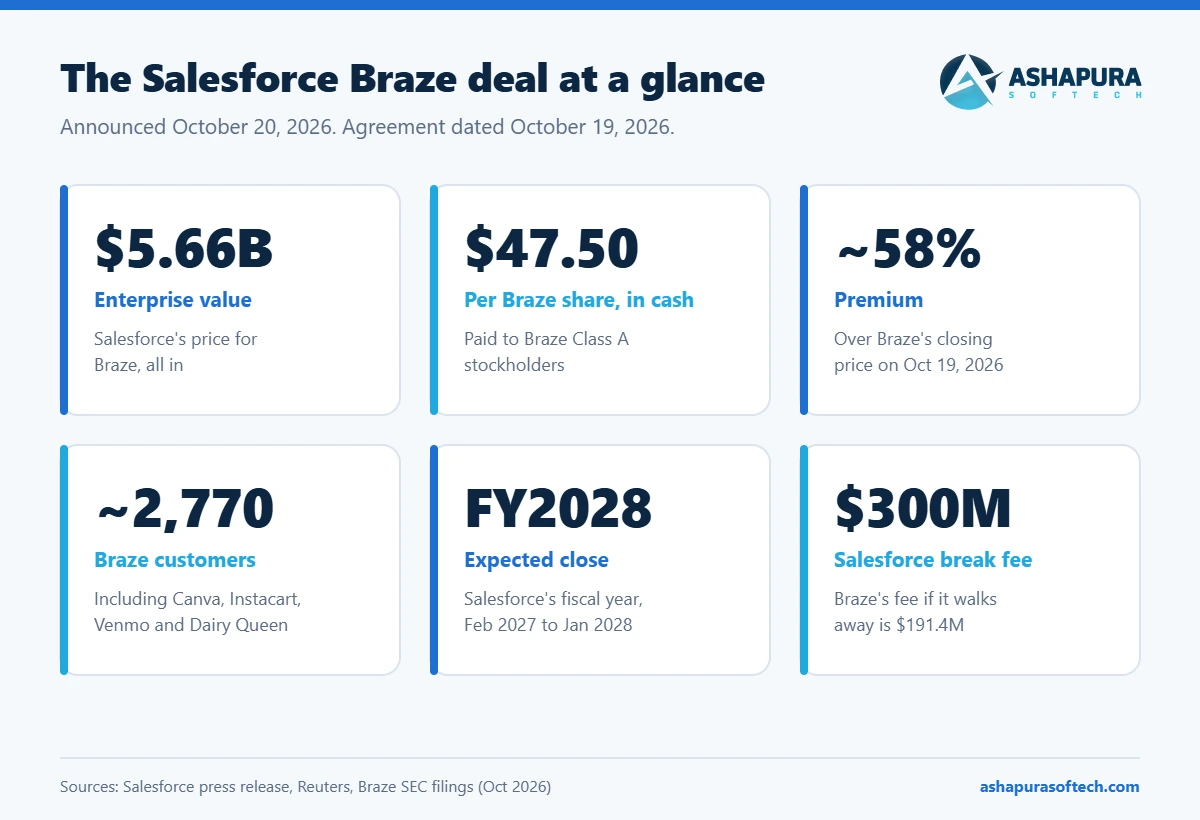
Salesforce signed the merger agreement on October 19, 2026 and announced the Salesforce Braze acquisition the next morning. It’s Salesforce’s biggest marketing bet since the ExactTarget deal that created Marketing Cloud. Some early social posts got the numbers wrong, so here are the facts straight from the filings.
| Detail | What was announced |
|---|---|
| Deal value | About $5.66 billion in enterprise value |
| Price per share | $47.50 in cash for Braze Class A stockholders |
| Premium | Roughly 58% over Braze’s October 19 close |
| Braze customers | About 2,770, including Canva, Dairy Queen, Instacart and Venmo |
| Expected close | Salesforce fiscal 2028, pending Braze shareholder and regulatory approval |
| Break fees | $300 million if Salesforce walks away, $191.4 million if Braze does |
| Guidance impact | Salesforce says its fiscal 2027 guidance does not change |
One number tells you how serious this is. When Salesforce bought ExactTarget back in 2013, the company that became the core of Marketing Cloud, it paid about $2.5 billion. Braze costs more than twice that. Salesforce is not buying a feature here. It’s buying a new engine for its marketing business.
What Is Braze, and Why Did Salesforce Want It?
Braze in plain English
Braze is a customer engagement platform founded in 2011 and based in New York. It helps brands send the right message at the right moment, across mobile push, in-app messages, web, email, SMS and WhatsApp. The key word is moment. Braze is built on an event-streaming setup, so it reacts to what a customer is doing right now, not what they did in last night’s batch file.
Think of a food delivery app. You add three items to your cart, get distracted and close the app. Ten minutes later you get a nudge with a small offer. That kind of live, behavior-triggered message is what Braze does very well, and it’s why mobile-first brands like Instacart and Venmo use it.
The business is healthy, too. In its fiscal second quarter of 2027 (ended July 31, 2026), Braze reported $227.2 million in revenue, up 26.2% year over year, and 361 customers paying $500,000 or more a year.
The gap it fills in Marketing Cloud
Marketing Cloud is excellent at email journeys and deep CRM data. Real-time app engagement has always been its weaker side, and analysts have said so openly. One analyst quoted by Reuters described Braze as a real-time engagement layer that Salesforce’s marketing business never really had.
Salesforce’s own announcement points the same way. It says Braze will strengthen Marketing Cloud’s cross-channel personalization inside Customer 360, and that Braze’s AI decisioning will help pick the content, offer, channel and timing for each person.
Where Braze Fits in the Salesforce Stack
Salesforce now talks about its platform in layers: Data 360 at the bottom, Customer 360 apps on top of that, Agentforce for AI agents, and SIForce. Braze is expected to plug into the engagement layer, sitting next to Marketing Cloud and reading from the same customer data. The Salesforce Braze acquisition makes a lot more sense once you see that map.
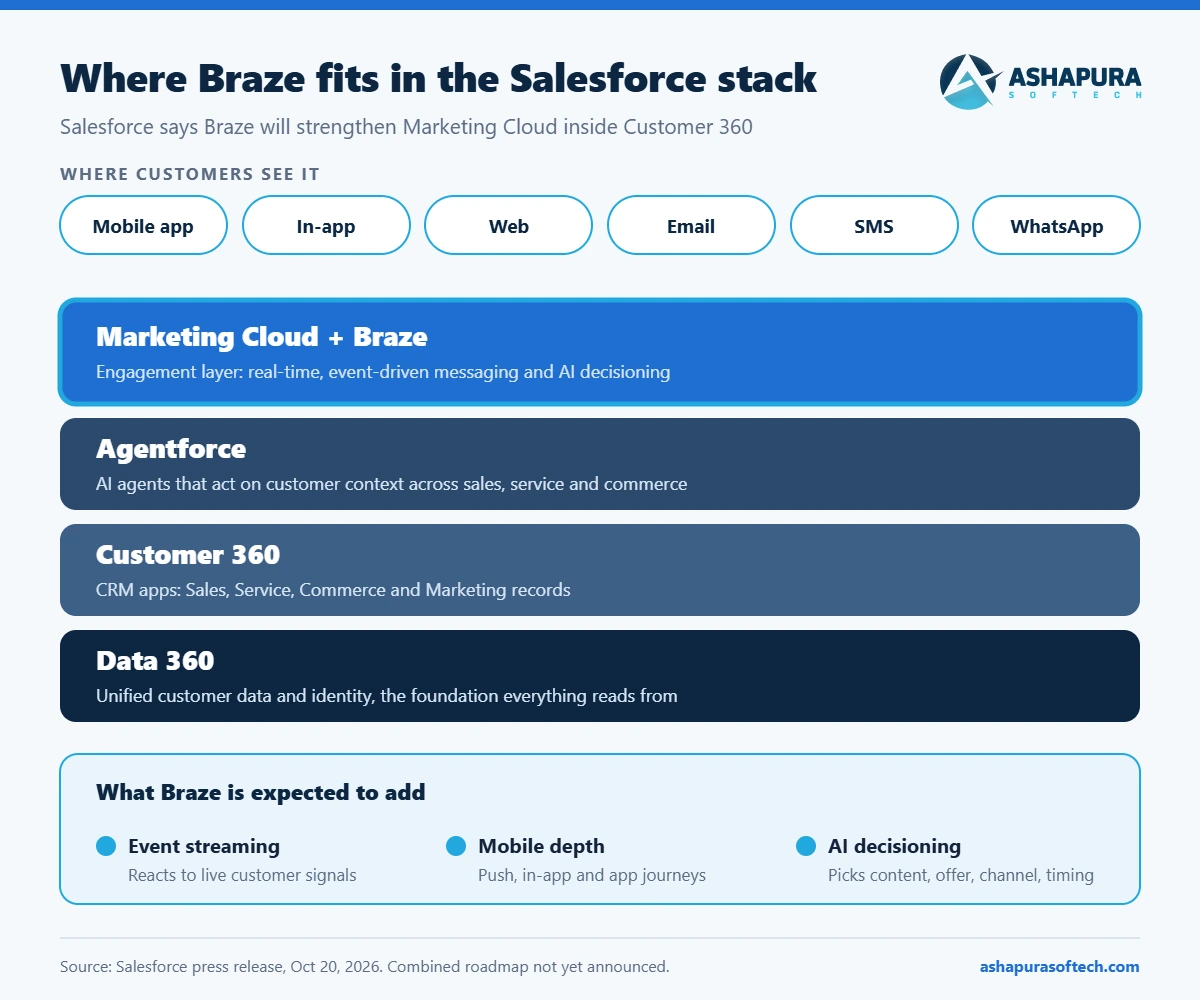
If that works the way Salesforce describes, you’d get something many teams have wanted for years. A sales or service event in Salesforce could trigger an in-app message within seconds, and an Agentforce agent could pick up the conversation later with full context. Right now, most teams stitch that together with connectors, custom code and a fair amount of hope.
That’s also why getting your Data Cloud foundation right matters so much here. Real-time engagement on top of messy data just sends the wrong message faster.
Braze vs Salesforce Marketing Cloud: Overlap and Differences
One of the most searched questions since the Salesforce Braze acquisition news broke is whether Braze is better than Salesforce. Honestly, it’s the wrong question. They grew up solving different problems, and the overlap is narrower than the headlines suggest.
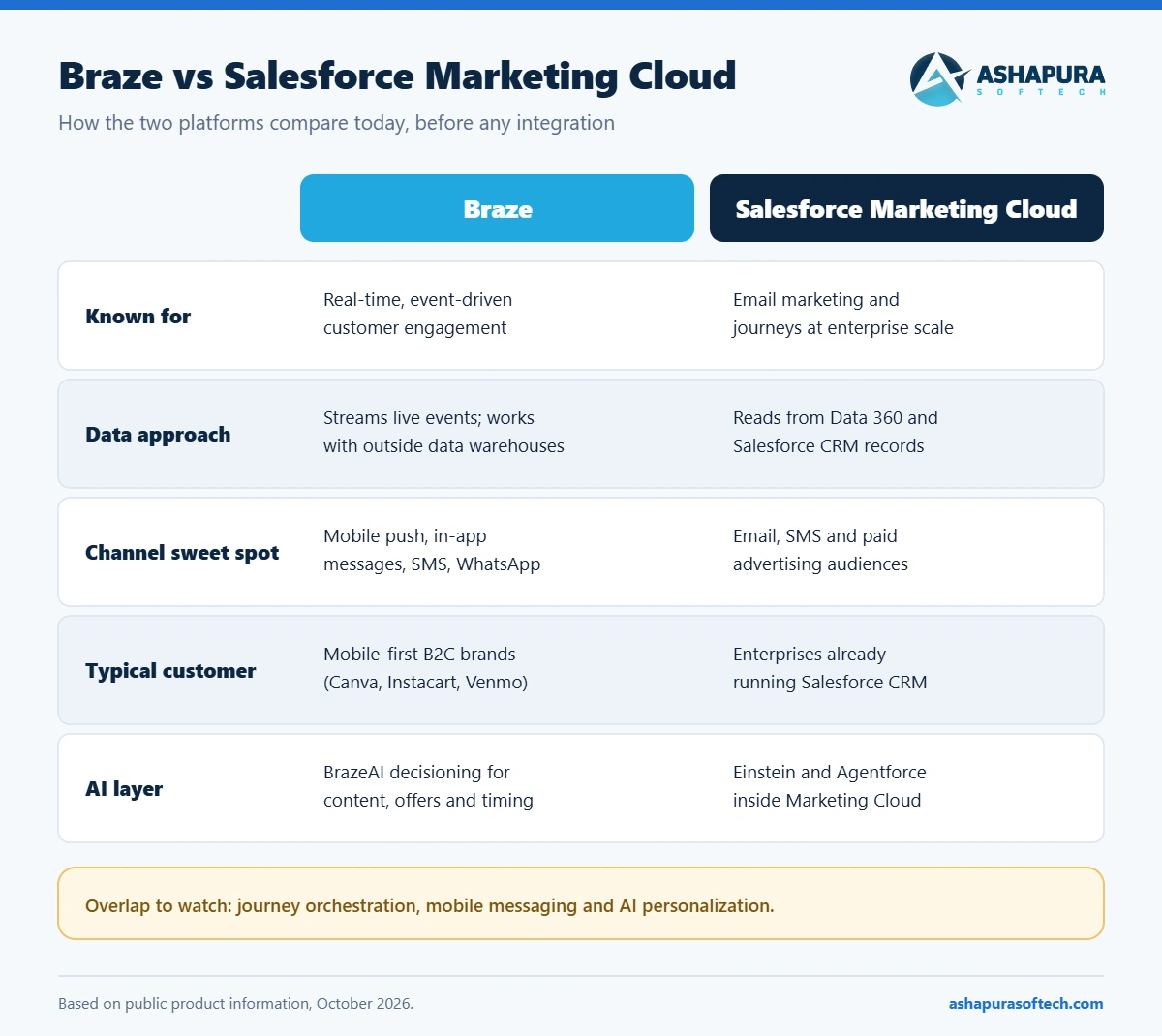
Here is how we’d sum it up:
- Braze shines when your customer lives in a mobile app and you need to react in real time. It’s also comfortable working with data that sits in an outside warehouse.
- Salesforce Marketing Cloud shines when your marketing is tied closely to CRM data, sales and service records, and big email programs.
- The overlap sits in journey orchestration, mobile messaging and AI personalization. That’s where you should expect product decisions over the next year.
If you want a refresher on what Marketing Cloud includes today, our complete Marketing Cloud guide walks through each part.
What the Salesforce Braze Acquisition Means for You
Your next steps depend on which side of the deal you’re on. Here’s how we’re advising teams right now.
If you run Marketing Cloud today
Don’t panic, and don’t rip anything out. Your contract, your journeys and your data all keep working. What you should do is ask your Salesforce account executive for anything in writing about roadmap and pricing before your next renewal. Then make a short list of journeys where you wish you had real-time app triggers. That list will be very useful once Salesforce shares how Braze will be packaged.
If you’re a Braze customer
Braze CEO Bill Magnuson has said Braze will keep building as Braze, and that’s a good sign. Still, get the practical things in writing: pricing at renewal, support levels and how your data can move if you ever leave. This matters most if your customer data lives in Snowflake, BigQuery or another warehouse outside Salesforce. Both companies talk about being open and composable. That promise is real today, but it hasn’t been tested through an integration yet.
If you already use both
Plenty of companies already run Braze next to Salesforce CRM, usually with a Braze to Salesforce connector keeping data in sync. Document exactly what that sync does today: which objects, which direction and how often. When the products start to merge, that document saves you weeks. It’s also worth checking whether both tools are messaging the same customer about the same thing. That happens more often than people admit.
Three Scenarios: How the Salesforce Braze Acquisition Could Play Out
The deal will land differently for every company, so here is how we picture it for three very different setups. These are examples we built from common setups, not announced features.
1. A retail brand with a big shopping app
Picture a US apparel retailer with an app, a loyalty program and Commerce Cloud on the back end. Today, its email team lives in Marketing Cloud while the app team runs push and in-app messages in a separate tool. The cart reminder email lands an hour after the push message, often with a different offer. Customers notice.
If Braze ends up wired into the same customer profile as Commerce Cloud and Marketing Cloud, that retailer could run one journey: the app event fires, the customer gets one message on the right channel, and the loyalty points shown are correct. That’s the dream version. Getting there still depends on clean product, order and loyalty data.
2. A fintech app that already uses Braze
Now take a fintech startup that chose Braze years ago and keeps its data in Snowflake. It uses Salesforce only for sales and support. For this team, the Salesforce Braze acquisition raises a fair worry: will Braze slowly start to favor Salesforce data over everything else?
Our advice here is simple. Keep building on Braze the way you do now, but write down every data source that feeds it and ask for written commitments on warehouse support at your next renewal. If the open approach holds, nothing changes for you. If it doesn’t, you’ll know early and have options.
3. A B2B company that only uses email
Plenty of B2B companies run Marketing Cloud or Account Engagement purely for email nurture and events. They don’t have a consumer app at all. For them, Braze may matter less in the short term. The bigger impact could come later, through AI decisioning that picks send times and content inside Salesforce journeys.
For this group, the smartest move is the least exciting one: tidy up lead and contact data, fix consent tracking and make sure Sales Cloud and Marketing Cloud agree on who a customer actually is. Whatever Salesforce builds next will read from that data.
The common thread across all three? The companies that get value fastest are the ones whose data is already in good shape. That’s not a Braze problem or a Salesforce problem. It’s a homework problem, and the good news is you can start on it today.
The Bigger Picture: Salesforce’s 2026 Buying Spree
Braze isn’t a one-off. Since 2025, Salesforce has agreed to buy Informatica for about $8 billion, closed a $3.6 billion deal for Fin on September 10, signed a deal for AI customer research company Listen Labs, and agreed to add AI analytics startup Loops to Tableau. Read together, the pattern is clear. Salesforce wants to own the data, the AI agents and now the moment of engagement itself.
There’s a defensive angle, too. Investors have been worried that AI agents could eat into traditional software spending. Buying companies with strong growth and real AI use cases is one way to answer that. If you’ve been following the Dreamforce ’26 news, our post on what AIforce is and our breakdown of Agentforce’s named agents fill in the rest of that story.
Timeline: What Happens Next
- October 19, 2026: Merger agreement signed.
- October 20, 2026: Deal announced. Braze shares jumped more than 50% that day.
- Coming months: Braze shareholder vote and regulatory reviews.
- Salesforce fiscal 2028 (February 2027 to January 2028): Expected close, if approvals come through.
Until the Salesforce Braze acquisition closes, Braze and Salesforce operate as separate companies. That means no shared roadmap, no merged pricing and no joint product for a while. Anyone selling you a “Braze plus Marketing Cloud bundle” today is guessing.
A 90-Day Checklist While the Deal Closes
Here’s the practical part. None of these steps depend on the final shape of the Salesforce Braze acquisition, so you can start this week.
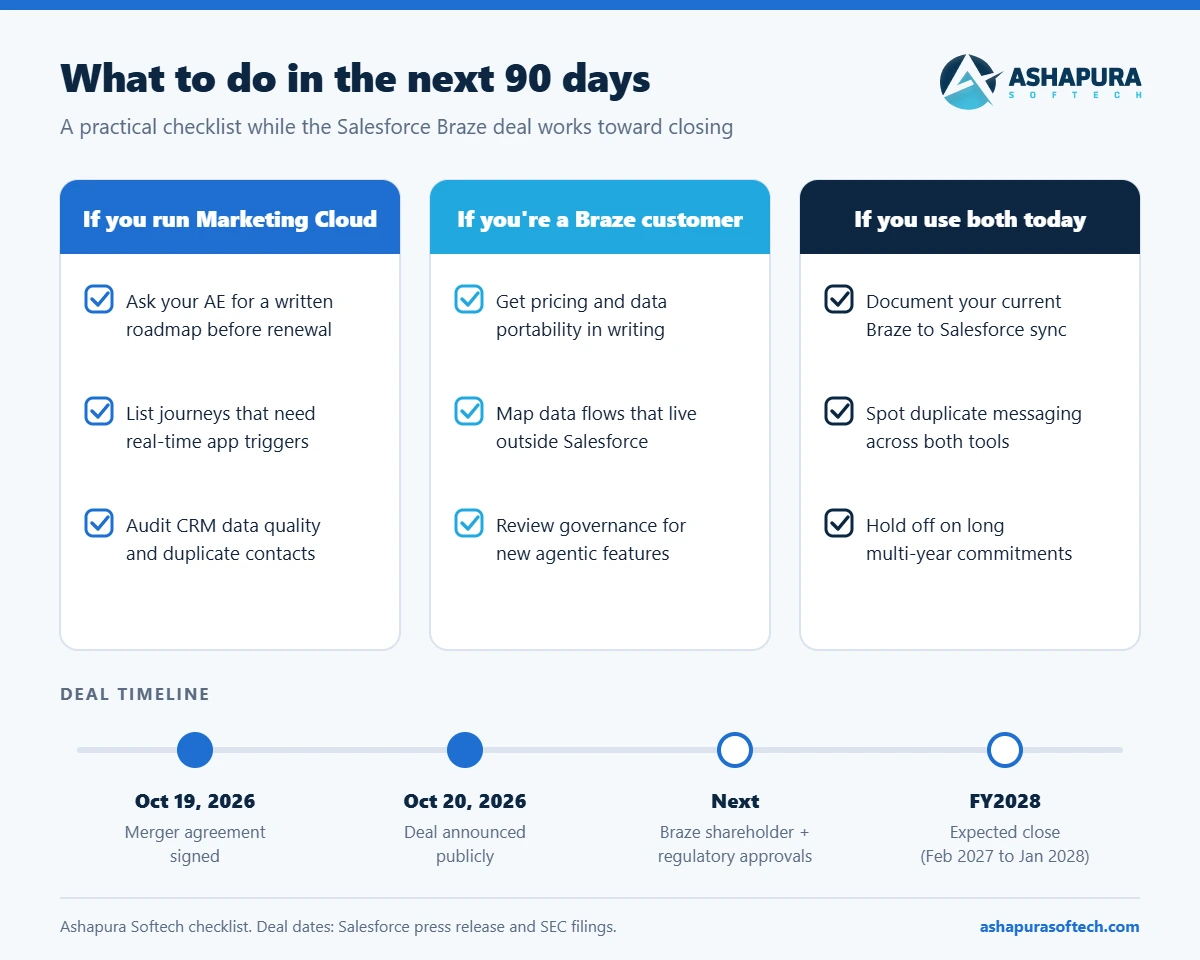
- Audit your CRM data. Duplicates, stale contacts and missing consent flags will hurt any real-time tool. Our CRM health check template is a free place to start.
- Map your journeys. Mark which ones are email-led and which ones need app or in-app triggers.
- Write down your data flows. Know what lives in Salesforce, what lives in a warehouse and what moves between them.
- Get renewal terms in writing. Roadmap, pricing caps and data portability for both tools.
- Set agent guardrails. Decide who approves AI-generated messages and what frequency limits apply, before agentic features land in your stack.
Our Take
We think the Salesforce Braze acquisition is a good deal for Salesforce customers, with one big condition: integration has to be done well. Salesforce has a mixed record here. ExactTarget became the base of Marketing Cloud, while some later acquisitions took years to feel like one product.
The teams that will benefit first won’t be the ones with the biggest budgets. They’ll be the ones that walk into 2027 with clean data, clear journeys and a short list of real-time use cases ready to go. That work is worth doing anyway, even if this deal took a different turn tomorrow.
If you’d like a second pair of eyes on your Marketing Cloud setup or a Braze plus Salesforce data flow, talk to our Salesforce team. We’re happy to tell you honestly whether you need to change anything right now. Often the answer is no.
Frequently Asked Questions
When did Salesforce announce the Braze acquisition?
Salesforce announced the deal on October 20, 2026. The merger agreement itself is dated October 19, 2026.
How much is Salesforce paying for Braze?
About $5.66 billion in enterprise value. Braze Class A stockholders will receive $47.50 per share in cash, roughly a 58% premium to the stock’s last close before the news.
When will the Salesforce Braze acquisition close?
Salesforce expects it to close during its fiscal 2028, which runs from February 2027 to January 2028. It needs Braze shareholder approval and regulatory clearance first.
Is Braze a CRM?
No. Braze is a customer engagement platform. It sends messages based on customer behavior, while a CRM like Salesforce stores and manages the customer relationship, sales and service data. Many companies use the two together.
Does Braze compete with Salesforce Marketing Cloud?
Partly. Both handle cross-channel campaigns and customer journeys. Braze is stronger in real-time and mobile engagement, while Marketing Cloud is stronger in email and CRM-connected marketing. After the deal closes, Salesforce plans to use Braze to strengthen Marketing Cloud.
Will Marketing Cloud pricing change because of the deal?
Salesforce has not announced any pricing or packaging changes. Until it does, base renewal decisions on your current contract and ask your account team for written commitments.
What happens to the Braze to Salesforce connector?
Nothing has been announced that changes it. The two companies operate separately until the deal closes, so existing connectors and integrations should keep working as they do today.
Sources
- Salesforce press release: Salesforce Signs Definitive Agreement to Acquire Braze
- Agreement and Plan of Merger, Braze 8-K filing (SEC)
- Reuters: Salesforce deepens AI bets with $5.66 billion Braze deal
- CMSWire: What does Salesforce’s Braze deal mean for Marketing Cloud customers?
- Braze fiscal Q2 2027 results (Business Wire)