On 15 September 2026, at Dreamforce in San Francisco, Salesforce announced AIforce. The framing Salesforce used for it is blunt: AI replaces the UI. Instead of asking people to open Salesforce to get work done, AIforce lets AI agents read and act on Salesforce data from wherever the person already is, whether that is Claude, Slack, Lightning or a tool your own team has built.
If you run a Salesforce org, this is the announcement from this Dreamforce that actually changes how your users will touch the system. Here is what was announced, what is available today, and what it is reasonable to do about it this quarter.
What is AIforce?
AIforce is a layer on top of Salesforce’s existing Agentic Enterprise architecture, not a replacement for Agentforce. It takes what already sits in your org, Customer 360 records, Data 360 context and the Agentforce agents you have configured, and exposes them to AI interfaces outside the Salesforce UI.
The practical effect is that a rep can update an opportunity, log a call, pull pipeline or ask for account research without opening a Salesforce tab. Marc Benioff described the idea as combining model intelligence with the context customers have already built inside Salesforce to create a composable system.
The word composable is doing real work in that sentence. AIforce is built on the Headless 360 toolkit Salesforce shipped in March 2026, which exposes platform capability through APIs, Model Context Protocol servers and developer tooling. Agents are assembled from those pieces rather than bought whole.
The three products inside AIforce
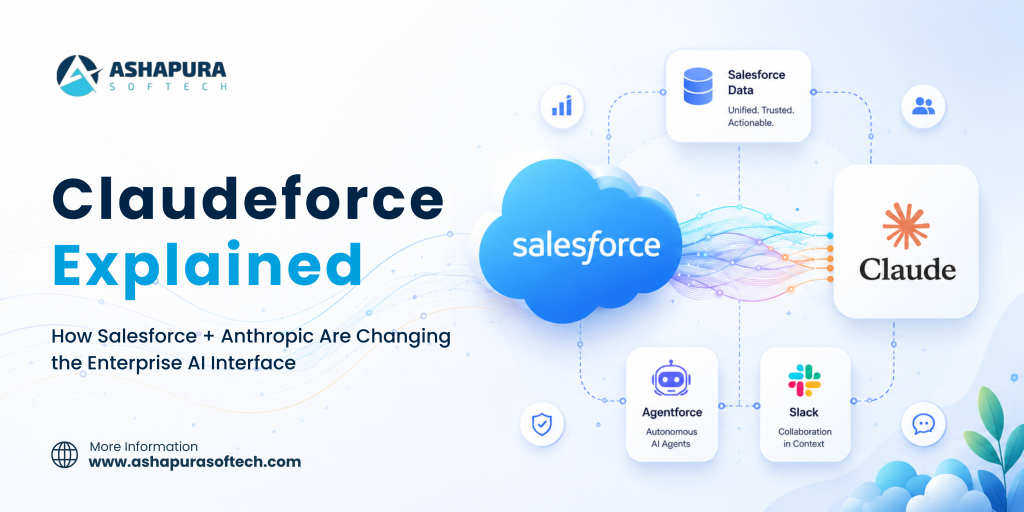
Claudeforce
Claudeforce is the extended Anthropic partnership. It puts Salesforce inside Claude, shipping with 37 prebuilt sales skills covering work like prospecting and pipeline management, with analytics and further skills for service, marketing, commerce and industries on the roadmap. There is also a Salesforce Development plug in for Claude Code carrying more than 40 skills for developers.
Salesforce in Claude is in beta and open to all customers now. If your team already uses Claude, this is the lowest friction way to see what the interface revolution actually feels like on your own data.
We covered the Salesforce and Anthropic partnership in detail in What is Claudeforce.
Slackforce
Slackforce brings Salesforce into Slack as an interactive surface rather than a notification feed. It includes a Slackbot assistant and Slack CRM, which lets a user create an account, log call notes and update records from a prompt without leaving the channel. Slack Code covers collaborative AI development in the same place.
For teams whose real working day happens in Slack, this closes the gap that CRM adoption programmes have been fighting for a decade. Data quality problems are usually a data entry friction problem, and this removes a large part of that friction.
Agentforce Coworker
Agentforce Coworker is an AI teammate inside the Lightning interface, working across devices and operating strictly inside your existing business rules, permissions and security model, with zero data retention. Salesforce has described it as instantly available to customers.
Coworker is the one to test first if your objection to agents so far has been governance. It inherits the permission set of the person it is working for, so it cannot see what that person cannot see. Our guide to Agentforce use cases covers where agents have actually been shipped in practice.
The Headless Toolkit and AgentExchange
Underneath the three products sits the Headless Toolkit, which exposes platform elements through MCPs, APIs, plug ins and skills so you can build your own AI experience rather than take one off the shelf. AgentExchange is where partners publish integrations, with Anthropic, AWS, Google, OpenAI, DocuSign and Vercel already named in that ecosystem.
This matters for anyone with a non standard process. The interesting AIforce work in 2027 will not be turning on Coworker, it will be exposing your own objects, validation rules and approval flows as skills an agent can call safely.
Salesforce Core, Advanced and Max: the edition change to read alongside it
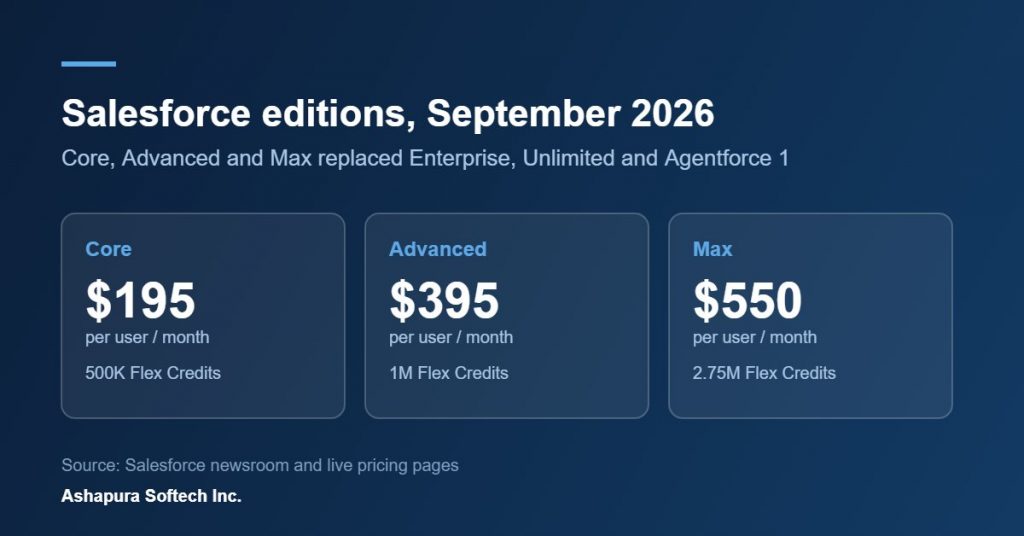
Salesforce also simplified its editions, effective September 2026, into Core, Advanced and Max across Agentforce Sales, Service and Industries. Every edition now bundles Agentforce capabilities such as Account Research and Service Rep Assistant, Slack and Slackbot, embedded agentic analytics powered by Tableau Next, enterprise grade data security and Premier Success Plans, along with Flex Credits: 500K on Core, 1M on Advanced and 2.75M on Max.
List pricing is 195 dollars per user per month for Core, 395 for Advanced and 550 for Max. Salesforce has said existing Agentforce 1 Edition customers can move to Max at no extra cost, legacy edition pricing is unchanged for current customers, and Industry Edition pricing is still to come this autumn.
Confirm your own numbers with your account executive before you budget against these. Published list pricing and what lands on a renewal quote are rarely the same thing, and consumption based Flex Credits change the shape of the bill.
What this actually changes for your org
Your interface strategy is now a real decision. Until this announcement, “where do users work” had one answer. Now there are four plausible answers and you should pick deliberately per team rather than let it happen by accident.
Permissions and sharing rules become the control surface. An agent that inherits a user’s permissions is only as safe as those permissions are tidy. If your profiles and permission sets have drifted over years of ad hoc requests, that debt is about to become visible in a new way.
Data quality gets more exposed, not less. An agent asked to research an account will answer from what is in your org. Duplicate accounts, stale contacts and half filled custom fields have been survivable while a human was reading the record and mentally correcting it. They are less survivable when the answer arrives as a confident sentence.
Automation you already have may be duplicated. Before you build an agent for a task, check whether a Flow already does it. Agents are the right tool for judgement and language, not for deterministic steps a Flow handles cheaply.
A sensible order of work
- Turn on Salesforce in Claude for a small group, in a sandbox or with a limited permission set, and watch what people actually ask it.
- Run a permissions audit before you widen access. Profiles, permission sets, field level security, sharing rules.
- Run a duplicate and data completeness pass on accounts and contacts, since that is what agent answers are built from.
- Pilot Agentforce Coworker with one team and one measurable task rather than across the org.
- Model your edition options against actual usage before renewal, including what Flex Credit consumption looks like at your volume.
Steps two and three are unglamorous and they are where most of the value is. Agent quality is downstream of org hygiene, which is the bulk of what our Salesforce managed services team spends its time on.
Frequently asked questions about AIforce
Is AIforce the same as Agentforce?
No. Agentforce is the agent platform inside Salesforce. AIforce is the layer that lets those agents and your Salesforce data be reached from outside the Salesforce interface, through Claude, Slack, Lightning or your own build.
Is AIforce available now?
Salesforce in Claude is in beta and open to all customers. Agentforce Coworker has been described as instantly available. Other components, including further Claudeforce skills for service, marketing, commerce and industries, are on the roadmap rather than shipped.
What does AIforce cost?
Salesforce has not published separate AIforce pricing. The related edition pricing effective September 2026 is 195, 395 and 550 dollars per user per month for Core, Advanced and Max respectively, with Flex Credits included at each tier. Check current pricing with Salesforce directly.
What are Salesforce Flex Credits?
Flex Credits are the consumption units bundled with the new editions, 500K with Core, 1M with Advanced and 2.75M with Max. Because agent usage draws on them, two orgs on the same edition can see very different bills depending on how heavily agents are used.
Do we need Data Cloud for this to work well?
You do not strictly need it, but the quality of agent answers depends on the context available to them. If your customer data is spread across systems Salesforce cannot see, that is the gap to close first. Our Salesforce Data Cloud and Data 360 consulting page covers what that work involves.
Where should a mid sized team start?
With one team, one task, and a permissions audit first. Agent quality follows org hygiene, so the groundwork matters more than the agent configuration.
Where AIforce lands
We are a certified Salesforce partner working with teams in the United States from Irving, Texas, with our development centre in Ahmedabad. The work we expect to matter most over the next two quarters is not agent configuration, it is the permission, data and automation groundwork that decides whether an agent gives a useful answer or a confidently wrong one.
If you want a second opinion on where your org stands before you widen agent access, get in touch.