Categories
Agentforce

Claude Commerce Agents: What Your ERP and CRM Actually Have to Give It

Claude Commerce Agents is the open blueprint Anthropic released on 2 September 2026: a working shopping agent and a working merchant agent, forkable, Apache 2.0. Almost every write up since has covered the storefront half. This article covers the half the blueprint deliberately leaves to you, which is what your ERP, your CRM and your permission model actually have to provide before either agent can answer a real customer question.

If your commerce runs on a CRM, an ERP and a warehouse system that disagree with each other on a good day, this is the work that decides whether a Claude Commerce Agents project ships or stalls. What follows is the requirement list we walk clients through, in the order it tends to bite.

There’s a specific moment in these projects that I’ve come to expect.

You demo the agent to the client. It’s fast, it understands a messy question, it builds a sensible cart, everyone in the room is pleased. Then somebody from operations asks what happens when a customer asks about an order that was partially returned, and the room goes quiet, because the answer is that nobody has decided which of the three systems holding pieces of that order is allowed to be the one the agent believes.

That question has nothing to do with the AI. It’s an integration question, and it was there before anyone mentioned agents.

Almost all the coverage in the days since has been about the storefront: what the agent can do for a shopper, what it means for product data, how it fits Shopify. Reasonable, as far as it goes. But it skips the part that decides whether the thing works, which is what happens behind the tool call.

What Anthropic released, briefly

Claude Commerce Agents is an Apache 2.0 reference blueprint, published 2 September 2026. Two agents. The shopping agent lives in your app or storefront and handles search, comparison, multi-item requests, cart building, and customer-service questions like order status and returns. The merchant agent faces your own staff and covers sales analysis, inventory monitoring, pricing and promotion recommendations, and campaign drafting.

Four runnable examples ship with it (retail, travel, telecom and ticketing) plus a Claude Code plugin that will scaffold an agent against your systems or review one you’ve already built.

The line I’d point any client to isn’t on the announcement page, though. It’s at the bottom of the repository README, where Anthropic states plainly that this is a reference implementation, that it is not maintained, and that it does not accept contributions.

That’s not a criticism. It’s a scoping fact, and it’s the most important one in the whole release. You are not adopting a product with a roadmap. You are forking a set of patterns that become your code, your maintenance burden and your security surface from the moment you clone it. Budget accordingly, and don’t let anyone put “Anthropic supports it” in a slide deck.

The blueprint deliberately stops at your systems

Here’s the part I think most readers have glossed over.

The repository ships no MCP connectors. If you have been following the agentic CRM architecture debate, this is the same boundary we described in What Is Salesforce Headless 360. None. Both agents reach the outside world through two Python interfaces, StorefrontBackend on the shopping side and MerchantBackend on the merchant side. Every method on those interfaces is a function your team writes, calling your service, server-side, with a credential your host application holds for the session. The model never sees the credential. It only sees what your method returns.

That design decision carries a commercial consequence that is easy to read past: every capability the agent appears to have is a method your team has to build, own and maintain.

The agent needs, at minimum: catalog search, product detail, cart operations, order lookup, returns and policy answers, customer preferences, sales analytics, inventory positions, pricing rules, promotion state and campaign data. On a mid-market stack, look at where those actually live. Order history is in the CRM. Inventory and cost are in the ERP. Contract pricing is in the ERP or a CPQ layer. Campaign state is in the marketing platform. Product attributes are wherever your PIM is, assuming you have one, which about half the businesses we talk to don’t.

Almost none of it is in the storefront.

So the honest name for a commerce agent project is systems integration project with a conversational front end. That’s a different budget line, a different team and a different risk register than “add an AI assistant to the website,” and if the proposal your client is looking at doesn’t say so, the proposal is wrong.

Claude Commerce Agents shopping agent answering a product question on a storefront with add to cart

The ERP and CRM readiness checklist for Claude Commerce Agents

Before any of the agent code matters, twelve things have to be true of your systems. Nine of the twelve are data and process questions that have nothing to do with AI. This is the list we work through with a client before we quote anything.

What your CRM has to give it

  • Session identity resolved by your host application. The agent inherits an authenticated shopper; it never decides who the user is. Guest checkout, duplicate email addresses on one account and B2B users buying for several ship-to locations all have to resolve to one answer.
  • Order and returns state readable live. Not last night’s extract. Partial returns, exchanges and in-flight refunds included, because those are the questions customers actually ask.
  • Account and contract pricing resolvable per customer. If the agent can only see list price, it will quote list price to a customer on a negotiated rate.
  • Memory scoped, with a written retention rule. What the agent is allowed to remember between sessions, for how long, and how a customer gets it deleted.

What your ERP has to give it

  • Revenue, margin and returns defined the same way everywhere. Two systems that disagree on margin will produce an agent that confidently reports the wrong number.
  • On-hand and committed stock, current. Committed matters as much as on-hand; an agent that only sees on-hand will promise stock that is already allocated.
  • Cost data to reason against, and price floors it cannot cross. The floor belongs in your system, enforced server-side, not in a prompt.
  • Product attributes as structured fields. Size, material, compatibility and voltage as fields, not buried in a paragraph of marketing prose.
  • A campaign calendar queryable by product. Otherwise the agent will recommend a discount on something already promoted.

What has to be true across both

  • Every merchant write staged for human approval. The blueprint is built this way; keep it that way when you extend it.
  • Credentials held server-side in the host application. The agent calls your backend methods, it does not hold keys to your ERP.
  • A test set of real edge cases before pilot. Partial returns, price exceptions, shared logins, discontinued SKUs. This is the part that gets cut, and it is the part that decides whether the pilot survives.

If you cannot tick nine of these twelve today, the honest answer is that the first phase of a Claude Commerce Agents project is a data and integration project, not an AI project.

What the Claude shopping agent wants from your CRM

Four things. Most mid-market CRMs supply two of them cleanly and struggle with the other two.

Identity, resolved per session. Before the agent can say anything account-specific it has to know who’s asking. Your host application authenticates the shopper and the agent inherits that context; it doesn’t get to decide who the user is. Straightforward in principle, and in practice this is where guest checkout, multiple email addresses on one account, and B2B users buying on behalf of three different ship-to locations all come and find you.

Order and returns state. Anthropic’s shopping agent is designed to answer service questions inside the same conversation as shopping ones (where the order is, how to return something, what the refund policy actually says) rather than dumping the customer on a support page. That’s genuinely the best feature in the release, and it’s also the one that exposes your data model fastest. Full orders are easy. Partial returns, split shipments, exchanges against a replacement SKU, and anything involving a third-party fulfilment partner are where teams discover their order record was never designed to answer a question in natural language.

Account and contract pricing. The repository’s guidance is that the price quoted is the session account’s price. If you sell B2B at all, that single sentence routes your pricing call out of the catalog and into the ERP or CPQ system, and it has to return within a latency budget a person will tolerate mid-conversation.

Memory that survives the session, and doesn’t become a liability. The agent is designed to remember what a customer tells it. Anthropic’s engineering guide treats this as a data-handling problem rather than a storage one, and the recommendations are worth reading in full, but the four that matter: decide up front which categories of fact you’re willing to hold and enforce that with a validator on the write path rather than an instruction in the prompt; give users a way to see, correct and delete what’s stored; wire that deletion into your existing account-deletion and data-request flows; and set a retention period, because a preference from two years ago is probably wrong now.

There’s a fifth recommendation in there that I’d have missed if I hadn’t read the guide carefully, and it applies to the merchant side. Merchant logins get shared between operators constantly: one account, four people on the floor. So memory should be keyed to the person, not the login, and reads have to respect that person’s permissions. A store manager’s agent shouldn’t be able to recall something a district manager said. That’s a small design decision that becomes an expensive retrofit.
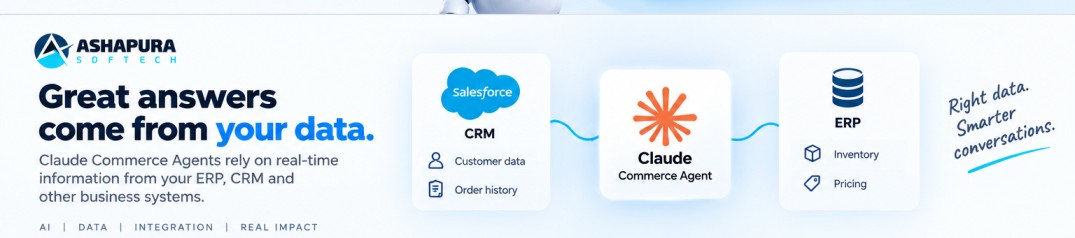
Claude Commerce Agent reading customer data and order history from CRM and inventory and pricing from ERP

What the Claude merchant agent wants from your ERP

The merchant agent’s capabilities ship as five named skills: performance-insights, catalog-listings, inventory-operations, pricing-promotions and marketing-campaigns. Each maps onto a back-office system, and each has a precondition that isn’t about AI at all.

Capability System that answers What has to be true
Sales performance questions ERP or warehouse Revenue, margin and returns defined the same way everywhere
Inventory alerts ERP or WMS On-hand and committed stock, current, not last night’s extract
Pricing and promotion recommendations ERP, CPQ or pricing engine Cost data to reason against and floors it cannot cross
Campaign drafting Marketing platform Campaign calendar queryable by product
Listing maintenance PIM or catalog Attributes as structured fields, not prose

Now the design detail that has the biggest operational consequence, and I don’t think anyone has written about it yet.

No merchant write goes live directly in the reference implementation. Every write produces a staged change with a server-generated ID, and applying it requires that ID to have been approved through a real surface, a button in the operator’s portal, a confirmation in the CLI. Fine, that’s the sensible pattern. But the guardrails are re-checked at apply time, against the limits in force then, not the limits that applied when the change was staged.

Think about what that requires of your ERP. Not “can you produce a report.” It’s: can you answer what is true right now, on demand, in the second the approver clicks the button. If your inventory or pricing data lands in the reporting layer on a nightly batch, you cannot support that, and closing the gap is your first sprint, before a single prompt gets written.

I’d rate that as the most common blocker we’ll see in mid-market Odoo and Dynamics estates over the next year. It isn’t glamorous and it doesn’t demo well, but it’s the thing.

The failure nobody plans for

This one I’d put money on.

The shopping agent reads availability from the storefront. The merchant agent reads availability from the ERP. A customer is told an item is in stock. The operations team, looking at the same SKU, sees that stock committed against a wholesale order. Both agents are behaving correctly. They’re reading two systems that have never agreed on what “available” means, and nobody noticed, because until now no two consumers of that number were ever quoted in the same conversation.

The agent didn’t create that contradiction. It made it legible.

That’s why I’d argue hard against building both agents at once, even when the budget exists and the client is enthusiastic. Two conversational surfaces reading through separate data logic will contradict each other in front of a customer within weeks, and when they do, the blame lands on “the AI” rather than on a definition mismatch that predates it by five years. The project gets cancelled for the wrong reason.

Before funding both, five things need one owner and one definition each: product and catalog data, customer identity, commercial rules, action authority, and how you’ll evaluate correctness. If your team can’t name the system of record for all five inside an hour, that reconciliation is the project. The agent comes after.

A trap for integrators specifically

There’s a warning in Anthropic’s engineering guide that I think is aimed squarely at people who do the kind of work we do, and it’s easy to walk straight into.

The rule is that the agent’s tools should call the systems you already run, not reimplement their logic. Your search ranking, your promotion engine, your inventory allocation, those encode years of tuning and see signals a model never will. The tool is where their logic ends and the model’s judgment starts. When the agent calls search_products, results should arrive already ranked; the agent’s job is deciding which of them serve the goal and how to present them.

Where it goes wrong is subtle. The guide describes an availability check that calls the catalog for the SKU, then the inventory service per store, then fulfilment for cutoffs, then applies substitution rules and pickup eligibility, all inside the tool’s own code. Every one of those steps looks reasonable while you’re writing it. What you’ve actually built is a tool carrying domain knowledge that belongs upstream, which will drift out of correctness the moment the business changes a rule, and which nobody will think to update because it doesn’t look like a business system.

The fix is boring and correct: one backend endpoint that answers the question, called by one agent tool.

I’m flagging this because the pressure to stitch missing logic into the tool layer is enormous on integration projects. It’s always the fastest path in the sprint you’re in. It’s also how you end up owning a shadow pricing engine written in a tool wrapper.

A related, smaller point from the same guide: tool results are context, so return the fields the model reasons with and drop the rest. Image URLs on every search row are named as the usual offender. That’s a token cost on every single turn for data the model does nothing with.

Claude Commerce Agents, Agentforce, Claudeforce

Clients ask this as though it’s a choice between three products. It mostly isn’t, and framing it that way leads to bad scoping.

Agentforce is native. Agents run inside Salesforce, on Salesforce data, under Salesforce permissions and governance, and the readiness questions there are different again, which we set out in our guide to choosing an Agentforce implementation partner. If your commerce operation genuinely lives in Salesforce Commerce Cloud end to end, most of the integration work described in this article is already done for you, and the trade is that you work within that ecosystem’s boundaries and its pricing model.

Claudeforce, the expanded Salesforce, Anthropic partnership announced in August 2026, is a different shape again: Claude supplies reasoning, Salesforce supplies the business context and governs the action. We wrote about the distinction separately in Claudeforce vs Agentforce, and it’s worth reading before you assume one replaces the other, because they don’t.

Claude Commerce Agents sits at the far end of that spectrum. You get the harness, the prompts, the skills, the tool contracts and the safety gates; you supply every connection to every system. Maximum control, maximum integration work, no platform lock-in. The same code runs on the Claude API, Amazon Bedrock, Microsoft Foundry or Google Cloud Vertex AI, which matters more than it sounds if you have a cloud commitment or a data-residency requirement.

My honest read: if you’re Salesforce end-to-end, look hard at the native options first and only fork the blueprint if you hit a wall. If you’re running Odoo for ERP and Zoho for CRM behind a custom storefront, which describes a lot of the North American mid-market we work with, there is no native path, and the backend-interface model is genuinely the shorter route, not just the more flexible one.

Where the safety design actually is

Worth understanding before you promise a client this is safe, because the guarantees are real but specific.

Enforcement lives in the harness, in code, not in the prompt. Anthropic’s reasoning is that in commerce the failures are financial and often irreversible, and a prompt rule is one injection away from being skipped. Three mechanisms do most of the work:

Server-issued IDs only. The harness keeps a per-session record of every ID it has handed the model, and that record is the only key any write or render will accept. The cart takes only product IDs the server returned in this session. An ID that arrived any other way, hallucinated, pasted in by a user, planted inside a product review, is refused before your backend ever sees it.

Caps enforced on the resulting state. Limits are checked against what the state would be after the write, so a shopper saying “add two more” three times can’t stack past a per-customer cap, and cart writes within a session are serialised so parallel tool calls can’t combine to exceed it. Merchant changes are checked the same way against caps on price movement, discount depth, restock size and campaign budget, plus a list of protected fields that no change may touch.

Third-party text is sanitised and fenced. In commerce most of your context is written by people who aren’t you, sellers, reviewers, competitors. Every backend read authored by a third party goes through one sanitiser before the model sees it, wrapped in a fence with a fixed label, with control and bidirectional characters stripped and anything imitating a conversation turn or a tool call defused. The prompt carries the other half of the contract: fenced text is material to report on, never to act on.

If you’re presenting this internally to a security or risk function, those three are the answer to “what stops the AI from doing something stupid with money.” The answer is that structurally it can’t, because the checkout interface has no charge method and the write path only accepts approved IDs.

What Claude Commerce Agents cost to run

The code is free. The inference isn’t, and it’s billed however you access Claude. If you are comparing this against a Salesforce-native route, the Agentforce Flex Credits pricing model works on a completely different unit and the two numbers are not directly comparable.

Two things from Anthropic’s engineering guidance belong in front of whoever signs the budget.

First: prompt caching is the dominant cost variable, not model choice. The guide reports that the strongest commerce deployments run at 90, 99% cache hit rates and that this is the range to design for from the start. Cached input reads cost roughly a tenth of fresh ones; cache writes carry about a 1.25x premium, so a cached prefix pays for itself on its second use.

Caching is prefix-based, which means order matters as much as content. Structure the request in three segments by how often they change: global (system prompt, tool definitions, identical every session, your warmest cache), then session (user context and conversation history), then volatile (current time, current page) at the very end. The most common mistake named in the guide is putting a timestamp or the current page at the top of the system prompt, which silently breaks the cache on every single request.

That is a fifteen-minute architecture decision in week one with an order-of-magnitude cost consequence in month six. It’s also invisible in testing, because with low volume nobody looks at the bill.

Second: measure cost per completed task, not per model call. A cheaper model that needs more turns, or fails more often, isn’t cheaper. Anthropic’s starting point is Opus-class for merchant agents, where the work is analysis-heavy, and Sonnet-class for consumer-facing agents, where latency weighs more, then run your eval suite across every model and effort level you’d consider and let the numbers decide. Current rates are at claude.com/pricing.

Testing Claude Commerce Agents, the part that gets cut

Every agent project I’ve seen under time pressure cuts evaluation first, and it’s the wrong cut.

The useful shift in Anthropic’s approach is to evaluate snapshots, not conversations. The API is stateless, so any state a conversation can reach can be constructed directly: build the test state, append the test message, let the agent run, then grade the final state and the rendered response, including the arguments of the last write. They explicitly recommend against grading the path the agent took, because those tests are brittle and over-constraining.

Two things I’d hold teams to:

Most suites are far too heavy on clean-state cases. If a bug only appears after a busy first turn or a contradiction earlier in the session, a test starting from a blank state will pass on every configuration and tell you nothing. Some meaningful share of your cases should start from long, messy, contradictory histories.

And write the negative for every positive. A “should refuse” for every “should serve,” a “should just do it” for every “should ask.” Missing negatives are named as the most common gap in real suites, and it matches what we see, teams test that the agent does the thing, never that it declines to do the thing it shouldn’t.

Fifty to a hundred cases per user flow is the suggested starting point. That sounds like a lot until the first regression ships.
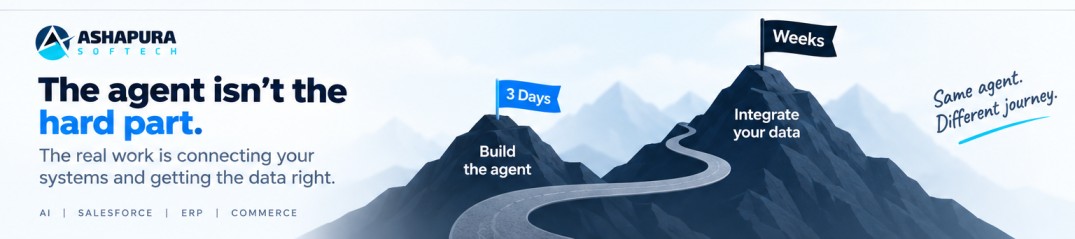
Building the agent takes days while integrating your ERP and CRM data takes weeks

How I’d actually start

Read-only, one workflow, one real system boundary.

The repository supports this directly and it’s the most underrated thing in it. A shopping pilot can implement search and product detail and stub everything else, a stubbed method returns unavailable and changes no prompt bytes. A merchant pilot can implement the read methods and have every write refuse, so digests and analysis run with no write path in existence. And any capability your business simply doesn’t have gets switched off through an enable_* flag, which strips its tools, prompt lines and grounding rules rather than leaving the agent to reason about a system you don’t operate.

That’s enough to answer the only question a first pilot needs to answer, which is whether your data, permissions and definitions can support the workflow at all.


Questions we’re getting

Is it free?

The repository is, under Apache 2.0. Running the agents consumes Claude model usage, billed through whichever platform you access Claude on, the Claude API, Amazon Bedrock, Microsoft Foundry or Google Cloud Vertex AI. Free code, metered inference.

Does it work with Salesforce Commerce Cloud?

Yes, but not out of the box, no platform connectors ship. Commerce Cloud connects through the backend interfaces the same way any other catalog, order or pricing system does, with credentials held server-side by your host application.

Can the agent place an order or charge a card?

No, and not by policy, by structure. In the reference implementation the checkout tool renders the cart for your own checkout to complete, and the backend interface the agent calls has no charge method at all. Every merchant write is staged until a person approves it. Payment is left entirely to your existing checkout or an agentic payments provider.

Do we need Shopify?

No. Shopify announced a reference storefront connecting the blueprint to Shopify stores through Catalog, the Universal Commerce Protocol and Shop Sign-in, but the blueprint itself is platform-agnostic.

Odoo, Zoho, Dynamics?

No prebuilt connector for any of them, and none needed. Each backend method is code your team writes that calls your service server-side, so they integrate exactly like any other system of record.

How long does it take?

The demo runs in an afternoon. A narrow read-only pilot against real systems is weeks, and the timeline is set almost entirely by the state of your product, inventory and customer data, not by the agent code. I’d be sceptical of any estimate that doesn’t start with a data assessment.

What about the results Anthropic published?

Anthropic reports that retailers running shopping agents on Claude have seen carts up to 35% larger and shoppers 60% more likely to complete a purchase. Those are Anthropic’s own figures. The announcement doesn’t publish sample size, test design, retailer mix or attribution method, so treat them as directional vendor evidence and build your own baseline before you commit to a number internally.


Ashapura Softech is a certified Salesforce, Zoho, Microsoft and Odoo implementation partner, based in Irving, Texas with a development centre in Ahmedabad. We’ve been doing CRM and ERP integration work for North American businesses since 2012. If you’re scoping a commerce agent and want a straight answer on whether your data is ready for one, talk to us, the assessment is usually a short conversation.
Categories
Salesforce

Dreamforce 2025 to Dreamforce 2026: What Salesforce Promised, What Actually Shipped, and What’s Coming in September

Every enterprise software conference makes promises. The interesting question is never what got announced. It’s what survived contact with a real customer’s data model eleven months later.

At Dreamforce 2025, Salesforce stood on stage at Moscone Center and told 50,000 people that the Agentic Enterprise had arrived. Agentforce 360 launched, voice agents shipped, Slack got repositioned as an operating system, and every major cloud in the portfolio was renamed around the word “agent.” It was the most aggressive repositioning the company has attempted since the Lightning migration.

Dreamforce 2026 runs 15-17 September, and it lands in a very different room. The vision has already been sold. This year Salesforce has to show receipts: production deployments, governance models, and numbers that hold up when a CFO asks what the agent actually did.

Below is the full record. Everything announced in October 2025, everything that has shipped since, and a grounded view of what to expect in September. If you run Salesforce, sell Salesforce services, or are deciding whether Agentforce deserves a budget line, this is the context to have before the keynote.

Quick answers

When is Dreamforce 2026?

15-17 September 2026, Moscone Center, San Francisco. Virtual attendance via Salesforce+ is free.

What was the biggest Dreamforce 2025 announcement?

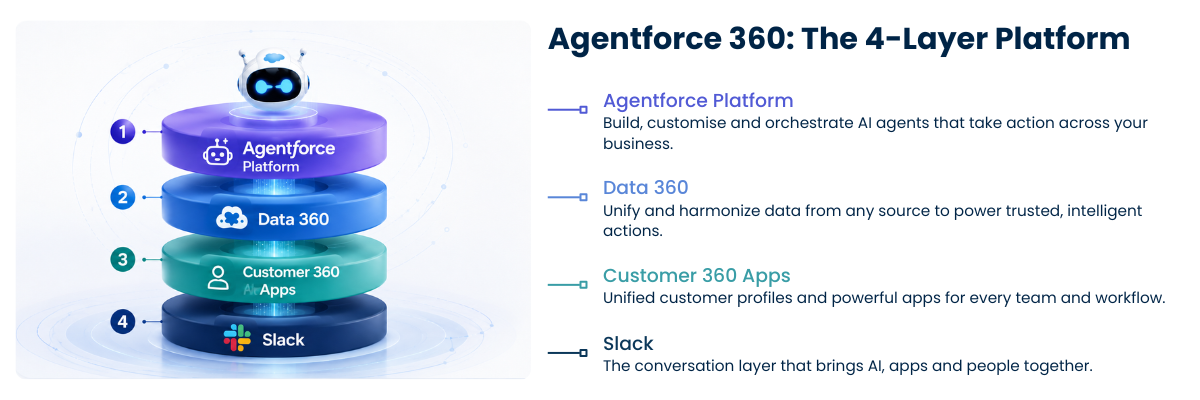
Agentforce 360, a four-layer platform combining the Agentforce Platform, Data 360 (formerly Data Cloud), Customer 360 apps, and Slack. It went generally available worldwide on 14 October 2025.

Has Agentforce actually sold?

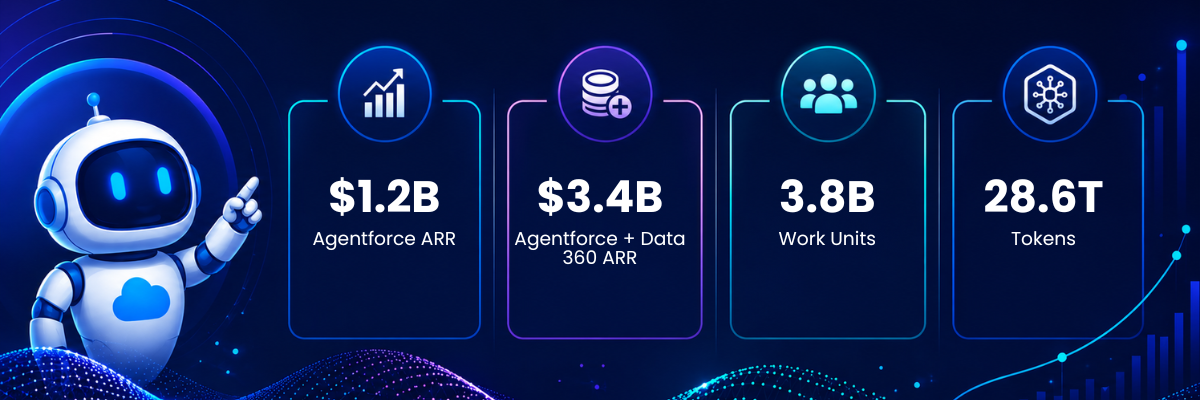
Yes. In Q1 FY27, the quarter ended 30 April 2026, Agentforce and Data 360 reached a combined $3.4 billion ARR, up more than 200% year on year. Agentforce alone hit $1.2 billion ARR.

What is Dreamforce 2026’s theme?

The Agentic Enterprise again, but the framing has moved from vision to production accountability.

What will Salesforce announce?

Nothing is confirmed beyond product areas. Expect proof-of-deployment case studies, agent governance tooling, Headless 360 expansion, and the Fin acquisition story.

Dreamforce 2026 dates, pricing and session details
Dreamforce 2026 runs 15-17 September at Moscone Center, San Francisco.

Part 1: What Salesforce announced at Dreamforce 2025

Dreamforce 2025 ran 14-16 October at Moscone Center in San Francisco. Roughly 45,000 to 50,000 people attended in person, with Salesforce claiming more than 180,000 including the Salesforce+ virtual audience. The speaker list mixed enterprise and entertainment: Marc Benioff, Sundar Pichai, Andrew Ng, Starbucks CEO Brian Niccol, Matthew McConaughey, Ellen Pompeo, America Ferrera. Metallica and Benson Boone headlined Dreamfest.

The product news mattered more than the celebrity list, and there was a lot of it.

Agentforce 360, the flagship launch

Agentforce 360 four-layer platform: Agentforce Platform, Data 360, Customer 360 Apps and Slack
The four layers of Agentforce 360, generally available since 14 October 2025.

Agentforce 360 became generally available on 14 October 2025. Salesforce said it was built on lessons from more than 12,000 Agentforce implementations, which is a useful detail. It means this was a v2 shaped by real deployment failures rather than a greenfield product.

It has four layers:

Layer What it does
Agentforce 360 Platform Agent build and runtime, hybrid reasoning, voice
Data 360 Rebrand of Data Cloud. Turns structured and unstructured data into context an agent can reason over
Customer 360 Apps Agents embedded directly into sales, service, marketing and commerce workflows
Slack The conversational surface where humans and agents actually meet

The architectural argument behind this explains most of what followed. Salesforce’s position is that agents fail for one of three reasons: they can’t see the right data, they behave unpredictably, or nobody knows where to talk to them. Data 360 addresses the first problem, Agent Script the second, and Slack the third.

Agentforce Voice

Voice agents were the most demo-able launch of the event. Agentforce Voice handles inbound and outbound calls with low enough latency to feel conversational, transcribes in real time, and lets a human take over mid-call with full visibility of what the agent has already said and done.

It integrates with Amazon Connect, Five9, NiCE and Vonage, which was a deliberate choice. Salesforce didn’t try to replace the contact center infrastructure enterprises already own. It layered on top of it, and that is a far shorter sales cycle than a rip-and-replace.

The developer and admin stack

Four launches here, and together they are the most consequential part of Dreamforce 2025 for anyone who actually builds on the platform.

Agent Script is a new agent-definition language written in human-readable JSON. It lets a developer specify exactly when an agent should follow deterministic logic and when it’s allowed to use LLM reasoning. This is Salesforce’s answer to the biggest enterprise objection to agents: you cannot put something non-deterministic in front of a customer and a compliance team at the same time.

Agentforce Builder was rebuilt around conversation. Instead of the old topic-action-instruction workflow, you describe what you want and refine it in three views: a natural-language editor, a low-code canvas, and a script view. A live simulator explains why the agent behaved the way it did.

Agentforce Vibes is a conversational coding assistant that generates Lightning Web Components and Apex logic, running inside VS Code and Code Builder, with 50 premium calls per day per org.

Setup Powered by Agentforce entered pilot. It brings natural-language administration to creating custom objects, building record-triggered and schedule-triggered flows, fixing permissions, and summarizing existing flows. If you have ever inherited an org with 400 undocumented flows, the summarization feature alone is worth the attention.

Data 360 and the context problem

The Data Cloud rename to Data 360 was not cosmetic. Two capabilities came with it. Intelligent Context lets agents reason over unstructured content such as PDFs, call transcripts and knowledge articles, rather than only structured records. Tableau Semantics enforces one consistent business vocabulary across the platform, so “active customer” means the same thing to an agent that it means in a Tableau dashboard.

Anyone who has run a data migration knows why this matters. An agent that pulls the wrong definition of “churned” doesn’t produce a slightly worse answer. It produces a confidently wrong one.

Slack as the agentic operating system

Slack was repositioned as the place work happens, with a reimagined Slackbot and, more importantly, support for Model Context Protocol (MCP). MCP support means third-party AI tools and agents from outside the Salesforce ecosystem can interoperate inside Slack. That is an unusually open move for Salesforce, and a clear signal that they would rather own the interface layer than fight every other agent vendor for it.

The great rebrand

Salesforce renamed its core product line around agents:

Before After
Sales Cloud Agentforce Sales
Service Cloud Agentforce Service
Marketing Cloud Agentforce Marketing
Data Cloud Data 360

Renaming products your customers have said out loud for fifteen years is not a decision anyone makes lightly. It tells you how completely Salesforce has bet the company on this positioning.

Acquisitions and partnerships

Apromore was acquired, a process intelligence company. The logic is straightforward. Before you can automate a workflow with an agent, you need to know what the workflow actually is, as opposed to what the process documentation claims it is. Apromore maps that gap.

OpenAI expanded its partnership. GPT-5 became available inside the Salesforce platform, Agentforce 360 data became queryable from ChatGPT, and Agentforce Commerce landed inside ChatGPT using the Agentic Commerce Protocol, enabling checkout without leaving the chat. A ChatGPT app for Slack and Codex access came with it.

Anthropic signed a new strategic partnership making Claude the preferred model for regulated industries including financial services, healthcare and life sciences, with bi-directional Claude and Slack integration. Running two frontier model partnerships in parallel, positioned at different industries, is a hedge against betting the platform on any single vendor. That hedge tilted in August 2026, when the two companies announced Claudeforce, making Claude the default reasoning model across Agentforce and Slack.

PwC launched an agentic contact center built on Agentforce Service.

Away from product, Salesforce announced a $15 billion, five-year investment in San Francisco.

Part 2: The audit, or what actually shipped

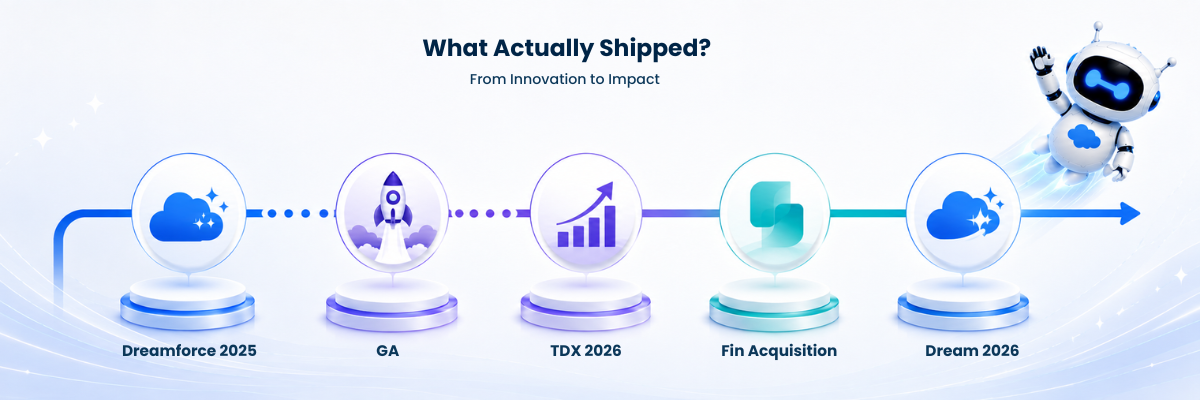
Salesforce Agentforce timeline from Dreamforce 2025 through GA, TDX 2026 and the Fin acquisition to Dreamforce 2026
From announcement to shipped product: the Agentforce timeline across four events.

This is the section most Dreamforce coverage skips, and it’s the one that should inform your budget decisions.

The revenue evidence

Agent products either sell or they don’t, and the filings are unambiguous.

Metric Q4 FY26 (ended Jan 2026) Q1 FY27 (ended 30 Apr 2026)
Total revenue $11.2B $11.1B (+13% YoY)
Agentforce ARR ~$800M $1.2B (+205% YoY)
Agentforce + Data 360 ARR not disclosed $3.4B (+200%+ YoY)
Informatica Cloud ARR not disclosed $1.1B
Agentic work units delivered not disclosed 3.8B (+111% QoQ)
Tokens processed (cumulative) not disclosed 28.6 trillion (+152% QoQ)
Salesforce Q1 FY27 results: $1.2B Agentforce ARR, $3.4B including Data 360, 3.8B agentic work units and 28.6 trillion tokens processed
The four numbers that matter from Q1 FY27, ended 30 April 2026.

Salesforce guided FY27 revenue to $45.9 to $46.2 billion and authorized a $50 billion buyback. Benioff’s framing on the Q1 call: “Agentic AI is the biggest growth opportunity for our customers, and for Salesforce.”

Two of those metrics deserve a closer look. Agentic work units and tokens processed are not standard SaaS disclosures. They are consumption metrics, and Salesforce putting them into quarterly reporting is a strong hint about where pricing is heading. If your Agentforce contract is currently seat-based, it is worth modeling what a consumption-based renewal would cost at your actual volumes.

TDX 2026 proved the developer story was real

Salesforce’s developer conference in March 2026 shipped the follow-through on the Dreamforce 2025 developer promises, which is the clearest available signal that the platform work wasn’t just keynote material.

Agent Script was open-sourced and published to GitHub. Announced in October, in public hands by March.

Agentforce Vibes 2.0 reads enterprise metadata through the Unified Catalog and supports both Claude Sonnet and GPT-5.

Agentforce Experience Layer (AXL) lets you define an interactive component once and deploy it to web, mobile, Slack and voice.

Agent Script for Voice extends the same deterministic control to voice channels.

Agentforce Mobile SDK brings native iOS and Android with push-to-talk voice.

Headless 360 runs Salesforce as an agent backend behind someone else’s front end.

Agentforce Labs and the Agent Development Life Cycle (ADLC) added safety reviews, deployment tooling and production observability.

AgentExchange grew to 10,000 Salesforce apps, 2,600+ Slack apps and 1,000+ agents.

Session Trace OTel API entered beta, returning full agent session traces as OpenTelemetry spans. The A/B Testing API entered pilot, and Testing Center enhancements went GA in May.

The ADLC and observability work is the tell. You don’t build production tracing and safety review tooling for a product still living in demos. You build it because customers have agents in production and are asking hard questions about what those agents did at 3am.

The Fin acquisition

In June 2026, Salesforce signed a definitive agreement to acquire Fin, formerly Intercom, for approximately $3.6 billion, expected to close in Q4 FY27. Fin’s proprietary Apex model reportedly resolves around 76% of support volume without human involvement.

The positioning is an admission about Agentforce’s weakness. Agentforce is a platform for enterprise-scale custom transformation, and platforms take months to deploy. Fin is packaged and fast. Salesforce buying it says plainly that the mid-market was never going to wait through a six-month implementation, and that plenty of buyers want an agent that works on Thursday rather than one perfectly modeled on their data by Q3.

What’s still thin

An honest audit has to include the parts that haven’t landed.

Adoption remains harder than the headline ARR suggests. The deployments most often cited as successes, including PenFed’s 76-agent system and UCLA Health, involved substantial data cleanup, integration work, process redesign and testing before any agent went live. That work is not optional and it is not fast.

Setup Powered by Agentforce was announced as a pilot in October 2025 and has not made a loud arrival since. Governance frameworks for agent accountability are still largely something each customer builds for themselves. And the honest answer to “which workflows are safe to hand to an autonomous agent” is still a shorter list than most vendor decks imply.

None of that makes Agentforce a bad bet. It makes it a project rather than a purchase.

Part 3: Dreamforce 2026, the confirmed facts

  • Dates: 15-17 September 2026
  • Venue: Moscone Center, San Francisco
  • Theme: “Where every business becomes an Agentic Enterprise”
  • Virtual: Free via Salesforce+, with 400+ sessions and 72 hours of programming

Scale

  • 1,600+ expert-led breakout sessions
  • 50+ visionary and product keynotes
  • 150+ hands-on training sessions
  • 240+ community roundtables
  • Live product demos across Slack, Agentforce, Data 360, Tableau, Customer 360 and Headless 360

Speakers confirmed so far

Marc Benioff delivers the opening keynote. The name that matters most this year is Dario Amodei, co-founder and CEO of Anthropic.

The rest of the confirmed list mixes enterprise and entertainment: Roland Busch, President and CEO of Siemens AG; H.E. Omar Sultan Al Olama, the UAE Minister of State for AI; Linda A. Hill of Harvard Business School; Alessandra Sala of UNESCO’s Women for Ethical AI; Allie K. Miller; Travis Kalanick; the All-In hosts Chamath Palihapitiya, Jason Calacanis and Dave Friedberg; and on the entertainment side Sterling K. Brown, Sheryl Lee Ralph and Reese Witherspoon. Salesforce is still adding names.

Dreamfest now has its headliners too: Usher and Gwen Stefani, playing the ballpark in support of UCSF Benioff Children’s Hospitals.

Amodei on a Salesforce main stage is the detail worth reading into. Less than three weeks before the conference, Salesforce made Claude the default reasoning model behind Agentforce. Putting Anthropic’s CEO on the keynote stage turns that from a press release into a position. If you are weighing up Agentforce, watch closely what these two say about who owns the interface.

Registration and pricing

PassPriceStatusLaunch Special$999ExpiredEarly Bird$1,499ExpiredLast Chance$1,899Through 20 August 2026Full Price$2,299After 20 August

Group registration of three or more brings it to $999 per pass, which is the cheapest route available by a wide margin and cheaper than the original launch special. The Trailblazer Bootcamp on 12-14 September can be added for $1,499 against a $2,299 list price. Discounted hotel blocks close on 21 August 2026.

One free certification exam is included per attendee. Registration requires a free Trailblazer account, attendees must be 18 or over, and Agenda Builder opens in August for session reservations.

Part 4: What to expect at Dreamforce 2026

Salesforce has confirmed dates, theme, session counts and product areas. Everything below is informed expectation based on the shipping pattern since October 2025, not company commitments.

  1. Proof replaces vision. The 2025 keynote sold a concept. The 2026 keynote has to defend an $11 billion quarter and a product line renamed around a promise. Expect named customers with hard before-and-after numbers rather than staged demos.
  2. Governance becomes a product, not a slide. The ADLC and observability work from TDX points toward a packaged agent governance layer covering testing, monitoring, escalation paths and audit trails. The market question has moved from “can an agent do this” to “who is accountable when it does it wrong,” and that is a gap Salesforce needs to close before regulated buyers commit.
  3. Agentic work units get formalized. Once a metric appears in quarterly earnings, it usually appears on a pricing page within a year. Watch for consumption-based packaging.
  4. Headless 360 expands. Salesforce as an agent backend behind a customer’s own interface is a real strategic shift. It means Salesforce is willing to give up the UI to keep the data and the logic.
  5. The Fin story gets told properly. The deal is expected to close in Q4 FY27, so it will likely still be pending during the event. Expect a clean split: Fin for fast-deployment SMB service, Agentforce for enterprise custom builds.
  6. Industry clouds get an agent layer. Financial services, healthcare, retail and manufacturing, with the Anthropic partnership doing visible work in the regulated verticals.
  7. Multi-model positioning gets louder. Claude for regulated industries, OpenAI for commerce and code. Salesforce has spent a year avoiding single-vendor dependency and will want credit for it.

Part 5: What this means for you

The right response to Dreamforce depends entirely on where you’re standing.

If you already run Salesforce

Your immediate concern isn’t the keynote. It’s the rebrand and the pricing signal. Sales Cloud is now Agentforce Sales. Service Cloud is now Agentforce Service. That renaming will eventually show up in your renewal paperwork, your admin training, and your internal documentation.

Three things to get clear before September.

  • Your data readiness. Data 360 is the dependency for everything else. If your org has duplicate accounts, inconsistent picklists and eight definitions of “active customer,” an agent will surface that problem faster and more publicly than any dashboard ever did.
  • Your consumption exposure. Work out what agentic work units mean at your transaction volumes before a consumption-based renewal arrives.
  • One workflow worth testing. Not your most important one. Pick something high volume, low risk and well documented, such as order status lookups, tier-one password resets, or lead qualification. Prove the model where a mistake is recoverable.

If you’re a Salesforce partner or consultancy

The demand signal is real and the capacity problem is worse. Agentforce implementations need data engineering, integration work, process mapping and test design. That is a wider skill mix than a standard Sales Cloud rollout, and one most boutique consultancies don’t have sitting idle.

The three weeks after Dreamforce are historically the heaviest inbound period of the year, because clients return from the keynote with a list of things they now want built. If your delivery capacity is already committed through Q4, that is a decision to make in August, not on 18 September.

If you haven’t started

Ignore the ARR numbers. They describe Salesforce’s business, not yours.

The useful benchmark is the deployment pattern. Organizations getting value spent significant time on data quality and process definition before they built anything. The ones that didn’t ended up with an agent confidently giving customers wrong answers from bad records.

Start with an honest assessment of what is actually in your CRM. It is less exciting than an agent pilot, and it is the reason the agent pilot will or won’t work.

Pre-Dreamforce readiness checklist

Work through this before 15 September and the sessions will be considerably more useful.

  • Audit data quality in the objects an agent would touch first: accounts, contacts, cases, orders
  • Document your top five customer-facing workflows as they actually run, not as the process doc describes them
  • Identify one candidate workflow that is high volume, low risk and clearly documented
  • Review your current Salesforce contract for renewal dates and consumption clauses
  • Confirm who in your organization owns agent governance, including testing, monitoring and escalation
  • Register for Salesforce+ even if you’re not travelling, and reserve sessions once Agenda Builder opens
  • Map your existing integrations. Agentforce is only as capable as the systems it can reach

Frequently asked questions

When and where is Dreamforce 2026?

15-17 September 2026 at Moscone Center in San Francisco. Free virtual attendance is available through Salesforce+ with 400+ sessions across 72 hours of programming.

How much does a Dreamforce 2026 ticket cost?

$1,899 through 20 August 2026, rising to $2,299 after that. Groups of three or more pay $999 per pass. Virtual attendance is free.

What was announced at Dreamforce 2025?

Agentforce 360 was the headline launch, alongside Agentforce Voice, Agent Script, Agentforce Builder, Agentforce Vibes, and the Data Cloud rebrand to Data 360. Salesforce also acquired Apromore, expanded its OpenAI partnership, signed a new partnership with Anthropic, and renamed Sales Cloud, Service Cloud and Marketing Cloud around Agentforce.

What is Agentforce 360?

A four-layer agent platform combining the Agentforce 360 Platform, Data 360, Customer 360 apps and Slack. It became generally available on 14 October 2025 and was built on learnings from more than 12,000 prior Agentforce implementations.

What is the difference between Data Cloud and Data 360?

Data 360 is the renamed Data Cloud, with two additions. Intelligent Context lets agents reason over unstructured data, and Tableau Semantics enforces consistent business definitions across the platform.

Is Agentforce actually being adopted?

Yes, at scale. Agentforce reached $1.2 billion ARR in the quarter ended 30 April 2026, up 205% year on year, with 3.8 billion agentic work units delivered that quarter. Adoption still requires meaningful data and process work before deployment.

What is Salesforce likely to announce at Dreamforce 2026?

Salesforce has not confirmed specific announcements. Based on the shipping pattern since October 2025, expect production case studies, agent governance tooling, Headless 360 expansion, consumption-based pricing signals, and integration positioning around the pending Fin acquisition.

Do I need to attend in person to see the announcements?

No. Salesforce+ streams the keynotes and 400+ sessions free. In-person value is concentrated in hands-on training, certification and networking rather than the announcements themselves.

Where to go from here

The pattern across the last eleven months is consistent. Agentforce works when the underlying data and processes are in order, and produces expensive disappointment when they aren’t. The technology is no longer the constraint. Implementation readiness is.

If you’re weighing an Agentforce project, or you’re already mid-implementation and the data layer is proving harder than the pitch suggested, a structured assessment before September is a cheap way to avoid an expensive detour.

Ashapura Softech offers a free 30-minute CRM health check. You get a written one-page findings document covering your data readiness, integration gaps, and the workflows most likely to succeed as a first agent deployment. There is no pitch deck and no obligation.

Book your CRM health check

Categories
Salesforce Sales Cloud

Agentic Ai in Salesforce Sales Cloud : Setup and Use Cases

Introduction

Agentic AI is rapidly reshaping the way today’s sales teams operate, and one of the best examples of this transformation is happening inside Salesforce Sales Cloud. As businesses move beyond traditional, rules-based automation, they’re increasingly turning to intelligent and autonomous AI agents that can analyze data, make decisions, and automate sales workflows. This shift toward smarter, real-time sales automation is creating new efficiency gains for every stage of the sales cycle—from lead qualification to forecasting. Salesforce is leading this evolution by introducing Agentic AI in Sales Cloud through its Agentforce framework. Agentforce brings a powerful layer of AI-driven automation directly into the CRM, helping teams streamline manual tasks, improve pipeline visibility, and deliver more accurate sales forecasting. With autonomous AI agents working inside Salesforce, sales reps can focus more on closing deals while AI handles repetitive tasks, data entry, follow-ups, and workflow execution.

In this comprehensive guide, you’ll learn exactly what Agentic AI is, why it matters for Sales Cloud users, and how it enhances sales productivity. We’ll walk step-by-step through how to set up Salesforce Agentic AI, how to configure Agentforce inside Sales Cloud, and what you need to get started—from permissions to data requirements. You’ll also discover the most valuable Agentforce use cases being used by high-performing sales teams today, including AI-driven lead scoring, automated opportunity updates, CRM data enrichment, and intelligent sales forecasting. Whether you’re a Salesforce admin, sales operations leader, or revenue strategist, this guide will help you understand how agentic AI unlocks faster workflows, higher-quality data, and smarter decision-making inside Salesforce Sales Cloud.

What Is Agentic AI in Salesforce Sales Cloud?

Agentic AI in Salesforce Sales Cloud represents the next major evolution of AI-driven sales automation. Unlike traditional automation tools that rely on static rules or predefined workflows, Agentic AI uses autonomous AI agents that can analyze context, make decisions, and carry out tasks independently. These AI agents operate with human-like reasoning—evaluating real-time data, choosing the best action, and continuously optimizing their behavior based on outcomes.

This approach marks a significant shift for sales organizations. With Agentic AI in Salesforce Sales Cloud, teams gain intelligent assistants that can clean and enrich CRM records, prioritize high-intent leads, draft personalized outreach, update opportunity stages, and trigger relevant follow-up actions—all without manual effort. These capabilities improve data quality, reduce administrative work, and give sales reps more time to focus on selling.

Salesforce’s earlier AI features, such as predictive scores and basic recommendations, provided insights but required human action. By contrast, Salesforce Agentforce introduces fully autonomous AI agents inside Sales Cloud that can act on those insights. These agents interact with core Sales Cloud objects—Leads, Accounts, Contacts, Opportunities, Activities, and Emails—to automate tasks that previously required human oversight.

In practice, this means sales teams can rely on AI to manage day-to-day workflows, from lead qualification and pipeline updates to meeting preparation and sales forecasting. As a result, Agentic AI, powered by Salesforce Agentforce, delivers faster workflows, more accurate data, and higher productivity across the entire sales cycle.

How Agentforce Brings Agentic AI to Salesforce Sales Cloud

Salesforce’s earlier AI tools—like Einstein Prediction Builder and predictive scoring—helped sales teams understand what might happen. But they still required humans to take action. With the introduction of Agentforce, Salesforce has moved beyond predictive insights and into a new era of autonomous AI agents that can act directly inside Sales Cloud.

Agentforce uses Agentic AI to create intelligent, task-oriented AI agents that work alongside sales reps. These agents can analyze CRM data, trigger workflow automations, update records, draft emails, schedule follow-ups, and manage pipeline changes—all without manual input. Instead of simply recommending actions, Agentforce performs them automatically based on real-time context and business logic.

Inside Salesforce Sales Cloud, these AI agents interact with core objects such as Leads, Contacts, Accounts, Opportunities, and Activities. They can interpret sales signals, prioritize the next-best action, and execute tasks immediately—creating a faster, cleaner, and more efficient CRM environment. This shift reduces admin work, eliminates data gaps, and helps teams scale sales operations with AI-driven precision.

By combining agentic reasoning, CRM intelligence, and Salesforce’s trusted data framework, Agentforce enables organizations to adopt fully autonomous sales workflows that adapt to rep behavior and customer signals. The result is a Sales Cloud environment that is smarter, more proactive, and optimally aligned with real-world selling motions.

Benefits of Agentic AI for Sales Automation in Salesforce Sales Cloud

Implementing Agentic AI in Salesforce Sales Cloud is revolutionizing the way modern sales teams operate. By leveraging autonomous AI agents, organizations can scale operations, reduce repetitive administrative tasks, and increase revenue predictability. Unlike traditional CRM automation, Agentic AI agents continuously learn from historical and real-time CRM data, adapt workflows dynamically, and deliver actionable insights—enabling smarter, AI-driven sales automation that goes beyond static rules. For sales leaders, this technology provides a competitive edge by optimizing pipeline efficiency, improving forecast accuracy, and increasing engagement with high-value prospects. Below, we break down the top benefits of adopting Agentic AI and Agentforce in Salesforce Sales Cloud, along with practical examples of how these features improve productivity, data quality, and decision-making.

1. Streamlined Lead Qualification with Agentforce AI

One of the most immediate benefits of Agentic AI in Salesforce Sales Cloud is the ability to streamline lead qualification and prioritization. Using Agentforce, AI agents automatically score incoming leads, identify high-intent prospects, and route them to the appropriate sales reps. This ensures no opportunity is overlooked and reduces the need for manual lead management workflows. Sales teams can now focus on closing deals rather than manually sifting through leads or evaluating CRM activity. The AI agents also provide next-best-action recommendations, helping reps take the most effective steps to nurture each prospect. By integrating lead scoring and automated routing, Sales Cloud users can maximize conversion rates while maintaining a clean and organized CRM.

2. Automated Sales Workflows for Maximum Productivity

Another major advantage of Agentic AI in Salesforce Sales Cloud is the automation of repetitive tasks. AI agents can manage opportunity updates, task creation, follow-up reminders, and automated email outreach—ensuring that routine work doesn’t slow down the sales cycle. By automating these workflows, sales reps gain more time for strategic selling activities, improving operational efficiency and productivity. The integration of AI-powered sales processes also allows managers to monitor workflow performance in real time, ensuring that the entire team remains aligned and focused on high-priority deals.

3. Personalized Engagement at Scale

Agentic AI enables personalized engagement at scale by drafting customized emails, recommending next-best actions, and providing contextual guidance based on historical interactions. This ensures that messaging aligns with each prospect’s stage in the sales funnel, boosting response rates and strengthening customer relationships. By leveraging AI-driven recommendations, sales reps can deliver a highly tailored experience for every lead or account, without the manual effort typically required for personalization. This feature integrates seamlessly with Salesforce Sales Cloud’s CRM objects, including Leads, Contacts, and Opportunities, creating a cohesive AI-powered sales workflow.

4. Enhanced Forecasting and Pipeline Intelligence

Agentic AI in Salesforce Sales Cloud improves sales forecasting and pipeline intelligence by analyzing both historical trends and real-time CRM data. AI agents can identify at-risk opportunities, recommend corrective actions, and highlight growth potential, enabling data-driven decision-making for sales leaders. Forecast accuracy is essential for planning and resource allocation. With AI-enhanced pipeline insights, teams can proactively address bottlenecks and optimize sales strategies. This level of predictive analytics is not only actionable but also helps teams align their workflows with business priorities.

5. Improved Data Quality and CRM Accuracy

AI agents maintain CRM data hygiene by automatically detecting missing or inconsistent data, enriching records, and ensuring high-quality information for reporting and decision-making. Clean, accurate data is critical for reliable automation, predictive insights, and improved sales performance. With Agentic AI, sales teams benefit from CRM optimization, including automated record enrichment, duplicate detection, and field-level validation. Accurate data also improves AI-driven recommendations, ensuring that Agentforce workflows and sales insights are actionable and reliable.

Salesforce Agentic AI Setup Guide for Sales Cloud

1. Step 1 – Enable Agentic AI and Agentforce in Salesforce

The first step in deploying Agentic AI is enabling Agentforce within your Salesforce Sales Cloud instance. Navigate to Setup → Feature Settings → Agentforce and activate Agentic AI functionality for your organization. It is important to assign licenses to the appropriate users and ensure that roles have sufficient permissions for Leads, Opportunities, Accounts, Contacts, and Tasks. Enabling AI agent logging allows administrators to monitor agent activity and workflow execution, providing valuable insights into performance and potential adjustments. For best results, we recommend rolling out Agentforce access in phases. Begin with Salesforce admins and power users to validate AI agent functionality before extending it to the broader sales team. This phased approach reduces implementation risks and allows for feedback-driven optimization.

2. Step 2 – Configure AI Agents and Define Workflows

Once Agentforce is enabled, the next step is to configure autonomous AI agents to execute specific sales workflows. Start by defining business objectives such as lead scoring, opportunity updates, pipeline management, or automated email outreach. Create AI agent profiles and assign each agent to a specific workflow, ensuring that responsibilities are clearly defined. Decision criteria must also be established for each agent. For example, rules can be based on lead scores, opportunity stages, account engagement, or historical activity patterns. AI agents should also be integrated with Salesforce Sales Cloud objects, including Leads, Accounts, Opportunities, Contacts, and Activities, to ensure seamless workflow execution.

3. Step 3 – Prepare CRM Data for AI Agents

High-quality CRM data is essential for Agentic AI success. AI agents rely on accurate, complete, and standardized data to make informed decisions. Begin by removing duplicate records, standardizing the formats of the Lead Source, Opportunity Stage, and Account Type fields, and enriching incomplete fields with internal or third-party data sources. Regular data validation ensures that AI agents have access to reliable inputs for scoring leads, updating records, and recommending next-best actions. Maintaining CRM hygiene also ensures the integrity of predictive analytics and AI-powered sales workflows. Without clean data, even the most advanced AI agents can generate inaccurate insights, leading to inefficiencies and missed opportunities.

4. Step 4 – Define AI Agent Rules and Next-Best Actions

Configuring AI agent rules is a key step toward ensuring intelligent, contextually relevant behavior. Define lead prioritization rules based on engagement levels, intent signals, and CRM history. Set up next-best-action recommendations, such as sending follow-up emails, creating tasks, or updating opportunity stages automatically. Agents can also trigger alerts for at-risk opportunities, ensuring sales reps take timely corrective actions. Testing AI agent rules in a sandbox environment before full deployment is highly recommended. This allows admins to validate logic, monitor agent decision patterns, and adjust criteria to align with organizational goals. Properly configured rules enable Agentforce to execute workflows accurately and consistently, reducing manual oversight while increasing reliability.

5. Step 5 – Monitor AI Agent Performance and Optimize Workflows

After deployment, continuous monitoring of Agentic AI performance is critical. Track key metrics such as lead conversion rates, opportunity updates, forecast accuracy, task completion, and CRM data quality. Review AI agent decisions to identify patterns, validate recommendations, and refine rules as needed. Periodic adjustments ensure agents remain aligned with business priorities and evolving sales strategies. Administrators should generate reports for leadership to demonstrate ROI from AI-driven workflows. Continuous optimization—combined with human expertise—ensures maximum efficiency and trust in AI recommendations.

Top Salesforce Agentforce Use Cases in Sales Cloud in 2025

Salesforce Agentforce is redefining how sales teams operate within Sales Cloud. By leveraging Agentic AI, organizations are automating repetitive tasks, improving CRM data quality, and enabling faster, more intelligent sales decisions. With AI-driven workflows, sales reps can focus on strategic activities such as engaging high-value prospects, closing deals, and improving customer relationships.

According to Salesforce’s 2025 State of Sales report, teams using AI-driven automation see up to 30% higher lead conversion rates and 25% faster pipeline movement. The following are the most impactful Salesforce Agentforce use cases in Sales Cloud that top-performing teams are adopting this year.

1. AI-Powered Lead Qualification

One of the most significant applications of Agentic AI in Sales Cloud is AI-powered lead qualification. Agentforce AI agents analyze behavioral engagement, track interactions across email, chat, and web, and autonomously score leads. High-intent leads are routed directly to SDRs, while lower-priority prospects are assigned nurture sequences automatically.

Practical example: A B2B software company using Agentforce reduced manual lead triaging by 40 hours per month, while increasing its MQL-to-SQL conversion rate by 22%. AI agents prioritize leads based on engagement signals such as email opens, website visits, and content downloads, ensuring no opportunity slips through the cracks.

2. Automated Opportunity Management

Another transformative use case is automated opportunity management. AI agents continuously monitor pipeline activity, updating opportunity stages, generating next-step tasks, and sending real-time alerts when deals stall. By suggesting actionable strategies to accelerate deal progression, Agentforce helps improve win rates while reducing the administrative workload on sales reps.

Practical example: A mid-market SaaS company reported a 15% increase in opportunity win rates after implementing Agentforce to automate follow-ups and update pipeline stages in real time. AI agents can suggest actions such as sending reminder emails, scheduling follow-ups, or prompting managers to reallocate resources for stalled deals.

3. Personalized Email Outreach for Reps

Agentforce can draft and send highly personalized emails for sales reps, including introductions, follow-ups, objection-handling responses, and meeting confirmations. AI agents analyze prior interactions and prospect behavior to optimize timing, content, and frequency, ensuring messaging resonates with each lead.

Practical example: A global marketing services firm implemented Agentforce for automated outreach and saved 12 hours per rep per week, while email engagement rates improved by 35%. Reps now focus on closing deals rather than drafting routine communications.

4. CRM Data Enrichment & Cleanup

High-quality CRM data is the backbone of effective AI-driven sales automation. Agentforce identifies missing fields, incorrect entries, and duplicate records, automatically correcting errors and enriching datasets with verified information. This ensures that AI recommendations and predictive analytics are accurate and actionable.

Practical example: A B2B tech company using Agentforce reduced duplicate contacts by 50% and improved forecast accuracy by 20%, thanks to cleaner CRM data feeding their AI workflows. Clean data supports predictive scoring, opportunity management, and engagement personalization, enabling smarter decision-making across the sales organization.

5. Predictive Forecasting and Pipeline Intelligence

Agentic AI in Salesforce Sales Cloud enables predictive forecasting by monitoring deal health, rep performance, buying signals, and risk factors. AI agents provide actionable insights, helping sales leaders make proactive, data-driven decisions to optimize pipeline performance and revenue outcomes.

Practical example: A global software company implemented Agentforce to track pipeline health and forecast revenue. They achieved 95% forecast accuracy for Q2 2025, allowing leadership to allocate resources more effectively and reduce stalled deals by 18%.

Best Practices for Using Agentic AI in Salesforce Sales Cloud

Implementing Salesforce AI in Sales Cloud can significantly enhance sales performance, but following expert best practices ensures reliable results and maximizes ROI. Here are key strategies for optimizing AI agents and AI sales automation across your organization.

1. Data Hygiene Before Activating AI Agents

Before deploying AI agents, ensure your CRM data is clean, complete, and standardized. Accurate lead records, opportunity details, and contact information are essential for AI-powered decision-making. Clean data improves lead scoring, next-best-action recommendations, and predictive analytics, allowing your AI agents to function effectively and generate meaningful insights.

2. Setting Clear Guardrails for AI Agents

Define explicit boundaries and rules for AI agent behavior. Guardrails prevent errors, maintain compliance, and align AI sales automation with organizational goals. For example, restrict automatic email outreach to verified contacts or enforce deal approval thresholds. These measures reduce risk and improve trust in AI-driven workflows.

3. Continuous Training & Feedback Loops

Regularly train your sales teams to interpret AI recommendations and provide feedback. Integrate feedback loops to refine AI agent performance over time. This ensures your Salesforce AI adapts to evolving sales strategies and improves workflow efficiency, creating a synergy between human expertise and AI intelligence.

4. Monitoring AI Bias & Ethical Guardrails

Monitor AI agents for potential bias in lead scoring, opportunity prioritization, or engagement recommendations. Implement ethical guardrails to promote fairness, transparency, and accountability. Proactive monitoring ensures AI enhances Sales Cloud productivity without introducing unintended consequences.

Agentic AI vs Traditional Salesforce Automation

1. Autonomous Decision-Making vs Static Automation

Traditional Salesforce automation executes tasks based on fixed triggers, such as sending an email when a lead reaches a specific stage. In contrast, Agentic AI acts as an autonomous AI agent, analyzing context, evaluating multiple factors, and making decisions dynamically. This allows sales teams to respond to changing opportunities without manual intervention, improving lead prioritization, opportunity management, and engagement outcomes.

2. Efficiency Gains in Sales Cloud

By leveraging Salesforce AI and Agentic AI workflows, sales teams can automate repetitive tasks like lead scoring, email follow-ups, and pipeline updates with higher accuracy. Studies show that AI-driven sales automation can increase productivity by 25–30%, allowing reps to focus on strategic selling and revenue-generating activities.

3. Real-Time Learning & Improvement

Unlike static automation, Agentic AI continuously learns from CRM data, prospect behavior, and sales outcomes. It refines recommendations, identifies patterns, and optimizes workflows over time. This real-time improvement ensures that sales operations stay agile, efficient, and aligned with evolving business priorities.

FAQs 

1. What is Agentic AI in Salesforce?

Agentic AI is an advanced form of Salesforce AI that functions as autonomous AI agents within Sales Cloud. Unlike traditional automation, it can make decisions, execute tasks, and adapt workflows in real time. Agentic AI helps sales teams improve lead scoring, opportunity management, pipeline forecasting, and overall AI sales automation, driving higher productivity and conversion rates.

2. Is Agentforce available to all Sales Cloud editions?

Agentforce is generally available for Sales Cloud Enterprise and Unlimited editions, though availability may vary by subscription. Admins should verify access in Salesforce Setup or consult Salesforce support. Using Agentforce in eligible editions allows organizations to leverage AI agents for automated lead qualification, opportunity management, and workflow optimization.

3. How do I set up Agentic AI in Salesforce Sales Cloud?

To set up Agentic AI, enable Agentforce, assign AI agent licenses, configure workflows, and connect with CRM objects like Leads, Opportunities, and Accounts. Ensure your CRM data is clean, standardized, and complete, as accurate data is critical for effective AI-powered sales automation and predictive analytics.

4. Can AI Agents automate sales tasks like follow-ups?

Yes. AI agents in Sales Cloud can automate follow-ups, email outreach, task creation, lead scoring, and opportunity updates. This reduces manual effort, allowing sales reps to focus on high-value activities, build stronger customer relationships, and improve overall pipeline velocity.

5. Is Agentic AI suitable for enterprise or SMB sales teams?

Agentic AI scales for both enterprise and SMB sales teams. Larger organizations benefit from advanced customization, multi-team workflows, and predictive analytics, while SMBs gain efficiency through automated lead prioritization, pipeline monitoring, and personalized engagement.

Conclusion

Agentic AI in Salesforce Sales Cloud is transforming modern sales operations by automating repetitive workflows, enhancing lead scoring, improving forecast accuracy, and enabling intelligent, AI-powered decision-making. By leveraging Agentforce, sales teams can prioritize high-value opportunities, reduce manual administrative tasks, and optimize pipeline management for better revenue outcomes. Organizations that implement Agentic AI gain actionable insights, improve sales efficiency, and accelerate deal closure. Ashapura Softech specializes in configuring, deploying, and fine-tuning Agentforce to deliver maximum ROI. Contact us at [email protected] and unlock the potential of AI-driven sales automation, smarter forecasting, and higher-performing sales teams.