

Most Salesforce Health Cloud implementation projects run late for the same two reasons: the EHR integration gets scoped after the CRM work, and nobody agrees who owns patient data quality before go-live.
We are a certified Salesforce implementation partner working with US organisations from Irving, Texas, with a delivery team in Ahmedabad. Our published work in regulated US data environments – credit repair, debt settlement and mortgage platforms – is where our compliance-first approach comes from: strict permission models, audit trails, and data handling that survives review.
For a Salesforce Health Cloud implementation we bring that same discipline plus the standards work below. If you want a Health Cloud reference before you talk to us, ask on the call and we will tell you straight where we are.
The EHR integration routes we work with
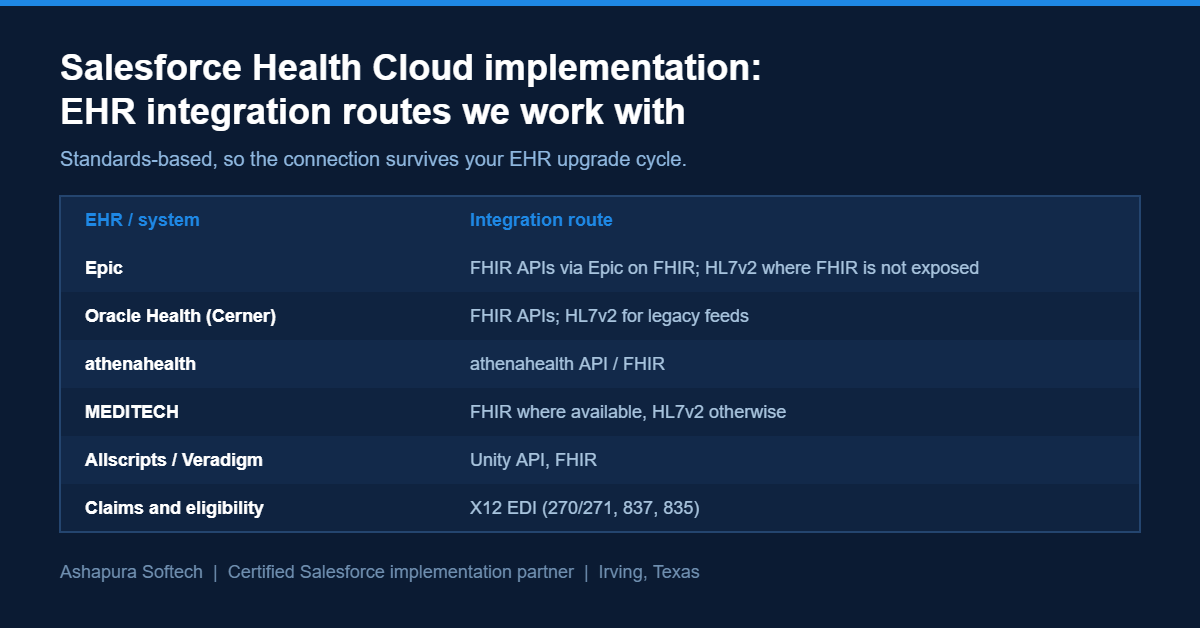
Health Cloud is only as useful as the clinical data flowing into it. We integrate through the HL7 FHIR and HL7v2 interoperability standards rather than point-to-point custom code, so the connection survives your EHR’s upgrade cycle.
| EHR / system | Integration route |
|---|---|
| Epic | FHIR APIs via Epic on FHIR; HL7v2 where FHIR resources are not exposed |
| Oracle Health (Cerner) | FHIR APIs; HL7v2 for legacy feeds |
| athenahealth | athenahealth API / FHIR |
| MEDITECH | FHIR where available, HL7v2 otherwise |
| Allscripts / Veradigm | Unity API, FHIR |
| Claims and eligibility | X12 EDI (270/271, 837, 835) |
We have written both of these up in detail: how to integrate Health Cloud with EHR systems and the integration challenges that come up most often.
Four questions we ask before quoting an integration
- Which FHIR resources does your EHR actually expose, and at what version?
- One-way into Salesforce, or bi-directional write-back?
- What latency is acceptable – real time, near real time, or nightly batch?
- Who owns the interface engine, and is there capacity on that team?
If the first two cannot be answered yet, a fixed scope is not realistic. We propose a discovery sprint rather than quoting around the uncertainty.
HIPAA controls we configure
Health Cloud is HIPAA-capable, not HIPAA-compliant out of the box. Compliance is what you configure and what you sign.
- BAA with Salesforce in place before any PHI enters the org. Salesforce sets out which products it will cover on its HIPAA compliance page
- Salesforce Shield where the risk assessment calls for it – Platform Encryption, Event Monitoring, Field Audit Trail
- Field-level security and sharing rules mapped to minimum-necessary access
- Consent management modelled properly, including revocation
- Audit trail retention aligned to your retention policy
- Sandbox data masking so PHI never sits in a dev or partial sandbox
- Integration user permissions scoped down rather than left broad
- Access review cadence documented and handed over
Full detail in our HIPAA checklist for Health Cloud integration.
How we run the engagement
Every Salesforce Health Cloud implementation we scope runs through the same five stages, and nothing is quoted as fixed price until discovery is done.
Discovery – current-state review, EHR interface inventory, data quality assessment, compliance gap review, success metrics agreed.
Design – data model, integration architecture, security and sharing model, care management design, migration approach.
Build – configuration first, code only where configuration cannot reach. Integrations built and tested against a sandbox with masked data.
Migrate and test – data migration in waves with reconciliation at each wave. UAT with real operations users, not just admins.
Go-live and hypercare – cutover, monitoring, and daily triage through the first weeks.
Timelines depend on the number of source systems, whether write-back is in scope, and the state of your data. We scope that in discovery rather than quoting a number we cannot stand behind.
What moves the price
Five things move the cost of a Salesforce Health Cloud implementation more than anything else on the list.
- Number of EHR and source systems – one integration versus four is not a linear difference
- Bi-directional versus read-only – write-back into a clinical system carries governance overhead
- Data volume and quality – migrating 50,000 clean records is not migrating two million dirty ones
- Salesforce Shield – needed or not, based on your risk assessment
- Custom versus configured – every custom object added is a maintenance cost later
Where our delivery experience comes from
We are a certified Salesforce implementation partner, and also certified for Zoho, Microsoft Dynamics and Odoo – which means we can tell you when Health Cloud is not the right answer.
Our published case studies in regulated US data environments:
- Credit repair platform
- Debt settlement agency platform
- U.S. mortgage brokerage
These are financial services, not healthcare. The overlap is the part that matters for a Health Cloud project: US regulatory constraints, strict permission models, audit requirements, and data migration that has to reconcile.
Ashapura Softech
2201 W Royal Ln, Irving, Texas 75063
+1 214-935-9893
Certified Salesforce implementation partner. Founded 2012.
Frequently asked questions
Can Health Cloud integrate with Epic?
Yes, through Epic on FHIR, with HL7v2 for feeds not exposed as FHIR resources. What matters is which FHIR resources your Epic instance exposes and whether write-back is in scope.
Is Salesforce Health Cloud HIPAA compliant?
Health Cloud can be configured to support HIPAA compliance, and Salesforce will sign a BAA. Compliance is a property of your configuration, your policies and your signed agreements – not a checkbox on the platform.
Do we need Salesforce Shield?
Not always. Shield adds Platform Encryption, Event Monitoring and Field Audit Trail. Whether you need it comes out of your risk assessment. We will not add it by default.
Health Cloud, or build on Sales Cloud?
Health Cloud ships the healthcare data model, care management objects and consent structures. Building the equivalent on Sales Cloud means maintaining that model yourself. For most healthcare organisations the licence difference is smaller than the maintenance difference.
Do you have a healthcare reference we can speak to?
Ask us on the call and we will tell you exactly what we can and cannot share.
Can you work alongside our existing Salesforce partner?
Yes. We are often brought in for the integration layer specifically, alongside an incumbent partner.