
Update (14 Sep 2026): On 11 Sep 2026 Salesforce announced a new portfolio of named, job-ready Agentforce agents built for specific high-value work: Casey (customer service), Paige (IT and HR service), Carter (shopper agent for e-commerce), Marshall (supply chain orchestration), Piper (inbound lead generation) and Fin (complex customer experience), all generally available now, plus Hunter (outbound sales), in pilot with general availability expected November 2026. The release also adds long-horizon runtime so agents can pursue goals over days or weeks rather than single interactions, AI Skills for teaching agents new tasks (pilot now, GA October 2026), multi-agent orchestration across workflows, and an Agent Optimizer for continuous performance tuning (GA October 2026). This sits on top of the Core, Advanced and Max editions Salesforce introduced in early September.
Most Agentforce pilots do not stall because the model underperforms. They stall because the data was not ready, the permission model was never audited, or nobody was watching consumption until the invoice arrived. All three are partner selection problems, not technology problems.
This is what to ask an Agentforce implementation partner before you sign, and what a proposal should contain if they have actually shipped an agent into production.
What an Agentforce implementation partner actually does
There are four workstreams. Most proposals cover two.
| Workstream | What it involves | Why it gets skipped |
|---|---|---|
| Readiness assessment | Data quality, permission model, process fit | Slows down the sale |
| Agent design and build | Topics, actions, instructions, grounding | Rarely skipped, it is the visible part |
| Permission and data governance | What the agent can see, and on whose behalf | Assumed to be someone else’s job |
| Consumption management | Monitoring Flex Credits or conversation spend after go-live | Not billable, so not offered |
The fourth is where budgets go wrong. An agent that runs a multi-step reasoning chain on every enquiry costs a different amount from one that answers a lookup, and the difference only shows up at volume. We wrote the full rate card up in our Agentforce pricing breakdown, and Salesforce publishes the current rates on its Agentforce pricing page.
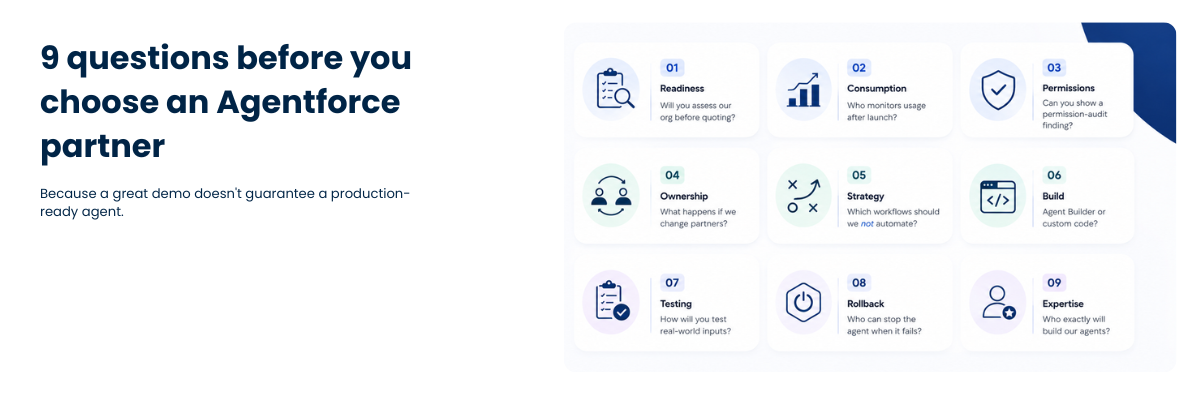
Nine questions to ask before you sign
These are the questions we would ask if we were sitting on your side of the table. Each one has an answer that tells you the partner has done this work before, and an answer that tells you they are learning on your budget. The difference is usually specificity.
1. Will you run a readiness assessment before quoting, or quote first?
Agentforce cost is driven by consumption, and consumption is driven by how many actions your workflows trigger. Nobody can know that number before looking at your org. A fixed price offered before anyone has opened your data model is a guess with a margin attached, and the margin exists because the partner is carrying risk they have not measured.
A good answer sounds like: a short paid discovery, two to three weeks, that produces a data quality report, a permission map and a consumption estimate with a range rather than a single number.
A weak answer sounds like: a firm price on the first call, or a free assessment that turns out to be a sales workshop with no written output.
2. Who owns consumption monitoring after go-live?
Flex Credits meter every action. A standard Agentforce action draws 20 credits and a voice action 30, so an agent that quietly starts running eight actions where it used to run three doubles your bill without a single new user. Somebody has to watch that, and the month you find out from an invoice is the month it has already happened.
A good answer sounds like: Digital Wallet configured before launch, a named person reviewing consumption weekly for the first quarter, and an agreed threshold that triggers a conversation.
A weak answer sounds like: “you will be able to see it in the dashboard.” That is true and it is not an owner.
3. How do you scope the permission audit, and can you show a sample finding?
An agent inherits the permissions of the context it runs in. If your permission model has drifted over five years of admin changes, and most orgs of that age have, the agent will surface records to people who should not see them, at machine speed, in writing.
A good answer sounds like: a redacted sample finding from real work. Partners who have run permission audits have examples they can show with the client details stripped out.
A weak answer sounds like: a description of a methodology. Anyone can describe a process. Findings come from having done it.
4. What happens to our agents if we change partners?
This is a fair question to ask politely at the start rather than angrily at the end. Agent definitions built in Agent Builder live in your org and stay with you. Custom Apex, undocumented prompt logic and orchestration held in a partner’s own tooling are a different matter.
A good answer sounds like: a clear statement of what is configuration in your org, what is custom code in your repo, and a commitment that prompt logic is documented in your instance rather than in their internal wiki.
A weak answer sounds like: reassurance that the question will never come up.
5. Which of our workflows would you tell us not to automate?
This is the single most useful question on the list, because it is the only one where the right answer costs the partner revenue. A partner who has watched an agent fail in production knows which workflows are a bad fit: the ones with ambiguous inputs, the ones where being wrong is expensive, the ones where the process is genuinely undecided and the agent would simply automate the confusion.
A good answer sounds like: two or three specific examples from your own process, named on the call.
A weak answer sounds like: “all of them are good candidates.” That is a sales position, not advice.
6. Agent Builder or custom code?
Both are legitimate. The question is whether the partner can explain the trade in your terms rather than theirs. Configuration in Agent Builder survives platform releases and can be maintained by your own admin. Custom code does things configuration cannot, and every line of it becomes a maintenance cost you carry after the partner has gone.
A good answer sounds like: a default of configuration, with custom code proposed only where a named requirement cannot be met otherwise, and an estimate of what maintaining it will cost you per year.
A weak answer sounds like: a custom build proposed before anyone has checked whether the standard capability covers it.
7. How do you test an agent before it touches a customer?
Traditional testing checks whether code does the same thing every time. An agent does not, which is the point of it. Testing an agent means testing a range of inputs, including the messy and the adversarial, and deciding in advance what an unacceptable answer looks like.
A good answer sounds like: a test set of real historical cases, an internal cohort using the agent before any customer does, and written pass criteria agreed with you rather than assessed by the partner alone.
A weak answer sounds like: “we test thoroughly.” Ask to see the test approach, not the assurance.
8. What is the rollback plan when an agent answers wrongly?
Not if, when. An agent will get something wrong in front of a customer, and the thing that separates an incident from a crisis is how quickly it can be stopped and who is allowed to stop it.
A good answer sounds like: a named kill switch, a named owner on your side who can use it without escalating, a defined path for the affected records, and a commitment on how the failure gets reviewed.
A weak answer sounds like: a support SLA. An SLA tells you when somebody will reply. It does not tell you who turns the agent off.
9. Which Agentforce credentials does the team hold, and who specifically is on our project?
Partner tier is a company attribute. It reflects volume and revenue across every client the firm has, and it tells you almost nothing about the four people who will actually build your agents. Credentials sit with individuals, and individuals get reassigned.
A good answer sounds like: named people, their certifications, the Agentforce work they have personally delivered, and a written commitment that a change of team is a change you get told about.
A weak answer sounds like: a badge on a slide and a promise that the whole team is certified.
Red flags in an Agentforce proposal
None of these is proof of a bad partner on its own. Each one is worth putting directly to the Agentforce implementation partner in front of you before the commercial conversation goes further, because the explanation is usually more revealing than the flag.
- A fixed price with no readiness assessment in scope. Either they have priced risk they cannot see, or they intend to raise it later through change requests.
- No mention of Flex Credits or consumption anywhere in the commercial section. The build is a one-off cost. Consumption is the cost you carry every month afterwards, and a proposal that ignores it has left out the larger number.
- “We will automate your entire service desk” as phase one. Scope like this fails in a way that is hard to recover from, because when it goes wrong you cannot tell which part went wrong.
- No permission audit line item. The agent inherits whatever your permission model currently allows, including the parts nobody has looked at since 2019.
- No named rollback owner or kill switch. If the proposal cannot say who stops the agent, the answer in practice is a support ticket.
- Agent design with no grounding strategy for your data. An agent with no defined sources will answer from whatever it can reach, confidently, and you will find out from a customer.
- Success measured in agents deployed rather than in a business number. Six agents live is an output. Handle time, resolution rate or quote turnaround is an outcome, and only one of those is worth paying for.
What to get in writing before you sign
Most disputes we see later trace back to something that was agreed verbally and never written down. This is the short list worth insisting on in the statement of work, whoever you choose.
| What to ask for | Why it matters later |
|---|---|
| The readiness findings as a written document | It becomes the baseline you measure the build against, and the record of what was known at the time |
| A consumption estimate with a stated range and the assumptions behind it | You can check the assumptions against reality after month one instead of arguing about the total |
| The business metric each agent is meant to move | Without it, phase two gets scoped on enthusiasm rather than on results |
| Named team members and a notice clause if they change | Credentials belong to people, not to the logo on the proposal |
| Prompt logic and agent documentation stored in your org | It is the difference between switching partners and rebuilding |
| A named kill switch owner on your side | It turns a live incident into a decision somebody is allowed to make |
| Stopping conditions for the pilot, agreed before it starts | Both “this worked” and “this did not” have to be permitted outcomes, or the pilot is theatre |
What a realistic first engagement looks like
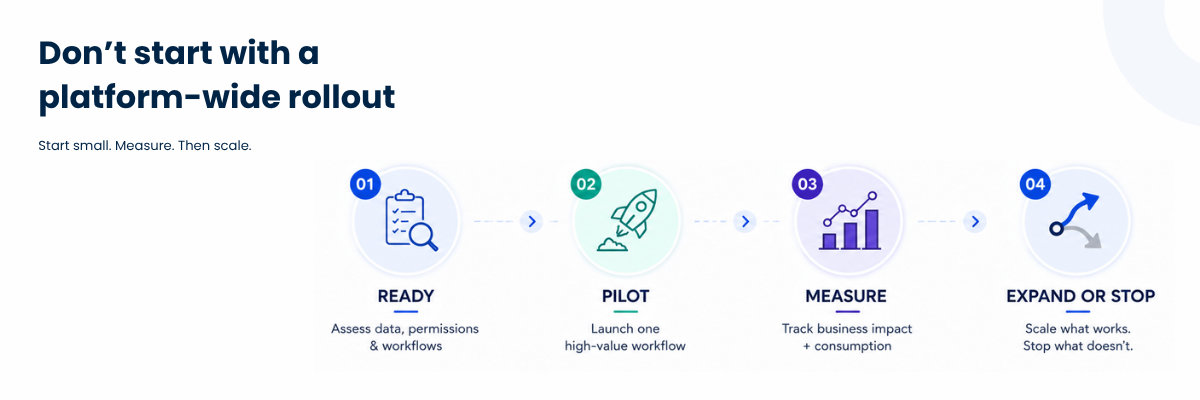
Phase 0: Readiness. Data quality assessment, permission model review, and a shortlist of workflows worth automating. Output is a go or no-go with reasons, not a proposal.
Phase 1: One workflow pilot. A single agent, a defined user group, and a measurement plan agreed before build. Consumption tracked from day one.
Phase 2: Measure. Against the metric agreed in phase 1, not against a demo.
Phase 3: Expand, or stop. Both are valid outcomes. A partner who cannot describe the conditions under which they would recommend stopping has not thought about it.
Platform-wide rollouts as phase one are how pilots become write-offs. Our Agentforce readiness checklist covers what phase 0 should actually test.
Where our Agentforce experience comes from
We are a certified Salesforce implementation partner, based in Irving, Texas with a delivery team in Ahmedabad, working since 2012. Our work as an Agentforce implementation partner sits alongside Zoho, Microsoft Dynamics and Odoo certifications, which means we are able to tell you when Agentforce is not the right tool for the job.
Our most recent Agentforce work was for a custom furniture retailer selling to both consumers and trade accounts. We embedded an Agentforce agent directly into the quote workflow, grounded on Data 360 (formerly Data Cloud), so it could recommend complementary pieces, surface saved room inspirations, and check live production timelines from their Odoo ERP before committing a date.
What the project involved:
- Salesforce Sales Cloud and CPQ with configurable furniture bundles
- Agentforce agent embedded in the quote workflow
- Data Cloud for behavioural tracking and unified customer profiles
- Service Cloud Omnichannel across WhatsApp, email and SMS
- Adobe Commerce and Odoo ERP integrations
Migration scale and results:
- 120,000+ contacts migrated
- 85,000+ custom orders unified
- 200,000+ email activities and 40,000 support tickets brought across
- Quote build time reduced from 45 minutes to under 10 minutes, a 78% improvement
- Zero data loss through the migration
The full write-up is here: Salesforce CPQ and Agentforce for a custom furniture retailer.
We have also written up what Agentforce does and does not automate in sustainability reporting, which is a useful read if you are weighing up where an agent earns its keep.
Ashapura Softech
2201 W Royal Ln, Irving, Texas 75063
+1 214-935-9893
Certified Salesforce implementation partner. Founded 2012.
Before you shortlist partners, it helps to know which agent you want first. See our breakdown of Agentforce use cases by team, including Agentforce Contact Center and Voice.
Related: agents are only as good as the data they can reach. Our Salesforce integration guide covers the methods for connecting Salesforce to ERP, marketing and support systems before an Agentforce rollout.
If the project is a wider Salesforce rollout, such as Sales Cloud, Service Cloud or a data migration, our guide to choosing a Salesforce implementation partner covers that evaluation in more detail.
Frequently asked questions
Is an Agentforce consultant the same as an implementation partner?
Not always. An Agentforce consultant is usually engaged for advice: a readiness review, a second opinion on a proposal you have been sent, or a single architecture decision. An implementation partner takes the build and the consumption monitoring as well. Agentforce consulting on its own is often the cheaper first step if you are still deciding whether a workflow is worth automating at all.
Do we need a partner at all, or can we do this in-house?
If you have a Salesforce admin with capacity, clean data and an appetite to own consumption monitoring, a small internal pilot is reasonable. The work that usually needs an Agentforce implementation partner is the permission audit and the integration grounding, because those are the parts that fail quietly.
How long before an Agentforce pilot shows results?
That depends entirely on whether phase 0 finds your data ready. Where readiness work is needed first, the pilot starts after it, not alongside it. Any partner quoting a result date before looking at your data is guessing.
What does an Agentforce readiness assessment include?
Data quality against the fields the agent will read, a permission and sharing model review, a shortlist of candidate workflows, and an estimate of consumption for each. See our readiness checklist.
Is Agentforce included in our Salesforce licence?
No. Agentforce is metered separately through Flex Credits or per-conversation pricing on top of your existing licences, as Salesforce sets out in its Agentforce pricing documentation. The pricing breakdown covers the four billing mechanisms.
Can a partner help reduce Flex Credit consumption?
Yes, mostly through agent design rather than negotiation. Narrower topic scope, fewer reasoning hops, and better grounding all reduce spend per interaction.
What is the difference between Agentforce and Claudeforce?
Agentforce is Salesforce’s agent platform. Claudeforce is the Salesforce and Anthropic partnership that puts Salesforce data inside Claude and makes Claude the default model in Agentforce surfaces. We covered the distinction in our Claudeforce breakdown.
Can you work alongside our existing Salesforce partner?
Yes. We are often brought in for a specific layer, such as the integration or the readiness work, alongside an incumbent.
Partner selection also comes down to delivery model, and how many hours of your day the team actually overlaps. We break down onshore, nearshore and offshore in choosing a Salesforce consulting partner.
If you already run Einstein Bots, see how the Einstein Bots to Agentforce auto-convert works before you choose a partner.
Editions note, September 2026: since Agentforce is now bundled into the Core, Advanced and Max editions, partner selection and edition selection are the same conversation. Our breakdown of the new Salesforce editions and what they include covers the pricing and the Flex Credit allocations.
Related reading: if commerce is in scope, the systems side matters as much as the partner side. Our ERP and CRM readiness checklist for Claude Commerce Agents covers the connector landscape platform by platform.
One thing to check before scoping a build: the prebuilt sales skills released under AIforce may already cover part of what you were planning to configure from scratch. The AIforce announcement breakdown lists what ships ready to use.
Before scoping a custom build, check the seven named agents against your requirement list. Some of it may already ship configured.