
Last updated: 15 October 2026
Short answer
Salesforce Koa is Salesforce’s first CRM reasoning model. It is NVIDIA Nemotron 3 Super, post-trained by Salesforce on synthetic CRM scenarios, and it runs inside Salesforce’s own trust boundary. Koa is built to help Agentforce agents pick the right action on multistep work like qualifying a lead or routing a case. Today it is limited to pilot customers. General availability is expected in winter 2026 in US regions, and pricing has not been announced.
Salesforce announced a lot at Dreamforce ’26, and Koa got less attention than Claudeforce or Agentforce Coworker. For admins and architects, though, it may be the announcement with the most day-to-day impact. Koa changes a question most teams never had to ask: which model should sit behind each of our agents?
This guide covers what Salesforce Koa is, how it was built, what Salesforce claims it does better, the three places it will show up in your org, and a practical checklist for getting ready before general availability. Where Salesforce has not published something yet, such as pricing, we say so instead of guessing.
What is Salesforce Koa?
Koa is a large language model that Salesforce trained specifically for CRM work. Salesforce describes it as a “CRM reasoning model” for Agentforce agents. Its job is not to write marketing copy or summarize long documents. It is meant to reason through tasks that involve several steps and several tool calls, such as updating an opportunity, routing a case to the right queue or scheduling a follow-up after a call.
Salesforce first showed Koa on 15 September 2026 at Dreamforce, as part of a wider announcement with NVIDIA. On 13 October 2026, Salesforce’s Chief Data Officer Michael Andrew gave more detail on how it was trained in a Salesforce newsroom interview.
Salesforce Koa at a glance
| Item | What we know (October 2026) |
|---|---|
| Announced | 15 September 2026, Dreamforce ’26 |
| Base model | NVIDIA Nemotron 3 Super (120B total parameters, 12B active, up to 1M token context) |
| Training data | Synthetic scenarios modeled on Salesforce CRM deployments across 14+ industries. Salesforce says no customer data was used. |
| Where it runs | Salesforce infrastructure. Salesforce controls the model weights. |
| Status | Pilot customers only, inside Agentforce |
| General availability | Expected winter 2026, US regions, with an open beta planned shortly after |
| Pilot customers named | 1-800Accountant, Baxter Credit Union, Engine, Formula 1, UChicago Medicine, Xero |
| Pricing | Not announced |
How Salesforce Koa was built
Salesforce did not train Koa from scratch. It started with NVIDIA Nemotron 3 Super, an open model NVIDIA released in March 2026. Nemotron 3 Super is a hybrid design that mixes Mamba-2 layers, mixture-of-experts layers and a small number of attention layers. Only about 12 billion of its 120 billion parameters are active for any one request, which keeps it cheaper to run than a dense model of the same size.
Salesforce then post-trained it in two stages:
- Supervised fine-tuning. The model learned from worked examples of CRM tasks done correctly.
- Reinforcement learning with GRPO. The model practised tasks in simulated environments and was rewarded for choosing the right tools and actions. Salesforce used NVIDIA’s NeMo RL, NeMo Gym and NeMo AutoModel tooling for this.
The training scenarios are synthetic. Salesforce built them from what it has learned running CRM deployments for close to three decades, across manufacturing, financial services, healthcare, travel and other industries. That matters for two reasons. First, it is why Salesforce can say no customer data went into training. Second, it is the main open question: synthetic scenarios are only as good as how closely they match messy real orgs, with their custom objects, half-used fields and years of validation rules.
What Salesforce Koa does better, according to Salesforce
Salesforce tested Koa on its own CRM benchmark, which it calls CRM Bench. The tasks are everyday CRM actions: updating an opportunity, routing a case, scheduling a follow-up. Here is what Salesforce reports.
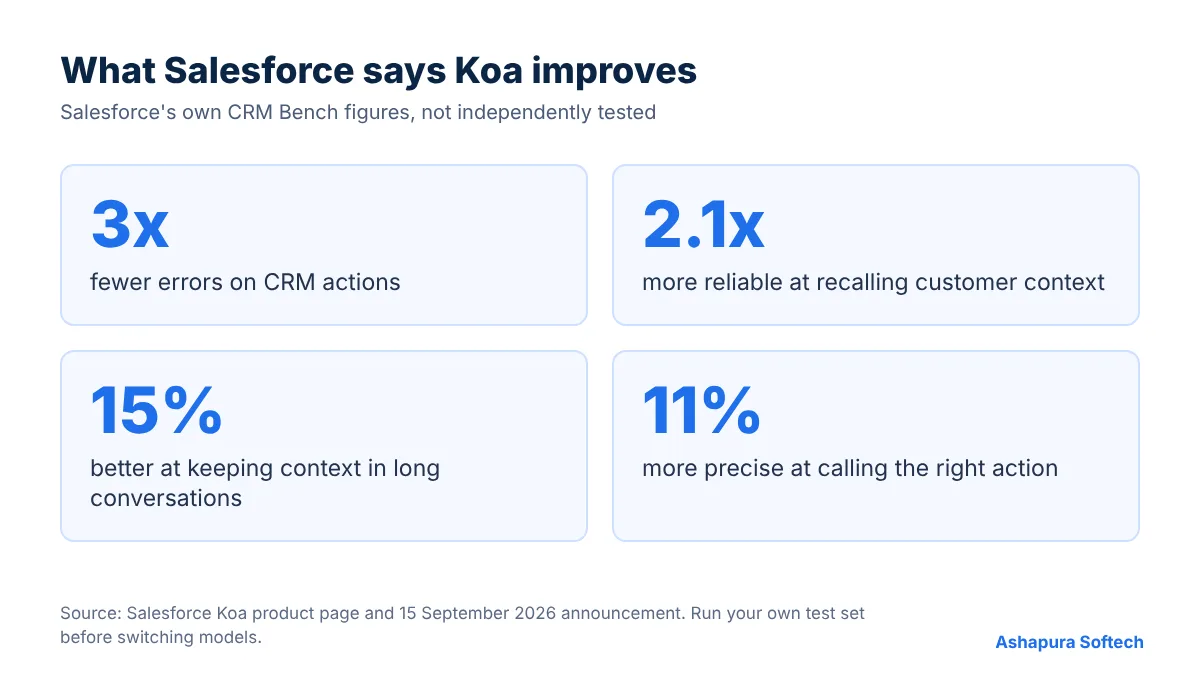
- 3x fewer errors on CRM actions, while matching or beating leading models
- 11% more precise at calling the right action, compared with default general-purpose models
- 2.1x more reliable at recalling customer context
- 15% better at keeping context across long back-and-forth conversations
Treat these as a reason to test Salesforce Koa, not as proof. Salesforce has not published the full benchmark, named the models it compared against for the “3x” figure, or shared independent results. Koa also runs at temperature 0, which means it gives the same answer to the same input. That is good for audit and repeatability, and it is one reason a model can look more reliable on structured tasks.
What we find most useful in these numbers is where the gains are. They are all about choosing actions and holding onto context. That lines up with the failures we see most often when teams pilot agents: the agent picks the wrong flow, updates the wrong record, or forgets what the customer said three turns earlier.
How to access Salesforce Koa in your org
According to the Koa product page, Salesforce Koa will be available in three places. All three are opt-in.
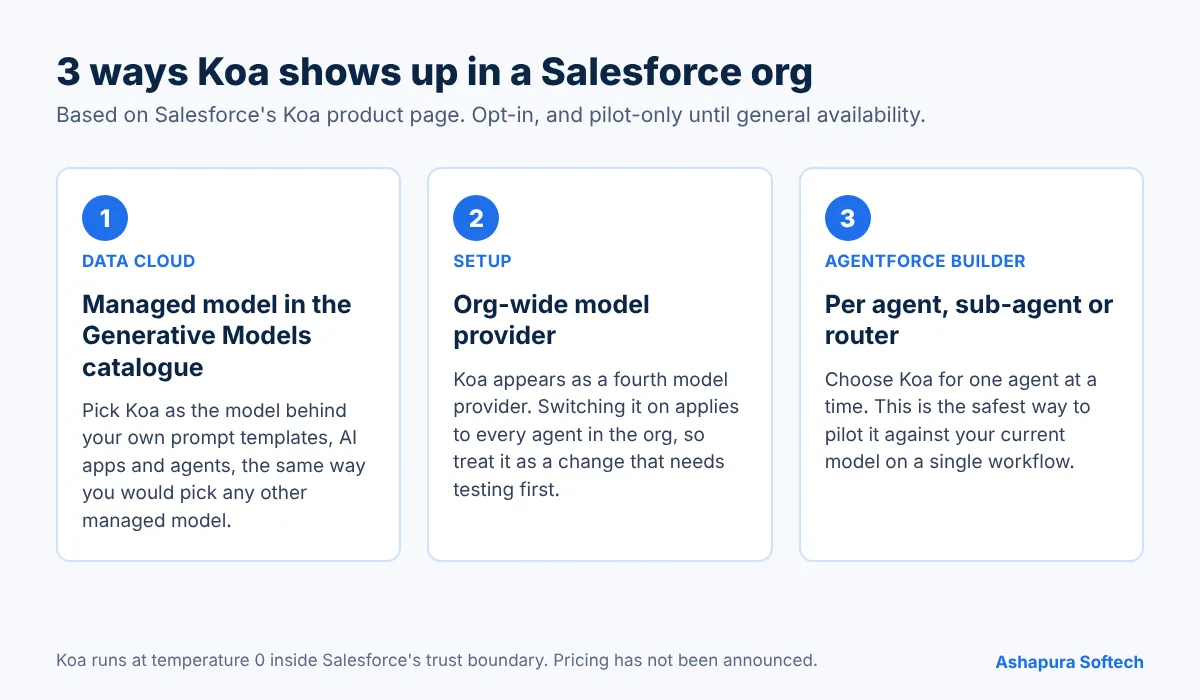
- Data Cloud Generative Models catalogue. Koa is listed as a managed model you can choose for prompt templates, AI apps and agents.
- Org-wide, in Setup. Koa appears as a fourth model provider. Turning it on here affects every agent in the org.
- Per agent, in Agentforce Builder. You can choose Koa for a single agent, sub-agent or agent router.
Our advice is to start with option 3. Switching the whole org to a new model in one step makes it hard to tell which change caused a problem. Running Salesforce Koa on one agent, next to an unchanged copy on your current model, gives you a clean comparison.
One note of caution: the product page also describes Koa as available “out of the box” in the Data Cloud catalogue, while the same page and the press release say it is pilot-only until general availability. If you do not see Koa in your org yet, that is expected. Check with your Salesforce account team if you want to join the pilot.
Salesforce Koa vs Claudeforce vs your current Agentforce model
Salesforce Koa arrives at the same time as Claudeforce, and the two are easy to confuse. They solve different problems.
| Salesforce Koa | Claudeforce | Default Agentforce models | |
|---|---|---|---|
| What it is | Salesforce’s own CRM reasoning model | Salesforce and Anthropic partnership: Salesforce in Claude, plus Claude inside Salesforce | General-purpose models from partner providers |
| Best at | Picking the right CRM action on multistep tasks | Working with Salesforce data from Claude, broad reasoning and writing | Broad tasks: summaries, drafting, Q&A |
| Where it runs | Salesforce infrastructure, Salesforce-controlled weights | Anthropic models through the Salesforce trust layer | Provider models through the trust layer |
| Status | Pilot, GA expected winter 2026 (US) | Salesforce in Claude in beta | Generally available |
| Pricing | Not announced | Depends on Claude plan and Salesforce usage | Through your Agentforce and Flex Credits agreement |
In practice, many orgs will end up using more than one. A service agent that routes and updates cases might run on Koa, while a sales rep drafts emails and reviews pipeline in Claude. Our Claudeforce vs Agentforce comparison explains how those two layers fit together.
Should you switch your agents to Salesforce Koa?
Not yet, for most orgs, simply because you cannot until general availability. The better question is which agents are good candidates once you can. Based on what Salesforce has published, Salesforce Koa looks like a strong fit when:
- The agent’s main job is taking actions in Salesforce, not writing long text
- Each task needs two or more tool calls in the right order, such as look up the account, check entitlements, then route the case
- Wrong actions are costly, for example a case sent to the wrong queue or an opportunity stage changed by mistake
- Conversations run long and the agent keeps losing earlier details
- Your security team prefers a model whose weights stay inside Salesforce
It is a weaker fit, or at least unproven, for open-ended writing, analytics questions across large datasets, and work outside the CRM. For those, a frontier model such as Claude may still be the better choice.
How to get your org ready for Salesforce Koa: a 6-step checklist
None of these steps depends on Koa pricing or release dates, so you can start now. They also improve your current agents, whichever model you use.
- List every agent and the model behind it. Include Agentforce agents, prompt templates, any Einstein features and any Claude or OpenAI connections. Many teams have never written this down.
- Pick two or three action-heavy workflows. Lead qualification, case routing and opportunity updates are the obvious ones. These are where Koa’s claimed gains apply.
- Build a test set from real cases. Collect 30 to 50 real examples per workflow, with the correct outcome for each. Strip out personal data. This is the only way to check Salesforce’s benchmark against your own org.
- Tighten permissions before you add any model. Review the permission sets, sharing rules and field-level security your agents run under. A more capable model with over-broad access is a bigger risk, not a smaller one. Our Agentforce readiness checklist covers this in detail.
- Set your pass and fail rules. Decide in advance what error rate is acceptable, when the agent must hand over to a person and what you need logged for audit.
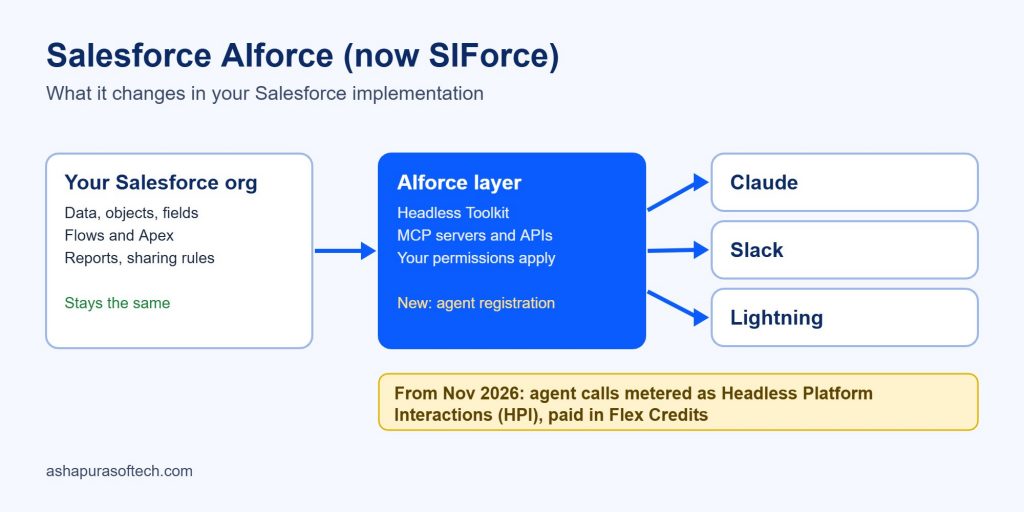
- Plan for cost uncertainty. Salesforce has not said whether Koa will cost more or less than current models. If you are on Flex Credits, track credit use per agent now so you can compare once Koa pricing is public. Agent calls from outside Salesforce are also getting a new meter, which we explain in our guide to AIforce (now SIForce) and your implementation.
Salesforce Koa timeline
- 11 March 2026: NVIDIA releases Nemotron 3 Super, the base model for Koa
- 15 September 2026: Salesforce announces Koa at Dreamforce ’26
- October 2026: Post-trained NVIDIA models reach select Missionforce customers. Salesforce shares more training detail on 13 October.
- Now: Koa available to select pilot customers in Agentforce
- Winter 2026: General availability expected in US regions, followed by an open beta
Planning an Agentforce rollout? We help US teams pick the right workflows, set up permissions and test agents before they go live. Book a free 30-minute consultation and we will review your current agents with you.
Related guides
- Dreamforce 2026: what Salesforce shipped: every major announcement in one place
- What is AIforce?: the platform layer Koa sits alongside
- Agentforce Coworker: the AI teammate inside Lightning
- Agentforce named agents: the prebuilt agents Salesforce ships
- Salesforce Missionforce: where Nemotron-based models go for government
- Choosing an Agentforce implementation partner
Frequently asked questions
What is Salesforce Koa?
Koa is Salesforce’s first CRM reasoning model. It is NVIDIA Nemotron 3 Super, post-trained by Salesforce on synthetic CRM scenarios, and it is designed to help Agentforce agents choose the right actions on multistep CRM tasks.
When will Salesforce Koa be generally available?
Salesforce expects general availability in winter 2026 in US regions, with an open beta to follow. Until then it is limited to select pilot customers.
Is Koa trained on customer data?
No, according to Salesforce. Koa was trained on synthetic scenarios built from Salesforce’s experience with CRM deployments, and Salesforce says no customer data crosses its trust boundary during training or inference.
How much does Salesforce Koa cost?
Salesforce has not announced Koa pricing. If you use Flex Credits today, track credit use per agent so you can compare costs once pricing is published.
Is Salesforce Koa the same as Claudeforce?
No. Koa is Salesforce’s own model, running on Salesforce infrastructure. Claudeforce is Salesforce’s partnership with Anthropic that brings Salesforce data into Claude and Claude into Salesforce. Many orgs may use both for different jobs.
How do I turn on Koa in Agentforce?
Once it is available to your org, you will be able to choose Koa per agent in Agentforce Builder, set it as an org-wide model provider in Setup, or pick it from the Data Cloud Generative Models catalogue. We recommend testing on one agent first.
The bottom line
Salesforce Koa is the company’s bet that a smaller model trained on CRM work can beat general models at the jobs agents actually do inside Salesforce. The claims are promising but come only from Salesforce so far, and there is no price yet. The smart move now is not to wait. Map your agents, pick the action-heavy workflows, build a real test set and fix permissions. When Salesforce Koa reaches general availability, you will be able to test it in days instead of months.
How we put this guide together
Product facts in this guide come from Salesforce’s 15 September 2026 Koa press release and its Koa product page, with base model details from NVIDIA’s Nemotron 3 Super model card. Benchmark figures are Salesforce’s own and are labeled that way. Pricing, Koa’s exact place in Agentforce packaging and independent test results were not public at the time of writing, so we have not guessed at them. We will update this page when Koa reaches general availability.
Sources: