For two years Agentforce was something you built. You picked a topic, wrote instructions, wired up actions, tested it, and hoped the thing behaved in production. At Dreamforce in September 2026 Salesforce changed the starting point: seven named agents that arrive already configured for a specific job, six of them generally available on day one.
That shift is bigger than the names suggest. A prebuilt agent is an opinion about how a job should be done, baked into software. It will fit some orgs closely and fight others. This guide goes through all seven, what each one is actually scoped to do, which cloud it needs, what is shipping today versus later, and where we would not use it.
The seven Agentforce named agents at a glance
| Agent | Job it does | Where it lives | Status |
|---|---|---|---|
| Casey | Customer service resolution across voice, SMS, WhatsApp and web chat | Service Cloud | GA now |
| Paige | IT and HR service requests through Slack and employee portals | Employee Experience | GA now |
| Carter | Product discovery, comparison and checkout help for shoppers | Commerce Cloud | GA now |
| Piper | Inbound lead engagement and qualification across web and email | Sales and Marketing | GA now |
| Fin | Complex customer experience workflows spanning channels | Customer Operations | GA now |
| Marshall | Back office process orchestration with deterministic execution | Back Office | GA now |
| Hunter | Outbound pipeline, from research through to outreach | Sales Cloud | Pilot now, GA expected November 2026 |
1. Casey: the service agent that finally covers voice
Casey handles customer service issues end to end across voice, SMS, WhatsApp and web chat. The channel spread is the part worth noticing. Most deflection projects we see start and stop at web chat, because chat is where the transcript is clean and the integration is easy. Voice is where the volume and the cost actually sit, and voice is where a handover to a human has always been ugly.
What Casey is good at: repeat, policy driven questions where the answer exists in a knowledge article or a record. Order status, appointment changes, password and access issues, returns inside policy.
What it does not remove: the need for a clean knowledge base. An agent that reads bad articles gives confident bad answers faster than a human would. If your knowledge base has not been audited in a year, that audit is the first project, not the agent.
2. Paige: employee service, where the ROI case is easiest
Paige answers IT and HR service requests inside Slack and employee portals. Of the seven, this is the one with the least risk attached, because the audience is internal. A wrong answer to an employee costs a follow up ticket. A wrong answer to a customer costs the customer.
That makes Paige a sensible first deployment even for an organisation whose real target is customer facing automation. You get the operating experience, the prompt tuning habits and the escalation design without putting revenue on the line while you learn.
3. Carter: commerce assistance, not a storefront replacement
Carter works inside Commerce Cloud on product discovery, comparison and checkout assistance. It is the agent most often confused with something it is not. Carter does not replace your storefront, your catalogue structure or your merchandising rules. It sits on top of them, and it inherits their quality.
If product data is thin, if attributes are inconsistent between categories, or if the same item appears three times under different SKUs, Carter surfaces those problems to shoppers rather than hiding them. Catalogue hygiene is the prerequisite. We cover how that data flows in our guide to Salesforce ecommerce integrations.
4. Piper: inbound lead qualification
Piper engages and qualifies inbound leads across websites and email. The job is speed to lead and consistency of questioning, two things humans are reliably bad at on a Friday afternoon.
The caution here is qualification criteria. Piper applies whatever definition of a qualified lead you give it, at scale, without the quiet human correction that normally happens in the background. If your MQL definition has drifted from what sales will actually accept, an agent will expose that gap within a week. Fix the definition before you automate it.
5. Fin: the cross channel workflow agent
Fin is scoped to complex customer experience workflows that span channels, which is the vaguest brief of the seven and also the most interesting. Think of the cases that start in chat, move to email, require a back office action and end with an outbound confirmation. Those are the ones that fall through today, because no single team owns them end to end.
Fin is worth evaluating if your complaint volume is driven by process breakage rather than by product problems. It is not worth evaluating if your handoffs are undocumented, because there is nothing for it to follow.
6. Marshall: deterministic back office execution
Marshall orchestrates back office processes with what Salesforce calls deterministic execution. That word matters. Most of the anxiety around agents in finance and operations comes from non determinism: the same input producing a different sequence of steps on different days. Marshall is positioned as the answer to that, running defined processes in a defined order rather than reasoning its way to an outcome.
Where this fits: invoice handling, order processing, fulfilment exceptions, reconciliation steps that today sit in a spreadsheet and a person’s head. Where it does not: anything where the process itself is undefined. Marshall executes a process, it does not design one for you.
7. Hunter: outbound pipeline, and the one that is not GA yet
Hunter covers outbound sales pipeline from account research through to outreach, and it is the only one of the seven still in pilot, with general availability expected in November 2026. It is also the agent that debuts long horizon runtime, which is the genuinely new platform capability in this release.
Long horizon runtime means an agent can pursue a goal across days and weeks rather than inside a single session. It preserves memory between runs, survives interruption through durable execution, and can be steered mid flight without being restarted. For outbound that is the difference between a sequence and a campaign that adapts.
It is also the capability that deserves the most governance attention. An agent working a goal for three weeks accumulates three weeks of decisions nobody reviewed individually. Decide in advance what it is allowed to send, to whom, and what it must escalate.
What shipped alongside the agents
Three platform pieces came with the agent portfolio and change how the seven are used together.
Multi agent orchestration is generally available now, and routes work across the specialised agents so they operate as a team rather than seven separate deployments. This is what stops Casey and Fin from both claiming the same case.
AI Skills in Agentforce Coworker lets an employee teach a task once and have it reused across the workforce. It is in pilot now with general availability expected in October 2026.
Agent Optimizer covers building, refining, testing and analysing agent performance across the lifecycle, with general availability expected in October 2026. Until it lands, measurement of agent quality is still something you assemble yourself.
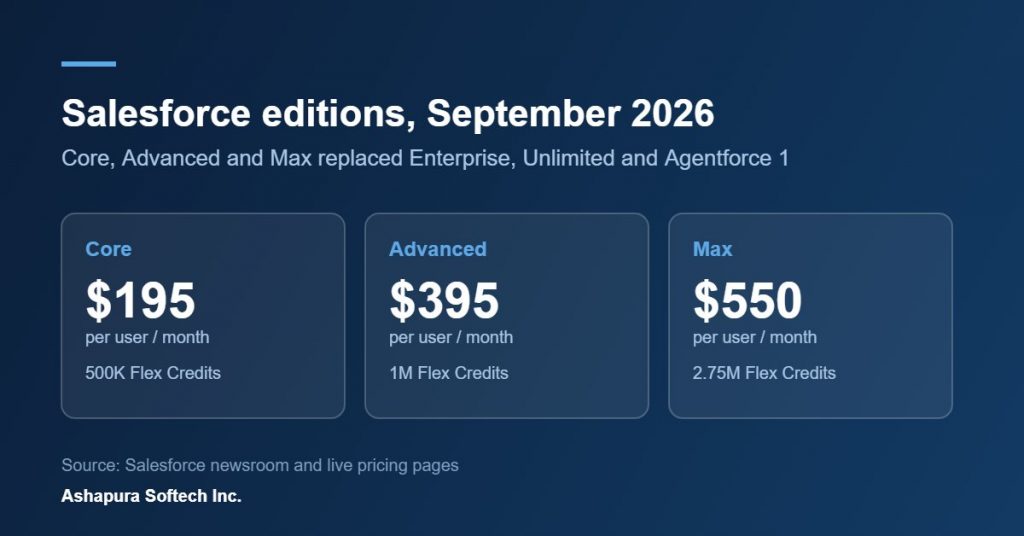
All of this sits inside the wider announcement Salesforce made at Dreamforce. If you want the commercial side, including which Flex Credit allowance comes with which tier, start with what AIforce actually changed and the Core, Advanced and Max editions.
When a named agent is the wrong answer
Four situations where we would tell a client to wait.
The underlying data is not trustworthy. Every one of these agents reads your records and your content. Duplicate accounts, stale knowledge articles and half migrated product data do not get smoothed over by an agent, they get amplified and put in front of a customer.
The process is undocumented. Marshall and Fin in particular assume a process exists. If the answer to “what happens next” depends on which person picks it up, an agent has nothing to follow.
Your volume is low. An agent earns its keep on repetition. A team handling forty cases a week will spend more effort tuning than it saves.
The job is judgement, not throughput. Complaint escalations that involve goodwill decisions, a renewal conversation with an unhappy account, anything with a legal or clinical dimension. Those stay human, with the agent doing preparation rather than resolution.
How to choose which one to turn on first
The order we recommend, and the reasoning behind it.
Start with Paige if you have an internal service desk. Lowest blast radius, fastest feedback loop, and the operating habits transfer directly to the customer facing agents afterwards.
Start with Casey if service cost is the board level number. It is the only one of the seven that touches voice, which is usually where the cost sits.
Start with Piper if speed to lead is the bottleneck. Measure current first response time before you deploy, because this is the one agent whose effect shows up in a single clean metric.
Wait on Hunter unless you are comfortable in a pilot. General availability is expected in November 2026, and long horizon runtime is new enough that early deployments are learning exercises as much as productivity ones.
Whichever you pick, scope one job, instrument it, and run it for a month before adding a second. Teams that switch on four agents at once cannot tell which one caused the change in their numbers.
What this means for existing Agentforce builds
If you already built custom agents, the named agents do not obsolete them, but they should prompt a review. Anything you built that maps closely to one of the seven jobs is now maintenance you may not need to carry. Anything you built that is specific to your business, your products or your regulatory position is exactly what should stay custom.
The practical exercise is to list your current agent topics against the seven and mark each as replace, keep or merge. Our Agentforce readiness checklist covers the questions to ask before either path, and the implementation partner guide covers how the delivery work is usually split.
Frequently asked questions
Are all seven Agentforce named agents available now?
Six are generally available: Casey, Paige, Carter, Piper, Fin and Marshall. Hunter is in pilot, with general availability expected in November 2026.
Do the named agents replace custom built Agentforce agents?
No. They cover common, well defined jobs. Anything specific to your products, your industry rules or your internal processes still needs to be built, and the two run alongside each other under multi agent orchestration.
Which licences do the named agents need?
Each sits inside a product area, so Casey needs Service Cloud, Carter needs Commerce Cloud and so on. Consumption is drawn from the Flex Credit allowance that comes with your edition, which means two organisations on the same edition can see very different usage. Confirm current entitlements with Salesforce or your account executive before budgeting.
What is long horizon runtime?
It lets an agent pursue a goal across days and weeks instead of within one session, by preserving memory between runs, surviving interruptions and accepting steering mid task. Hunter is the first agent to use it.
Where do we start if we have never deployed an agent?
With an internal use case, a documented process and a single measurable metric. Paige on an IT or HR service desk is the usual low risk starting point.
Talk to us about which agent fits
Ashapura Softech is a certified Salesforce partner working with teams in the United States on Service Cloud, Sales Cloud, Commerce Cloud and Agentforce delivery. If you want a view on which of the seven fits your org, and what would have to be cleaned up first, get in touch.