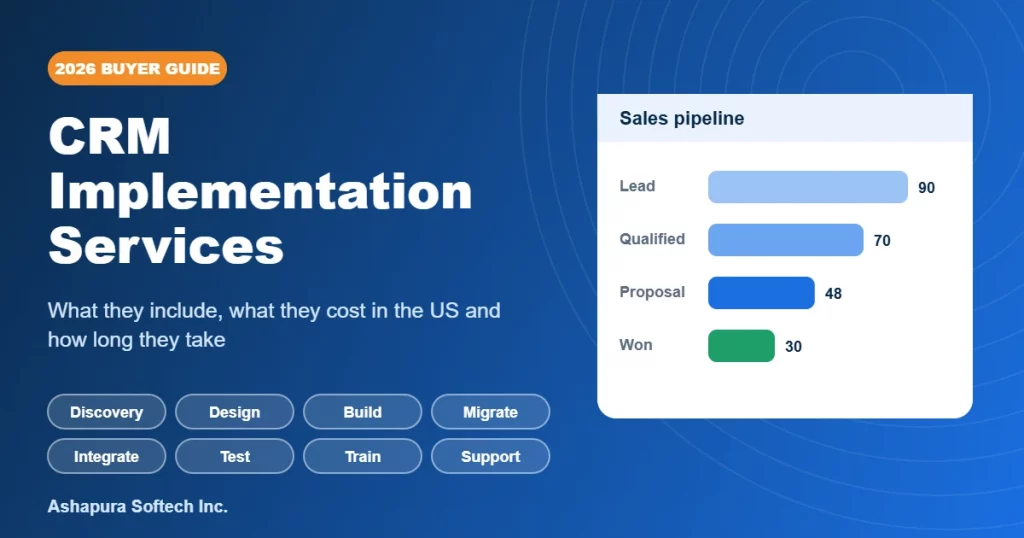


Short answer: CRM implementation services cover everything between buying a CRM and your team using it every day: planning, configuration, data migration, integrations, testing, training and support after go-live. In the US, a small and simple rollout usually costs about $5,000 to $20,000 and takes 6 to 10 weeks. A large, multi-team project can run $40,000 to $150,000 or more and take 4 to 9 months (Empat, 2026 guide). Where you land depends on user count, data quality, integrations and who does the work.
Last updated: 29 October 2026. By Ankur Pandey, Marketing Manager at Ashapura Softech Inc.
If you are about to hire a partner for CRM implementation services, the quotes you collect will probably look very different from each other. One firm says $12,000. Another says $45,000. Both can be honest. This guide explains what sits behind those numbers, so you can compare quotes properly instead of guessing which one is wrong.
We are a Salesforce and Odoo consulting firm based in Irving, Texas, with a development center in Ahmedabad, India, and we have worked with small and mid-size businesses since 2012. So yes, we sell CRM implementation services. I have tried to write this the way I would want it explained if I were the buyer: plain numbers, sources you can open, and the parts vendors usually skip.
What are CRM implementation services?
CRM implementation services are the professional work of getting a CRM live and useful in your business. The software is only one input. The rest is decisions and effort: how your sales process maps into the system, which data comes across, which tools it connects to, and how your people learn it.
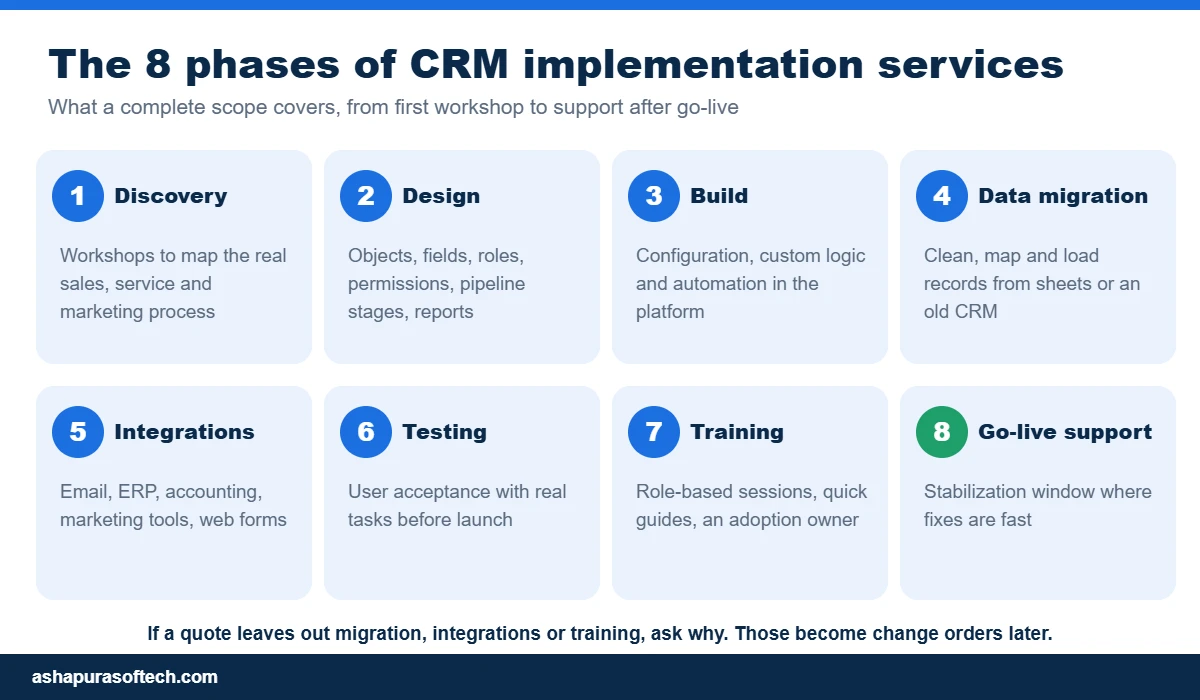
A decent scope usually includes these pieces:
- Discovery and requirements: workshops to map your real sales, service or marketing process, not the one on a slide.
- Solution design: objects, fields, roles, permissions, pipeline stages, reports.
- Configuration and customization: building the design in the platform, including automation.
- Data migration: cleaning, mapping and loading records from spreadsheets or an old CRM.
- Integrations: connecting email, ERP, accounting, marketing tools or your website forms.
- Testing and user acceptance: your team tries real tasks before launch.
- Training and change management: role-based sessions, quick guides, an owner for adoption.
- Go-live and support: a stabilization period after launch where fixes are fast.
If a quote leaves out data migration, integrations or training, ask why. Those are the items that most often show up later as change orders.
How much do CRM implementation services cost in the US?
There is no single price, because implementation cost is mostly hours multiplied by an hourly rate. Both numbers move with your project.
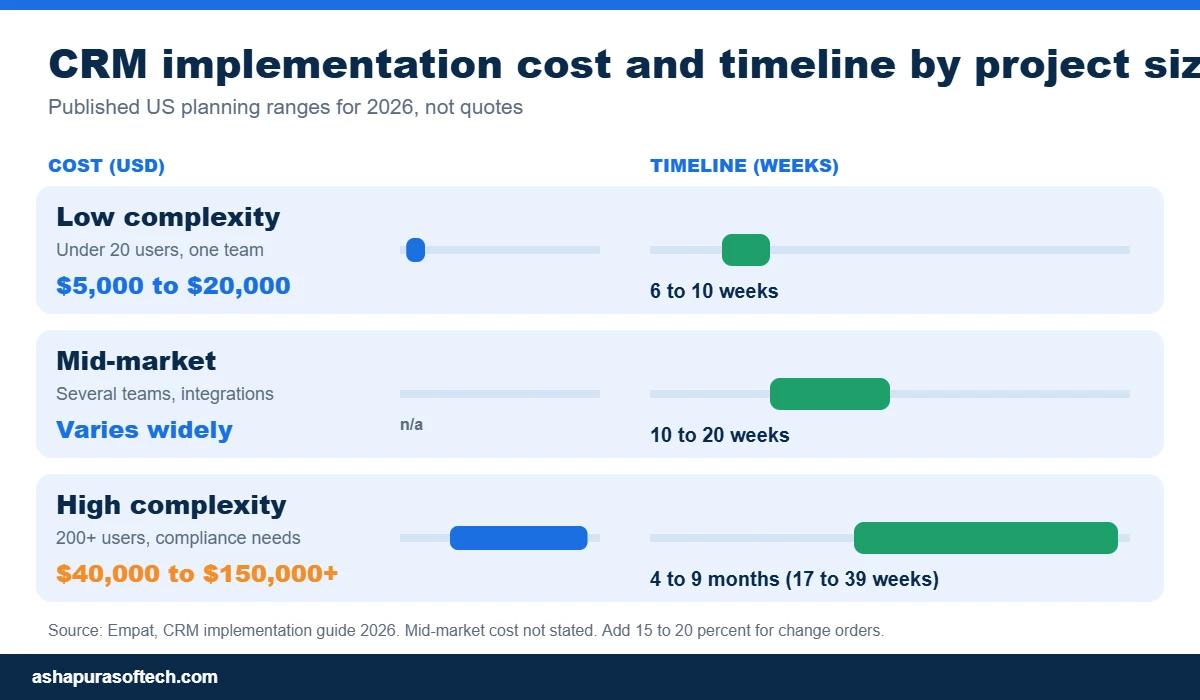
Here are published ranges from recent 2026 guides. Treat them as planning ranges, not quotes.
| Project type | Typical effort or size | Cost range | Typical timeline | Source |
|---|---|---|---|---|
| Small team, standard pipeline, one data import (Salesforce) | 60 to 150 hours | $6,000 to $37,500 at US partner rates | Not stated | The Frontkit |
| Low complexity | Under 20 users, one team | $5,000 to $20,000 | 6 to 10 weeks | Empat |
| Mid-market | Several teams, integrations | Varies widely | 10 to 20 weeks | Empat |
| High complexity | 200+ users, many departments, compliance needs | $40,000 to $150,000+ | 4 to 9 months | Empat |
Another rule of thumb from one implementation firm’s project history: for small and mid-size businesses, implementation tends to cost one to three times the first-year license bill, while mid-market projects run three to ten times (Ecosire). If a partner quotes a tiny fraction of your license cost for anything beyond a starter setup, the same source warns that scope is probably missing, often migration or integrations.
What drives the price
Hourly rate. Rates for Salesforce work in the US vary by role. One 2026 guide puts certified consulting partners at roughly $100 to $250 an hour and senior architects at $200 to $400 (Codleo). Offshore delivery rates are commonly 30 to 60 percent lower than US rates (Clientell), which is why many US firms, including us, deliver with a blended US and India team.
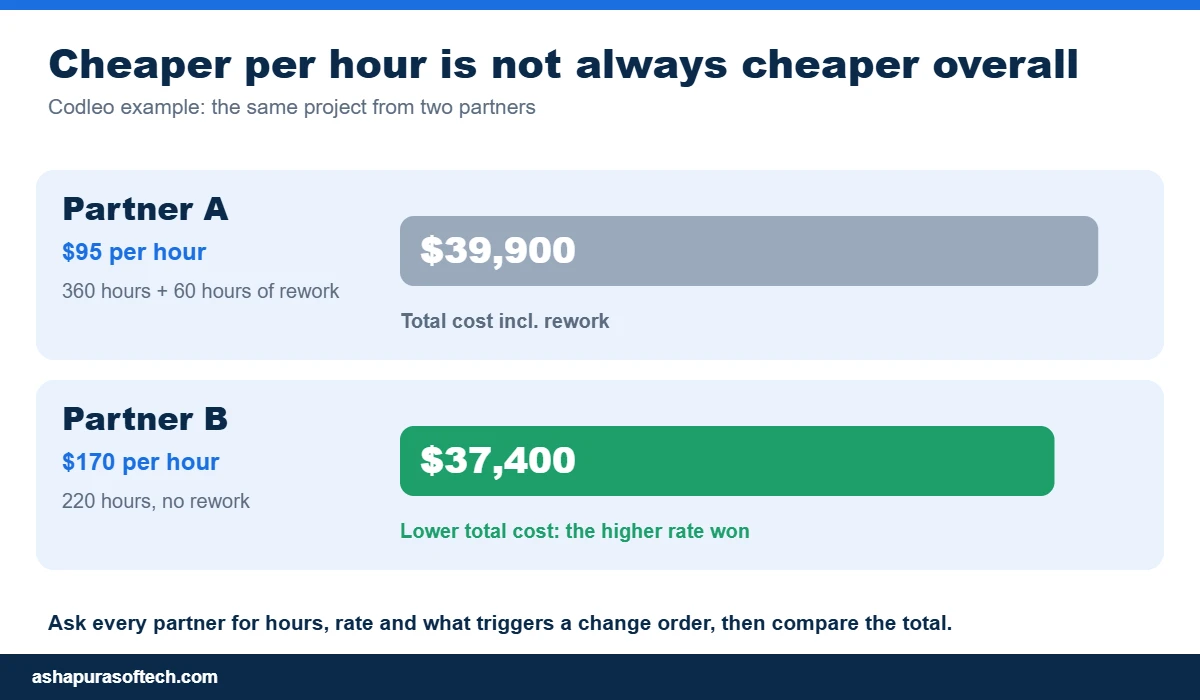
Cheaper per hour is not always cheaper overall. The Codleo guide gives a simple example. Partner A charges $95 an hour and estimates 360 hours plus 60 hours of rework after launch, for $39,900 in total. Partner B charges $170 an hour, estimates 220 hours and has no rework, for $37,400. The higher rate won.
Data quality. Messy data takes longer to clean and map. A spreadsheet with five years of duplicate contacts is a bigger job than a clean export from another CRM.
Number of integrations. Each connection to ERP, accounting, email or a marketing tool adds design, build and testing time. See our guide to Salesforce integration with other tools for what that involves.
Customization. Custom objects, approval flows and role-based logic cost more than standard setup.
Compliance and security. SSO, audit trails or industry rules add scope. Empat lists SOC 2, HIPAA or SSO requirements as a cost driver in the higher-complexity case.
Your own time. The same Empat guide says a mid-market project commonly takes 80 to 150 hours of internal staff time. That does not show up on the partner’s invoice, but it is real cost.
Budget a buffer
Requirements change once people see a working system. One 2026 cost guide suggests planning a 15 to 20 percent buffer for change orders on fixed-price projects (Clientell). I would add the buffer to your internal budget even if the quote says fixed price.
How long does CRM implementation take?
For most companies, one provider’s overview puts it at three to six months, with simple SaaS rollouts for small teams taking as little as a few days to a few weeks (Hauer Power). That matches the Empat ranges above.
What stretches a timeline in practice:
- Unclear goals at the start, which leads to scope creep.
- Data cleanup nobody owned.
- Slow feedback from your team during design and testing.
- Late integration requirements.
- Training squeezed in at the end.
A phased plan helps. Launch the core pipeline first, then add service, marketing or reporting in later phases. We scope projects in phases so clients can see results before committing to the next stage.
Why do CRM projects fail, and what does that mean for you?
You will see scary numbers online. One review of the research puts CRM implementation failure somewhere between 30 and 63 percent (LowCode Agency). Treat those with care. A DestinationCRM article on the topic quotes consultants arguing that the figures depend on how “failure” is defined, and that projects without agreed success metrics cannot be judged fairly either way (DestinationCRM).
So the practical lesson is not “most projects fail.” It is this: write down what success means before you start. Three or four measurable goals are enough, for example:
- Reps log calls and deals in the CRM, not in personal spreadsheets.
- Forecast reports come from the system, not a monthly manual rebuild.
- Leads get a first response within a set time.
- Duplicate records stay under an agreed level.
When a project drifts, it is usually for people reasons: nobody owns adoption, training is thin, or the system was built for managers’ reports and not for the daily work of the people entering data. Choose a partner who asks about those things in the first call. If your system is already live and has drifted, start with our free CRM health check.
Salesforce, Zoho, HubSpot or Odoo: does the platform change the services you need?
The phases are the same, but the effort is not. Salesforce is highly configurable, so more of the work is design decisions and admin setup. Zoho CRM often suits smaller teams that want lower license cost. Odoo makes sense when you want CRM and ERP in one system. The right choice depends on your process, your budget and how many tools you already run.
If you are still choosing, read our comparison of Zoho vs Salesforce CRM and the breakdown of Salesforce Core, Advanced and Max editions before you request quotes. Picking the wrong edition or platform is a more expensive mistake than picking a slightly pricier partner.
A scoping checklist before you ask for quotes
Send every partner the same brief. You will get quotes you can actually compare.
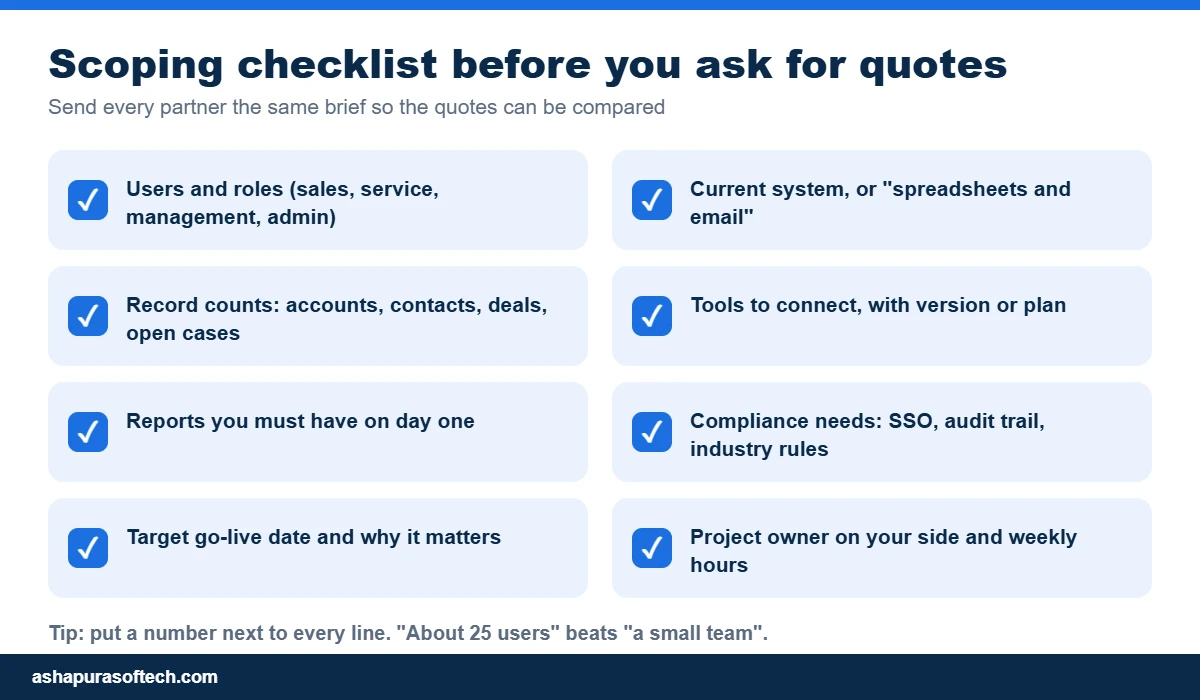
- Number of users and their roles (sales, service, management, admin).
- Your current system, or “spreadsheets and email.”
- Rough record counts: accounts, contacts, deals, open cases.
- Tools to connect, with the version or plan where you know it.
- Reports you must have on day one.
- Any compliance requirement (SSO, audit trail, industry rules).
- Your target go-live date and why it matters.
- Who on your side will own the project, and how many hours a week they can give.
Questions to ask a CRM implementation partner
- Can I see two or three projects similar to mine, with the outcome and timeline?
- Who will actually do the work, and where are they based?
- What is included in the fixed price, and what triggers a change order?
- How do you handle data migration, and who signs off on data quality?
- What does training look like, and is it role-based?
- What happens after go-live? How long is the support window, and what does it cost afterward?
- What do you need from my team each week?
Good partners answer these without hesitation. If the answers are vague, that tells you something.
How we approach CRM implementation services at Ashapura
We work in US hours from our Irving, Texas headquarters and deliver with a team in Ahmedabad. Typical engagements include new CRM rollouts, data migration, integrations, custom development and CRM health checks for teams whose system has drifted from how they actually work. You can see examples in our case studies, such as Salesforce implementation for a fleet management firm and Salesforce for a U.S. industrial supply business.
If you want a second opinion on a quote you already have, or a rough scope and budget range for your project, you can book a free 30-minute consultation. No pitch deck, just a conversation about your setup.
Frequently asked questions
How much do CRM implementation services cost?
For a small team with a simple setup, published 2026 ranges run from about $5,000 to $20,000. Large, multi-department projects with integrations and compliance needs can reach $40,000 to $150,000 or more. Your quote depends mainly on hours, hourly rate, data quality, integrations and customization.
How long does CRM implementation take?
Simple rollouts for small teams can take a few weeks. Mid-market projects often take 10 to 20 weeks, and complex ones can take 4 to 9 months. Clean data, clear goals and fast feedback from your team shorten the timeline.
What is included in CRM implementation services?
Most scopes include discovery, solution design, configuration, data migration, integrations, testing, training and go-live support. Always confirm in writing which of these a quote covers, since migration, integrations and training are the items most often left out.
Should I choose a fixed-price or hourly engagement?
Fixed price works when requirements are clear and stable. Hourly or time-and-materials suits projects where scope will evolve. Either way, ask what triggers a change order, and keep a 15 to 20 percent buffer for scope changes.
Why do CRM implementations fail?
Reported failure rates vary widely because failure is defined differently from study to study. The common causes are unclear goals, poor data, weak training and no owner for adoption. Defining success metrics before you start is the simplest protection.
Can a small business afford CRM implementation services?
Yes. A phased scope lets you launch the essentials first and add features later. Starting with a clean pipeline, basic automation and a tidy data import is often enough to begin, and you can expand once the team is using it.
Sources
- Empat: CRM implementation guide 2026
- The Frontkit: Salesforce implementation cost in 2026
- Codleo: Salesforce consulting cost
- Clientell: Salesforce consultant cost
- Ecosire: CRM system cost guide 2026
- Hauer Power: How long does CRM implementation take
- LowCode Agency: CRM implementation failure rate
- DestinationCRM: The truth about CRM success and failure
About the author
Ankur Pandey is the Marketing Manager at Ashapura Softech Inc., a Salesforce and Odoo consulting firm in Irving, Texas. He writes about CRM and ERP implementation for small and mid-size US businesses.