
Last updated: 22 October 2026
Written by Ankur Pandey, Marketing Manager at Ashapura Softech, with input from our CRM delivery team.
Quick answer
In the Zoho vs Salesforce CRM decision, Zoho CRM usually wins for teams that want a full CRM at a low per-user cost and can live within its customization limits. Paid Zoho CRM plans cost $14 to $52 per user per month on annual billing. Salesforce makes more sense when you need deep customization, complex approvals, a big partner ecosystem or AI agents at scale. Its Sales Cloud editions go from $25 (Starter Suite) to $550 (Max) per user per month. On a 25-user team, the license gap alone can run from about $5,000 to over $50,000 a year, so price out year three, not just year one.
Zoho vs Salesforce CRM at a glance
| Zoho CRM | Salesforce Sales Cloud | |
|---|---|---|
| Free plan | Yes, up to 3 users | No (free trial only) |
| Paid plans (per user/month, annual) | Standard $14, Professional $23, Enterprise $40, Ultimate $52 | Starter Suite $25, Pro Suite $100, Core $195, Advanced $395, Max $550 |
| AI | Zia assistant and Zia Agents | Agentforce, included from Core up with Flex Credits |
| Customization | Strong for its price, low-code with Zoho Creator | Deepest in the market, Flow plus Apex code |
| Ecosystem | 100+ Zoho apps, Zoho One suite | AppExchange, large partner and admin talent pool |
| Admin effort | Lower, often a part-time admin | Higher, most mid-market orgs need an admin or partner |
| Best fit | Cost-focused SMB and lower mid-market teams | Complex sales processes, regulated or fast-scaling teams |
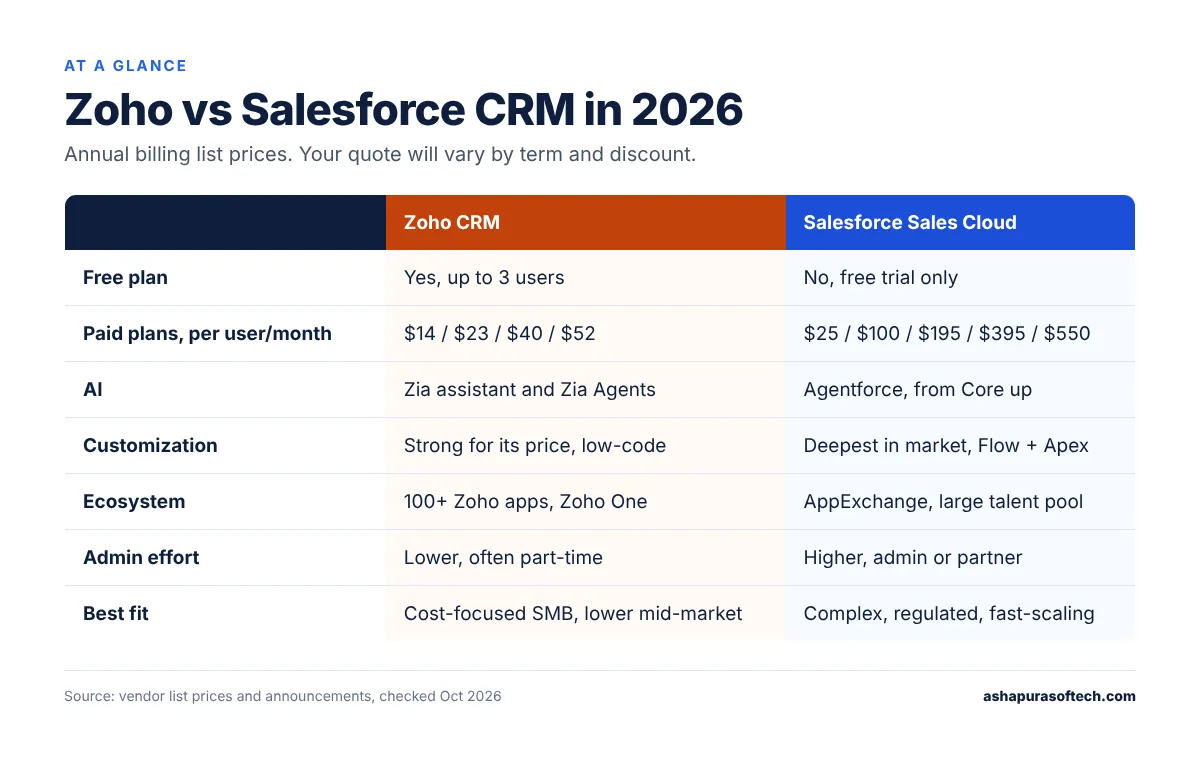
These are list prices, checked in October 2026 on each vendor’s pricing pages and recent pricing guides. Your quote will depend on region, contract length and discounts.
Zoho vs Salesforce CRM pricing in 2026
Zoho CRM
Zoho gives you a free edition for up to three users. After that you pick from four paid editions. On annual billing, Standard is $14, Professional $23, Enterprise $40 and Ultimate $52 per user per month. Paying month to month costs more ($20, $35 and $50 for the first three).
Once you have picked a platform, the next question is budget. Our guide to CRM implementation services for Salesforce or Zoho breaks down scope, cost and timeline.
There are two other ways to buy it. Bigin is a stripped-down pipeline tool for very small teams, from $7 a user. Zoho One bundles the CRM with dozens of other Zoho apps and is priced per employee. It’s worth pricing only if you’d actually use several of those apps; otherwise it’s a bundle you pay for and ignore.
Salesforce
Salesforce changed Sales Cloud in September 2026. Starter Suite ($25) and Pro Suite ($100) are still there at the bottom. Above them are three new editions: Core at $195, Advanced at $395 and Max at $550 per user per month, billed annually. All three include Agentforce plus a yearly pool of Flex Credits for AI work: 500,000 on Core, 1 million on Advanced and 2.75 million on Max. That pool is per org, not per seat.
Enterprise and Unlimited are now “legacy” editions. If you’re on one today, Salesforce says your current pricing stays the same. We cover the new tiers in more detail in our guide to Salesforce Core, Advanced and Max editions.
What 25 users pay for a year
License only, list price:
| Option | Per user/month | 25 users, 12 months |
|---|---|---|
| Zoho CRM Professional | $23 | $6,900 |
| Zoho CRM Enterprise | $40 | $12,000 |
| Salesforce Pro Suite | $100 | $30,000 |
| Salesforce Core | $195 | $58,500 |
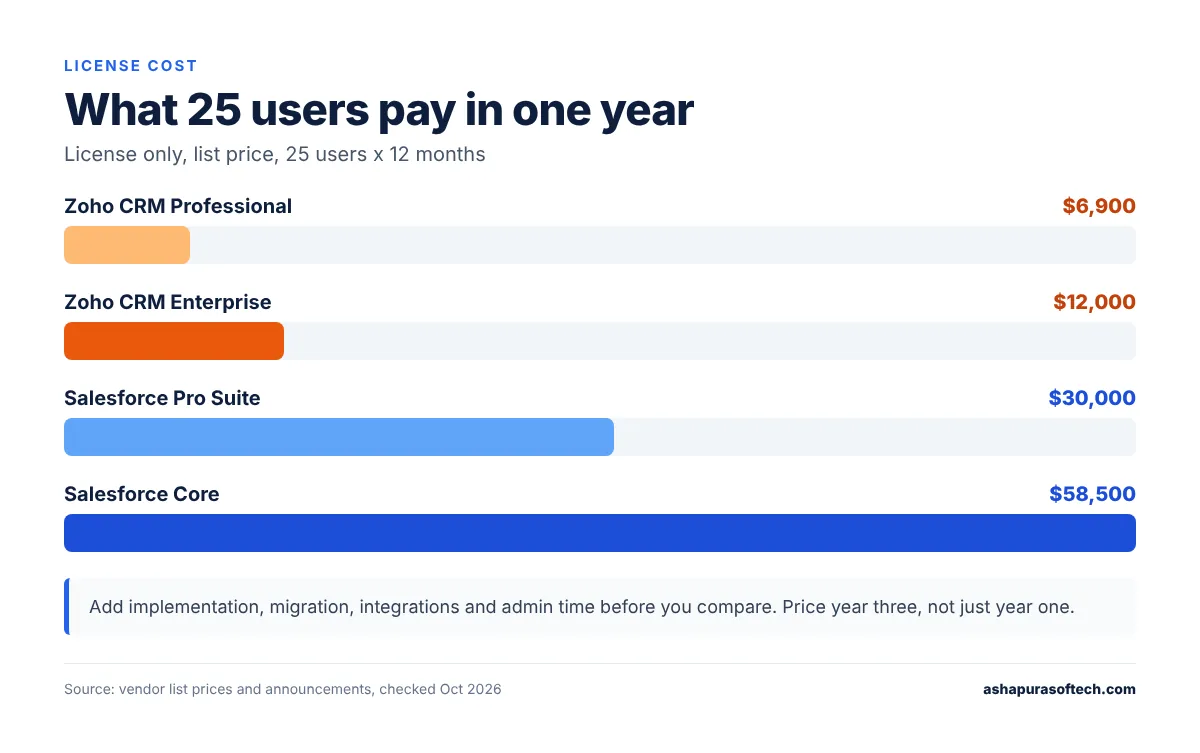
That’s the number most Zoho vs Salesforce CRM comparisons stop at. It shouldn’t be. Implementation, data migration, integrations and the person who keeps the system clean all cost money too. On Salesforce, admin time often ends up bigger than the license difference. On Zoho, the surprise usually shows up later, when the team starts adding Desk, Analytics and Campaigns one app at a time. Our Zoho CRM implementation cost guide has typical project ranges if you want the full picture.
Customization: the real dividing line
If you only read one section of this Zoho vs Salesforce CRM guide, read this one.
Zoho CRM handles more than people expect. You get custom modules and fields, Blueprint for guided sales steps, and Deluge scripting when point-and-click isn’t enough. Zoho Creator covers the odd internal app. For a standard B2B pipeline, that’s plenty.
Salesforce is in a different league. Flow takes care of most automation without code, Apex handles what’s left, and the data model, sharing rules and approval chains can bend to almost any process. That flexibility is exactly why large and regulated companies choose it. It’s also why so many Salesforce orgs turn messy after a few years when nobody really owns them.
Here’s a quick gut check. Can you sketch your sales process on one page, and does it change maybe once a year? Zoho will cover it. Do you have several product lines, regional approvals, partner deals or tricky quoting? That’s what Salesforce was built for.
Picture a 30-person distributor with one sales team and one price list. Zoho Enterprise handles that comfortably. Now give the same company a dealer channel, three levels of regional discount approval and quotes that pull live stock from an ERP. That’s usually the point where Zoho needs a lot of custom Deluge code, and Salesforce starts to look cheaper than the workarounds.
AI: Zia Agents vs Agentforce
AI is the newest front in the Zoho vs Salesforce CRM race. Both vendors now sell AI agents that do work, not just chatbots that answer questions.
Zoho launched Zia Agents, an Agent Studio and an Agent Marketplace in February 2025. You can use pre-built agents or build your own. Zoho has also said publicly that it doesn’t plan to charge a premium for AI agents, which matters if budget is the reason you’re looking at Zoho in the first place.
Agentforce is further along for large-scale use. It now comes bundled with Core, Advanced and Max, and anything beyond your included credits is billed in Flex Credits at $500 per 100,000. A standard agent action uses 20 credits, roughly ten cents. Well-designed agents stay cheap. Agents working on messy data take extra steps, and every step costs. Our Agentforce pricing and Flex Credits breakdown walks through real numbers.
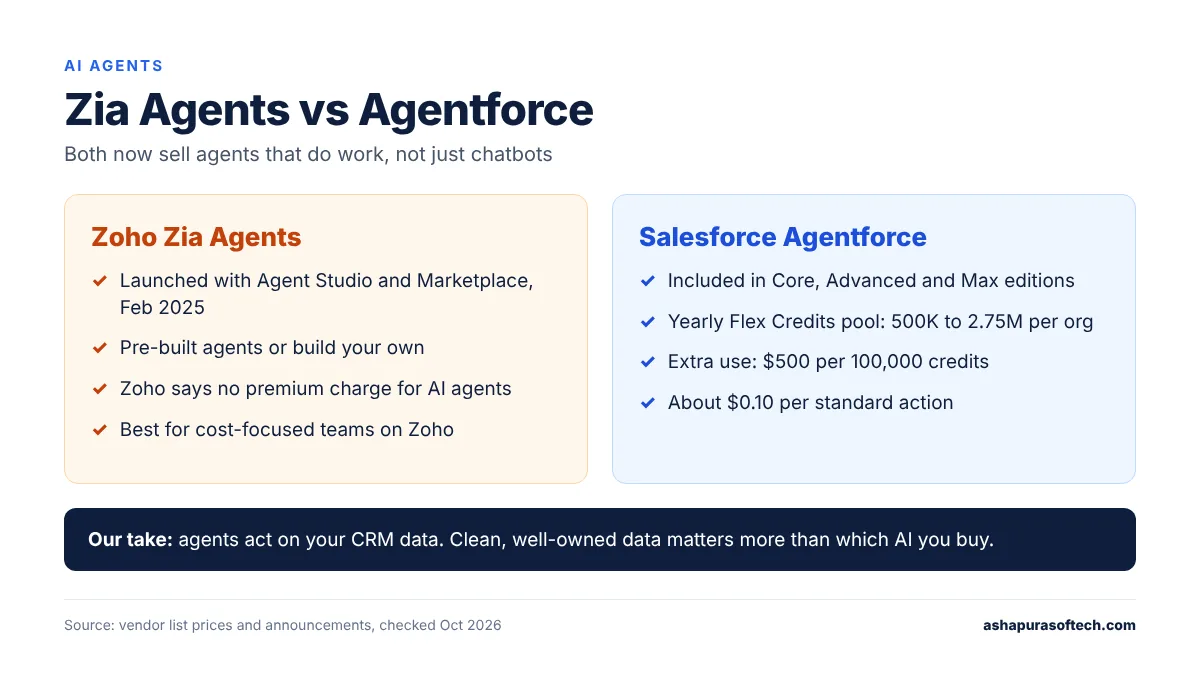
Honestly, we wouldn’t let AI decide this on its own. Agents on either platform act on whatever is in your CRM. Clean, well-owned data will get you more from a cheaper AI tool than a messy org will get from an expensive one.
Integrations and ecosystem
Integrations are where a Zoho vs Salesforce CRM comparison often gets decided late. Zoho’s strength is its own suite. Already on Zoho Books, Desk, Campaigns or Analytics? The CRM plugs into them with almost no setup and your data stays in one place.
Salesforce’s strength is everything outside it. AppExchange has thousands of apps, most US SaaS vendors build their Salesforce connector first, and hiring a Salesforce admin or developer in the US is simply easier than finding a Zoho specialist. Both platforms have solid APIs for ERP, finance and data warehouse links, but Salesforce usually has more ready-made connectors. If you’re planning to connect Zoho to a lot of outside tools, our guide to Zoho integration with third-party apps covers what tends to work.
Day-to-day use and admin effort
Ask any sales team that has lived through a Zoho vs Salesforce CRM switch and they’ll mention the learning curve first. Most reps get comfortable in Zoho CRM within a day or two, and plenty of small teams run it with a part-time admin.
Salesforce takes longer to learn and needs someone who owns it. Lightning is a good interface once it’s set up properly. Set up badly, it confuses people fast. Either way, budget for training and for an admin, in-house or through a partner.
Reporting and forecasting
Both cover the basics: pipeline reports, dashboards, forecasts. Salesforce goes deeper with collaborative forecasting and territory views, and from Core up it includes Tableau Next. Zoho adds forecasting from Professional up, and Ultimate brings in Zoho Analytics for heavier BI. If your leadership team runs on dashboards, rebuild your three most important reports in each trial before you decide. It tells you more about the Zoho vs Salesforce CRM question than any feature grid.
Zoho vs Salesforce CRM: which one fits your team?
Zoho CRM is likely the better fit if:
- You have fewer than about 50 sellers and a fairly standard sales process.
- License cost is a deciding factor, and you’d like AI without a premium price tag.
- You already use other Zoho apps, or Zoho One would replace tools you’re paying for today.
- You don’t have, or don’t want, a full-time CRM admin.
Salesforce is likely the better fit if:
- You deal with complex quoting, approvals, territories or partner channels.
- You expect fast growth, acquisitions or a move into a regulated industry.
- You need a wide integration ecosystem and an easy talent pool to hire from.
- You plan to run AI agents across both sales and service.
Can Zoho replace Salesforce? For a lot of small and lower mid-market teams, yes. We see companies make the switch when they realise they’re paying for a big Salesforce org but using a small slice of it. It rarely makes sense if you depend on heavy customization, complex sharing rules or a stack of AppExchange apps.
Switching from one to the other
Whichever way your Zoho vs Salesforce CRM decision goes, moving between them is a data and process project, not an export button. Map your fields first. Clean up duplicates before the move, not after. Then run both systems side by side for one team before everyone cuts over. Our checklist on preparing Salesforce data for a Zoho CRM migration goes step by step, and our Zoho migration services page covers moves in both directions.
The mistake we’d warn you about first: moving records before you’ve agreed who owns each account. Duplicates and orphaned deals follow you into the new system, and cleaning them up afterwards takes far longer than doing it before the move.
How we’d run a two-week Zoho vs Salesforce CRM evaluation
When clients ask us to compare the two, we skip the feature lists and test the real process:
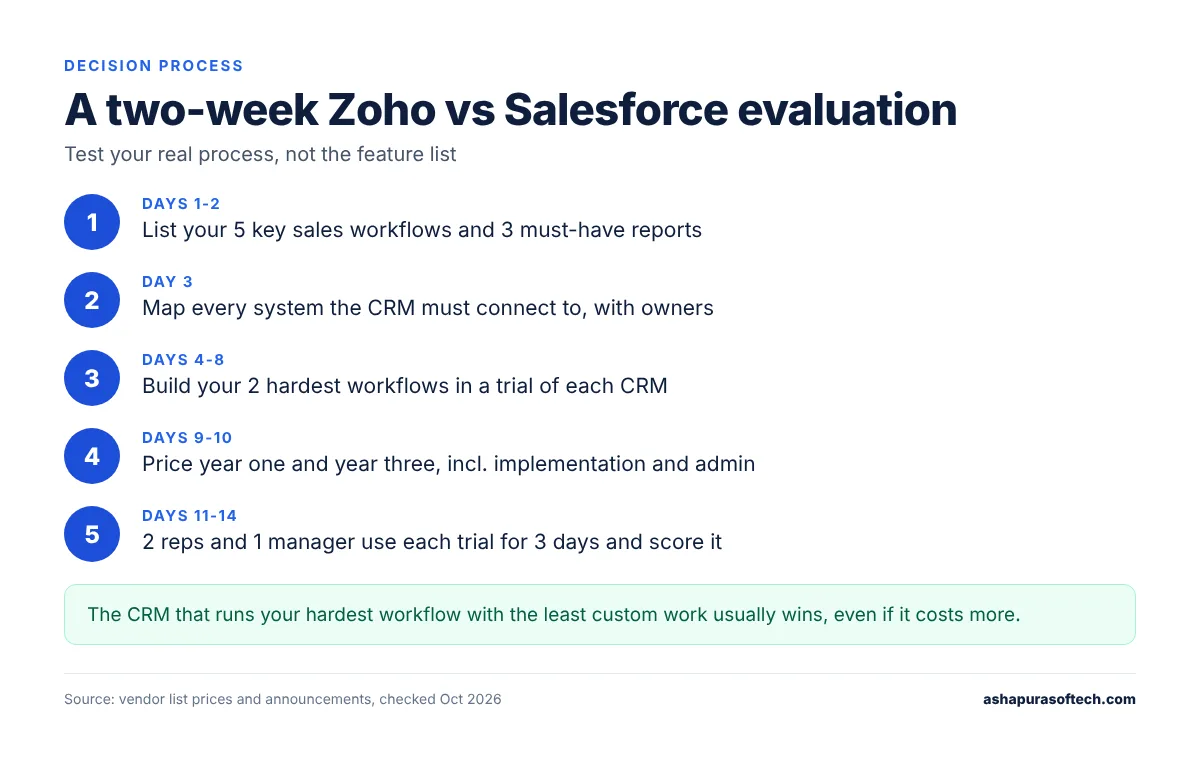
- Write down your five most important sales workflows and the three reports you can’t live without.
- List every system the CRM has to connect to, and who owns each one.
- Build your two hardest workflows in a trial of each CRM.
- Price year one and year three for your real user count, including implementation, admin and add-ons.
- Hand each trial to two reps and one manager for three days, then ask them to score it.
In a Zoho vs Salesforce CRM trial, whichever CRM handles your hardest workflow with the least custom work is usually the right call, even when it isn’t the cheapest. If you’d like a second opinion on your shortlist, our team does CRM software development and implementation on both platforms.
Frequently asked questions
Is Zoho CRM cheaper than Salesforce?
Yes, by a wide margin at list price. Zoho CRM paid plans cost $14 to $52 per user per month on annual billing, while Salesforce Sales Cloud runs from $25 to $550. For a 25-user team, Zoho Enterprise costs about $12,000 a year in licenses, compared with $30,000 for Salesforce Pro Suite.
Can Zoho replace Salesforce?
For many small and lower mid-market teams, yes, especially if they use only basic Salesforce features. It is a poor swap for companies that depend on heavy customization, complex sharing rules or many AppExchange apps.
Which is better for a mid-market company, Zoho or Salesforce?
It depends on process complexity, not company size alone. A mid-market team with a standard sales process and tight budget often does well on Zoho CRM Enterprise. Teams with complex quoting, approvals or several sales channels usually get more from Salesforce.
Does Zoho CRM have AI agents like Agentforce?
Yes. Zoho launched Zia Agents, Agent Studio and an Agent Marketplace in 2025. Agentforce is more established for large-scale use and is included in Salesforce’s Core, Advanced and Max editions with a yearly Flex Credits allowance.
How long does it take to migrate from Salesforce to Zoho CRM?
A simple migration for a small team can take a few weeks. Larger orgs with custom objects, automation and integrations usually need two to three months, including testing and a period of running both systems.
About the author
Ankur Pandey is Marketing Manager at Ashapura Softech, a Salesforce and Odoo consulting partner based in Irving, Texas, that also builds on Zoho. He works with the delivery team on CRM selection, pricing and migration questions from US companies, and writes about what those projects teach, including the Zoho vs Salesforce CRM question US teams ask most often.
Sources
- Salesforce, Sales Cloud pricing: https://www.salesforce.com/sales-cloud/pricing/
- Salesforce newsroom, new editions (3 Sep 2026): https://www.salesforce.com/news/?p=94976
- Salesforce, Agentforce pricing: https://www.salesforce.com/agentforce/pricing/
- Zoho, CRM edition comparison: https://www.zoho.com/crm/comparison.html
- Zeeg, Zoho CRM pricing guide (28 Sep 2026): https://zeeg.me/en/blog/post/zoho-crm-pricing
- Method, Zoho CRM cost breakdown: https://www.method.me/blog/zoho-crm-cost/
- Business Wire, Zoho announces Zia Agents (4 Feb 2025): https://www.businesswire.com/news/home/20250204066995/en/Zoho-Corporation-Announces-Zia-Agents-AI-Platform-Supporting-Autonomous-Agents-Across-Organizations-Broad-Portfolio
- CX Today, Zoho previews AI agents and low pricing: https://www.cxtoday.com/crm/zoho-previews-ai-agents-commits-to-low-pricing-shares-more-on-its-ceo-transition