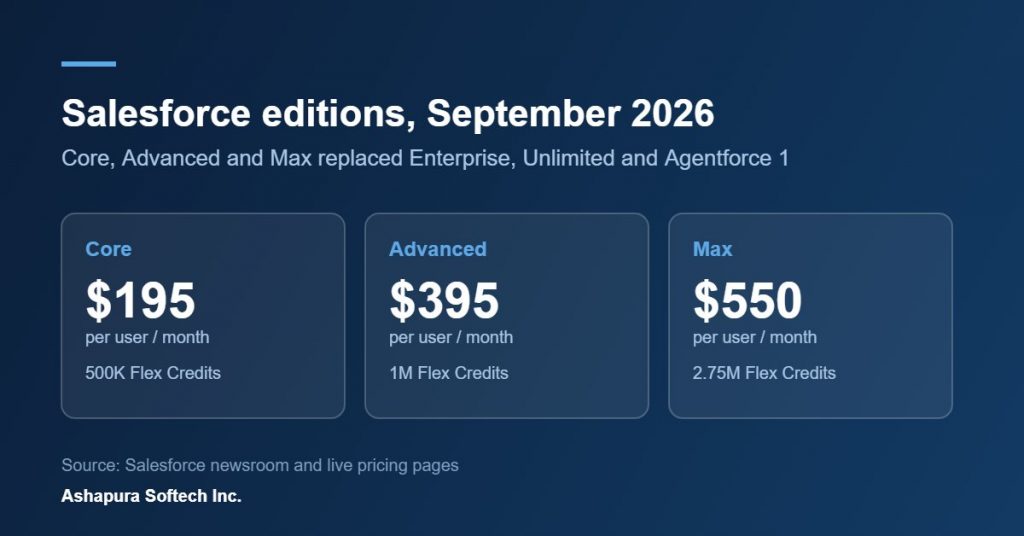

Salesforce Core, Advanced and Max editions are the packages that now replace Enterprise, Unlimited and Agentforce 1. Salesforce announced them on 3 September 2026, and they apply across Agentforce Sales, Agentforce Service and Agentforce Industries. If you are mid way through a Salesforce evaluation, or you renew in the next two quarters, this changes the quote in front of you.
This article covers what each edition costs, what moved into the bundle, what happens to existing contracts, and the questions Salesforce has not answered yet. Every figure here comes from Salesforce’s own announcement and its live pricing pages, both linked at the end.
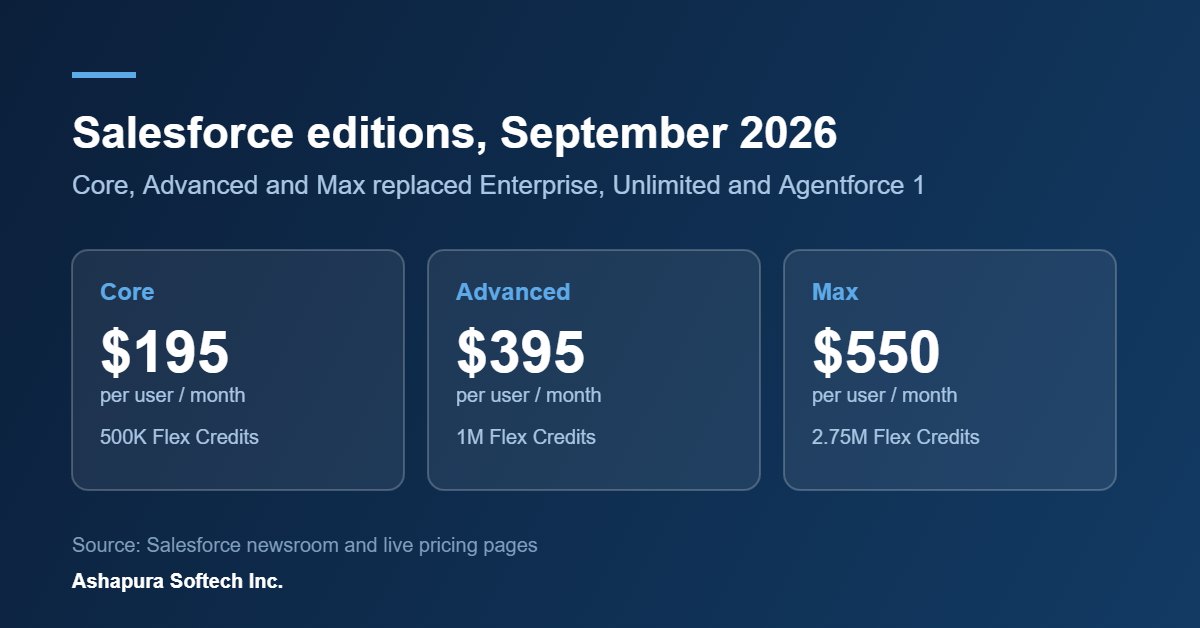
The three new Salesforce editions at a glance
The old ladder of Essentials, Professional, Enterprise and Unlimited is gone at the top end. What remains is Starter Suite and Pro Suite for small teams, and then three agentic editions above them.
| Edition | Price per user per month | Flex Credits included | Who it fits |
|---|---|---|---|
| Core | $195 | 500,000 | Teams moving off legacy Enterprise who want AI included rather than bolted on |
| Advanced | $395 | 1,000,000 | Organisations that need stronger security, structured sales programs and autonomous service agents |
| Max | $550 | 2,750,000 | Businesses running agents across sales and service at scale, including workforce engagement and IT service |
Two details matter more than the headline numbers. Core and Advanced carry new pricing, because Salesforce has moved a lot of separately sold products inside them. Max costs the same as Agentforce 1 did, so for anyone already on that SKU the packaging changed and the invoice did not.
What replaced what
This is the question most buyers are actually asking, so here it is plainly.
| Legacy edition | New equivalent | What Salesforce claims |
|---|---|---|
| Enterprise Edition | Core | 70% more value than legacy Enterprise |
| Unlimited Edition | Advanced | More than 50% more value than legacy Unlimited |
| Agentforce 1 Edition | Max | Nearly 60% more value, with no price change |
Treat the value percentages as vendor framing, not as a measurement. What is verifiable is the list of products that used to be separate line items and now sit inside the edition. That list is where the real comparison lives, and it is the next section.
What is now bundled that you used to buy separately
Every one of the three tiers now includes five things that were previously priced or contracted on their own:
- Agentforce, with capabilities such as Account Research, Service Rep Assistant and Agentforce Coworker built into the daily flow of work rather than sold as an add on.
- Slack and Slackbot, so deal and case work happens in one conversational surface alongside agents.
- Embedded agentic analytics, delivered through prebuilt apps and semantic models rather than a separate analytics purchase.
- Data security, covering sensitive data protection and permission change management as the AI footprint grows.
- Premier Success Plan, which on the old ladder was an extra percentage on top of the licence bill for most editions.
If your current budget already carries lines for Slack, an analytics product, Premier Support and Agentforce credits, compare the total of those lines against the new edition price before you conclude that Salesforce got more expensive. For some accounts it is a repackaging of spend that already existed. For others, particularly teams that never bought Slack or Premier, it is a genuine increase.
What differs between the tiers
The tier specific features are where the $195 to $550 gap gets decided:
| Capability | Core | Advanced | Max |
|---|---|---|---|
| Momentum, automatic CRM record capture | Yes | Yes | Yes |
| Sales programs, repeatable playbooks and incentives | No | Yes | Yes |
| Agentforce Help Agent, autonomous customer resolution | No | Yes | Yes |
| Service Rep Assistant with unmetered Coworker access | No | No | Yes |
| Workforce Engagement, AI workforce management and coaching | No | No | Yes |
| Agentforce IT Service, employee request automation | No | No | Yes |
One pricing mechanic inside this table is worth pausing on. Agentforce Help Agent carries outcome based pricing, which means the charge lands when an issue is actually resolved rather than per conversation. That is a different budgeting model from per user licensing and it needs its own forecast.
If you are already on Enterprise, Unlimited or Agentforce 1
Salesforce has been explicit that existing customer pricing on legacy editions remains unchanged. Nobody is being repriced mid contract.
Agentforce 1 customers get the clearest deal: an upgrade to Max at no extra cost, which Salesforce describes as up to $500 in added value. If you hold that SKU, this is a call worth booking rather than waiting for renewal.
For Enterprise and Unlimited customers the practical consequence is quieter. Your current agreement holds, but new purchases, added seats and renewals will be quoted on the new structure. So the planning question is not whether your bill changed today. It is what your renewal looks like at $195 or $395 per seat, and whether the bundled products replace things you are already paying for elsewhere.
If you are buying Salesforce for the first time
Start by separating what you need from what is included. Core at $195 already carries AI, Slack, analytics, security and Premier Success, which is a wide floor. The honest test for moving up a tier is whether you will use the tier specific features within the first year.
Advanced earns its price when two conditions are true together: you run a service operation with enough volume that autonomous resolution changes headcount maths, and your sales motion is repeatable enough that structured programs are worth configuring. One of the two on its own rarely justifies the jump.
Max earns its price when agents are the operating model rather than an experiment, and when workforce management and IT service are problems you were going to solve with other software anyway.
What none of this decides is implementation. Licensing is a subscription. Configuration, data migration, integration and training are a separate project with a separate budget, and a bundled edition does not reduce that work. If anything, more included capability means more decisions to make during configuration.
The Flex Credits question
Each edition ships with Flex Credits: 500,000 on Core, 1 million on Advanced, 2.75 million on Max. Credits are the consumption currency behind agent actions, so the allocation is what lets a team experiment without a second purchase order.
The mistake we see teams make is treating the included allocation as a capacity plan. It is a starting balance. What consumes it is the number of agent actions your workflows trigger, and that number is decided by design choices made during implementation, not by the edition you bought. A chatty agent placed in a high volume workflow will burn through an allocation that a carefully scoped one would not touch.
Before signing, ask for a consumption estimate tied to your actual use cases. If nobody can produce one, the honest position is that the first year is a measurement exercise, and the budget should say so.
What Salesforce has not answered yet
Three things are genuinely open, and it is better to name them than to guess:
- Industry Editions pricing. Salesforce has said new pricing for Agentforce Industry Editions takes effect later this fall. Anyone in financial services, healthcare or public sector planning a purchase this quarter is quoting against a moving target.
- Headless 360 capacity. Salesforce says Max editions will include an allocation in the future. Future is not a date, so it should not appear in a business case today.
- Migration mechanics for large estates. The announcement covers packaging and price. It does not describe what a multi org, multi cloud customer does at renewal, and that is where the real work sits.
What the new editions change about an implementation project
A licensing change is usually invisible to a delivery team. This one is not, for three reasons.
First, scope grows quietly. When Slack, analytics and agent capability arrive inside the edition, stakeholders assume they are in scope for the rollout. Somebody has to decide whether Slack workflows and agentic analytics belong in phase one or phase two, and that decision belongs in the project plan before kickoff, not in week six.
Second, agent design becomes part of configuration. On the old ladder, buying Salesforce and deploying agents were two projects separated by months. With Agentforce inside every tier, teams reasonably expect at least one working agent at go live. That means agent scoping, guardrails and testing sit next to the usual object model and automation work. Our Agentforce readiness checklist covers what has to be true before an agent is worth deploying at all.
Third, consumption needs an owner. Credits are a shared resource that any automation can spend. Someone has to watch the balance and know which workflow is consuming it, the same way someone watches API limits and storage. We wrote about how the credit model behaves in practice in our guide to Agentforce pricing and Flex Credits.
Seven checks to run before you sign
These are the questions we put to clients evaluating a quote on the new structure. None of them require a partner to answer, so run them yourself first.
- List what you already pay for separately. Slack, an analytics tool, Premier Support, any Agentforce credits. Total those lines, then compare against the edition price. That comparison, not the sticker, tells you whether your cost went up.
- Name the tier specific feature you will actually use. If you cannot name a use case for sales programs or Help Agent, Advanced is not yet justified.
- Ask for a credit consumption estimate against your workflows. Not an industry average. Your cases, your volumes.
- Check whether outcome based pricing applies. Help Agent charges on resolution, which behaves differently in a budget than per seat licensing does.
- Confirm what happens at renewal, in writing. Legacy pricing holds today. Get the renewal position stated rather than assumed.
- Separate licence budget from implementation budget. They are different money with different approval paths, and mixing them is how projects stall at month three.
- If you are on Agentforce 1, ask about the Max upgrade now. It is offered at no extra cost, so there is no reason to wait for a renewal cycle to have that conversation.
How this fits with the rest of the Salesforce AI stack
The editions change is packaging. It sits alongside two other moves worth understanding together, because buyers keep conflating them.
Agentforce is the agent platform, and it is now inside every tier rather than an add on. Claudeforce is the separate arrangement bringing Anthropic’s models into Salesforce, which we compared against Agentforce in Claudeforce vs Agentforce. Headless 360 is the route for using Salesforce capability outside the Salesforce interface, and Max editions are due an allocation of it at a date Salesforce has not named.
Three different things, three different decisions. An edition upgrade does not settle which models you use, and a model choice does not settle how agents reach your other applications. If you are choosing an implementation partner for any of this, our guide to picking an Agentforce implementation partner sets out what to ask.
Frequently asked questions
Did Core replace Enterprise Edition?
Yes. Core is the replacement tier for legacy Enterprise Edition, priced at $195 per user per month, with Agentforce, Slack, analytics, data security and Premier Success included.
What do the new Salesforce editions cost?
Core is $195 per user per month, Advanced is $395 and Max is $550. Starter Suite at $25 and Pro Suite at $100 remain below them for smaller teams.
What happens to my Agentforce 1 Edition?
Agentforce 1 customers can move to Max at no extra cost. Salesforce puts the added value at up to $500, and the price of Max matches what Agentforce 1 cost.
Will my existing Salesforce pricing change?
No. Salesforce has stated that existing customer pricing on legacy editions remains unchanged. The new structure applies to new purchases and, in practice, to what gets quoted at renewal.
How many Flex Credits come with each edition?
Core includes 500,000, Advanced includes 1 million and Max includes 2.75 million. Consumption depends on how many agent actions your workflows trigger, so the allocation is a starting balance rather than a capacity plan.
When did the new editions take effect?
Salesforce announced them on 3 September 2026. Pricing for Agentforce Industry Editions is scheduled for later this fall, and availability can vary by region.
Where this leaves a buying decision
The packaging is simpler than what it replaced, and that is a real improvement for anyone who has ever assembled a Salesforce quote out of six SKUs. The cost question is less tidy. Whether Core at $195 is more expensive than Enterprise was depends entirely on what you were already buying alongside Enterprise.
The work that decides your total spend has not changed. It is scope, data quality, integrations and adoption. A bundle does not configure itself, and credits do not spend themselves carefully.
Ashapura Softech Inc. is a certified Salesforce implementation partner based in Irving, Texas, delivering Salesforce cloud services and Salesforce CRM development for US teams. If you are working out which edition your requirements actually need, we will walk the requirement list with you before anyone talks about a quote.
Sources
Salesforce’s announcement of the new editions is published on its newsroom as Salesforce Simplifies Editions, dated 3 September 2026. Per user prices were verified against the live Sales pricing page and Service pricing page. Salesforce notes that pricing and packaging are subject to change and availability varies by region.
Related reading: on the commerce side, the systems requirement is separate from the licence question. See what your ERP and CRM have to give a Claude commerce agent.