
Last updated: 21 October 2026
Quick answer
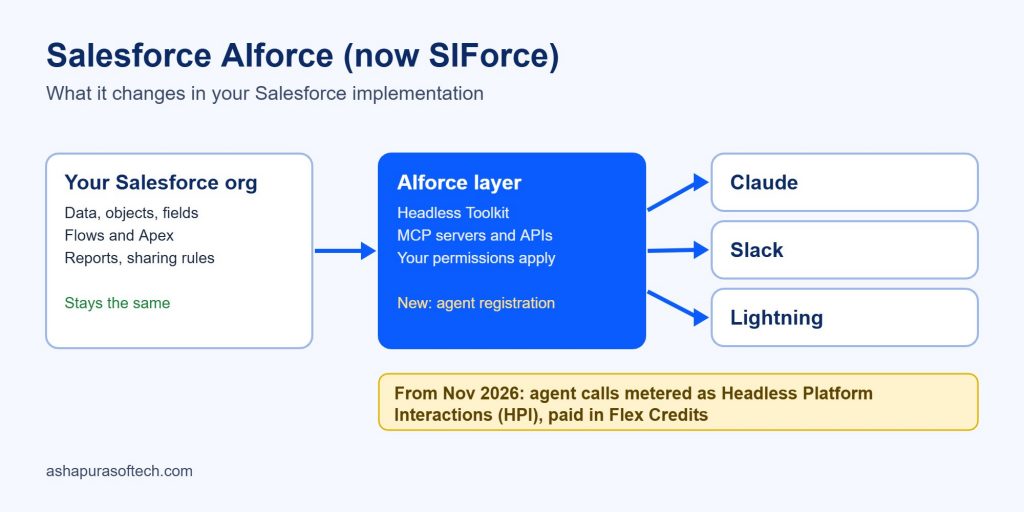
Claudeforce vs Agentforce is not an either/or choice. Agentforce is Salesforce’s platform for building and running AI agents inside Salesforce. Claudeforce is the Salesforce and Anthropic partnership announced on 26 August 2026, and its main product, Salesforce in Claude, lets your team work with Salesforce data from inside Claude using 37 prebuilt sales skills. Since Dreamforce 2026, both sit under Salesforce AIforce (now SIForce): Agentforce agents do the work, and Claude is one of the places your team reaches them from.
Related: how to convert existing Einstein Bots into Agentforce agents.
Update (14 Sep 2026): On 11 Sep 2026 Salesforce announced a new portfolio of named, job-ready Agentforce agents built for specific high-value work: Casey (customer service), Paige (IT and HR service), Carter (shopper agent for e-commerce), Marshall (supply chain orchestration), Piper (inbound lead generation) and Fin (complex customer experience), all generally available now, plus Hunter (outbound sales), in pilot with general availability expected November 2026. The release also adds long-horizon runtime so agents can pursue goals over days or weeks rather than single interactions, AI Skills for teaching agents new tasks (pilot now, GA October 2026), multi-agent orchestration across workflows, and an Agent Optimizer for continuous performance tuning (GA October 2026). This sits on top of the Core, Advanced and Max editions Salesforce introduced in early September.
Claudeforce vs Agentforce is the question we now get on almost every Salesforce AI call, and the reason is simple: the two names sound like variations of the same product, and they are not. One brings Salesforce data into Claude. The other runs autonomous agents inside Salesforce. They point in opposite directions, they serve different people, they are bought differently, and only one of them has published pricing.
This is the long version, including the part that trips up most teams, a worked example of what Agentforce actually costs, and the governance question nobody asks until it is late.
Claudeforce vs Agentforce, in one line each
Agentforce is Salesforce’s AI agent platform. You build agents that act on your behalf inside Salesforce surfaces: resolving service cases, qualifying leads, answering employee requests, scheduling appointments, handling IT tickets. The work happens in your org, and the people it serves are usually your customers or your employees. Salesforce describes it as the platform for 24/7 autonomous support at enterprise scale.
Claudeforce is the Salesforce and Anthropic partnership. Its first deliverable, Salesforce in Claude, puts your CRM data inside Claude with 37 pre-built sales skills covering prospecting through close. The work happens in Claude, and the person it serves is your seller. Salesforce sets this out on the official Claudeforce page.
So the cleanest way to hold the difference: Agentforce sends an agent to your customer, Claudeforce brings your CRM to your employee. Everything else in this article follows from that one sentence.
The comparison table
This is the Claudeforce vs Agentforce comparison as it stands on 21 October 2026. Prices come from Salesforce’s own pages unless marked as reported.
| Claudeforce (Salesforce in Claude) | Agentforce | |
|---|---|---|
| What it is | A partnership between Salesforce and Anthropic. Its first product is a plugin that lets Claude work with live Salesforce data. | Salesforce’s platform for building and running AI agents inside Salesforce. |
| Who builds it | Salesforce and Anthropic jointly. Salesforce prebuilt the 37 sales skills, and an admin connects it once. | Salesforce builds the platform. Your admins or a partner build the agents in Agent Builder. |
| Where the work happens | In Claude, plus Slack and other connected tools. | Inside Salesforce, Slack and customer channels such as web chat and voice. |
| Who it serves | Sellers and sales managers. | Customers and employees, across sales, service and IT. |
| Pricing model | No published price. Anthropic bills for Claude separately. TD Cowen reports Salesforce in Claude is included in the Max edition (CRN Asia). | Included in Core, Advanced and Max editions. Otherwise Flex Credits at $500 per 100,000, $2 per conversation, or $125 per user per month add-ons (Salesforce). |
| Data access | Reads live Salesforce data through MCP, plus Slack, email and other Claude connectors. Runs under each user’s existing Salesforce permissions. Writes route back through Salesforce. | Grounded in Salesforce and Data 360 data inside the Salesforce Trust Boundary. Claude models run through Amazon Bedrock inside that boundary. |
| Autonomous? | No. A seller asks, Claude helps, and Claude can ask for approval before acting. | Yes. Agents can act on their own within the guardrails you set. |
| Availability | Open beta since 15 September 2026. Sales only. Other clouds coming soon. | Generally available. |
| Best use | Sellers who avoid the CRM and want answers and updates where they already work. | High volumes you cannot staff, such as service queues and repeat employee requests. |
See the full list of Claudeforce skills Salesforce has named so far.
Where Claude actually appears in the Salesforce stack
Before comparing the two, it helps to know that Claude now shows up in three separate places. Most of the confusion in the Claudeforce vs Agentforce debate comes from collapsing these into one.
- Claude as the default model in Slack. Claude powers Slackbot and is the default model there
- Claude as the reasoning model inside Agentforce. Claude is integrated as the reasoning model for the Atlas Reasoning Engine and is available in Agent Builder. Your agent still lives in Salesforce, it just thinks with Claude
- Salesforce in Claude. The new one. Your CRM data, permissions and workflows become available inside Claude itself
Only the third is what people mean when they say Claudeforce as a product. The first two have existed alongside it.
Inside Salesforce, Claude is now a reasoning model for the Atlas Reasoning Engine and the default model behind Agentforce Vibes and Agentforce Coworker (Salesforce newsroom). That is still Agentforce, not Claudeforce. The agent runs in Salesforce and is priced like any other Agentforce work.
The part that confuses everyone: Claude in Agentforce is not Claudeforce
This is where most of the Claudeforce vs Agentforce confusion actually comes from, and it is worth slowing down on.
Claude as the reasoning model inside Agentforce is a model choice. Your agent reasons using Claude instead of another model, but the agent still lives in Salesforce, still runs in your channels, and still serves your customer. Nothing about who uses it changes.
Salesforce in Claude is the reverse. Nothing runs in Salesforce. Your seller opens Claude, and Salesforce data, permissions and workflows are available to them there. The user changes from your customer to your employee, and the surface changes from your org to a third party application.
If someone tells you “we already have Claudeforce, we switched our agent to Claude,” they have almost certainly done the first thing, not the second. Worth checking before you plan a budget around it.
What Salesforce in Claude actually does, day to day
The 37 skills at launch cover the sales cycle from prospecting through close. Salesforce names meeting prep, deal health review and pipeline review among them. In practice the seller is doing three kinds of thing:
- Reading. Reasoning over live revenue context rather than pulling a report. Asking what changed on an account, which deals slipped, what a call should cover
- Writing back. Automating pipeline updates without opening the CRM, which is where most CRM hygiene problems start
- Acting. Taking governed action from inside Claude, with the action routed back through Salesforce so business rules still apply
Two details matter more than the skill count. First, onboarding reads your enterprise context and builds a tailored dashboard of accounts, pipeline and live data, so the seller is not starting from a blank prompt. Second, and this is the one admins care about, an admin connects it once. Authentication and permissions are managed centrally, every seller on the team gets access from day one, and there is no per-user setup and no new permissions model to build.
That last point is worth reading twice if you have ever rolled out a Salesforce tool user by user.
What Agentforce actually does, day to day
Agentforce is the opposite shape of work. Instead of assisting one person, it removes a person from a queue. The published use cases are:
- Resolving customer service cases and answering questions across self-service portals and messaging channels
- Processing employee requests such as leave approvals and HR queries
- Scheduling appointments and managing field service
- Qualifying leads and managing opportunities
- Handling IT help desk tickets and system administration
Underneath, the Atlas Reasoning Engine breaks a prompt into smaller tasks, evaluates at each step, and proposes a plan for how to proceed. You assemble the agent in Agent Builder, which is low code, and drop to flows, prompts, Apex or MuleSoft APIs where configuration cannot reach.
The design decision that costs people money later is how much of that they build in code. Configuration survives platform upgrades. Custom code becomes your maintenance bill.
Claudeforce vs Agentforce: what each one costs
Agentforce now has four price routes, all listed on Salesforce’s Agentforce pricing page:
- Flex Credits: $500 per 100,000 credits. A standard action uses 20 credits, about $0.10.
- Conversations: $2 per conversation.
- Per-user add-ons: $125 per user per month for Sales, Service and Field Service, $150 for Industries. A $5 per user license is also available, with Flex Credits bought on top.
- Editions: Core ($195), Advanced ($395) and Max ($550) include Agentforce and 500,000, 1 million or 2.75 million Flex Credits per org per year (Salesforce newsroom).
If you are deciding between them, our guide to the Core, Advanced and Max editions compares what each tier includes.
Here is why the design matters. If 5,000 conversations a month each trigger 4 standard actions, Flex Credits cost about $2,000. At 25 actions each, they cost about $12,500. The same 5,000 conversations on conversation pricing cost $10,000 flat. For the full rate card, see our Agentforce pricing guide.
Claudeforce still has no published price. Marc Benioff has said customers need Salesforce’s premium edition (SF Ben), and TD Cowen reports Salesforce in Claude is included in Max. You will also pay Anthropic for Claude. Budget for both bills until Salesforce publishes packaging.
What a Flex Credit actually buys
A Flex Credit works out at half a cent. Salesforce meters each agent action rather than each interaction, and it publishes the action rates: a standard Agentforce action is 20 Flex Credits, an Agentforce Voice action is 30. So a standard action costs ten cents and a voice action fifteen.
Salesforce puts its own worked examples on the same page, and they are worth reading because they show how the shape of the workload matters more than the rate itself.
- An employee agent answering 20 requests a day at 40 credits each comes to about $120 a month
- A service agent handling 3 cases a day at 60 credits, across 100 users, comes to about $1,800 a month
- A field service agent booking 3 appointments a day at 100 credits, across 10 reps, comes to about $300 a month
- An onboarding agent answering 5 questions each for 20 new employees at 20 credits comes to about $10 a month
- Agentforce Voice at 120 credits across 300 calls a month comes to about $180 a month
A worked example, so the numbers mean something
Take a service desk handling 5,000 customer conversations a month. What it costs depends entirely on how many actions each conversation triggers, and this is the part teams underestimate. At the published rate of 20 credits per action:
| Actions per conversation | Credits per month | Cost per month |
|---|---|---|
| 4 (a simple lookup and reply) | 400,000 | $2,000 |
| 8 (a lookup, a check, an update) | 800,000 | $4,000 |
| 15 (multi-step reasoning, several systems) | 1,500,000 | $7,500 |
| 25 (long chains across several systems) | 2,500,000 | $12,500 |
The action counts are ours for illustration, not Salesforce figures. The rates are published. The point is that the same 5,000 conversations can cost $2,000 or $12,500 depending on how the agent is designed. That is an architecture decision your team controls, not a discount you negotiate.
This is also why we tell clients to pilot with a small cohort and measure real consumption for a few weeks before signing anything org wide. We have written the full arithmetic up in our Agentforce pricing and Flex Credits breakdown.
Claudeforce has no published price. That is the honest answer, and it is worth saying plainly because a lot of the guides circulating right now quietly guess around it. There is no price list, no packaging and no per-seat figure. What we would expect to matter commercially is that Anthropic is a separate vendor, so the inference is not obviously something Salesforce resells inside your existing licence. Treat that as a reasonable question to put to your account team, not as a published fact.
Free CRM health check: 30 checks in 5 pages
Score your CRM in about an hour across data quality, pipeline, adoption, automation, integrations, reporting and security. Free PDF, no signup.
Claudeforce vs Agentforce governance: why it differs for each
Security review is where these two diverge most sharply, and it is usually the last thing anyone looks at.
For Agentforce the question is what the agent can see and act on, and on whose behalf. An agent inherits a permission model you designed for humans, and it will use every bit of access you leave open. The work is a proper permission and sharing review before the agent goes near production data, plus a named owner for the kill switch when it answers something wrongly. Not if. When.
For Salesforce in Claude the shape is different. Setup is centralised: the admin connects once, authentication and permissions are managed centrally, and actions route back through Salesforce so business rules are enforced when an action is taken. That removes a lot of per-user risk. What it does not remove is the question your security team will ask, which is what happens to data displayed in a surface that sits outside Salesforce, and how you audit it. Salesforce has not published that detail at the level a regulated buyer will want.
If you work in healthcare, financial services or anything with a data residency clause, put that question on the pilot call rather than after it.
Claudeforce vs Agentforce: which one do you actually need
Choose Agentforce if the problem is volume you cannot staff: a service queue that never clears, repetitive employee requests, lead qualification that nobody gets to. You want work done without a person in the loop, and you are prepared to own the permission model and watch consumption after go live. Our Agentforce readiness checklist covers what to test before you commit, and what to ask an implementation partner before you sign.
Wait for Claudeforce if the problem is that your sellers avoid the CRM. You are not trying to remove the human, you are trying to remove the interface friction. There is nothing to buy yet, so the sensible move is to get into the beta and measure with your own data rather than plan a rollout around a product with no commercial terms.
Look at Einstein first if you have not turned on what you already pay for. Einstein is natively embedded in the platform and provides insights, predictions and generated content from CRM and external data. Plenty of the “can AI do this?” questions we get are answered by embedded features sitting unused in the org. That is the cheapest win available and it costs a configuration session, not a new contract.
These are not mutually exclusive. For most organisations the end state is all three, and the order matters more than the choice.
Five mistakes we see teams make on this decision
- Treating Claudeforce as an Agentforce replacement. They solve different problems for different people. Nothing in Salesforce’s material positions one as retiring the other
- Budgeting for one pricing mechanism. Teams model Flex Credits, then get billed on conversations, or the reverse. Model both against your own agent design
- Automating the whole service desk as phase one. Platform wide rollouts as a first project are how pilots become write-offs. One workflow, one user group, measured
- Skipping the permission audit because the demo worked. A demo runs on clean data with a generous profile. Production does not
- Waiting for Claudeforce instead of fixing the data. Whatever you eventually run, it reads your CRM. Bad data produces a confident wrong answer faster than a human would
What is still unknown about Claudeforce
We would rather list the gaps than paper over them:
- Price. Nothing published, and the launch material notes pricing is subject to change
- Packaging. Whether it lands as an add-on, an edition, or a separate Anthropic contract
- Scope beyond sales. Service, Marketing, Commerce, Revenue, Field Service, Tableau, MuleSoft, Data 360, Headless 360 and Industries are listed as coming, without dates. More prebuilt skills are expected late 2026
- Governance detail. How audit and monitoring work when the surface your data is used in sits outside Salesforce
- What happens at renewal. Whether adoption inside Claude changes how your Salesforce seats are counted
Anyone giving you confident numbers on these today is guessing. Our fuller write up is here: what Claudeforce actually is, and what it changes.
What to do in the next 90 days
- Name the problem first. Queue volume points at Agentforce. CRM avoidance points at Claudeforce. Unused platform features point at Einstein
- Join the Salesforce in Claude beta through your account team if sales adoption is your issue. It costs nothing to be in the queue
- Run one Agentforce workflow, not a department. A defined user group, a metric agreed before the build, consumption tracked from day one
- Do the permission and data quality review now. It is required for either path and it is the work that does not depend on a pricing announcement
- Model both pricing mechanisms against your own expected action counts before any commercial conversation
Where our view comes from
We are a certified Salesforce implementation partner, based in Irving, Texas with a delivery team in Ahmedabad, working since 2012. We are also certified for Zoho, Microsoft Dynamics and Odoo, which is usually why clients ask us this question in the first place: they want someone who is not obliged to answer “Agentforce” every time.
Our most recent Agentforce delivery embedded an agent directly into the quote workflow for a custom furniture retailer, grounded on Data Cloud, checking live production timelines from their Odoo ERP before committing a date. Quote build time went from 45 minutes to under 10, a 78 per cent improvement, across a migration of more than 120,000 contacts and 85,000 custom orders with zero data loss. The full write up is here: Salesforce CPQ and Agentforce for a custom furniture retailer. We have also covered where Agentforce helps with sustainability reporting and where it stops.
On Claudeforce we have no delivery experience, because nobody has. It is in pilot. Everything written above about it is drawn from Salesforce’s own published material, and we have said plainly where the gaps are. If you want a reference before you talk to us, ask on the call and we will tell you straight where we are.
Ashapura Softech
2201 W Royal Ln, Irving, Texas 75063
+1 214-935-9893
Certified Salesforce implementation partner. Founded 2012.
Frequently asked questions
Is Claudeforce replacing Agentforce?
No. Salesforce positions Claudeforce as a partnership framework, not a replacement, and continues to ship Agentforce. They solve different problems: autonomous work for your customers versus CRM access for your sellers.
Can we use both?
Yes, and for most organisations that is the likely end state. Agents handling volume inside Salesforce, sellers working with CRM data inside Claude, Einstein doing the embedded predictive work underneath both.
Which is cheaper, Claudeforce vs Agentforce?
It is too early to say. Agentforce has published prices: Flex Credits at $500 per 100,000, $2 per conversation, or add-ons from $125 per user per month. Claudeforce has no published price, and you also pay Anthropic for Claude.
Do we need Data Cloud for either?
Grounding quality is what separates a useful agent from a confident wrong one, and in practice that is where Data Cloud earns its place on Agentforce projects. Whether it is strictly required depends on your build, so treat it as a design question rather than a fixed prerequisite.
Is Einstein being retired?
There has been no such announcement. Salesforce describes Einstein as natively embedded in the platform, providing insights, predictions and generated content from CRM and external application data.
How do we get into the Claudeforce beta?
Salesforce in Claude has been in open beta since 15 September 2026. Salesforce customers can request access through the beta page linked from Salesforce’s Claudeforce site on Agentforce Exchange.
Does Salesforce in Claude need a new permissions model?
No. Salesforce states that an admin connects it once, authentication and permissions are managed centrally, and every seller on the team gets access from day one with no per-user setup.
Does any of this apply if we are building on Anthropic’s own blueprint instead?
Partly. The commercial questions are the same but the integration burden sits with you rather than with Salesforce. We have written up what your ERP and CRM must provide before you build a Claude commerce agent.
What happens to our agents if we change partners?
Agent definitions built in Agent Builder stay in your org. Custom code and undocumented prompt logic are the parts that travel badly, which is a good argument for configuring rather than coding wherever you can.
Can you work alongside our existing Salesforce partner?
Yes. We are often brought in for a specific layer, such as the integration or the readiness work, alongside an incumbent.
Is Claudeforce included in any Salesforce edition?
TD Cowen analysts reported that Salesforce in Claude is included in the Max edition. Salesforce has not confirmed this on its pricing pages as of 21 October 2026.
Is Claude inside Agentforce the same as Claudeforce?
No. When Claude powers an Agentforce agent, Agentforce Coworker or Agentforce Vibes, the work runs inside Salesforce and is priced as Agentforce. Claudeforce is when the work happens in Claude itself.
Do I need Agentforce to use Claudeforce?
Salesforce has not said Agentforce is required. Salesforce in Claude needs a Salesforce org and a Claude plan. Confirm edition requirements with your account executive, since Marc Benioff has said a premium edition is needed.
Both products now sit under a wider banner. Salesforce grouped Claudeforce, Slackforce and the Agentforce Coworker together as AIforce at Dreamforce 2026, which changes how you choose between them rather than what each one does. Here is what AIforce covers and where each piece fits.