Last updated: 14 October 2026
Short answer
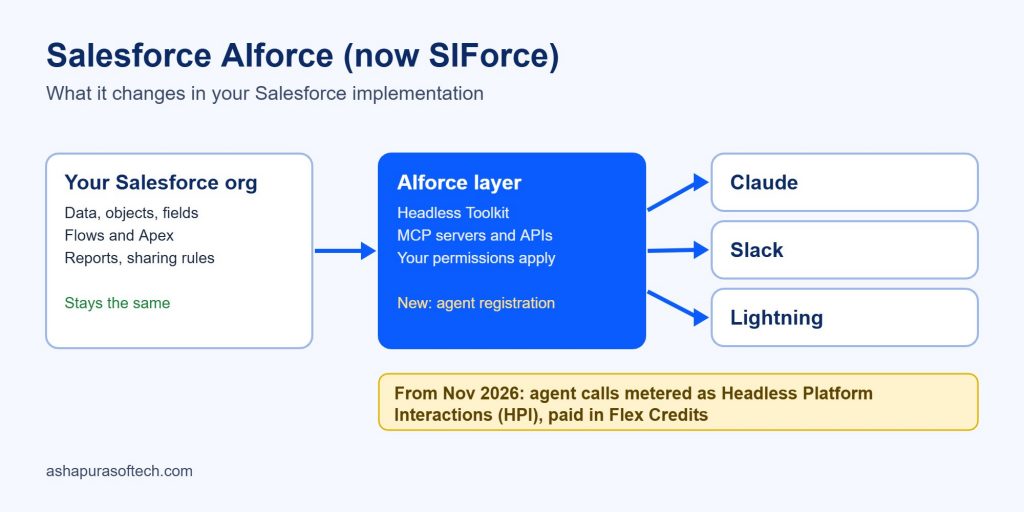
Salesforce AIforce does not move your data or replace your org. It is a layer that lets people and AI agents use Salesforce from Claude, Slack and Lightning, under the permissions you already have. What does change is how agents connect: each agent that calls Salesforce over MCP or API will need its own registered identity, and those calls get a new usage meter paid in Flex Credits. Salesforce is targeting November 2026 for these changes, and existing customers with API-based agents move over at renewal.
Three names in two months. Headless 360 in spring, AIforce at Dreamforce, and SIForce last week. If you look after a Salesforce org, the obvious worry is that one of these quietly turns into a migration project nobody budgeted for.
We read Salesforce’s own impact notes so you don’t have to, and the honest answer is: it’s smaller than it sounds, but it isn’t nothing. This guide walks through the AIforce impact on your Salesforce implementation, what stays exactly as it is, the dates that matter, and the checklist we’d work through before the new rules switch on. If you want the background on the announcement itself, start with our explainer What Is AIforce?
What is Salesforce AIforce?
AIforce is Salesforce’s interface layer for AI. It brings Salesforce data, workflows and permissions into the tools people already work in, so a rep can ask Claude or Slack about an account instead of opening Salesforce. Salesforce first showed the idea at TDX 2026 under the name Headless 360 and launched it as AIforce at Dreamforce on 15 September 2026.
It arrives in three forms, all running on the same foundation:
- Claudeforce (Salesforce in Claude): a prebuilt MCP server with 37 sales skills that lets Claude read and act on Salesforce records. It launched in beta for Salesforce customers. Our guide to Claudeforce covers it in detail.
- Slackforce: Salesforce context and actions inside Slack, such as creating accounts or logging notes from a prompt.
- Agentforce Coworker: an AI teammate inside the Lightning interface that works within existing permissions and can call the Agentforce agents you have built. See our Agentforce Coworker guide.
Under all three sits the Headless Toolkit: the MCP servers, APIs, skills and plug-ins that expose the platform to outside AI tools. That toolkit is where the implementation impact comes from.
AIforce is now SIForce: what the rename means
On 9 October 2026, Marc Benioff posted on X: “AIForce is officially SIForce.” The rename followed a US executive order that asks federal agencies to say “super intelligence” instead of “artificial intelligence”.
For your org, the rename changes nothing yet. No features, prices or availability were announced with it, and Salesforce’s help documentation still uses the name AIforce. Our advice is the same as for the Agentforce product names Salesforce reversed in September: keep contracts, order forms and internal documents on the current names until your account team confirms how they will appear at renewal. In this guide we use “AIforce”, because that is the name in Salesforce’s own documentation today.
Do you need to migrate to AIforce?
No, not in the usual sense. There is no data migration, no new object model and no rebuild of your flows, reports or page layouts. AIforce reads from the org you already have.
The “migration” is narrower and more technical. It applies to agents: any AI tool, script or MCP client that connects to Salesforce on its own. Salesforce’s help article Understand AIforce Impact sets out two changes for them.
What Salesforce AIforce changes in your implementation
1. Salesforce agent registration: every agent gets its own identity
Right now, a lot of AI tools get into Salesforce by borrowing someone’s login or a shared integration user. Under the new model, admins register each agent through a feature called Agentic Identity. The agent gets its own identity on the platform, and you can give it a narrower permission set than any human user has.
Security-wise, this is a good change. An agent with its own identity can be limited, watched and switched off without touching a person’s account. The catch is the work behind it: someone has to find every agent, register it, and swap its OAuth credentials so Salesforce knows it’s talking to an agent and not a human.
2. Headless Platform Interactions: a new meter for agent calls
Each successful call a registered agent makes to Salesforce, over MCP or direct API, is metered as a Headless Platform Interaction (HPI). HPIs are tracked in Digital Wallet and paid for with Flex Credits, under the Customer 360 Platform section of the Flex Credits rate card.
Two details matter for budgeting:
- The price isn’t set yet. The HPI multiplier is listed as “TBA”, and Salesforce says it will give 30 days’ notice before metering begins.
- Your org must be on Flex Credit billing. Salesforce names Salesforce Foundations (listed at $0) or another SKU that enables Flex Credits. If Flex Credits are new to you, our guide to Agentforce pricing and Flex Credits explains how they work.
3. The deadline depends on how you buy and connect
| Your situation | What you must do | Deadline |
|---|---|---|
| New purchase on or after 17 Sep 2026 | Register all agents that use Salesforce APIs | Within 3 months of Salesforce’s notice that Agentic Identity is available |
| Existing customer with API-based agents | Register all agents and move them to the new billing model | At your renewal |
| Any customer using a Salesforce MCP server | Register the agents that use it | Within 3 months of the Agentic Identity notice |
| Traditional (non-agent) integrations | Nothing: pricing and security options are unchanged | None |
Salesforce is targeting November 2026 for agent registration, the new security controls and the billing model.
Our take: the rename gets the headlines, but the meter is what will show up in budgets. If your renewal falls in the next six months, it’s worth getting the agent inventory done now, while the multiplier is still “TBA” and nothing is being charged.
4. Sandboxes stay free
HPIs are only charged in active production orgs. Sandboxes, scratch orgs and Developer Edition orgs aren’t metered, so your team can build and test agents without using credits.
What stays the same
Most of your implementation doesn’t change at all. This is the part teams worry about most, so here it is side by side.
| Area | Changes with AIforce? |
|---|---|
| Your data, objects and fields | No |
| Flows, Apex, validation rules | No |
| Reports and dashboards | No |
| Lightning UI and page layouts | No: Lightning stays, and Agentforce Coworker runs inside it |
| Sharing rules and field-level security | No, but they now control what AI can see (see below) |
| Traditional integrations (ERP sync, middleware) | No: pricing and security options are unchanged |
| AI agents and MCP clients that call Salesforce | Yes: registration, new credentials and HPI billing |
| Contracts and product names | Possibly, at renewal: confirm with your account team |
Where your current setup will show its gaps
AIforce doesn’t create new problems in an org. It makes the existing ones visible faster, because an AI answer is only as good as the data and permissions behind it.
- Over-wide permissions. Every AIforce request runs as the user who makes it. If a profile has collected extra access over years of quick fixes, Claude or Slack will show that data to anyone who asks the right question. Permission sets that were “fine because nobody looks there” stop being fine.
- Duplicate and stale data. An agent asked to brief a rep on an account reads whatever is in the org. Duplicate accounts and opportunities stuck in old stages produce answers that sound confident and are wrong. Approval steps catch bad writes, not bad reads.
- Agents nobody listed. Scripts, browser extensions and MCP clients set up by individual teams are easy to miss. Under the new rules, an unregistered agent is both a security gap and an unplanned bill once metering starts.
- Integrations running on a person’s login. If an integration or AI tool uses a named employee’s account, it breaks when that person leaves, and it hides what the tool is actually doing. Registration is the right moment to fix this.
If you want to measure these gaps before the November changes, our free CRM health-check template covers permissions, data quality and integrations in 30 checks.
AIforce readiness checklist for existing Salesforce orgs
Here’s the order we’d tackle it in. For most mid-sized orgs this is a few days of admin time, not a project. Start with the inventory; everything else depends on knowing what’s actually connected.
- Inventory every agent. List each AI tool, script and MCP client that connects to Salesforce, who owns it, and which user it runs as today.
- Split production from sandbox. Only production calls will be metered, so note which connections touch production.
- Design one permission set per agent. Give each agent the least access it needs. Don’t reuse an admin or a sales manager’s profile.
- Confirm Flex Credit billing. Check whether your org already has Salesforce Foundations or another SKU that enables Flex Credits.
- Note your renewal date. Existing API-based agents move to the new billing model at renewal, so that date sets your timeline.
- Plan the credential switch. Each agent will need new OAuth credentials tied to its registered identity. Schedule the reconnection so nothing breaks mid-quarter.
- Clean the data your first use case touches. Merge duplicate accounts and close out stale opportunities on the objects your pilot will read.
- Pilot read-only first. Start one team on Salesforce in Claude or Agentforce Coworker with read access, check the answers, then allow writes with approval.
- Watch for Salesforce’s notices. The Agentic Identity announcement starts the three-month clock, and the 30-day HPI notice tells you when billing begins.
Free: Salesforce implementation checklist
A step-by-step list covering permissions, data and integrations. Use it alongside this AIforce checklist before the November changes.
Related guides
- What Is AIforce?: the Dreamforce 2026 announcement explained
- Agentforce pricing and Flex Credits: how the credit model works
- Agentforce readiness checklist: data, permissions and use cases
- What is Claudeforce?: Salesforce in Claude, skills and pricing
- Agentforce Coworker: the AI teammate inside Lightning
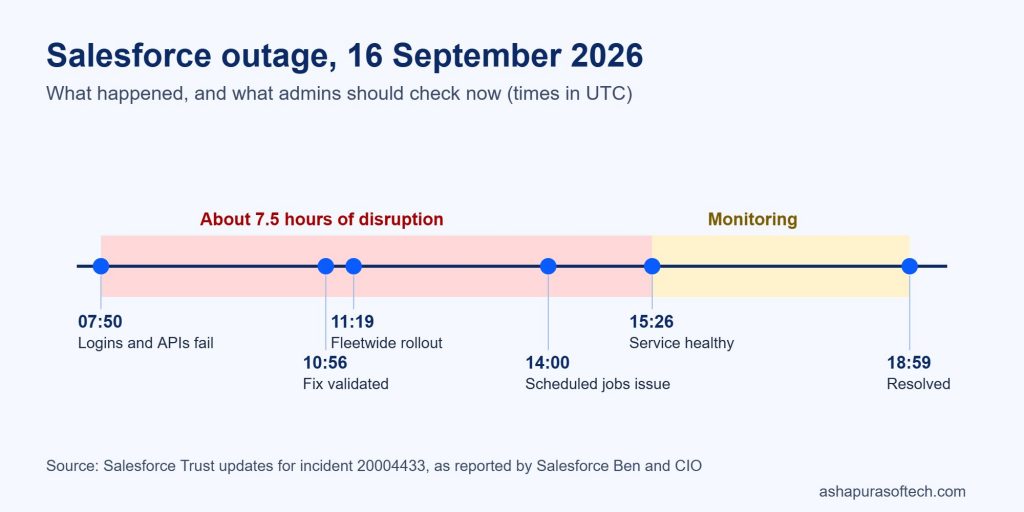
- Salesforce outage September 2026: what happened and what admins should check
Frequently asked questions
AIforce vs Agentforce: is it the same thing?
No. Agentforce is the set of AI agents that do work inside Salesforce. AIforce is the layer that lets people and agents reach Salesforce from Claude, Slack and Lightning. Agentforce Coworker is where the two meet. Our comparison of Claudeforce vs Agentforce goes deeper.
Is SIForce a different product from AIforce?
No. SIForce is the new name Marc Benioff announced on 9 October 2026 for the same product. No feature or pricing change came with it.
Do we have to pay extra for AIforce?
Salesforce hasn’t published a single AIforce price. What is confirmed is that registered agent calls to production orgs will be metered as Headless Platform Interactions and paid in Flex Credits, at a rate still listed as “TBA”. Confirm your entitlements with your account executive.
Will our existing integrations be billed as HPIs?
Traditional integrations keep their current pricing. The new meter applies to AI agents and MCP clients that are registered under Agentic Identity.
Which Claude plan does Salesforce in Claude need?
Published sources disagree, so check the current admin setup guide on AgentExchange or ask your Salesforce account team before you budget for it.
When do the new rules start?
Salesforce is targeting November 2026. New purchases from 17 September 2026 and anyone using a Salesforce MCP server have three months from Salesforce’s Agentic Identity notice to register agents. Existing customers with API-based agents move over at renewal.
The bottom line
AIforce, now SIForce, is not a migration of your Salesforce org. It is a new front door, and the house behind it stays the same. The work is in the doorway: knowing which agents come in, giving each one its own key, and budgeting for the new meter before it starts.
Ashapura Softech can run an AIforce readiness review for your org, covering an agent inventory, a permission audit and a Flex Credit estimate. Our Salesforce Agentforce consulting team handles agent setup and permissions, or you can talk to our Salesforce team directly.
How we put this guide together
Everything about registration, billing and deadlines here comes from Salesforce’s own help article on AIforce impact, dated 17 September 2026. Product details come from Salesforce’s Dreamforce announcements, and the rename from Marc Benioff’s post on 9 October. A few things are still open (the HPI price, final packaging), and we’ve said so where they come up rather than guessing. We’ll update this page when Agentic Identity goes live.
About the author
Ankur Pandey is Marketing Manager at Ashapura Softech, a certified Salesforce and Odoo partner with offices in Irving, Texas and Ahmedabad, India. He writes about Salesforce, Zoho and ERP planning for US mid-market businesses.