



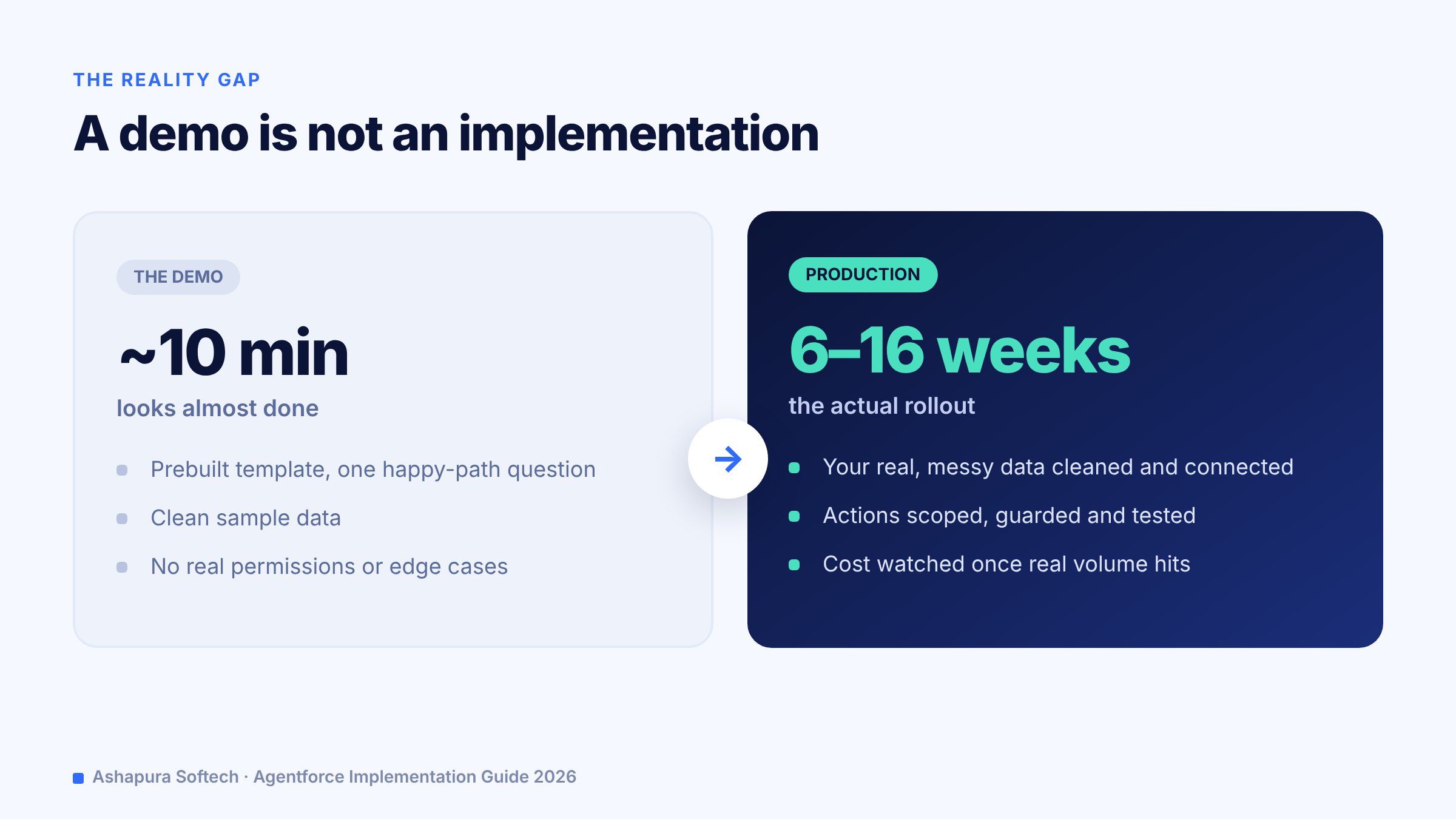
Most teams come to Agentforce implementation expecting a switch they can flip. The demo takes ten minutes, the agent answers a question, and it feels close to done. Then the project meets real data, real permissions and real edge cases, and the ten-minute demo turns into a multi-month program.
We build on Salesforce every week, and the pattern is consistent: the gap between a working demo and a production agent is almost never the AI. It is the data the agent reads, the actions it is allowed to take, and the cost of every action once real volume hits. This guide walks through what an Agentforce implementation actually involves in 2026, what it costs, how long it takes, and how to tell whether your org is ready before you spend anything.
What Agentforce implementation actually means
Agentforce is Salesforce’s platform for building autonomous AI agents that sit on top of your CRM. An agent reads data, decides what to do, and takes actions, for example looking up an order, drafting a reply, updating a case, or escalating to a human.
An implementation is the work of getting one or more of these agents from idea to production. It is not a single task. It is a sequence: deciding what the agent should do, cleaning the data it will rely on, defining the actions it is allowed to perform, testing it against real scenarios, and watching the cost once it goes live.
One point that trips up buyers: Agentforce sits on an existing Salesforce foundation. For service agents that usually means Service Cloud, and recent editions require a capable tier underneath. So the Agentforce cost is an addition on top of your platform license, not a standalone price. Budget for both.
The five phases of an Agentforce implementation
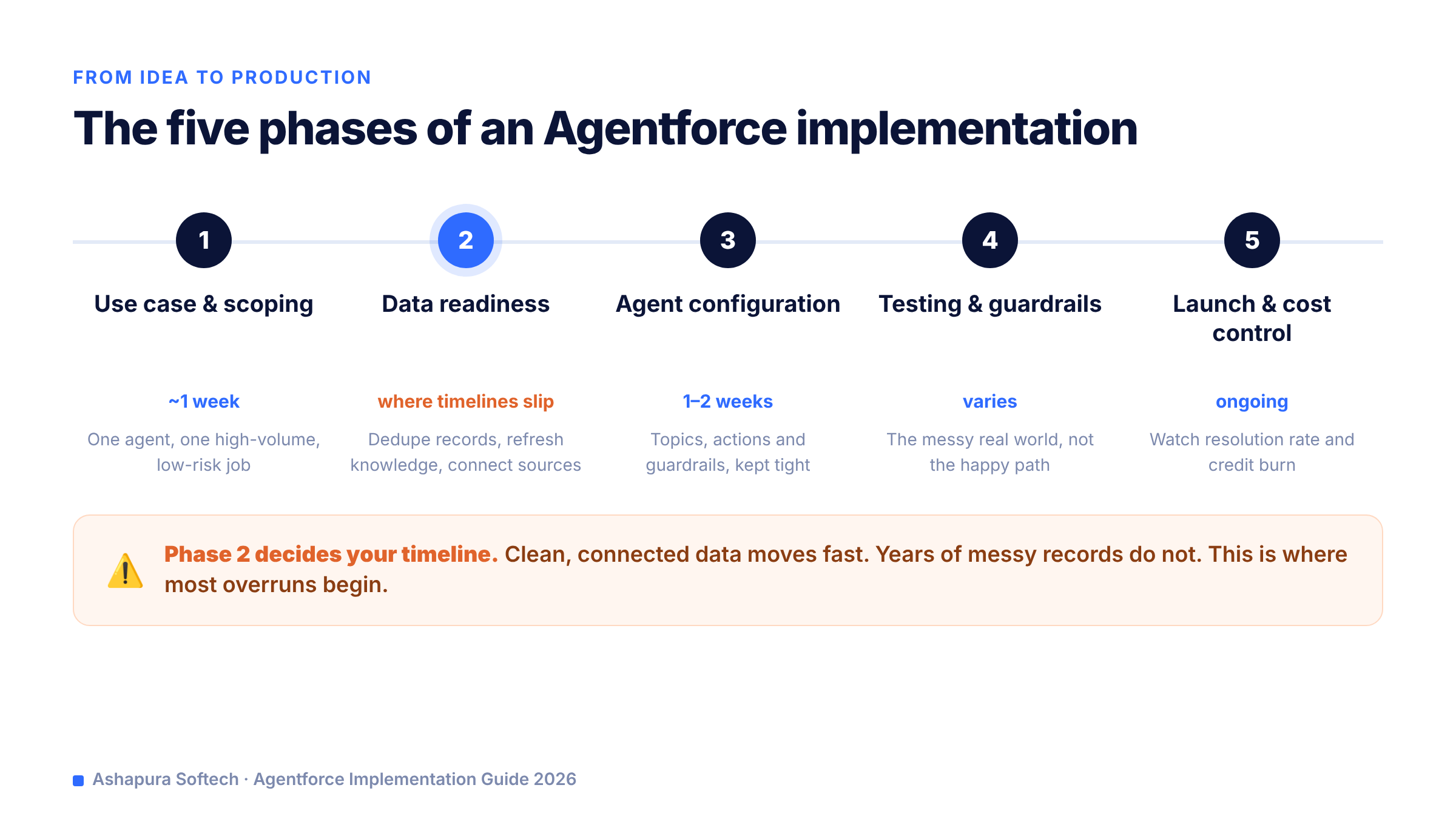
Across projects, a realistic Agentforce implementation moves through five phases. The phase names vary by partner, but the Agentforce implementation work itself does not.
Phase 1: Use case and scoping (about 1 week)
Pick one agent and one job. The teams that struggle are the ones who try to make an agent do everything in version one. The teams that succeed pick a single, high-volume, low-risk task, order status lookups, password resets, appointment scheduling, and prove it before adding scope.
Phase 2: Data readiness (the phase that decides your timeline)
This is where most timeline overruns begin. An agent is only as good as the data it reads. If your knowledge articles are stale, your records are duplicated, or your data is scattered across systems that were never connected, the agent inherits all of it. Deduplicating records, refreshing knowledge, and connecting sources is unglamorous work, and it is the single biggest driver of how long the project takes.
Phase 3: Agent configuration (1 to 2 weeks)
This is the part that looks like the demo. You define the agent’s topics, the actions it can take, and the guardrails around them. The work here is less about building and more about restraint, giving the agent exactly the actions it needs and no more, because every extra action is both a risk and a cost.
Phase 4: Testing and guardrails
A production agent needs to be tested against the messy real world, not the happy path. What happens when the customer asks something off-topic? When the data is missing? When the agent is about to take an action it should not? This phase is where a safe agent is separated from a liability.
Phase 5: Launch, monitoring and cost control
Going live is the start, not the finish. Once real volume hits, you watch two things: whether the agent is actually resolving interactions, and what each interaction is costing you. We will come back to that cost, because it is where budgets quietly break.
How long does an Agentforce implementation take?
Here is where an Agentforce implementation forces you to ignore the headline and read the benchmarks.
Salesforce and some partners point to a quick start, and it is true that a basic agent using prebuilt templates can be stood up in days. That is a pilot, not a production rollout.
For a realistic production timeline, independent reporting across many deployments lands in a wide band:
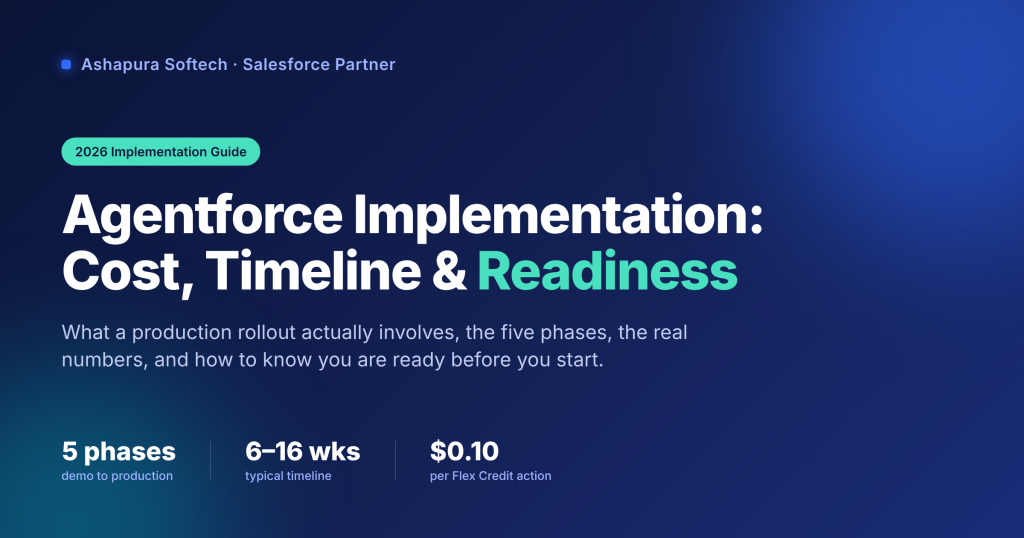
- A first agent on reasonably clean data: roughly 6 to 8 weeks
- An enterprise multi-agent program with data harmonization and legacy integration: 12 to 16 weeks
- At full enterprise scale, third-party analysis has pegged the realistic range at 22 to 44 weeks, or about 5.5 to 11 months, and reported that fewer than 10 percent of customers have scaled it fully
The spread in Agentforce implementation timelines is not because the software is slow. It is because phase 2, your data, varies enormously from one company to the next. A team with clean, connected data moves fast. A team with years of messy records does not.
How much does Agentforce implementation cost?
An Agentforce implementation has two separate costs, and buyers routinely confuse them: the running cost of the agent, and the one-time cost of implementing it.
The running cost: Flex Credits and the models
As of the Salesforce Agentforce pricing page checked in September and October 2026, Salesforce runs several meters at once. For a full breakdown, see our guide to Agentforce pricing. In short:
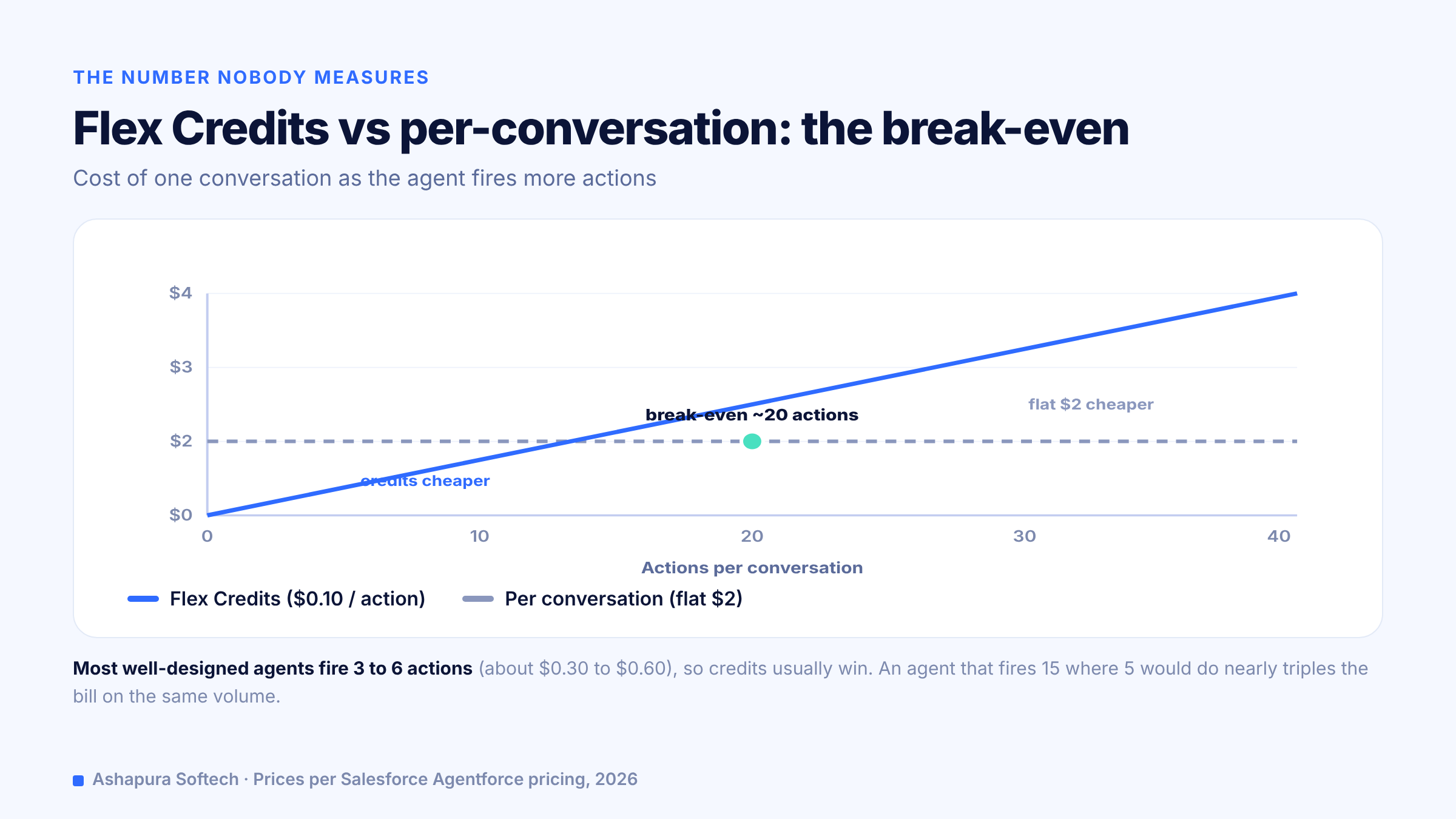
- Flex Credits: 500 US dollars per 100,000 credits. A standard action consumes 20 credits, so about 0.10 US dollars per action. A voice action is 30 credits, about 0.15 US dollars.
- Per conversation: 2 US dollars per conversation, regardless of how many actions it triggers.
- Per resolution (Help Agent): 2 US dollars per resolved conversation, or 400 credits.
- Per user and editions: the newer Core, Advanced and Max editions run from about 195 to 550 US dollars per user per month, bundling large annual credit pools.
The number almost nobody measures before signing: Flex Credits and the flat 2 dollar conversation model break even at about 20 actions per conversation. Below 20 actions, credits are cheaper. Above 20, the flat conversation model wins. Salesforce’s own example puts a typical exchange at 3 to 6 actions, or about 0.30 to 0.60 US dollars on credits versus 2 dollars flat, so for most well-designed agents, credits are the cheaper meter.
This is why agent design is a cost decision, not just a capability decision. An agent that fires 15 actions where 5 would do nearly triples your bill on the same volume.
For a deeper breakdown of every pricing meter, see the SalesforceBen guide to Agentforce pricing.
The implementation cost
The one-time cost of getting to production depends almost entirely on your data and complexity. Independent benchmarks across the market in 2026 put partner implementation somewhere in the range of about 35,000 to 150,000 US dollars for a mid-market deployment, with strategy and discovery often a separate line, and data preparation frequently the largest hidden cost. At enterprise scale with heavy integration, totals run far higher.
The honest takeaway: ask any partner for a combined total cost of ownership, license plus implementation plus data work plus ongoing credits, before you commit. A quote that covers only the license is the start of the number, not the number. The same discipline applies when you choose a Salesforce implementation partner for any project, not just Agentforce.
An Agentforce readiness checklist
Before you start an Agentforce implementation, run through this. If you cannot answer yes to most of it, fix that first.
- One clear use case. Can you name one high-volume, low-risk task the agent will own first?
- Clean, connected data. Are the records and knowledge the agent will read accurate and in one place, or do they need work?
- Defined actions. Do you know exactly which actions the agent should and should not be able to take?
- A cost baseline. Have you estimated the average actions per interaction and modeled it against your worst-case volume?
- A human escape hatch. Is there a clean path for the agent to hand off to a person when it should?
- An owner. Who watches the agent after launch, both its resolution rate and its credit burn?
A red flag worth remembering: any partner who quotes you an agent build without first insisting on a data readiness assessment is skipping the phase that decides whether the project succeeds.
Where this leaves a buying decision
Agentforce can genuinely take work off a team’s plate. The implementations that deliver that are the ones built on a clear use case, clean data, a tightly designed set of actions, and a cost model someone is actually watching. The ones that disappoint are almost always the ones that treated the Agentforce implementation as a demo that scaled itself.
If you are weighing an Agentforce implementation and want a straight answer on readiness, cost, and timeline for your specific setup, our team offers a Salesforce Agentforce consulting assessment worth doing before anyone talks about a contract.
Frequently asked questions
How long does an Agentforce implementation take?
A first agent on reasonably clean data typically takes 6 to 8 weeks. An enterprise multi-agent program runs 12 to 16 weeks, and third-party analysis puts full enterprise scale at 22 to 44 weeks, about 5.5 to 11 months. The variable that decides it is your data readiness.
How much does Agentforce cost?
Running cost: Flex Credits are 500 US dollars per 100,000 credits, about 0.10 US dollars per action; the per-conversation model is 2 US dollars; the Help Agent resolution model is 2 US dollars per resolved conversation; and the Core, Advanced and Max editions run from about 195 to 550 US dollars per user per month. On top of that, partner implementation for a mid-market deployment is commonly in the 35,000 to 150,000 US dollars range.
Do I need Service Cloud for Agentforce?
Agentforce sits on an existing Salesforce foundation. For service agents that usually means a capable Service Cloud tier underneath, so the Agentforce cost is added on top of your platform license rather than replacing it.
What is the biggest hidden cost in an Agentforce implementation?
Data preparation. Deduplicating records, refreshing knowledge and connecting sources is the single biggest driver of timeline and cost, and it is frequently larger than the agent configuration itself. A poorly designed agent that fires too many actions is the second hidden cost, because every extra action adds to the bill.
Flex Credits or per-conversation pricing: which is cheaper?
They break even at about 20 actions per conversation. Below 20 actions, Flex Credits are cheaper; above 20, the flat 2 dollar conversation model is cheaper. Since most well-designed agents fire only 3 to 6 actions, credits usually win.