


Last updated: October 26, 2026
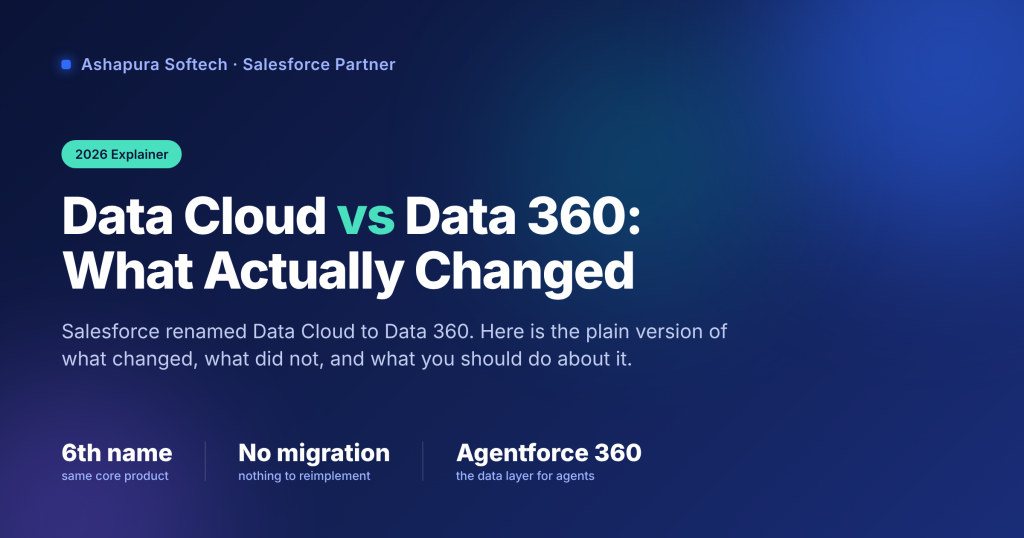
If you run Salesforce, you woke up one morning to find Data Cloud had a new name. Data Cloud vs Data 360 is the question every admin and RevOps lead started asking, and the honest first answer is that it is the same product with a new name and a changed center of gravity. The deeper answer, the one that matters for your roadmap, is that the rename signals a shift in what Salesforce expects you to do with your data.
We work on Salesforce data projects every week, so here is the plain version of the Data Cloud vs Data 360 change: what changed, what did not, and what, if anything, you need to do about it.
Data Cloud vs Data 360: the short answer
Data 360 is the new name for Salesforce Data Cloud. Salesforce announced it at Dreamforce in October 2025, and it is available globally. Nothing you built in Data Cloud breaks, and you do not need to reimplement anything. Your data streams, data model objects, identity resolution rules and segments carry over as they are.
If that were the whole story, it would not be worth an article. The reason the Data Cloud vs Data 360 change matters is that it is the sixth name this product has carried, and each rename has marked a change in purpose. This one moves the product from a place where data is stored and queried to a place where data acts.
Data Cloud vs Data 360 at a glance
| Area | Data Cloud (before) | Data 360 (now) |
|---|---|---|
| Name | Salesforce Data Cloud | Data 360, announced at Dreamforce in October 2025, available globally |
| Your implementation | As built | Carries over as is, no reimplementation or forced migration |
| Data streams, model, identity resolution, segments | In place | Unchanged |
| Pricing and licensing | Existing contracts | Unchanged, as far as Salesforce has said |
| Center of gravity | Data you store, query and report on | Data that acts: feeds agents and workflows in real time |
| Headline additions | Not available | Intelligent Context, Tableau Semantics, Real-Time Pipelines, Data 360 Lakehouse |
Six names, one product: how we got to Data 360
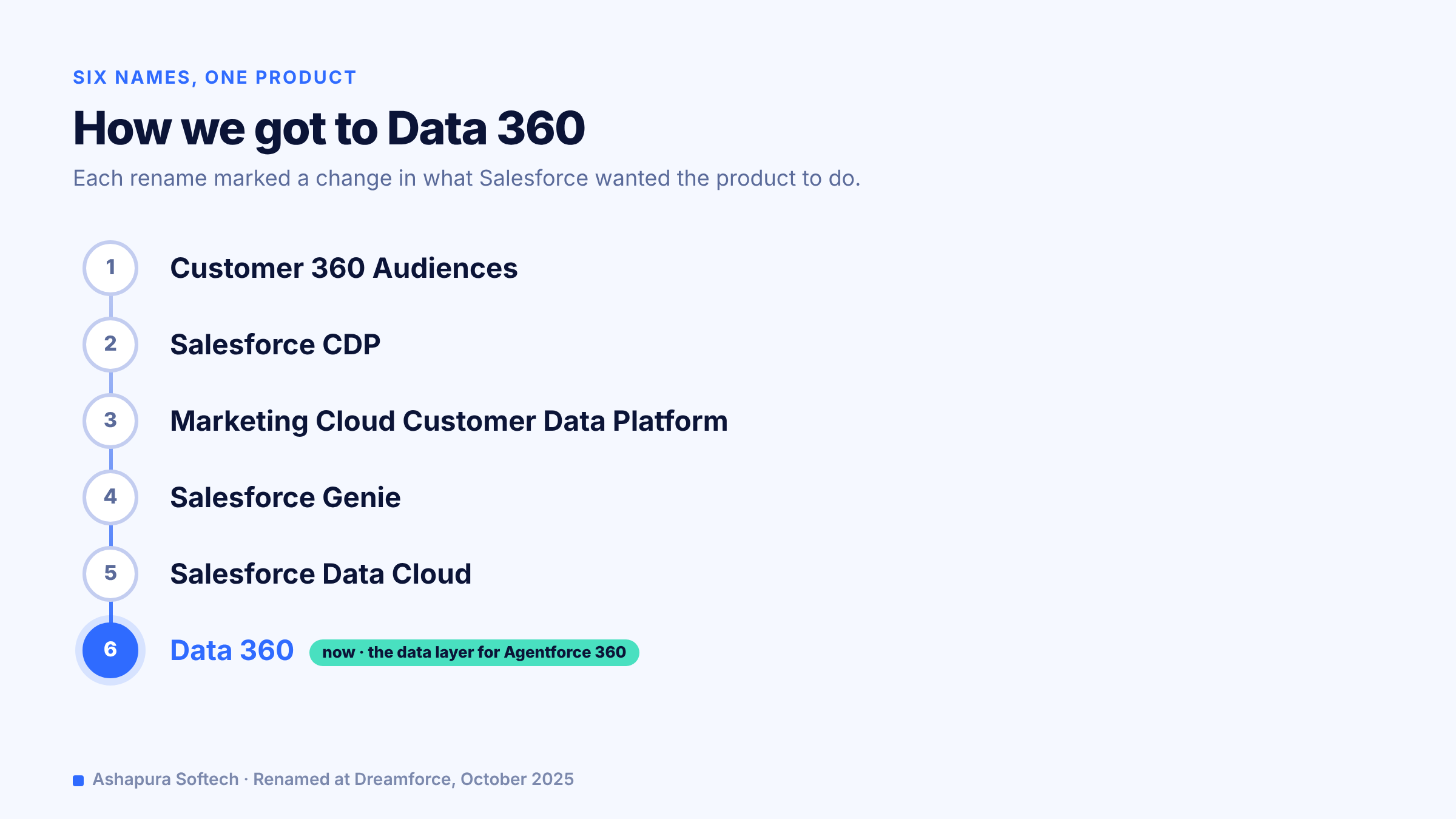
The lineage helps explain the latest Data Cloud vs Data 360 rename. This product has been, in order, Customer 360 Audiences, Salesforce CDP, Marketing Cloud Customer Data Platform, Salesforce Genie, Salesforce Data Cloud, and now Data 360. Each name reflected what Salesforce wanted the product to be at the time, from a marketing data platform to a real-time data engine.
Data 360 is positioned as the data layer for the wider Agentforce 360 framework, as SalesforceBen reported from Dreamforce. In other words, the rename is less about data storage and more about feeding Salesforce’s AI agents the clean, real-time context they need to act.
What actually changed beyond the name
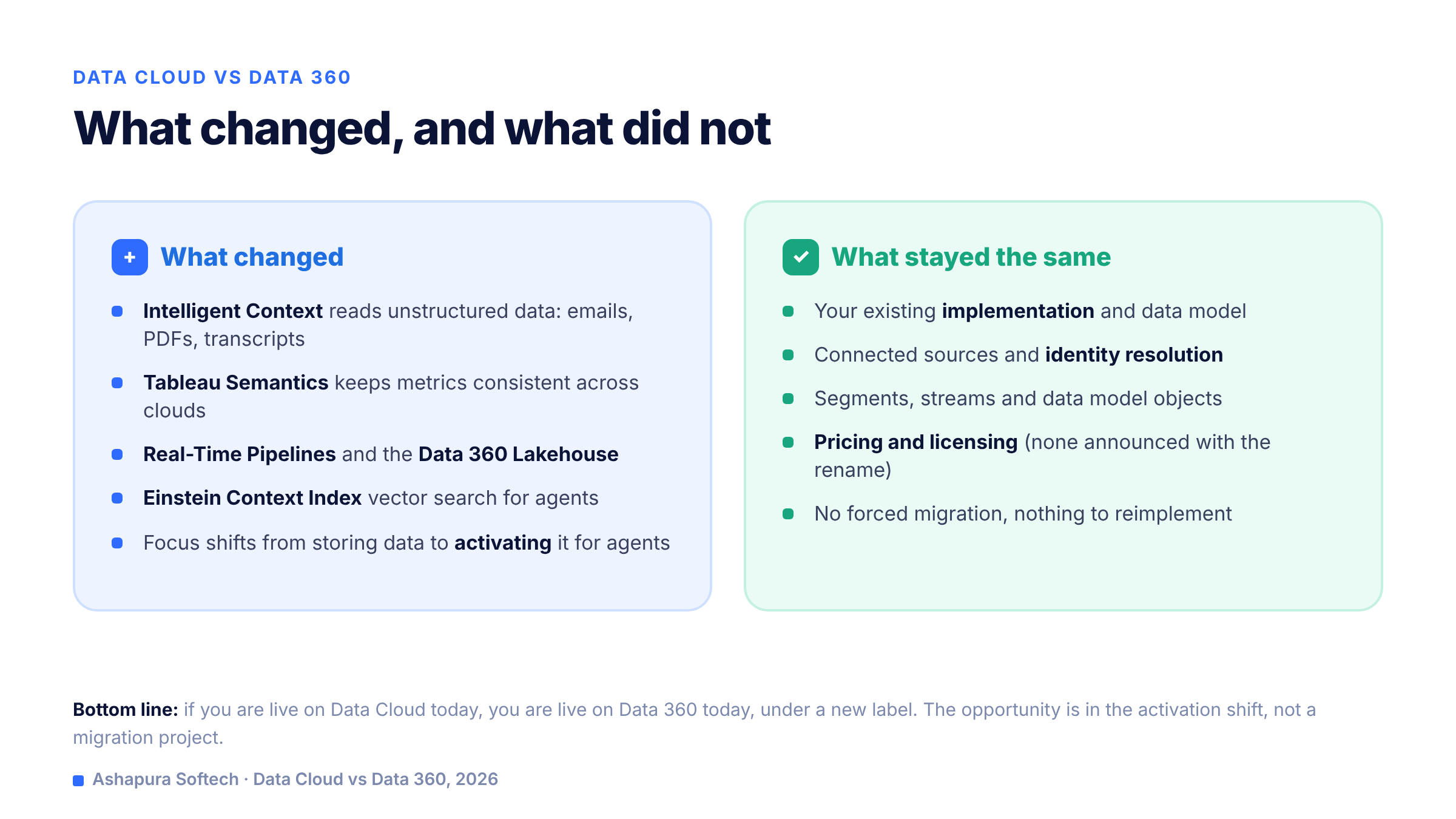
The Data Cloud vs Data 360 rename came with a set of capabilities that are worth knowing, whether they are brand new or evolutions of existing features. The practical theme across all of them is activation: moving data from something you report on to something that drives agents and workflows in real time.
- Intelligent Context. Links structured CRM records with unstructured sources such as emails, PDFs and call transcripts, so an agent can reason over a support history or a contract, not just fields.
- Tableau Semantics. Shared business definitions so a metric like active customer reads the same across clouds and apps, built on the Customer 360 Semantic Data Model.
- Real-Time Pipelines. Faster ingestion and harmonization across Salesforce clouds and external platforms.
- Data 360 Lakehouse. A single architecture for live and historical data, rather than separate stores.
- Einstein Context Index. A vector database that gives agents contextual search across your organization’s data.
If you strip the branding away, the direction is clear. Salesforce wants your data ready to feed agents the moment they need it, which is exactly what an Agentforce implementation depends on.
What did not change
This is the part that saves you a panic. In the Data Cloud vs Data 360 shift, the following did not change: your existing implementation, your data model, your connected sources, your identity resolution, and, as far as Salesforce has said, your pricing and licensing. There was no forced migration and no re-architecture. If you are live on Data Cloud today, you are live on Data 360 today, under a new label.
Free Salesforce implementation checklist
Moving onto Data 360 starts with the same groundwork as any rollout. These are the steps we check on every Salesforce project, from scoping and data to go-live.
Free Salesforce implementation checklist
Moving onto Data 360 starts with the same groundwork as any rollout. These are the steps we check on every Salesforce project, from scoping and data to go-live.
What you should actually do about it
The Data Cloud vs Data 360 rename itself is a no-op for your operations. The opportunity is in the shift it signals. Here is the short list we give clients.
- Do not reimplement. There is no migration project here. Anyone selling you a Data 360 migration is selling you a rename.
- Audit your data quality first. Activation only helps if the data feeding your agents is clean. Duplicates, stale records and gaps become visible fast once an agent is acting on them.
- Map one activation use case. Pick one place where real-time data could drive an action, for example an agent that reads a customer’s full history before replying, and prove it before expanding.
- Connect it to your AI roadmap. Teams that link Data 360 to Agentforce and Einstein early get the advantage. The data layer and the agent layer are now designed to work together.
If you are weighing how Data 360 should feed your agents, our Salesforce Agentforce consulting team can map the data-to-agent path for your specific setup.
Where this leaves you
Data Cloud vs Data 360 is, on the surface, a rename, and you can treat the label change as a non-event. Underneath, the Data Cloud vs Data 360 shift is Salesforce telling you where the platform is going: data that acts, not just data that reports. The teams that read the rename as a prompt to get their data clean and wired into their agents will be the ones who get value from the next wave of Salesforce AI. The teams that treat it as a migration project will waste money on work that does not exist.
Does the Data Cloud vs Data 360 rename change the build-vs-buy question?
A fair question we hear from technical leads in the Data Cloud vs Data 360 debate: if Data 360 is really about activating data for agents, does that change whether you should centralize on Salesforce or keep a separate warehouse or customer data platform? The short answer is that it sharpens the trade-off rather than settling it.
If your agents live in Salesforce and need real-time context to act, keeping that data close to the agent, inside Data 360, removes a round trip and a sync lag that a separate platform introduces. The Data 360 Lakehouse and real-time pipelines exist precisely to make that activation fast.
On the other hand, if your analytics and data science already live in Snowflake, Databricks or BigQuery, you do not have to move them; Tableau Semantics and the partner integrations are designed so Data 360 can share definitions with those platforms rather than replace them.
The Data Cloud vs Data 360 rename does not force a consolidation. It makes the case that the data feeding your agents should be fast and governed, wherever the rest of your stack sits.
Is your data ready for Data 360 activation? A quick check
Because the Data Cloud vs Data 360 shift pushes data from reporting into action, the quality bar goes up. A dashboard can tolerate a few duplicate records; an agent acting on them cannot. Before you lean into the activation story, run this short readiness check.
- Duplicates. Do you have a working identity resolution and dedupe process, or are the same customers represented several times?
- Freshness. How old is the data an agent would read? Real-time activation is only as good as your slowest pipeline.
- Coverage. Are the unstructured sources an agent needs, such as emails and documents, actually connected, or only your structured CRM fields?
- Definitions. Does active customer or churn risk mean the same thing across teams, or will Tableau Semantics be reconciling conflicting definitions?
- Governance. Who owns access and retention once an agent, not just a report, is reading this data?
If most of those answers are shaky, that is your real project, and it has nothing to do with the rename. It is the groundwork that makes the Data Cloud vs Data 360 activation shift pay off.
Data Cloud vs Data 360 frequently asked questions
Is Data 360 the same as Data Cloud?
Yes. Data 360 is the new name for Salesforce Data Cloud, announced at Dreamforce in October 2025. It is the same product with a new name and a sharper focus on feeding real-time data to AI agents.
Do I need to migrate from Data Cloud to Data 360?
No. There is no migration. Your existing Data Cloud implementation, data model, connected sources and identity resolution carry over unchanged. Anyone proposing a Data 360 migration project is charging you for a rename.
Did pricing change with Data 360?
Salesforce did not announce any pricing or licensing change with the rename. If your contract or consumption changes, that would come separately from the renaming, so check your own agreement rather than assuming the new name carries a new price.
What is actually new in Data 360?
The capabilities highlighted alongside the rename include Intelligent Context for working with unstructured content, Tableau Semantics for consistent metrics, real-time pipelines, the Data 360 Lakehouse architecture, and the Einstein Context Index vector database for agent search. The common theme is activating data for AI agents in real time.
How does Data 360 relate to Agentforce?
Data 360 is the data layer of the wider Agentforce 360 framework. It supplies the clean, real-time context that Salesforce AI agents need to reason and act, which is why data quality matters more once you start building agents.