Categories
CRM Salesforce Health Cloud

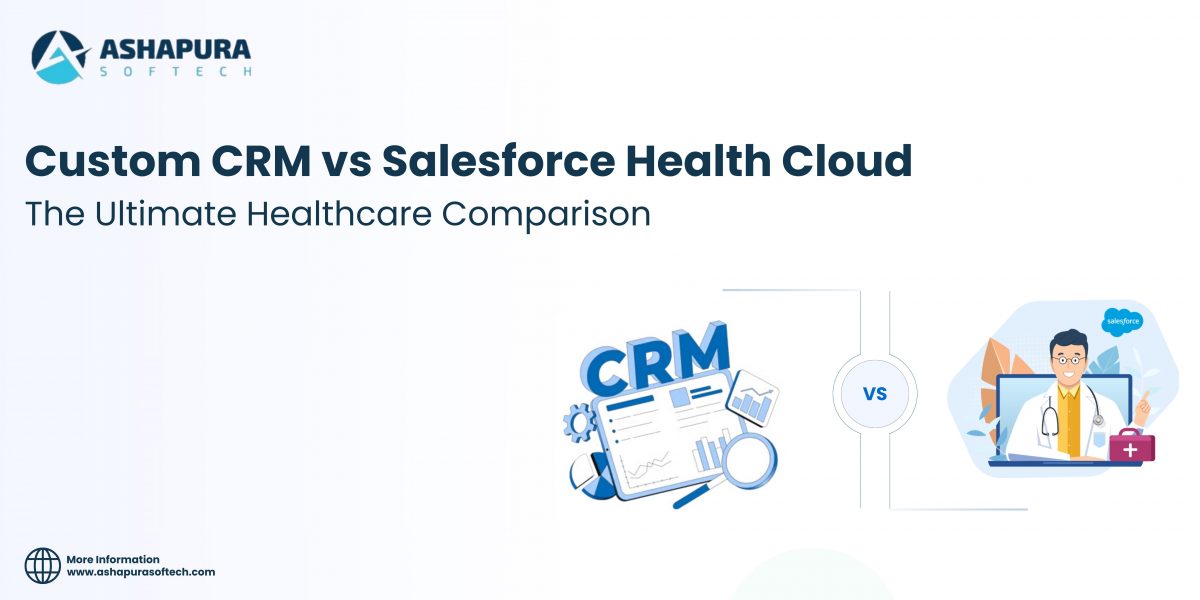
Custom CRM vs Salesforce Health Cloud vs Epic: Healthcare Comparison

Introduction

If you are weighing Salesforce Health Cloud vs Epic, start here: they are not competitors. Epic is the clinical system of record and Health Cloud is the CRM that works around it, which is why most health systems end up running both. The genuine choice is between Salesforce Health Cloud and a custom healthcare CRM, and that is what this guide compares, with a section on where Epic fits further down.

The healthcare industry is undergoing one of its fastest-ever digital transformations. As hospitals, clinics, labs, and pharmacies prioritize patient-centric care, the demand for intelligent, interoperable, and compliant CRM platforms has never been higher. From improving care coordination to enhancing patient engagement and reducing administrative burden, healthcare CRM systems now play a critical role in how modern organizations operate.

In 2025, two major CRM approaches dominate conversations among healthcare IT leaders: Custom healthcare CRM development and Salesforce Health Cloud. Each model offers powerful capabilities, but they are fundamentally different in design, scalability, customization, integration workflows, and long-term cost structure. Understanding these differences is essential for any organization evaluating which system best supports their clinical workflows, digital strategy, or expansion plans.

A Custom CRM for healthcare providers is built from the ground up to match exact operational needs, giving complete control over workflows, modules, data flows, and compliance mechanisms. In contrast, Salesforce Health Cloud offers a ready-to-deploy, enterprise-grade CRM with built-in healthcare features, Patient 360 insights, native compliance controls, and strong EHR integration capabilities.

Choosing between a custom CRM and Salesforce Health Cloud is not a simple feature comparison. It is a strategic decision that affects interoperability with EHR systems, the speed of digital transformation, HIPAA compliance, and the long-term scalability of your healthcare organization. Whether you’re managing complex hospital workflows, operating a small clinic, expanding diagnostic labs, or running a pharmacy network, the right CRM can significantly improve patient outcomes and operational efficiency.

In this comprehensive guide, we break down the strengths, limitations, costs, integrations, and ideal use cases for both CRM options to help you make the best decision for 2025 and beyond. If you’re comparing custom CRM and Salesforce Health Cloud for your healthcare organization, this guide gives you the clarity you need to move forward confidently.

Salesforce Health Cloud vs Epic: what each one is actually for

This comparison comes up in almost every healthcare CRM conversation, and it starts from a false premise. Epic and Salesforce Health Cloud are not competing products. Epic is an electronic health record, the clinical system of record where charting, orders, results and documentation live. Health Cloud is a CRM, the engagement layer that sits around that record and manages outreach, care coordination and service.

Most health systems running Epic also run a CRM. The real question is not which one to buy. It is which system owns which job, and how the two exchange data.

Epic (EHR)Salesforce Health Cloud (CRM)
Primary jobClinical system of recordEngagement and relationship layer
What it holdsCharts, orders, results, clinical documentationCare plans, outreach history, cases, consent and communication preferences
Primary usersClinicians, coders, revenue cycle teamsCare coordinators, patient access, service and marketing teams
Integration routeFHIR APIs via Epic on FHIR; HL7v2 for legacy feedsConsumes those feeds; the Health Cloud data model maps to FHIR resources
Replaces the other?NoNo

When the choice does actually matter

There are two situations where teams genuinely have to decide rather than run both.

  • Epic already covers the requirement. Epic ships its own tools for scheduling outreach and patient messaging. If your need stops there, adding a CRM means another licence and another integration for limited gain.
  • You need to serve people who are not patients yet. Referral sources, prospective members, employer groups, community programme contacts. Those records do not belong in a clinical chart, and this is where a CRM earns its place.

The same logic applies to Oracle Health (Cerner), athenahealth and MEDITECH. The EHR stays the clinical record and the CRM handles the relationship around it. For the technical detail on how that connection is built, see Salesforce Health Cloud EHR integration, and for the delivery side, our Health Cloud implementation services.

How Health Cloud and Epic actually connect

The standard route is FHIR. Epic exposes patient data through its FHIR APIs, and Salesforce Health Cloud consumes it through its own healthcare data model. HL7 interfaces are still common where older data flows are already in place, and MuleSoft is used when several systems need connecting rather than just two.

The direction of trust matters more than the technology. Epic stays the clinical source of truth. Health Cloud reads from it, acts on it, and writes back only where a workflow genuinely requires it. Teams that let both systems edit the same clinical fields end up with two versions of the same record and a compliance problem nobody wants to own.

What goes wrong when the roles get confused

Two failure patterns show up repeatedly. The first is running outreach and care management inside Epic because it is already there. The tooling for campaigns, consent and follow up was never built for that work, so it quietly moves into spreadsheets and shared inboxes.

The second is treating Health Cloud as a second clinical record. It is not the legal medical record, and using it as one creates duplication, audit gaps and reconciliation work that grows every month.

If you are choosing between them, the useful question is not Epic or Health Cloud. It is whether the problem you are trying to fix is clinical documentation, or everything that happens around it.

What Is a Custom Healthcare CRM?

A custom healthcare CRM is a fully personalized patient relationship management platform designed to streamline clinical workflows, administrative operations, and patient engagement for healthcare providers. Unlike off-the-shelf CRMs, a custom solution aligns perfectly with your organization’s clinical protocols, care programs, and compliance requirements, delivering optimized workflows and enhanced patient experiences.

Custom healthcare CRMs support a broad range of functions, including

  • Physician-specific workflows and care team coordination
  • Multi-location patient journey tracking for hospitals, clinics, and labs
  • Electronic medical record (EMR) and medical record management
  • Personalized patient communication via email, SMS, or portals
  • Analytics and reporting dashboards for administrators and management

The key advantage of custom CRM development for healthcare is flexibility. Organizations can design modules tailored for patient onboarding, chronic care management, physician scheduling, insurance verification, and operational reporting. Every workflow can be adapted to the unique requirements of hospitals, outpatient clinics, diagnostic labs, or pharmacies, making it ideal for complex healthcare operations.

Compliance is a cornerstone of modern healthcare CRMs. A HIPAA-compliant CRM for healthcare includes role-based access controls, encrypted data transmission (TLS 1.2+), secure PHI storage, and detailed audit logs. Many platforms also integrate HL7 and FHIR standards, enabling seamless EHR integration with CRM systems.

Integration capabilities are another strength. Custom CRMs can connect with leading EHR/EMR systems such as Epic, Cerner, Allscripts, and AthenaHealth via HL7/FHIR APIs. This ensures automated patient data synchronization, reduces manual entry errors, and enhances care coordination. By combining full customization, regulatory compliance, and robust interoperability, a custom healthcare CRM empowers healthcare organizations to improve operational efficiency, patient satisfaction, and long-term clinical outcomes in today’s evolving digital healthcare ecosystem.

What Is Salesforce Health Cloud?

Salesforce Health Cloud is a cloud-based, healthcare-specific CRM platform built on the robust Salesforce ecosystem. Designed for hospitals, clinics, laboratories, and pharmacies, it helps healthcare organizations deliver patient-centered care, streamline clinical workflows, and boost operational efficiency. Unlike traditional CRMs, Health Cloud comes with pre-built healthcare modules, strong interoperability, and enterprise-grade security, making it a top choice for organizations that want rapid deployment without compromising on scalability, compliance, or performance.

Overview and Core Capabilities

Salesforce Health Cloud offers a Patient 360 view, unifying patient data across EHR/EMR systems and other healthcare sources.

Its core features include:
  • Care coordination and team collaboration across departments and facilities
  • Automated patient engagement through email, SMS, and secure portals
  • Clinical workflow management for appointments, follow-ups, and chronic care programs
  • Analytics and reporting dashboards for outcomes and operational performance
  • AI-powered insights via Salesforce Einstein to support clinical decision-making

Built-In Compliance and Security

Health Cloud is built for HIPAA and HITRUST compliance, offering:
  • Salesforce Shield for encryption, field-level security, and auditing
  • Role-based access controls to safeguard PHI (Protected Health Information)
  • Multi-layered security frameworks to ensure regulatory adherence

Integration Capabilities

Salesforce Health Cloud seamlessly integrates with leading EHR/EMR systems like Epic, Cerner, Allscripts, and AthenaHealth using HL7 and FHIR APIs. This enables automated patient record updates, smoother data interoperability, and more efficient care coordination, while minimizing manual data entry errors.

Health Cloud for Healthcare Verticals
  • Clinics: Quick deployment of patient engagement workflows
  • Hospitals: Enterprise-scale CRM for multi-location operations
  • Laboratories: Automated test orders and results notifications
  • Pharmacies: Prescription, inventory, and patient history management

By combining pre-configured workflows, enterprise-level security, AI insights, and seamless EHR integration, Salesforce Health Cloud empowers healthcare organizations to accelerate digital transformation, improve patient satisfaction, and optimize operational efficiency in 2025 and beyond.

Custom CRM vs Salesforce Health Cloud: Side-by-Side Comparison

Selecting the right healthcare CRM in 2025 requires a deep evaluation of features, flexibility, integration capabilities, cost, and scalability. Both a custom healthcare CRM and Salesforce Health Cloud offer robust solutions for patient management, care coordination, and compliance, but their strengths differ depending on the healthcare setting. From hospitals managing large patient populations to small clinics optimizing workflow efficiency, understanding these differences is critical for informed decision-making.

Feature Comparison: Custom CRM vs Salesforce Health Cloud

When comparing custom healthcare CRMs and Salesforce Health Cloud features, several key areas stand out. Custom CRMs provide fully customizable workflows, patient management modules, and dashboards tailored to specific organizational needs. Messaging and communication can include secure notifications, telehealth integration, and automated follow-ups, while care plans are entirely designed to match internal clinical processes. Interoperability is flexible, with HL7 and FHIR EHR integration tailored to the healthcare provider’s exact workflows. Reporting and analytics can be customized with dashboards and KPI tracking specific to patient outcomes and operational efficiency.

In contrast, Salesforce Health Cloud delivers a Patient 360 view with standardized workflows and pre-built dashboards, enabling rapid onboarding and easy adoption. Messaging is built in and secure, while care plans are pre-configured with AI-assisted recommendations. Interoperability comes with ready-made HL7/FHIR connectors for Epic, Cerner, and AthenaHealth, and analytics include AI-powered insights for population health and operational reporting.

Scalability & Flexibility

Custom healthcare CRMs excel in flexibility, allowing healthcare organizations to design workflows, add features, and scale modules according to evolving needs. Long-term scalability depends primarily on development resources, offering unparalleled customization for hospitals, labs, and multi-location clinics. On the other hand, Salesforce Health Cloud scalability is enterprise-ready out of the box. It supports multi-location health systems and large patient populations without the need for extensive custom development, making it ideal for organizations that require fast deployment and standardized workflows.

Cost Comparison

The cost of a custom CRM generally includes one-time development, periodic updates, and ongoing support. Although the initial investment can be higher, recurring licensing costs are minimal, providing a predictable total cost of ownership over time. Salesforce Health Cloud costs typically include subscription licensing, consulting fees, and optional implementation services. While Health Cloud offers faster deployment, recurring licensing and consulting expenses can accumulate, especially for larger hospital systems.

Data Interoperability (EHR/EMR Integration)

Custom CRMs can integrate deeply with electronic health record (EHR) systems like Epic, Cerner, and AthenaHealth using HL7 and FHIR standards. Integration depth can be tailored to meet specialized workflows, lab reporting, and telehealth requirements. Salesforce Health Cloud integration with EHR comes with pre-built connectors for Epic and Cerner, facilitating fast interoperability and enabling seamless patient data flow across clinical systems. Both options support healthcare CRM interoperability, but custom CRMs offer more flexibility for highly specialized workflows.

Compliance & Security

Custom healthcare CRMs can be designed to fully comply with HIPAA, HL7, and FHIR standards. Features often include encrypted data storage, detailed audit trails, and granular access controls, ensuring sensitive patient information remains secure. Salesforce Health Cloud comes with built-in HIPAA compliance, Salesforce Shield security, and robust auditing capabilities, making regulatory adherence straightforward with minimal customization.

Time-to-Market & Deployment Speed

Custom CRMs typically require 3 to 12 months for full development and deployment, depending on workflow complexity and integrations. While longer, this timeline allows full customization and a system tailored to the organization’s needs. Salesforce Health Cloud can be deployed within weeks, thanks to pre-built modules, templates, and standardized workflows. This makes it ideal for healthcare organizations prioritizing rapid implementation, such as multi-location hospitals or urgent clinic expansions.

Which Solution Is Better for Hospitals, Clinics, Labs, and Pharmacies?

Selecting the right healthcare CRM in 2025 requires evaluating organizational size, workflow complexity, integration needs, and patient engagement goals. Both custom healthcare CRMs and Salesforce Health Cloud provide robust solutions for improving patient management, operational efficiency, and regulatory compliance. However, the best choice often varies by healthcare vertical. By examining hospitals, clinics, laboratories, and pharmacies, healthcare leaders can identify which CRM solution aligns with their operational strategy and long-term digital transformation goals.

Hospitals & Multi-Location Health Systems

Large hospitals and multi-location health systems manage extensive patient data across numerous departments. In these environments, Salesforce Health Cloud for hospitals often provides the best fit. With enterprise-level scalability, pre-built workflows, and Patient 360 capabilities, clinicians can access a comprehensive view of patient records, coordinate care effectively, and track outcomes across all locations. Health Cloud also supports seamless EHR integration with Epic and Cerner, enabling secure data exchange while maintaining HIPAA compliance. Custom CRMs can be implemented in large hospitals; their development timeline and integration complexity may slow deployment. Organizations with highly specialized workflows, custom reporting needs, or unique clinical processes may still benefit from a tailored CRM approach, particularly for long-term adaptability.

Clinics & Small Practices

Small clinics and private practices often gain more from custom healthcare CRM solutions. These systems allow healthcare providers to design patient management workflows that fit their size, specialization, and care delivery model. Features such as appointment scheduling, care plan management, and telehealth communication can be customized, eliminating unnecessary complexity. While avoiding ongoing licensing fees typical of enterprise platforms like  Salesforce Health Cloud can still serve clinics well, especially when standardized workflows, AI-driven patient engagement, or integration with a larger hospital network is a priority. Clinics should weigh the advantages of rapid deployment against the flexibility and long-term cost efficiency offered by a custom CRM.

Laboratories & Diagnostics

Laboratories require precise integration with diagnostic instruments, Lab Information Systems (LIS), and EHR platforms to deliver timely and accurate results. Salesforce Health Cloud for labs provides pre-built EHR connectors, secure messaging, and standardized workflow automation, ensuring faster results sharing and improved operational efficiency. Custom CRMs, however, enable labs to build highly specialized integration modules, tailor reporting pipelines, and support proprietary software or complex analytics. This flexibility is ideal for research-focused labs or diagnostic centers with unique workflow requirements.

Pharmacies & Retail Health

Pharmacies and retail healthcare chains manage prescriptions, refill reminders, medication adherence, and patient engagement while maintaining HIPAA compliance. Salesforce Health Cloud for pharmacies offers pre-configured workflows, automated adherence tracking, and built-in patient communication, making it ideal for high-volume retail operations. Custom CRMs allow pharmacies to create tailored workflow automation, integrate loyalty programs, and manage telehealth or inventory processes. This flexibility helps organizations with complex retail operations or specialized services that standard platforms may not fully support.

When to Choose Custom Healthcare CRM

A custom healthcare CRM is best suited for healthcare organizations with highly specialized workflows, unique patient engagement requirements, or complex integration needs. These solutions offer complete flexibility, allowing hospitals, clinics, laboratories, and pharmacies to design modules that align precisely with clinical and operational processes.

Key scenarios for choosing a custom CRM include:
  • Highly Specialized Workflows: Organizations with unique clinical protocols, research-oriented processes, or multi-department coordination may require tailored modules that off-the-shelf platforms cannot provide.
  • Advanced Integration Needs: When seamless connection with multiple EHRs, telehealth platforms, lab systems, or proprietary software is critical, a custom CRM can be configured for deep interoperability using HL7/FHIR standards.
  • Full Data Ownership: Custom solutions allow healthcare providers to control how patient data is stored, accessed, and analyzed, providing more flexibility in compliance management and reporting.
  • Predictable Long-Term Costs: While initial development may require investment, custom CRMs typically avoid recurring licensing fees, making budgeting more predictable.

When to Choose Salesforce Health Cloud

Salesforce Health Cloud is ideal for healthcare organizations seeking rapid deployment, enterprise-level scalability, and standardized workflows. Its pre-built modules and AI-assisted features make it an excellent choice for hospitals, multi-location systems, and organizations with existing EHR integrations.

Key scenarios for choosing Salesforce Health Cloud include:
  • Rapid Deployment: Organizations needing a solution quickly can leverage Health Cloud’s ready-made templates, reducing implementation time from months to weeks.
  • Enterprise-Scale Operations: Large hospitals, multi-site clinics, and laboratories benefit from Health Cloud’s ability to manage vast patient populations while maintaining HIPAA-compliant security and auditing features.
  • AI and Automation: Health Cloud includes Patient 360, AI-driven insights, and workflow automation, improving care coordination and patient engagement without extensive custom coding.
  • Integration with Major EHRs: Health Cloud provides pre-built EHR integration with Epic, Cerner, AthenaHealth, and other major systems, simplifying interoperability for large healthcare networks.

Implementation Considerations for Both Options

Successful implementation of a healthcare CRM, whether a custom healthcare CRM or Salesforce Health Cloud, requires strategic planning and a strong understanding of technical, operational, and compliance factors. As healthcare organizations move toward more connected, patient-centric ecosystems, implementation decisions directly impact workflow efficiency, interoperability, and long-term ROI. Key considerations include the role of healthcare IT consulting firms, potential integration challenges, and the total cost of ownership and vendor dependence for each solution.

Role of Healthcare IT Consulting Firms

A trusted healthcare IT consulting firm plays a critical role in guiding CRM projects from planning to deployment. Consultants specialize in workflow optimization, system architecture, HL7/FHIR strategy, HIPAA compliance, and data governance, helping organizations avoid costly mistakes during setup. Healthcare IT consultants can evaluate whether a custom healthcare CRM or Salesforce Health Cloud is the better strategic fit based on operational size, interoperability needs, and long-term digital transformation plans. They also assist with:

  • Staff training and onboarding
  • Change management for clinical teams
  • System configuration and testing
  • Integration roadmaps for EHRs, LIS, telehealth, and billing platforms

Common Integration Challenges

Integration remains one of the most complex parts of any CRM implementation. Custom healthcare CRMs rely on tailored integrations using HL7, FHIR, APIs, and middleware to connect with EHRs, lab systems, scheduling software, and telehealth platforms. While Salesforce Health Cloud includes pre-built connectors for systems like Epic, Cerner, and AthenaHealth, integration in multi-vendor ecosystems can still create friction.

Common challenges include:
  • Data Mapping and Migration: Ensuring accurate and clean migration of patient histories, care plans, and records from legacy systems.
  • Access Control & HIPAA Security: Aligning permissions across multiple technologies to preserve compliance and prevent unauthorized access.
  • Workflow Alignment: Adjusting clinical and administrative processes to match CRM capabilities and avoid workflow disruption.

Cost, Maintenance & Vendor Dependency

Cost structure is one of the most important factors in CRM decision-making. A custom healthcare CRM typically requires a higher upfront development investment but offers full ownership of the system. Organizations maintain control over:

  • System updates
  • Custom feature development
  • Security and storage models
  • Integration expansion

Salesforce Health Cloud, on the other hand, operates on a subscription-based pricing model that includes platform licensing, consulting fees, and optional add-ons like Salesforce Shield. While the platform provides rapid deployment and continuous innovation, the recurring cost structure and vendor dependency can increase the total cost of ownership for larger enterprises.

Healthcare leaders should evaluate:
  • Annual licensing and consulting fees
  • Ongoing support contracts
  • Expected customization and integration costs
  • Downtime risks and dependency on Salesforce updates

Custom CRM vs Salesforce Health Cloud: Final Recommendation

Choosing between a Custom Healthcare CRM and Salesforce Health Cloud ultimately depends on your organization’s workflows, integration environment, compliance needs, and long-term digital strategy. Both platforms strengthen patient engagement, care coordination, and interoperability, but each serves different operational models.

Custom Healthcare CRM is the better choice for providers that require full control over features, tailored workflows, advanced EHR/EMR integrations, or predictable ownership costs. Clinics, specialty practices, labs, and pharmacies benefit most from this flexibility.

Salesforce Health Cloud excels where rapid deployment, enterprise scalability, standardized workflows, and AI-driven insights are priorities. Large hospitals and multi-location health systems gain significant value from its Patient 360 capabilities, HIPAA-ready security, and native integrations with Epic, Cerner, and AthenaHealth.

The right decision depends on whether your organization prioritizes complete customization or fast, scalable implementation that supports long-term growth.

FAQs

Q1: What is the main difference between a custom healthcare CRM and Salesforce Health Cloud?

A custom healthcare CRM is built specifically for your organization’s workflows, integrations, and reporting needs. Salesforce Health Cloud is an out-of-the-box healthcare CRM with pre-built care management tools, Patient 360, and rapid deployment capabilities. Custom CRMs offer maximum flexibility, while Health Cloud excels in scalability and ready-made healthcare features.

Q2: Is Salesforce Health Cloud better for hospitals or clinics?

Salesforce Health Cloud is typically better for hospitals and multi-location health systems due to its enterprise scalability, standardized workflows, and strong EHR integrations. Clinics may prefer custom CRMs for affordability and tailored workflows.

Q3: Can a custom CRM integrate with EHR systems like Epic and Cerner?

Yes. Custom healthcare CRMs can integrate with Epic, Cerner, AthenaHealth, Meditech, and other EHRs using HL7, FHIR, and API-based interoperability. Custom integrations allow deeper personalization and tighter workflow alignment.

Q4: Is a custom healthcare CRM HIPAA compliant?

A custom CRM can be fully HIPAA-compliant if developed with secure hosting, access controls, encryption, audit trails, and healthcare-grade data governance. Compliance depends on the development partner, such as Ashapura Softech, ensuring all regulations are met.

Q5: How much does Salesforce Health Cloud implementation cost?

Salesforce Health Cloud costs vary by licensing tier, number of users, customization level, and consulting fees. Most healthcare organizations invest in licenses + implementation services, which can range from moderate to high depending on complexity.

Q6: Is Salesforce Health Cloud a replacement for Epic?

No. Epic is the clinical system of record and holds the legal medical record. Health Cloud is the CRM layer around it, handling outreach, care coordination and service. Most health systems that run Health Cloud are also running Epic.

Q7: Can Salesforce Health Cloud integrate with Epic?

Yes. The usual route is Epic FHIR APIs mapped to the Health Cloud data model, with HL7 interfaces used for older data flows and MuleSoft where several systems need connecting rather than just two.

Q8: Which should a hospital invest in first, Epic or Salesforce Health Cloud?

The EHR, always. It is the clinical and legal record. A CRM is added once the organisation needs to manage the engagement and coordination work the EHR was never designed to do.

Conclusion

Healthcare organizations advancing their digital transformation journey need a CRM strategy that elevates patient engagement, streamlines clinical workflows, and improves system-wide interoperability. Whether your team is considering a fully customized healthcare CRM or the enterprise capabilities of Salesforce Health Cloud, the priority is selecting a solution that supports better care delivery and long-term operational performance. Ashapura Softech helps hospitals, clinics, labs, and pharmacies make the right decision with end-to-end consulting, custom CRM development, Salesforce Health Cloud implementation, and seamless EHR/EMR integration. Our specialists ensure you deploy a secure, scalable, and future-ready CRM aligned with your real-world workflows. Ready to modernize your healthcare operations or explore the right CRM approach? Contact us at [email protected] to book a discovery call and receive a personalized CRM strategy roadmap.

If Health Cloud turns out to be the right answer for you, our Salesforce Health Cloud implementation page covers the EHR integration routes and the five things that move the cost.


Categories
CRM

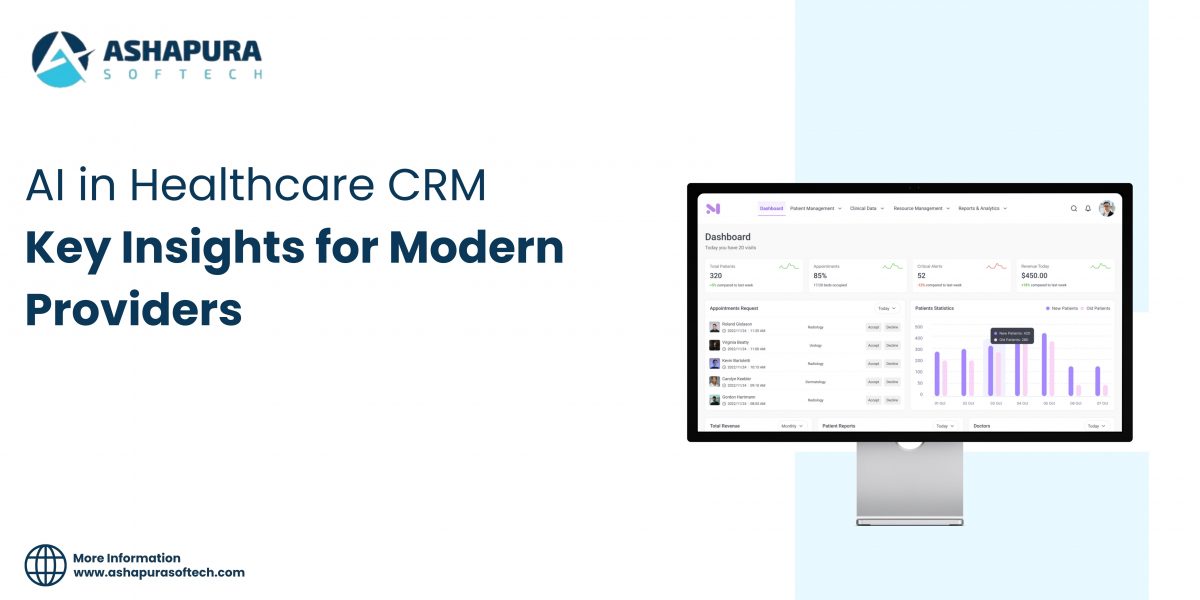
AI in Healthcare CRM: Key Insights for Modern Providers

Introduction

In today’s fast-evolving digital health landscape, AI in healthcare CRM (Customer Relationship Management) is transforming how providers connect with patients, manage medical data, and deliver personalized care experiences. As hospitals, clinics, and health systems adapt to rising patient expectations, AI-powered healthcare CRM solutions are becoming essential for improving efficiency, automation, and data-driven decision-making across every stage of the patient journey.

Unlike traditional CRM systems, artificial intelligence in healthcare CRM combines predictive analytics, machine learning, and real-time data insights to help healthcare organizations anticipate patient needs, personalize outreach, and optimize care coordination. By integrating AI automation into daily operations, providers can streamline administrative tasks — such as appointment scheduling, follow-ups, and billing — and dedicate more time to delivering high-quality, patient-centered care.

For modern healthcare providers, AI CRM software functions as an intelligent ecosystem rather than a standalone tool. It connects Electronic Health Records (EHR), patient engagement platforms, and healthcare marketing automation systems into one seamless interface. This unified, data-driven approach empowers organizations to improve patient satisfaction, boost retention rates, and enhance clinical outcomes — all while maintaining strict compliance with HIPAA and data-security standards.

In this comprehensive guide, you’ll discover the key benefits, use cases, and future trends of AI in healthcare CRM. We’ll explore how custom AI CRM development is reshaping hospital workflows, how predictive insights improve population health management, and how next-generation healthcare technology is setting new standards for efficiency in 2025. Whether you’re a healthcare provider, administrator, or IT leader, understanding how to leverage AI CRM tools effectively is critical for staying competitive, compliant, and patient-centric in the era of intelligent healthcare.

Top Benefits of AI-Powered Healthcare CRM Solutions

1. Enhanced Patient Engagement and Personalization

AI-enabled CRMs leverage machine learning algorithms to analyze patient preferences, medical histories, and communication patterns. This allows healthcare organizations to create personalized outreach strategies, automate appointment reminders, and design care plans tailored to each individual. Patients benefit from proactive health alerts, AI chatbots, and personalized content, leading to higher satisfaction, trust, and long-term retention. For providers, this means stronger patient relationships, better treatment adherence, and measurable improvements in overall care experience.

2. Streamlined Administrative Workflows and Productivity

AI CRM software automates time-consuming administrative tasks — from appointment scheduling and billing to follow-up reminders — freeing clinical staff to focus on high-value patient care. By integrating with Electronic Health Records (EHR) and telemedicine platforms, these systems ensure data accuracy, reduce human error, and accelerate decision-making. Hospitals adopting AI workflow automation report up to 30% improvement in staff productivity and a significant reduction in manual workloads.

3. Predictive Analytics for Better Clinical and Business Outcomes

Through predictive analytics, AI-powered healthcare CRMs identify patient trends, forecast readmission risks, and anticipate appointment cancellations. These insights enable providers to launch data-driven preventive care campaigns and optimize resource allocation. For leadership teams, this intelligence translates into improved clinical outcomes, enhanced population health management, and stronger financial performance. Predictive analytics also support better workforce planning and more accurate revenue forecasting.

4. Improved Compliance and Data Security

Data privacy is paramount in healthcare, and AI healthcare CRM systems are built with HIPAA-compliant frameworks and AI-driven anomaly detection. These systems automatically identify suspicious login patterns, prevent unauthorized access, and protect sensitive patient data in real time. By embedding machine learning for cybersecurity, organizations strengthen trust and transparency — two pillars of Google’s E-E-A-T and healthcare credibility.

5. Higher ROI and Long-Term Scalability

Investing in AI-powered healthcare CRM software delivers measurable ROI by cutting costs, optimizing resource utilization, and improving patient retention. Over time, these CRMs evolve using machine learning, becoming more accurate and predictive as they process new data. They integrate seamlessly with healthcare marketing automation, virtual care, and telehealth technologies, ensuring a future-ready infrastructure that scales with your organization’s growth and changing patient needs.

How AI CRM Enhances Patient Engagement and Retention 

1. Personalized Patient Communication at Scale

Modern AI CRM platforms analyze patient demographics, health histories, and behavioral data to deliver tailored messages across multiple touchpoints — email, SMS, mobile apps, and patient portals. Using natural language processing (NLP) and AI-driven segmentation, healthcare marketers can automatically send the right message to the right patient at the right time — whether it’s a medication reminder, preventive screening alert, or wellness tip. This data-backed personalization enhances patient trust and engagement, making care feel both human and proactive.

2. Predictive Engagement and Retention Analytics

AI-driven CRMs use predictive analytics to identify patients at risk of disengagement or missed appointments. By analyzing appointment patterns, response times, and health indicators, the system proactively triggers re-engagement workflows — such as automated follow-ups, telehealth reminders, or loyalty programs. This data-driven engagement strategy helps reduce patient churn, improve adherence to care plans, and increase lifetime value for healthcare organizations.

3. Real-Time Feedback and Continuous Improvement

Integrating AI CRM tools with patient satisfaction surveys, chatbots, and social listening platforms enables healthcare providers to capture feedback instantly. Sentiment analysis algorithms process this data to identify satisfaction levels and pinpoint service gaps in real time. These insights empower teams to respond quickly, resolve issues before they escalate, and continuously improve the patient experience — an essential step for delivering value-based care and building E-E-A-T trust.

4. Integration With EHR and Telehealth Platforms

AI-powered CRM systems integrate seamlessly with EHR software and telemedicine tools, providing a unified view of patient interactions across online and offline channels. This holistic approach ensures that every provider — from front-office staff to clinicians — has access to the same accurate patient data, supporting coordinated care and consistent engagement across the continuum.

5. Building Long-Term Patient Loyalty Through Automation

AI-driven marketing automation keeps patients connected even after treatment. Automated wellness campaigns, follow-up reminders, and satisfaction surveys nurture ongoing engagement — transforming one-time visitors into loyal advocates. With advanced AI analytics, providers can measure campaign performance, monitor engagement rates, and fine-tune strategies for continuous growth.

Custom AI CRM Development for Hospitals and Clinics

1. Healthcare Providers Need Custom AI CRM Solutions

Each healthcare organization operates within unique workflows, compliance frameworks, and data ecosystems. A custom AI CRM for hospitals and clinics integrates these variables into one centralized, intelligent platform — managing patient data, appointments, billing, and communication efficiently. By leveraging AI automation, providers can reduce administrative burden, improve care coordination, and focus more on patient outcomes. AI-driven insights also help identify trends, forecast patient needs, and optimize scheduling and follow-ups.

2. Capabilities of a Custom AI Healthcare CRM

A robust AI-powered healthcare CRM integrates clinical, financial, and operational systems to maximize efficiency and deliver exceptional patient experiences,  Key features include:

  • Predictive Care Analytics to anticipate patient risks and improve treatment outcomes.
  • Automated workflows for scheduling, billing, and follow-ups.
  • EHR, telemedicine, and IoT integration for unified data access.
  • HIPAA-compliant security frameworks for enhanced data privacy.
  • Omnichannel communication tools for seamless patient engagement.
  • Performance dashboards with actionable insights for decision-makers.

3. Security, Compliance, and Scalability

Healthcare data security is non-negotiable. Custom AI CRM systems are built to comply with HIPAA, GDPR, and HL7 interoperability standards, ensuring patient data protection and transparency across platforms. Modern solutions leverage cloud-native infrastructure (AWS, Azure, or Google Cloud for Healthcare) to provide scalability for multi-site hospital networks, clinics, and outpatient facilities. Cloud integration also enhances uptime, disaster recovery, and cross-department data accessibility — key for maintaining continuity of care.

Integrating AI CRM with EHR and Data Security Systems

1. How AI CRM Integration Enhances Clinical Efficiency

Modern AI healthcare CRM platforms synchronize patient data across EHR databases, telehealth portals, and billing systems in real time. This interoperability eliminates manual data entry, reduces duplication, and ensures that physicians, administrators, and care coordinators all access the same accurate information. Through machine learning and predictive algorithms, integrated systems can automatically flag abnormal results, identify patients due for preventive screenings, and trigger personalized outreach campaigns.

2. AI in Healthcare Data Security and Compliance Automation

As digital transformation accelerates, AI in healthcare data security has become a top priority. Next-generation CRMs use AI-driven compliance automation to continuously monitor system activity, detect anomalies, and prevent unauthorized access before breaches occur. Built-in HIPAA, GDPR, and HL7 interoperability frameworks ensure that sensitive health information remains protected across integrated environments. Automated audit trails, role-based access controls, and real-time encryption updates strengthen transparency and maintain trust — critical pillars of EEAT (Experience, Expertise, Authority, and Trustworthiness) for healthcare providers. Cloud-native architectures (AWS, Azure, Google Cloud for Healthcare) further enhance resilience by providing secure, scalable infrastructure that supports continuous uptime and regulatory compliance.

3. The Future of EHR-CRM Integration in Digital Health

Looking ahead, AI CRM integration with EHR will evolve beyond simple synchronization into intelligent orchestration. Expect to see real-time analytics dashboards, voice-enabled clinician tools, and AI-based workflow assistants that proactively guide care decisions. These innovations will empower healthcare organizations to deliver unified, personalized, and secure patient experiences — bridging the gap between operational efficiency and empathetic care.

Challenges and Future Trends in AI-Driven Healthcare CRMs

Key Challenges of AI Adoption in Healthcare CRM

1. Data Fragmentation and Integration Complexity

Many healthcare organizations operate across disconnected EHRs, legacy billing software, and siloed data warehouses. Integrating these systems into a unified AI healthcare CRM remains a top hurdle. Without clean, interoperable data, even the most advanced AI models struggle to deliver accurate predictions.

2. Compliance, Privacy, and Ethical AI Governance

As patient data flows through cloud-based CRMs, maintaining HIPAA, GDPR, and HL7 compliance is mission-critical. Hospitals must balance innovation with privacy, ensuring transparent use of AI algorithms. Ethical AI governance frameworks — including bias mitigation and explainable AI (XAI) — are becoming standard expectations from regulators and patients alike.

3. Workforce Readiness and Change Management

While AI promises automation and insights, true transformation requires human alignment. Clinical and administrative teams need training to interpret AI-driven analytics and integrate them into daily workflows. Lack of staff readiness often slows adoption or limits system potential.

Future Trends in AI Healthcare CRM for 2025 and Beyond

1. Generative AI for Personalized Care Journeys

Generative AI tools will help providers craft tailored patient communication, automate follow-up messages, and even summarize complex medical data in human-readable language. This ensures consistent, empathetic engagement across all touchpoints.

2. Voice and Chat-Enabled CRM Interfaces

AI-powered voice assistants and chatbots integrated into CRMs will streamline scheduling, intake, and triage. Natural language processing (NLP) allows staff to retrieve records or update charts through simple voice commands — improving workflow speed and accessibility.

3. Predictive + Prescriptive Analytics Fusion

Next-generation CRMs will combine predictive analytics (what will happen) with prescriptive intelligence (what should happen). These insights help providers design proactive interventions, reduce hospital readmissions, and improve population health outcomes.

4. Blockchain-Backed Data Integrity

Emerging blockchain integration ensures immutable audit trails for patient records — boosting data trust and enabling secure data sharing between hospitals, insurers, and research institutions.

5. AI-Native Interoperability Standards

New interoperability models using FHIR 2.0 and AI-ready APIs will allow CRMs to seamlessly exchange structured and unstructured healthcare data, improving cross-platform collaboration.

FAQ

1. What is AI Healthcare CRM and how does it improve patient management?
An AI healthcare CRM uses artificial intelligence to automate communication, predict patient needs, and streamline data across systems. Hospitals and clinics use it to enhance engagement, reduce administrative work, and deliver personalized, efficient care.

2. Why is custom AI CRM development important for healthcare providers?
Custom AI CRM development allows healthcare providers to design tailored solutions that fit unique workflows, compliance needs, and patient engagement goals. It ensures seamless integration with EHR systems, predictive analytics, and telehealth platforms for maximum ROI.

3. How does AI CRM for hospitals enhance efficiency and care quality?
An AI CRM for hospitals improves operational efficiency through automation, predictive scheduling, and smart data insights. It connects departments, reduces manual errors, and helps staff deliver faster, more coordinated patient care experiences.

4. What are the benefits of using healthcare CRM software powered by AI?
Healthcare CRM software powered by AI helps providers automate repetitive tasks, analyze patient behavior, and improve communication. It delivers actionable insights that increase satisfaction, retention, and operational performance while ensuring compliance and security.

5. How can clinics and hospitals get started with AI healthcare CRM solutions?
Clinics and hospitals can start by assessing their workflow gaps and partnering with experts in AI healthcare CRM or custom AI CRM development. Scalable, compliant CRM platforms can be customized to enhance patient engagement and data-driven decision-making.

Conclusion

AI in healthcare CRM is revolutionizing how hospitals and clinics manage patient relationships, automate workflows, and deliver personalized, data-driven care. With advanced predictive analytics, machine learning, and automation, custom AI CRM development enables healthcare providers to boost efficiency, maintain compliance, and enhance patient engagement. At Ashapura Softech, we specialize in designing scalable, secure, and intelligent AI healthcare CRM solutions tailored for hospitals, clinics, and healthcare startups. Contact us at [email protected] to schedule your free consultation and start transforming your digital health strategy today.


Categories
CRM

How Important Is CRM in the Healthcare Industry?

Introduction

Understanding CRM in Healthcare

Customer Relationship Management (CRM) systems are transforming industries—and healthcare is no exception. At its core, CRM in healthcare is a strategic approach that integrates technology to manage and analyze patient interactions and data throughout the patient lifecycle. Its purpose is simple yet vital: improve service quality, patient satisfaction, and health outcomes.

The Growing Importance of Patient-Centric Care

Today’s healthcare model is shifting toward patient-centric care. Patients are more informed, empowered, and expect seamless digital experiences. CRM implementation plays a key role in meeting these demands by streamlining interactions, improving responsiveness, and personalizing care—making it an indispensable asset for modern healthcare providers.

What is Healthcare CRM?

A healthcare CRM is a specialized platform that consolidates patient data, demographics, behavioral patterns, social/financial backgrounds, contact details, and medical histories—into a unified, actionable profile. Unlike generic CRM tools, it is tailored to address the nuanced needs of healthcare providers, ensuring compliance with regulations like HIPAA while enhancing patient engagement.

Key Benefits of CRM in Healthcare

  1. 360-Degree Patient Insights: By integrating data from EHRs, appointment systems, billing platforms, and patient surveys, CRMs offer a holistic view of each individual. This enables providers to anticipate needs, tailor treatments, and address concerns proactively.
  2. Enhanced Patient Engagement: Automated reminders, personalized health tips, and seamless communication channels (e.g., SMS, email, or patient portals) keep patients informed and involved in their care journey.
  3. Operational Efficiency: Streamline appointment scheduling, reduce no-shows with automated follow-ups, and simplify referral management to optimize staff workflows.
  4. Retention & Loyalty: Foster trust through consistent, timely interactions—from post-discharge check-ins to chronic disease management—turning satisfied patients into lifelong advocates.
  5. Data-Driven Growth: Identify trends in patient acquisition, track satisfaction metrics, and refine marketing strategies to attract new demographics while retaining existing ones.

The Patient-Centric Advantage

A healthcare CRM isn’t just a tool; it’s a strategy. By managing interactions throughout the entire patient journey (from initial inquiry to post-treatment follow-up), these systems create a seamless experience that prioritizes patient needs. The result? Higher satisfaction rates, stronger trust in care providers, and a reputation for excellence that sets institutions apart in a competitive landscape.

In an era where patient expectations are higher than ever, healthcare CRM systems bridge the gap between clinical care and human connection, ensuring providers not only meet but exceed the demands of modern healthcare.

Types of Healthcare CRM Software

Healthcare CRM (Customer Relationship Management) software is designed to address diverse needs in the medical sector, improving efficiency, patient engagement, and data-driven decision-making. Based on functionality, healthcare CRM systems can be categorized into three primary types:

1. Operational CRM

Operational CRM focuses on streamlining daily workflows to enhance productivity and patient care. It automates routine tasks such as:

  • Appointment scheduling and reminders to reduce no-shows.
  • Patient record management, ensuring accurate and centralized data storage.
  • Task coordination among staff for seamless operations.

By optimizing administrative processes, operational CRM reduces manual workload, minimizes errors, and allows healthcare providers to focus more on patient care.

2. Analytical CRM

Analytical CRM leverages data to uncover actionable insights for better decision-making. It helps healthcare organizations:

  • Analyze patient trends, preferences, and behaviors.
  • Track treatment outcomes and identify areas for improvement.
  • Refine marketing strategies by segmenting patient demographics.

With advanced reporting tools, analytical CRM empowers providers to personalize care, predict patient needs, and enhance operational efficiency.

3. Collaborative CRM

Collaborative CRM emphasizes communication and teamwork across departments and external stakeholders. Key features include:

  • Secure messaging platforms for real-time discussions among healthcare teams.
  • Integrated patient portals for seamless information sharing between providers and patients.
  • Referral management to coordinate care with specialists or external facilities.

By fostering collaboration, this CRM type improves care coordination, reduces redundancies, and ensures a unified approach to patient treatment.

CRM’s Role in Patient Journey Management

From Appointment Scheduling to Follow-Up

CRM supports the full journey, from initial contact to post-treatment feedback. Automation ensures no missed steps, making the patient experience seamless and efficient.

Personalized Communication and Education

Segmentation tools allow providers to send the right message at the right time. For example, diabetic patients can receive customized tips and appointment reminders based on their condition.

Managing Chronic Diseases and Preventive Care

CRM enables long-term tracking, outreach, and monitoring for chronic patients. Preventive care campaigns, timely screenings, and regular check-ins become easy to manage and personalize.

Integration with Other Healthcare Systems

Electronic Health Records (EHR) Integration

Effective CRM solutions integrate seamlessly with EHR systems, offering a unified view of the patient’s clinical and behavioral data. This ensures consistency in diagnosis, treatment, and care.

Telehealth and Remote Monitoring

As telehealth becomes a staple in healthcare delivery, CRM platforms support virtual care coordination, device integration, and patient data monitoring from afar.

Data Analytics and Reporting

From disease trends to appointment patterns, CRM platforms analyze vast data sets. These insights allow administrators and clinicians to make data-driven decisions that enhance service and performance.

Challenges and Considerations

Data Privacy and Security Concerns

Healthcare data is sensitive. CRM systems must ensure strong encryption, role-based access, and compliance with laws like HIPAA to prevent breaches and maintain trust.

Staff Training and Change Management

Even the best CRM implementation can fail without proper training. Change management strategies, including workshops and user feedback, are essential for adoption.

Cost and ROI Analysis

Initial CRM development and integration costs can be high. However, benefits like improved patient retention, staff efficiency, and lower error rates offer significant long-term ROI.

Case Studies and Success Stories

Hospitals Improving Patient Satisfaction

A US-based hospital implemented CRM to improve communication, leading to a 20% increase in patient satisfaction scores and a notable drop in missed appointments.

Clinics Streamlining Operations

A mid-sized clinic used CRM for billing and follow-up automation, reducing admin costs by 30% and improving patient engagement through mobile communication tools.

CRM Impact on Healthcare Marketing

A healthcare marketing team used CRM to segment patient data for targeted campaigns. This led to higher conversion rates and improved awareness of specialized services like pediatric care and cardiology.

Future Trends in Healthcare CRM

AI and Predictive Analytics

Future CRM systems will use AI to predict patient needs, identify at-risk individuals, and suggest personalized treatment options, revolutionizing proactive care.

Mobile CRM Solutions

Mobile access empowers both providers and patients. From appointment management to real-time alerts, mobile CRM apps ensure constant connection and accessibility.

Patient Self-Service Portals

Empowering patients through self-service tools is on the rise. Features like appointment scheduling, bill payment, access to records, and chatbots for queries improve autonomy and reduce administrative load.

FAQs

  1. What is a CRM system in healthcare, and how does it work?
    A healthcare CRM system collects and manages patient data, enabling personalized communication, scheduling, billing, and treatment tracking—all in a single platform.
  2. How does CRM improve the patient experience?
    CRM enhances patient satisfaction through timely reminders, real-time communication, access to health records, and personalized care journeys.
  3. Is CRM integration possible with EHR and telehealth platforms?
    Yes, modern CRM solutions are designed for seamless integration with Electronic Health Records (EHR) and telehealth tools to centralize data and streamline care delivery.
  4. What are the biggest challenges of CRM implementation in healthcare?
    Key challenges include ensuring data privacy (HIPAA compliance), managing change resistance, training staff, and justifying ROI.
  5. How can a CRM development company help healthcare providers?
    A CRM development company designs, integrates, and customizes CRM systems that align with specific clinical workflows, boosting efficiency and improving patient care.

Conclusion

In today’s patient-focused healthcare environment, implementing a CRM system is no longer a luxury—it’s a necessity. From enhancing patient communication to streamlining clinical and administrative tasks, CRM empowers providers to deliver more connected, informed, and personalized care. By bridging the gap between data and patient engagement it enables smarter decision-making and operational efficiency. Whether you’re a hospital, clinic, or private practitioner, choosing the right CRM solution company is crucial. At Ashapura Softech, we specialize in CRM implementation, CRM integration, and custom solutions tailored for healthcare providers. Contact us at [email protected] to learn how we can support your business with CRM. We’re ready to help you lead the change in healthcare technology.

Categories
CRM Salesforce Zoho

Zoho vs Salesforce CRM: An Honest 2026 Comparison From a Partner of Both

Zoho vs Salesforce is one of the most common CRM decisions we help US businesses make, and as a certified partner for both platforms we have no reason to push you toward either. This guide compares Zoho CRM and Salesforce on pricing, features, AI, customisation, integrations and total cost, then tells you plainly which one fits which kind of business.

Zoho vs Salesforce at a glance

FactorZoho CRMSalesforce
Best fitSmall and mid-sized businesses, cost-conscious teamsMid-market and enterprise, complex or fast-scaling sales operations
Entry price (billed annually)Free for 3 users, paid plans from about $14 per user per monthFree for 2 users, paid plans from $25 per user per month
Top standard editionUltimate, about $52 per user per monthUnlimited $350, Agentforce 1 Sales $550 per user per month
AI assistantZia, included in higher editionsAgentforce and Einstein, often a paid add-on
EcosystemZoho One suite (Books, Desk, Campaigns, Analytics and more)AppExchange marketplace, Service, Marketing, Commerce and Data Cloud
CustomisationLow-code, Deluge scriptingLow-code Flow plus Apex and Lightning Web Components
Time to go liveUsually shorterUsually longer, depends on scope

Zoho CRM vs Salesforce pricing in 2026

Price is the first reason most businesses compare the two, so here are the published list prices per user per month, billed annually, at the time of writing.

Zoho CRM editionPriceSalesforce Sales Cloud editionPrice
Free (up to 3 users)$0Free (up to 2 users)$0
Standard$14Starter Suite$25
Professional$23Pro Suite$100
Enterprise$40Enterprise$175
Ultimate$52Unlimited$350
Agentforce 1 Sales$550

Both vendors change prices and bundles often, and monthly billing costs more than annual billing, so always confirm on the vendor’s own pricing page before you budget.

What the table does not show: licence price is rarely the biggest cost. Implementation, data migration, integrations, training and ongoing admin usually decide the real number. For a 20-user team on the Enterprise editions, the list-price gap alone is about $32,000 a year in Zoho’s favour, but a poorly set up system of either kind costs more than that in lost productivity. Our guide to the Salesforce editions explains what each tier actually unlocks.

Features compared

Sales automation and pipeline

Both platforms cover leads, contacts, deals, pipelines, workflows, email and forecasting. Salesforce goes deeper on complex processes: territory management, advanced forecasting, CPQ, approval chains and large sales teams with many layers. Zoho covers what most small and mid-sized teams need at a much lower price, with Blueprint for guided processes and Cadences for follow-up sequences.

AI: Zia vs Agentforce

Zoho’s Zia gives predictions, anomaly alerts, deal scoring and writing help inside the CRM, included in the higher editions. Salesforce has moved further toward AI agents with Agentforce, which can answer customers, qualify leads and take actions across Sales, Service and Marketing Cloud. Agentforce is more powerful, but it usually costs extra and needs clean data to work well. See our Agentforce use cases for what companies have put live.

Customisation and development

Zoho CRM is highly configurable with custom modules, fields and layouts, and Deluge scripting covers most custom logic. Salesforce offers the same low-code tools through Flow, plus Apex and Lightning Web Components for fully custom applications. If your process is unusual or your data model is complex, Salesforce gives developers more room.

Reporting and analytics

Zoho includes solid reports and dashboards, and Zoho Analytics adds deeper BI. Salesforce reports and dashboards are strong out of the box, with Tableau and Data Cloud for advanced analytics and unified customer profiles, at additional cost.

Integrations and ecosystem

Zoho’s strength is its own suite: Zoho One bundles more than 40 apps, including Books, Desk, Campaigns, Projects and People, that work together without connectors. Salesforce’s strength is AppExchange, the largest CRM app marketplace, plus native Service, Marketing, Commerce and Data Cloud products. Both connect to common tools; see how we approach Zoho integration with third-party apps.

Ease of use

Zoho is generally quicker to learn and faster to set up for small teams. Salesforce has a steeper learning curve and usually needs an admin or partner, especially once the org grows.

Salesforce vs Zoho CRM: which one should you choose?

Choose Zoho CRM if:

  • You are a small or mid-sized business and cost matters
  • You want CRM, accounting, support and marketing in one suite
  • Your sales process is fairly standard
  • You want to go live quickly with a small admin effort

Choose Salesforce if:

  • You have a large or fast-growing sales team with complex processes
  • You need enterprise features such as advanced forecasting, CPQ or territory management
  • You plan to use AI agents, or already run Service, Marketing or Commerce Cloud
  • You need deep custom development or a very large integration marketplace

Personal observations

Having worked with both platforms, one thing stands out: Salesforce feels like the Ferrari of CRMs, while Zoho CRM is more like a dependable Toyota Corolla. A small business owner once told us that Zoho fit like a glove, but when the company started scaling, Salesforce was the engine it needed. That is why we always ask where the business will be in three years, not only where it is today.

Switching between Zoho and Salesforce

Moves happen in both directions. Growing companies move from Zoho to Salesforce when their processes outgrow it, and some teams move from Salesforce to Zoho to cut licence costs. In either case, clean the data first, map fields and automations carefully, and run both systems side by side for a short period. Read how to prepare Salesforce data for a Zoho CRM migration and our complete guide to Zoho migration services.

How Ashapura Softech helps

Ashapura Softech is a certified partner for both Zoho and Salesforce, so our advice starts from your requirements, not a quota. We help with platform selection, setup, customisation, integration and migration through our Zoho development services, Zoho CRM development, Zoho migration services, Salesforce CRM development and Salesforce cloud services. If neither fits, we also build custom CRM software. Comparing more options? See Salesforce vs Odoo and the benefits of Zoho CRM development for US small businesses.

FAQs

Is Zoho cheaper than Salesforce?

Yes. Zoho CRM’s paid editions start at about $14 per user per month billed annually, compared with $25 for Salesforce Starter Suite, and the gap widens at higher tiers.

Is Zoho CRM good enough for large enterprises?

Some large companies run Zoho successfully, especially with Zoho One. Enterprises with complex processes, many teams or heavy AI and integration needs usually get more from Salesforce.

Which is easier to use, Zoho or Salesforce?

Zoho is usually easier to learn and set up. Salesforce has more depth, which brings a steeper learning curve and a greater need for an admin.

Can I migrate from Zoho CRM to Salesforce later?

Yes. Records, custom fields and most automations can be moved, but workflows usually need to be rebuilt in Salesforce Flow. Planning the data model early makes a later move much easier.

Does Zoho have AI like Salesforce Agentforce?

Zoho has Zia, which covers predictions, scoring and writing help. Agentforce goes further with autonomous agents that take actions, usually at extra cost.

Conclusion

In the Zoho vs Salesforce decision, there is no universal winner. Zoho CRM gives small and mid-sized businesses excellent value and a connected suite, while Salesforce gives growing and enterprise teams more depth, AI and room to scale. Match the platform to your processes, budget and growth plans, and talk to a partner who works with both before you commit.

Categories
CRM

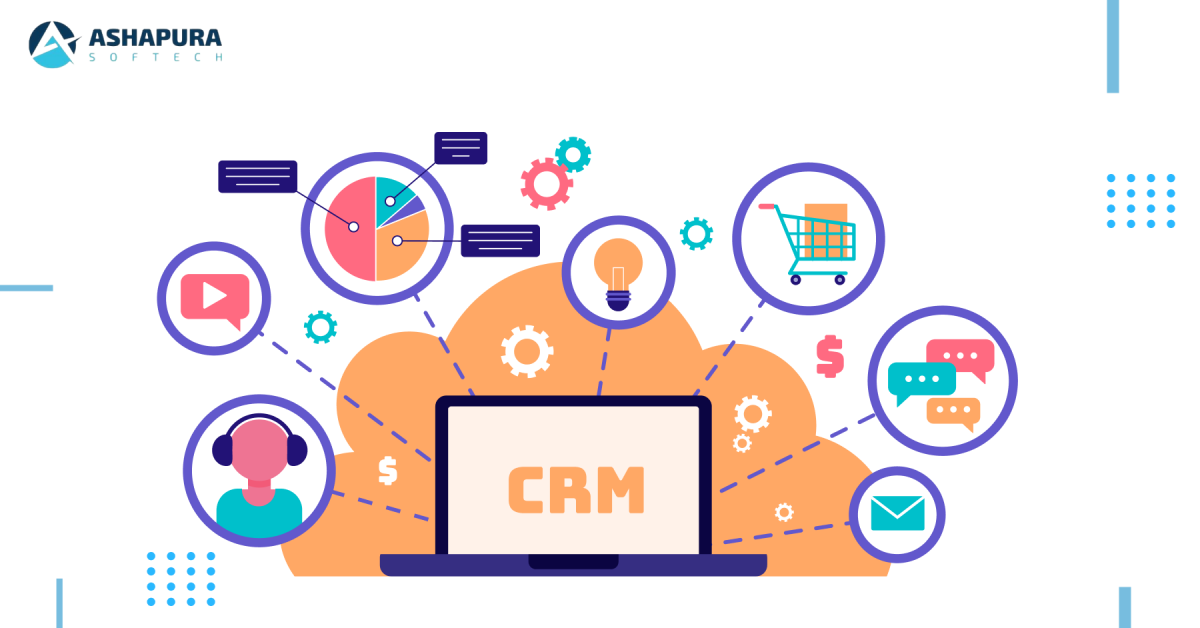
 Best Practices for CRM Integration: Boost Efficiency with Ease

CRM systems are the backbone of business operations in this day and age. However, that is where the magic is when your CRM actually gets to integrate with other business tools out there to create an ecosystem from which efficiency, streamlined processes, and enhanced customer experience would come forth. So let’s dive deep into best practices for integrating CRM with other business tools and unlocking its full potential.

Why CRM Integration Matters

But that’s not all-integrating your CRM into other business tools is about having one big workflow. Imagine a sales team that needs to work with three platforms for tracking leads, managing emails, and creating invoices. Sound familiar? Imagine a world where all these tools talk to each other with ease. That’s the power of integration.

Here’s the best part: businesses that actually integrate their CRMs with other tools have seen, on average, a 30% boost in productivity. Your CRM can really rock when integrated with marketing automation, project management software, accounting tools, and a lot more.

Best Ways to Integrate Your CRM

Selection of Right CRM System

Not all CRMs are created equal, and some are way more flexible than others when it comes to integrating with other tools. When choosing a CRM, make compatibility with your current tech stack a top priority. Salesforce, HubSpot, and Zoho CRM are good examples of CRMs that offer impressive integrations.

Pro Tip: Look for CRMs that have pre-built connectors to popular tools like Slack, QuickBooks, or Mailchimp. This reduces the amount of manual work required and quickens the pace of integration.

Map Out Your Business Needs

Before diving into the integration, define which tools you want to connect and why. Ask yourself:

  • Which processes can be automated?
  • What data needs to flow between the tools?
  • How will integration improve collaboration between teams?

This will help to avoid unnecessary complications by highlighting your needs and focusing your resources on what adds more value.

Make Use of APIs for Custom Integrations

APIs, or Application Programming Interfaces, are the unsung heroes of seamless integration. They let your CRM “talk” to other tools and share data without much hassle. Say, you can sync lead information from your website directly into your CRM using APIs, or have them automate data transfer from some accounting software.

Here’s a personal example: At Ashapura Softech, we once integrated Salesforce CRM with a client’s bespoke ERP system using custom APIs. The result? A 40% reduction in manual data entry and a 20% boost in operational efficiency.

Ensure Data Consistency and Accuracy

Data is king, but only if it’s accurate. During integration, inconsistencies in data formats-for example, date formats and naming conventions-can create chaos. Implement data validation rules to maintain uniformity.

Best Practice: Utilize a middleware tool such as Zapier or MuleSoft for handling data transformations. These platforms act as a bridge, ensuring data is synced correctly between systems.

Focus on Security and Compliance

Integrating tools means sharing data across platforms, which can increase security risks if not handled properly. Ensure all tools involved in the integration comply with regulations like GDPR or HIPAA (for healthcare businesses).

Actionable Tip: Use encryption and multi-factor authentication to secure your data during transfers. Additionally, regularly audit access permissions to prevent unauthorized access.

Train Your Team

After all, integration is only as good as the people who will use it. Provide your team with regular training sessions that familiarize them with the integrated system to ensure they’re using not just the tools but leveraging them to the fullest.

Fun Fact: A well-trained team is 25% more likely to identify process improvements post-integration.

Monitor and Optimize

Integration isn’t a set-it-and-forget-it process. Regularly monitor the performance of your integrated tools to ensure everything works as expected. Use analytics dashboards to track metrics such as lead response time, sales cycle length, and customer satisfaction.

Top Tools for CRM Integration

If you’re wondering which tools pair best with your CRM, here’s a quick guide:

  • Marketing Automation: HubSpot, Marketo, Pardot
  • Project Management: Asana, Trello, Monday.com
  • Accounting: QuickBooks, Xero, FreshBooks
  • Communication: Slack, Microsoft Teams, Zoom
  • E-Commerce: Shopify, WooCommerce, Magento

Common Challenges in CRM Integration (And How to Overcome Them)

Lack of Technical Expertise

Integration can be intimidating without the right skills. This is where experts like Ashapura Softech come in. We specialize in creating tailor-made CRM integrations to suit your unique business needs.

Resistance to Change

Employees might be resistant to the change of a new system. This can be diminished by bringing them into the process early and showing them the benefits.

Frequently Asked Questions

What are the advantages of integrating CRM with other business tools?

The integration of CRM enhances efficiency, eliminates data silos, enhances collaboration, and brings actionable insights throughout departments.

How much does CRM integration cost?

The cost depends on the complexity of the integration and the tools involved. Basic integrations can start from a few hundred dollars, while complex setups can run into the thousands.

Will Ashapura Softech be able to help with CRM integration?

Absolutely! We specialize in CRM solutions according to your business needs. Reach us at [email protected].

Conclusion

CRM integration is not just a technical upgrade; it’s a strategic move that can revolutionize how your business operates. By following best practices, addressing challenges proactively, and leveraging expert support, you can unlock unparalleled efficiency and growth. Ready to take your business to the next level? Contact us Ashapura Softech at [email protected] today for personalized CRM integration solutions.

Categories
CRM

Chatbots in Customer Support: Revolutionizing CRM Experiences

Imagine this scenario: It’s midnight, and you’re wrestling with a question about a product you just bought. You don’t want to wait hours for customer support to open. You don’t want to send an email that’ll disappear into the void. Instead, you click a chat bubble, type a question, and boom, you have got your answer in seconds. The magic behind this? Chatbots.

It’s no exaggeration to say that chatbots are rewriting the rules of customer support. What started as a clunky “Hi! How can I help you?” experience has transformed into seamless, intelligent interactions that feel, dare I say, human. And in this world where customer expectations are skyrocketing, that matters—a lot.


The Chatbot 101: What Are They, Really?

Let’s take a moment to define what we’re talking about here. A chatbot is software designed to engage in a conversation with a user. Think of it as the lovechild of your favorite customer support agent and a really fast, always-on assistant.

Now, there are two flavors of chatbots: rule-based and AI-driven. Rule-based bots follow predefined scripts. They’re like the first-generation iPod—useful but limited. AI-driven bots, on the other hand, are like the latest iPhone—sleek, smart, and always learning. They leverage technologies like machine learning and Natural Language Processing (NLP) to understand context, adapt to user behavior, and deliver personalized responses.


Why Chatbots Are Changing the CRM Game

Here’s the thing about chatbots: they aren’t just helping businesses manage customer queries. They’re transforming how businesses interact with customers. It’s not just about efficiency—it’s about experiences.

  • Always On: Customers don’t care about your time zone. They want answers when they want them. Chatbots are always awake. No coffee breaks required.
  • Cost-Efficiency: Let’s face it hiring and training human agents is expensive. Chatbots offer a scalable, budget-friendly solution.
  • Personalization: Chatbots remember details. They greet you by name, know your past interactions, and even suggest solutions before you ask. It’s like having a concierge for every customer.

Anecdote Time: My First Chatbot Experience

I’ll never forget the first time I interacted with an AI chatbot. It was 3 a.m., and I was trying to book a flight (classic me—always traveling, always last minute). The chatbot not only helped me find the best deals but also suggested a seat with extra legroom. That’s when it hit me: this wasn’t just customer service; this was next-level personalization.


AI-Powered Chatbots: The Real MVPs

Let’s geek out for a second. AI-powered chatbots are the crown jewels of customer support. They don’t just respond; they understand. Using NLP, they pick up on nuances like tone and sentiment. If you’re frustrated, they’ll offer empathy. If you’re curious, they’ll dive into details.

These bots also learn over time. Each interaction helps them improve, making future conversations even smoother. It’s like having a support agent who gets better with every chat.


How Chatbots Elevate CRM

Customer Relationship Management (CRM) is all about creating meaningful interactions. Chatbots excel here. They don’t just handle queries; they gather data. Every question, complaint, or suggestion feeds into the CRM system, offering insights that help businesses understand their customers better.

  1. Data-Driven Insights: Chatbots capture valuable data points, like common issues and customer preferences.
  2. Seamless Integration: Modern chatbots sync effortlessly with CRM platforms like Salesforce, Zoho, or HubSpot.
  3. Improved Retention: By offering fast, personalized service, chatbots keep customers happy and loyal.

Real-World Applications

Want proof that chatbots work? Look no further than these examples:

  • Retail: Brands like Sephora use chatbots to help customers find products, schedule appointments, and track orders.
  • Banking: Chatbots in banks handle everything from checking balances to processing loan applications. (No judgment here if you’ve ever yelled at a phone bot.)
  • Healthcare: In hospitals, chatbots assist with scheduling, provide basic medical advice, and even share lab results securely.

The Challenges: It’s Not All Smooth Sailing

Let’s address the elephant in the room: Chatbots aren’t perfect.

  1. Technical Glitches: Integration can be a headache, especially for smaller businesses.
  2. Customer Pushback: Not everyone loves bots. Some people just want to talk to a human.
  3. AI Limitations: Despite their smarts, chatbots can misinterpret complex queries.

Human Agents vs. Chatbots: Friends, Not Foes

Here’s the truth: Chatbots aren’t here to replace humans. They’re here to complement them. For routine tasks, chatbots shine. For nuanced issues, human agents take the lead. The best customer support teams use a hybrid approach, blending the speed of bots with the empathy of humans.


Ashapura Softech: Pioneers in Chatbot Innovation

At Ashapura Softech, we’re not just creating chatbots; we’re crafting solutions that redefine customer support. Our bots aren’t just tools they’re experiences. From small startups to global enterprises, we’ve helped businesses revolutionize their CRM systems.


The Future: What’s Next for Chatbots?

The future of chatbots is exciting. We’re talking about bots that work in augmented reality, bots that communicate in multiple languages simultaneously, and bots that anticipate customer needs before they even ask.


FAQs About Chatbots in Customer Support

  1. What is a chatbot?
    A chatbot is software that interacts with users through text or voice, simulating a conversation.
  2. Can chatbots handle complex issues?
    Some can, especially AI-driven ones. But for highly complex or sensitive issues, human agents are better.
  3. Are chatbots secure?
    Yes, especially when implemented correctly. Encryption and secure integrations ensure data safety.
  4. How do chatbots integrate with CRM?
    Most chatbots integrate with popular CRM platforms, syncing data and streamlining workflows.
  5. Do customers prefer chatbots over humans?
    It depends. Many appreciate the speed and availability of bots, but some still value human interaction.
  6. How can I get started with chatbots?
    Partner with experts like Ashapura Softech to design and implement a chatbot tailored to your needs.

Final Thoughts

Chatbots are more than a trend—they’re a revolution. They’re changing how businesses connect with customers, making support faster, smarter, and more personalized. At Ashapura Softech, we’re proud to be part of this journey, helping businesses embrace the future of customer support. Ready to transform your CRM experience? Let’s chat(bot). Just Contact us today at [email protected] to see how we can elevate your CRM experience.

Categories
CRM

Gamification in CRM: Boosting User Engagement and Sales

What Is Gamification in CRM?

Gamification takes game-design elements-think points, leaderboards, badges, and levels and applies them to non-game environments such as CRM systems. For what? To motivate people, boost engagement, and drive desired behaviors that align with business goals.

Imagine this: Rather than having your sales team plod through their CRM dashboard, filling out tax forms, they are running after a leaderboard position, unlocking achievements, and maybe even winning tangible rewards. Sounds more interesting, right?

Why Gamification Works (and Why You Should Care)

This works because it taps into something deep within us: competition, rewards, and instant gratification. It is Psychology 101—dopamine hits keep bringing users back for more. Applied to CRM systems, this creates a cycle where the user adopts the platform but then enjoys using it.

And here’s where it gets personal. I once worked with a team that implemented gamification for their CRM. At first, the idea was met with eye rolls. “Badges for closing deals? Really?” But within weeks, the team was abuzz with friendly competition, racing to log activities and claim the top spots on the leaderboard. The kicker? Monthly sales jumped by 18%.

Benefits of Gamification in CRM

Increased User Engagement

Getting employees to use CRM systems sometimes feels like pulling out a tooth. Gamification is what changes that scene into one where CRM use is fun and engaging; people start seeing it as challenging, not as a duty.

Increased Efficiency

Friendly competition will inspire people to stay on top of things, follow up, and close deals faster. No one leaves reminders unattended anymore and misses deadlines.

Data Accuracy

When employees are motivated to log every activity to earn points, your CRM becomes a treasure trove of accurate, real-time data.

Better Team Collaboration

Team-based challenges and goals foster collaboration. Think of it as a bonding experience, but with sales numbers to show for it.

Gamification Features That Elevate CRM

Leaderboards

Nobody wants to be last, right? Leaderboards tap into that competitive spirit, encouraging users to outperform their peers.

Badges and Achievements

Who doesn’t love a little recognition? Unlockable badges can celebrate everything from logging 50 calls in a week to closing that major deal.

Point Systems

Assign points for CRM activities completed. The user earns a higher rank the more points they accumulate. Bonus: Let them redeem the points for real rewards such as gift cards or extra days off.

Challenges and Quests

Why not turn routine chores into thrilling competitions? “Record all overdue activities today and get 500 points.” Clear, concise, and exciting.

Gamification in CRM: How to Do It

Clearly Define Your Goals

Identify what you want to accomplish. Do you want greater user adoption? Improved data entry? Higher sales? Those goals will inform your gamification strategy.

Select the Correct Tools

Some CRMs, like Salesforce, come with built-in gamification features. If yours doesn’t, explore third-party tools.

Design Engaging Mechanics

Define how users earn points, what challenges they can tackle, and how rewards are distributed.

Communicate the Why

Don’t just slap a leaderboard on your CRM and expect results. Explain how gamification benefits both the company and the team.

Monitor and Adjust

Monitor how people engage with the gamification elements. Based on that, fine-tune the system using feedback and performance metrics.

Frequently Asked Questions: Gamification in CRM

Q1. Is gamification a sales thing?

No way. Of course, the sales team is a natural beneficiary, but gamification can be used in customer support, marketing, and even human resource activities within your CRM.

Q2. Isn’t gamification going to distract people from their work?

Not if it’s implemented right. Gamification complements work by aligning activities with business goals.

Q3. Is gamification expensive to implement?

It depends on your CRM and the features you choose. Many tools offer affordable gamification options, making it accessible even for small businesses.

Q4. Can Ashapura Softech help us implement gamification in our CRM?

Absolutely! Ashapura Softech is a solution provider for Salesforce, Microsoft, and custom CRM solutions. Reach out to us at [email protected] to find out how gamification can enable your business.

Conclusion

Gamification is not a buzzword; it’s a powerful tool to get your CRM adopted, drive engagement among users, and therefore increase sales. Think of it as a spark to your team’s day-to-day grind. And if you are looking for where to start, we are here to help. At Ashapura Softech, we believe in making your CRM from a forgotten tool to a game-changing asset. Let’s make your business success a game. Just contact us at [email protected] for more on our complete solution sets in CRM that can take your business to the next level of smart and efficient management.

Categories
CRM

Navigating Data Privacy: Best Practices for CRM Implementation

Responsible management of customer information in today’s data-driven world is not only a regulatory requirement but also a business imperative. Customer Relationship Management (CRM) systems are the backbones of modern customer engagement strategies. But how well businesses navigate this complex terrain of data privacy and compliance determines the success of such systems. Ineffective management of customer data can have serious legal implications, lead to lost trust, and even damage the reputation of the brand. This guide will explore the best practices in ensuring data privacy while implementing CRM, thus making sure that your organization not only complies with the international standards but also builds a long-lasting customer trust.

Why Data Privacy in CRM Matters

Your CRM system is a treasure trove of customer data: names, email addresses, purchase histories, preferences, and sometimes even sensitive financial details. This data feeds your ability to offer personal experiences. But with this great data comes great responsibility.

Data breaches are expensive, According to IBM’s annual report, the average cost of a data breach in 2023 was more than $4.45 million. Besides fines, lost customer trust is irrecoverable. Implementing CRM without a solid data privacy strategy is building a mansion on quicksand. A good foundation in data protection protects your business against both financial and reputational risks.

Best Practices for CRM Implementation and Data Privacy

Start with Privacy by Design

From the get-go, your CRM implementation plan should integrate privacy as a core principle. This isn’t just a trend; it’s a legal requirement in jurisdictions like the European Union under the General Data Protection Regulation (GDPR).

  • Minimize Data Collection: Only collect what you need. Avoid hoarding unnecessary information.
  • Embed Data Protections: Incorporate encryption, pseudonymization, and anonymization into your CRM systems.
  • Perform Privacy Impact Assessments (PIAs): Anticipate risks and mitigate them before they occur.

Understand and Comply with Regulations

Global regulations like GDPR, CCPA (California Consumer Privacy Act), and others mandate strict data handling rules. Non-compliance isn’t just risky—it’s costly.

  • Map Your Data: Understand where customer data is stored and processed across your CRM platform.
  • Know Consent Rules: Explicit consent is often required for collecting and processing personal data.
  • Set Retention Policies: Have clear guidelines for how long you’ll store data and when to delete it.

Implement Role-Based Access Controls (RBAC)

Not everyone in your organization needs access to the entire CRM database. Limiting access reduces the risk of accidental or malicious misuse of data.

  • Audit User Permissions: Ensure that employees only have access to the data they need for their role.
  • Monitor Activity Logs: Track who accesses what, and investigate anomalies promptly.
  • Use Multi-Factor Authentication (MFA): Add layers of security for CRM login credentials.

Transparency and Customer Trust

Develop a Clear Privacy Policy

Customers should know how their data is collected, used, and shared. A transparent privacy policy fosters trust and ensures compliance.

  • Be Honest and Simple: Avoid legal jargon. Use plain language to describe your practices.
  • Emphasize Benefits: Demonstrate how data collection improves their experience, including personalized recommendations.

Provide Data Portability and Control

Give customers the power to control their data. GDPR is very clear about the right to data portability, access, and erasure.

  • Self-Service Portals: Allow customers to view, download, and delete their data when they want.
  • Respond Promptly to Requests: Have a streamlined process to respond to data access or deletion requests.

Protecting Data from Breaches

Encrypt and Secure Data

Encryption isn’t optional—it’s a necessity. Whether data is in transit or at rest, ensure it’s protected with advanced encryption protocols.

  • TLS for Data in Transit: Secure data transfers between customers and your CRM using Transport Layer Security (TLS).
  • Regular Security Audits: Periodically review your CRM infrastructure for vulnerabilities.
  • Backup Systems: Maintain secure backups to avoid data loss during cyberattacks.

Train Your Team

Even the best systems fail without knowledgeable users. Employee negligence accounts for a significant percentage of data breaches.

  • Regular Training: Teach employees about phishing, secure password practices, and recognizing social engineering attacks.
  • Simulate Attacks: Run mock scenarios to gauge employee readiness and response.

How Technology Enhances Data Privacy

Invest in Advanced CRM Platforms

Not all CRMs are created equal. Modern CRM platforms come with built-in privacy features that can automate compliance.

  • AI-Powered Insights: Advanced CRMs employ AI to detect data usage anomalies and alert on potential risks.
  • Data Masking Features: Replace the sensitive data with placeholder information during processing for protecting them.

Use Automation to Achieve Compliance

The risk of human error exists while undertaking manual compliance checks. Using the CRM automation tools will automate the compliance tasks.

  • Automated Consent Management: Automatic monitoring of customer consent status
  • Real-time Alerts: Receive notifications regarding potential policy breaches or data anomalies

Personal Observations: Lessons from a Mistake

Once, as a consultant to a midsize retailer, I saw how abysmal data practices at CRM almost torpedoed a loyalty program. They left customer credit card information unencrypted—a ticking time bomb. Well, putting encryption and RBAC in place soon turned everything around. Takeaway lesson? Never spend money in vain on data privacy. The scaffolding to customer trust and long-term growth.

FAQs on Data Privacy and CRM Implementation

What is Privacy by Design in CRM?

Privacy by Design is an approach to ensure that data privacy is built into the architecture and processes of a CRM from the very start, reducing risks and enhancing compliance.

How do global regulations like GDPR impact the use of CRM?

Regulations such as GDPR stipulate how businesses can collect, store, and process customer data. Compliance will require explicit consent, secure storage, and giving the user control over their information.

Can automation help CRM data privacy?

Automation streamlines compliance activities like consent tracking, data anonymization, and real-time breach detection, reducing human error and ensuring efficiency.

How often should businesses audit their CRM for privacy compliance?

Regular audits preferably quarterly ensure your CRM is aligned with changing regulations and secured against emerging threats.

What is the role of encryption in CRM security?

Encrypt data to ensure it cannot be accessed or read without authorized access. It makes it safe and secure in its transmission and storage.

Conclusion: Earn Trust through Data Privacy

The navigation of data privacy within CRM implementation goes beyond the penalty aspect. Instead, it creates trust. Here at Ashapura Softech, we can assist any company in setting up its CRMs with rock-solid data privacy protocols. Your customers are entitled to no less than best practices for data security. Ready to elevate your CRM strategy while ensuring data privacy? Contact us today at [email protected].

Categories
CRM

The Role of Data Analytics in Enhancing Your CRM Strategy

Customer Relationship Management is no longer a buzzword in business but the backbone of modern enterprises. Still, managing customer relationships today differs from simply keeping a few records or firing off a few emails here and there. Rather, it’s all about using data analytics to optimize those relationships, predict customer behavior, and deliver experiences that can convert transactions into lifelong bonds.

In this blog post, let’s dive into the cutting edge of using data analytics: it is not just a tool in CRM strategy, but actually the fuel that actually runs the show. Buckle up because we’re about to explore how data can elevate your CRM to levels you probably never imagined.

What is Data Analytics in CRM?

Data analytics, simply, is the process of analyzing raw data with a view to drawing out useful insights that inform decision-making. In the context of CRM, it allows companies to track customer behavior to predict their needs and thus provide personalized experiences that will last. It means unraveling piles of data-included demographic information, purchase history, and how they interact with customers online-to turn raw information into actionable insights.

For clarity, think of it this way: The CRM system is the car, and data analytics is the engine. Without the engine, you have no real moving power in a static car; but when you add data analytics to your CRM strategy, you’re able to drive your CRM system places you never thought possible-faster, more efficiently, with far greater results.

How Data Analytics Improves Your CRM Strategy

It gets interesting from here. Data analytics helps CRM strategies in ways unthinkable a little over a decade ago. Data-driven personalization, predictive analytics, customer segmentation, and near-real-time decisioning – the list just goes on and on. Let’s break down how data analytics supercharges each of the above areas.

1. Personalization at Scale

It does not mean sending an email that says “Hi John.” True personalization means changing every interaction based on a deep understanding of the customer’s needs, desires, and pain points. And with data analytics, businesses can collect insight from so many touch points-such as social media, customer service interactions, and purchase history-building up a comprehensive profile of the individual customer.

This allows businesses to craft hyper-targeted campaigns and product recommendations that speak directly to the individual. A customized experience will increase engagement with a customer, build loyalty, and, really, hell, feels a lot better than a generic, one-size-fits-all approach.

2. Predict Customer Behavior
We have all seen those “recommended for you” lists when shopping online. They are usually driven by predictive analytics, which is a tool that builds on historical data and trends to forecast future behavior. The same holds true in the CRM arena.

Data analytics can predict the needs of customers even before they utter those words. Just think about knowing when a customer might need a product replacement or probably when a service may warrant an upgrade. These predictions lead you to offer the right product at the right time, avoiding churn and thus increasing customer satisfaction.

3. Customer Segmentation
Not all customers are the same. They may be either frequent buyers or visitors. Some may prefer communication via e-mail or social media. Data analytics enables segmentation of customers into various categories according to behavior, preferences, and other vital metrics. With segmentation, businesses can craft highly specific marketing campaigns that resonate with each customer group, ensuring that their messaging hits the mark every time. Segmentation ensures you’re not sending irrelevant messages to customers, which can lead to unsubscriptions or worse, negative feedback.

4. Real-Time Decision-Making
While the business world is always in fast motion, waiting around for days and weeks for insights is no more the way it works. Real-time analytics empowers businesses to take instantaneous decisions. If a campaign needs to be readjusted, if the product offering needs a change, or if support needs to be provided to a customer now, real-time analytics allows businesses to act with the speed required without missing a beat.

Real-Life Example: How Data Analytics Transformed One CRM Strategy

let me take a moment here to share one personal anecdote. Not so long ago, I was approached by a mid-sized e-commerce company. They had an excellent CRM system in place but weren’t seeing the engagement they hoped for. They realized they had a tremendous amount of data, but it was disorganized and scattered.

There is data analytics. We directed them to the full potential of predictive analytics and segmentation. After a couple of weeks, they enjoyed an increase of 40% of customer engagement, which they could see in the form of sales in no time. Why? They were using data to understand precisely what their customers wanted and delivering personalized experiences.


Benefits of Data Analytics Integration into CRM Strategy

Let’s take a summary of some of the fundamental benefits of using data analytics in your CRM strategy.

Better customer insights: Know what drives their behavior and interact according to that.
Better customer retention: Predict churn and prevent it.
Optimization of marketing campaigns: Right message to the right person at the right time.
Increased Sales: You can upsell or cross-sell at the right moment if you predict a customer’s behavior and needs.

Suitable Analytics Tools for CRM Strategy

While data analytics may be just about miraculous for your CRM strategy, you need to find the right tools. There are numerous analytics tools available-from Google Analytics and Salesforce Analytics Cloud. In pursuit of finding the right tool for business, one must consider these things:

Integration with Your CRM: The tool should integrate easily into your CRM system, which will make it easy to make the data-pulling process convenient.
Ease of Use: Analytics tools ought to be easy to use. In fact, you would not wish to spend a lot of your time finding your way through complicated software.
Customization: Seek tools that can be tailored to your specific business needs.
Scalability: While your business grows, your analytics tools must grow with you.


Conclusion

In today’s digital world, data analytics is no more a luxury but a necessity. If analytics are integrated into a CRM strategy, the business opens up a whole treasure trove of insights on which to propel business success. It allows you to have personalized experiences, predict behavior based on customer-based analytics, and make decisions in real time for enhanced engagement and sales. Stay on top of the curve: embrace data analytics as a part of your CRM strategy. Trust me, your future self will appreciate you for it. At Ashapura Softech, we continue to help businesses like yours navigate the new world of data using forward-looking CRM solutions empowered with advanced data analytics. Just Contact us today at [email protected] to see how we can elevate your CRM strategy.