
Every enterprise software conference makes promises. The interesting question is never what got announced. It’s what survived contact with a real customer’s data model eleven months later.
At Dreamforce 2025, Salesforce stood on stage at Moscone Center and told 50,000 people that the Agentic Enterprise had arrived. Agentforce 360 launched, voice agents shipped, Slack got repositioned as an operating system, and every major cloud in the portfolio was renamed around the word “agent.” It was the most aggressive repositioning the company has attempted since the Lightning migration.
Dreamforce 2026 runs 15-17 September, and it lands in a very different room. The vision has already been sold. This year Salesforce has to show receipts: production deployments, governance models, and numbers that hold up when a CFO asks what the agent actually did.
Below is the full record. Everything announced in October 2025, everything that has shipped since, and a grounded view of what to expect in September. If you run Salesforce, sell Salesforce services, or are deciding whether Agentforce deserves a budget line, this is the context to have before the keynote.
Quick answers
When is Dreamforce 2026?
15-17 September 2026, Moscone Center, San Francisco. Virtual attendance via Salesforce+ is free.
What was the biggest Dreamforce 2025 announcement?
Agentforce 360, a four-layer platform combining the Agentforce Platform, Data 360 (formerly Data Cloud), Customer 360 apps, and Slack. It went generally available worldwide on 14 October 2025.
Has Agentforce actually sold?
Yes. In Q1 FY27, the quarter ended 30 April 2026, Agentforce and Data 360 reached a combined $3.4 billion ARR, up more than 200% year on year. Agentforce alone hit $1.2 billion ARR.
What is Dreamforce 2026’s theme?
The Agentic Enterprise again, but the framing has moved from vision to production accountability.
What will Salesforce announce?
Nothing is confirmed beyond product areas. Expect proof-of-deployment case studies, agent governance tooling, Headless 360 expansion, and the Fin acquisition story.
Part 1: What Salesforce announced at Dreamforce 2025
Dreamforce 2025 ran 14-16 October at Moscone Center in San Francisco. Roughly 45,000 to 50,000 people attended in person, with Salesforce claiming more than 180,000 including the Salesforce+ virtual audience. The speaker list mixed enterprise and entertainment: Marc Benioff, Sundar Pichai, Andrew Ng, Starbucks CEO Brian Niccol, Matthew McConaughey, Ellen Pompeo, America Ferrera. Metallica and Benson Boone headlined Dreamfest.
The product news mattered more than the celebrity list, and there was a lot of it.
Agentforce 360, the flagship launch
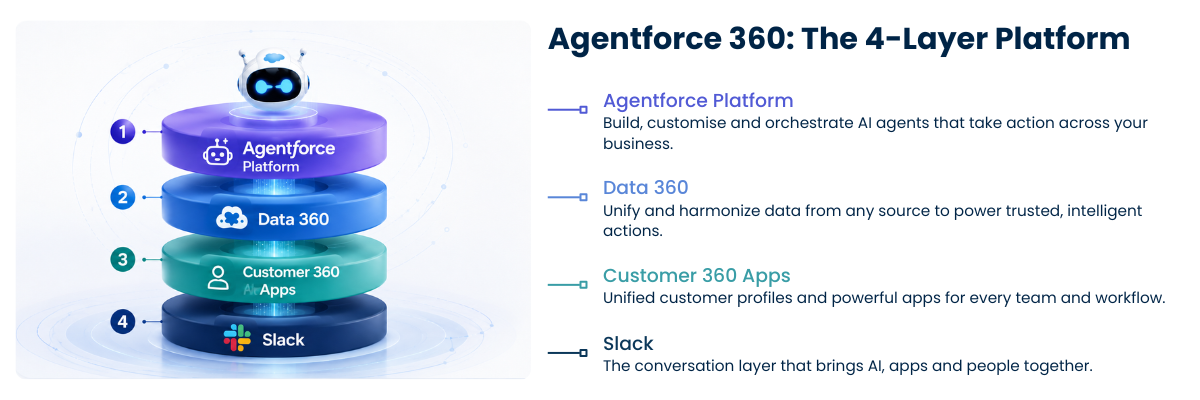
Agentforce 360 became generally available on 14 October 2025. Salesforce said it was built on lessons from more than 12,000 Agentforce implementations, which is a useful detail. It means this was a v2 shaped by real deployment failures rather than a greenfield product.
It has four layers:
| Layer | What it does |
|---|---|
| Agentforce 360 Platform | Agent build and runtime, hybrid reasoning, voice |
| Data 360 | Rebrand of Data Cloud. Turns structured and unstructured data into context an agent can reason over |
| Customer 360 Apps | Agents embedded directly into sales, service, marketing and commerce workflows |
| Slack | The conversational surface where humans and agents actually meet |
The architectural argument behind this explains most of what followed. Salesforce’s position is that agents fail for one of three reasons: they can’t see the right data, they behave unpredictably, or nobody knows where to talk to them. Data 360 addresses the first problem, Agent Script the second, and Slack the third.
Agentforce Voice
Voice agents were the most demo-able launch of the event. Agentforce Voice handles inbound and outbound calls with low enough latency to feel conversational, transcribes in real time, and lets a human take over mid-call with full visibility of what the agent has already said and done.
It integrates with Amazon Connect, Five9, NiCE and Vonage, which was a deliberate choice. Salesforce didn’t try to replace the contact center infrastructure enterprises already own. It layered on top of it, and that is a far shorter sales cycle than a rip-and-replace.
The developer and admin stack
Four launches here, and together they are the most consequential part of Dreamforce 2025 for anyone who actually builds on the platform.
Agent Script is a new agent-definition language written in human-readable JSON. It lets a developer specify exactly when an agent should follow deterministic logic and when it’s allowed to use LLM reasoning. This is Salesforce’s answer to the biggest enterprise objection to agents: you cannot put something non-deterministic in front of a customer and a compliance team at the same time.
Agentforce Builder was rebuilt around conversation. Instead of the old topic-action-instruction workflow, you describe what you want and refine it in three views: a natural-language editor, a low-code canvas, and a script view. A live simulator explains why the agent behaved the way it did.
Agentforce Vibes is a conversational coding assistant that generates Lightning Web Components and Apex logic, running inside VS Code and Code Builder, with 50 premium calls per day per org.
Setup Powered by Agentforce entered pilot. It brings natural-language administration to creating custom objects, building record-triggered and schedule-triggered flows, fixing permissions, and summarizing existing flows. If you have ever inherited an org with 400 undocumented flows, the summarization feature alone is worth the attention.
Data 360 and the context problem
The Data Cloud rename to Data 360 was not cosmetic. Two capabilities came with it. Intelligent Context lets agents reason over unstructured content such as PDFs, call transcripts and knowledge articles, rather than only structured records. Tableau Semantics enforces one consistent business vocabulary across the platform, so “active customer” means the same thing to an agent that it means in a Tableau dashboard.
Anyone who has run a data migration knows why this matters. An agent that pulls the wrong definition of “churned” doesn’t produce a slightly worse answer. It produces a confidently wrong one.
Slack as the agentic operating system
Slack was repositioned as the place work happens, with a reimagined Slackbot and, more importantly, support for Model Context Protocol (MCP). MCP support means third-party AI tools and agents from outside the Salesforce ecosystem can interoperate inside Slack. That is an unusually open move for Salesforce, and a clear signal that they would rather own the interface layer than fight every other agent vendor for it.
The great rebrand
Salesforce renamed its core product line around agents:
| Before | After |
|---|---|
| Sales Cloud | Agentforce Sales |
| Service Cloud | Agentforce Service |
| Marketing Cloud | Agentforce Marketing |
| Data Cloud | Data 360 |
Renaming products your customers have said out loud for fifteen years is not a decision anyone makes lightly. It tells you how completely Salesforce has bet the company on this positioning.
Acquisitions and partnerships
Apromore was acquired, a process intelligence company. The logic is straightforward. Before you can automate a workflow with an agent, you need to know what the workflow actually is, as opposed to what the process documentation claims it is. Apromore maps that gap.
OpenAI expanded its partnership. GPT-5 became available inside the Salesforce platform, Agentforce 360 data became queryable from ChatGPT, and Agentforce Commerce landed inside ChatGPT using the Agentic Commerce Protocol, enabling checkout without leaving the chat. A ChatGPT app for Slack and Codex access came with it.
Anthropic signed a new strategic partnership making Claude the preferred model for regulated industries including financial services, healthcare and life sciences, with bi-directional Claude and Slack integration. Running two frontier model partnerships in parallel, positioned at different industries, is a hedge against betting the platform on any single vendor. That hedge tilted in August 2026, when the two companies announced Claudeforce, making Claude the default reasoning model across Agentforce and Slack.
PwC launched an agentic contact center built on Agentforce Service.
Away from product, Salesforce announced a $15 billion, five-year investment in San Francisco.
Part 2: The audit, or what actually shipped
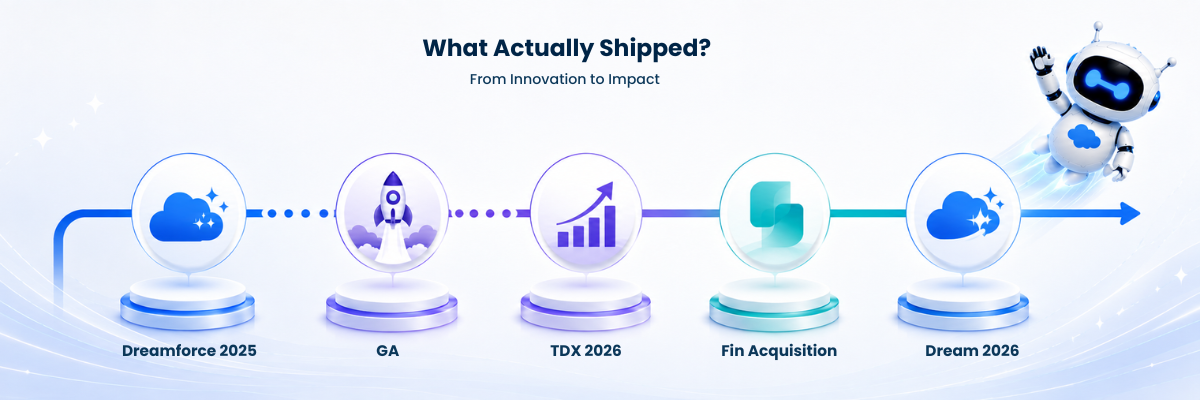
This is the section most Dreamforce coverage skips, and it’s the one that should inform your budget decisions.
The revenue evidence
Agent products either sell or they don’t, and the filings are unambiguous.
| Metric | Q4 FY26 (ended Jan 2026) | Q1 FY27 (ended 30 Apr 2026) |
|---|---|---|
| Total revenue | $11.2B | $11.1B (+13% YoY) |
| Agentforce ARR | ~$800M | $1.2B (+205% YoY) |
| Agentforce + Data 360 ARR | not disclosed | $3.4B (+200%+ YoY) |
| Informatica Cloud ARR | not disclosed | $1.1B |
| Agentic work units delivered | not disclosed | 3.8B (+111% QoQ) |
| Tokens processed (cumulative) | not disclosed | 28.6 trillion (+152% QoQ) |
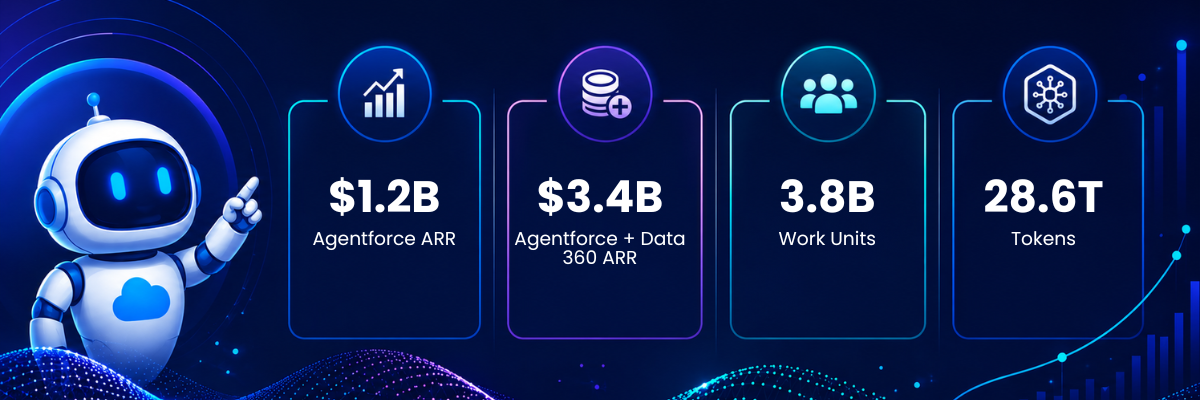
Salesforce guided FY27 revenue to $45.9 to $46.2 billion and authorized a $50 billion buyback. Benioff’s framing on the Q1 call: “Agentic AI is the biggest growth opportunity for our customers, and for Salesforce.”
Two of those metrics deserve a closer look. Agentic work units and tokens processed are not standard SaaS disclosures. They are consumption metrics, and Salesforce putting them into quarterly reporting is a strong hint about where pricing is heading. If your Agentforce contract is currently seat-based, it is worth modeling what a consumption-based renewal would cost at your actual volumes.
TDX 2026 proved the developer story was real
Salesforce’s developer conference in March 2026 shipped the follow-through on the Dreamforce 2025 developer promises, which is the clearest available signal that the platform work wasn’t just keynote material.
Agent Script was open-sourced and published to GitHub. Announced in October, in public hands by March.
Agentforce Vibes 2.0 reads enterprise metadata through the Unified Catalog and supports both Claude Sonnet and GPT-5.
Agentforce Experience Layer (AXL) lets you define an interactive component once and deploy it to web, mobile, Slack and voice.
Agent Script for Voice extends the same deterministic control to voice channels.
Agentforce Mobile SDK brings native iOS and Android with push-to-talk voice.
Headless 360 runs Salesforce as an agent backend behind someone else’s front end.
Agentforce Labs and the Agent Development Life Cycle (ADLC) added safety reviews, deployment tooling and production observability.
AgentExchange grew to 10,000 Salesforce apps, 2,600+ Slack apps and 1,000+ agents.
Session Trace OTel API entered beta, returning full agent session traces as OpenTelemetry spans. The A/B Testing API entered pilot, and Testing Center enhancements went GA in May.
The ADLC and observability work is the tell. You don’t build production tracing and safety review tooling for a product still living in demos. You build it because customers have agents in production and are asking hard questions about what those agents did at 3am.
The Fin acquisition
In June 2026, Salesforce signed a definitive agreement to acquire Fin, formerly Intercom, for approximately $3.6 billion, expected to close in Q4 FY27. Fin’s proprietary Apex model reportedly resolves around 76% of support volume without human involvement.
The positioning is an admission about Agentforce’s weakness. Agentforce is a platform for enterprise-scale custom transformation, and platforms take months to deploy. Fin is packaged and fast. Salesforce buying it says plainly that the mid-market was never going to wait through a six-month implementation, and that plenty of buyers want an agent that works on Thursday rather than one perfectly modeled on their data by Q3.
What’s still thin
An honest audit has to include the parts that haven’t landed.
Adoption remains harder than the headline ARR suggests. The deployments most often cited as successes, including PenFed’s 76-agent system and UCLA Health, involved substantial data cleanup, integration work, process redesign and testing before any agent went live. That work is not optional and it is not fast.
Setup Powered by Agentforce was announced as a pilot in October 2025 and has not made a loud arrival since. Governance frameworks for agent accountability are still largely something each customer builds for themselves. And the honest answer to “which workflows are safe to hand to an autonomous agent” is still a shorter list than most vendor decks imply.
None of that makes Agentforce a bad bet. It makes it a project rather than a purchase.
Part 3: Dreamforce 2026, the confirmed facts
- Dates: 15-17 September 2026
- Venue: Moscone Center, San Francisco
- Theme: “Where every business becomes an Agentic Enterprise”
- Virtual: Free via Salesforce+, with 400+ sessions and 72 hours of programming
Scale
- 1,600+ expert-led breakout sessions
- 50+ visionary and product keynotes
- 150+ hands-on training sessions
- 240+ community roundtables
- Live product demos across Slack, Agentforce, Data 360, Tableau, Customer 360 and Headless 360
Speakers confirmed so far
Marc Benioff delivers the opening keynote. The name that matters most this year is Dario Amodei, co-founder and CEO of Anthropic.
The rest of the confirmed list mixes enterprise and entertainment: Roland Busch, President and CEO of Siemens AG; H.E. Omar Sultan Al Olama, the UAE Minister of State for AI; Linda A. Hill of Harvard Business School; Alessandra Sala of UNESCO’s Women for Ethical AI; Allie K. Miller; Travis Kalanick; the All-In hosts Chamath Palihapitiya, Jason Calacanis and Dave Friedberg; and on the entertainment side Sterling K. Brown, Sheryl Lee Ralph and Reese Witherspoon. Salesforce is still adding names.
Dreamfest now has its headliners too: Usher and Gwen Stefani, playing the ballpark in support of UCSF Benioff Children’s Hospitals.
Amodei on a Salesforce main stage is the detail worth reading into. Less than three weeks before the conference, Salesforce made Claude the default reasoning model behind Agentforce. Putting Anthropic’s CEO on the keynote stage turns that from a press release into a position. If you are weighing up Agentforce, watch closely what these two say about who owns the interface.
Registration and pricing
PassPriceStatusLaunch Special$999ExpiredEarly Bird$1,499ExpiredLast Chance$1,899Through 20 August 2026Full Price$2,299After 20 August
Group registration of three or more brings it to $999 per pass, which is the cheapest route available by a wide margin and cheaper than the original launch special. The Trailblazer Bootcamp on 12-14 September can be added for $1,499 against a $2,299 list price. Discounted hotel blocks close on 21 August 2026.
One free certification exam is included per attendee. Registration requires a free Trailblazer account, attendees must be 18 or over, and Agenda Builder opens in August for session reservations.
Part 4: What to expect at Dreamforce 2026
Salesforce has confirmed dates, theme, session counts and product areas. Everything below is informed expectation based on the shipping pattern since October 2025, not company commitments.
- Proof replaces vision. The 2025 keynote sold a concept. The 2026 keynote has to defend an $11 billion quarter and a product line renamed around a promise. Expect named customers with hard before-and-after numbers rather than staged demos.
- Governance becomes a product, not a slide. The ADLC and observability work from TDX points toward a packaged agent governance layer covering testing, monitoring, escalation paths and audit trails. The market question has moved from “can an agent do this” to “who is accountable when it does it wrong,” and that is a gap Salesforce needs to close before regulated buyers commit.
- Agentic work units get formalized. Once a metric appears in quarterly earnings, it usually appears on a pricing page within a year. Watch for consumption-based packaging.
- Headless 360 expands. Salesforce as an agent backend behind a customer’s own interface is a real strategic shift. It means Salesforce is willing to give up the UI to keep the data and the logic.
- The Fin story gets told properly. The deal is expected to close in Q4 FY27, so it will likely still be pending during the event. Expect a clean split: Fin for fast-deployment SMB service, Agentforce for enterprise custom builds.
- Industry clouds get an agent layer. Financial services, healthcare, retail and manufacturing, with the Anthropic partnership doing visible work in the regulated verticals.
- Multi-model positioning gets louder. Claude for regulated industries, OpenAI for commerce and code. Salesforce has spent a year avoiding single-vendor dependency and will want credit for it.
Part 5: What this means for you
The right response to Dreamforce depends entirely on where you’re standing.
If you already run Salesforce
Your immediate concern isn’t the keynote. It’s the rebrand and the pricing signal. Sales Cloud is now Agentforce Sales. Service Cloud is now Agentforce Service. That renaming will eventually show up in your renewal paperwork, your admin training, and your internal documentation.
Three things to get clear before September.
- Your data readiness. Data 360 is the dependency for everything else. If your org has duplicate accounts, inconsistent picklists and eight definitions of “active customer,” an agent will surface that problem faster and more publicly than any dashboard ever did.
- Your consumption exposure. Work out what agentic work units mean at your transaction volumes before a consumption-based renewal arrives.
- One workflow worth testing. Not your most important one. Pick something high volume, low risk and well documented, such as order status lookups, tier-one password resets, or lead qualification. Prove the model where a mistake is recoverable.
If you’re a Salesforce partner or consultancy
The demand signal is real and the capacity problem is worse. Agentforce implementations need data engineering, integration work, process mapping and test design. That is a wider skill mix than a standard Sales Cloud rollout, and one most boutique consultancies don’t have sitting idle.
The three weeks after Dreamforce are historically the heaviest inbound period of the year, because clients return from the keynote with a list of things they now want built. If your delivery capacity is already committed through Q4, that is a decision to make in August, not on 18 September.
If you haven’t started
Ignore the ARR numbers. They describe Salesforce’s business, not yours.
The useful benchmark is the deployment pattern. Organizations getting value spent significant time on data quality and process definition before they built anything. The ones that didn’t ended up with an agent confidently giving customers wrong answers from bad records.
Start with an honest assessment of what is actually in your CRM. It is less exciting than an agent pilot, and it is the reason the agent pilot will or won’t work.
Pre-Dreamforce readiness checklist
Work through this before 15 September and the sessions will be considerably more useful.
- Audit data quality in the objects an agent would touch first: accounts, contacts, cases, orders
- Document your top five customer-facing workflows as they actually run, not as the process doc describes them
- Identify one candidate workflow that is high volume, low risk and clearly documented
- Review your current Salesforce contract for renewal dates and consumption clauses
- Confirm who in your organization owns agent governance, including testing, monitoring and escalation
- Register for Salesforce+ even if you’re not travelling, and reserve sessions once Agenda Builder opens
- Map your existing integrations. Agentforce is only as capable as the systems it can reach
Frequently asked questions
When and where is Dreamforce 2026?
15-17 September 2026 at Moscone Center in San Francisco. Free virtual attendance is available through Salesforce+ with 400+ sessions across 72 hours of programming.
How much does a Dreamforce 2026 ticket cost?
$1,899 through 20 August 2026, rising to $2,299 after that. Groups of three or more pay $999 per pass. Virtual attendance is free.
What was announced at Dreamforce 2025?
Agentforce 360 was the headline launch, alongside Agentforce Voice, Agent Script, Agentforce Builder, Agentforce Vibes, and the Data Cloud rebrand to Data 360. Salesforce also acquired Apromore, expanded its OpenAI partnership, signed a new partnership with Anthropic, and renamed Sales Cloud, Service Cloud and Marketing Cloud around Agentforce.
What is Agentforce 360?
A four-layer agent platform combining the Agentforce 360 Platform, Data 360, Customer 360 apps and Slack. It became generally available on 14 October 2025 and was built on learnings from more than 12,000 prior Agentforce implementations.
What is the difference between Data Cloud and Data 360?
Data 360 is the renamed Data Cloud, with two additions. Intelligent Context lets agents reason over unstructured data, and Tableau Semantics enforces consistent business definitions across the platform.
Is Agentforce actually being adopted?
Yes, at scale. Agentforce reached $1.2 billion ARR in the quarter ended 30 April 2026, up 205% year on year, with 3.8 billion agentic work units delivered that quarter. Adoption still requires meaningful data and process work before deployment.
What is Salesforce likely to announce at Dreamforce 2026?
Salesforce has not confirmed specific announcements. Based on the shipping pattern since October 2025, expect production case studies, agent governance tooling, Headless 360 expansion, consumption-based pricing signals, and integration positioning around the pending Fin acquisition.
Do I need to attend in person to see the announcements?
No. Salesforce+ streams the keynotes and 400+ sessions free. In-person value is concentrated in hands-on training, certification and networking rather than the announcements themselves.
Where to go from here
The pattern across the last eleven months is consistent. Agentforce works when the underlying data and processes are in order, and produces expensive disappointment when they aren’t. The technology is no longer the constraint. Implementation readiness is.
If you’re weighing an Agentforce project, or you’re already mid-implementation and the data layer is proving harder than the pitch suggested, a structured assessment before September is a cheap way to avoid an expensive detour.
Ashapura Softech offers a free 30-minute CRM health check. You get a written one-page findings document covering your data readiness, integration gaps, and the workflows most likely to succeed as a first agent deployment. There is no pitch deck and no obligation.