
Quick answer
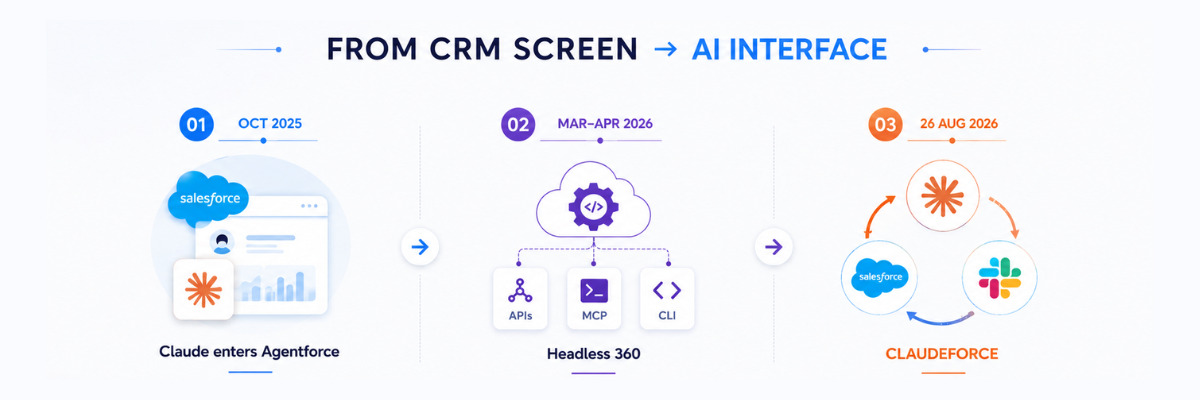
Headless 360 is the API driven layer Salesforce announced at TDX 2026 that lets AI agents read, write and reason over Salesforce data without opening the Salesforce interface. It does not replace your org. It exposes the same data, workflows and business rules to an agent through MCP servers, under the permissions that user already has. It is also the foundation the Claudeforce partnership is built on.
Update (14 Sep 2026): On 11 Sep 2026 Salesforce announced a new portfolio of named, job-ready Agentforce agents built for specific high-value work: Casey (customer service), Paige (IT and HR service), Carter (shopper agent for e-commerce), Marshall (supply chain orchestration), Piper (inbound lead generation) and Fin (complex customer experience), all generally available now, plus Hunter (outbound sales), in pilot with general availability expected November 2026. The release also adds long-horizon runtime so agents can pursue goals over days or weeks rather than single interactions, AI Skills for teaching agents new tasks (pilot now, GA October 2026), multi-agent orchestration across workflows, and an Agent Optimizer for continuous performance tuning (GA October 2026). This sits on top of the Core, Advanced and Max editions Salesforce introduced in early September.
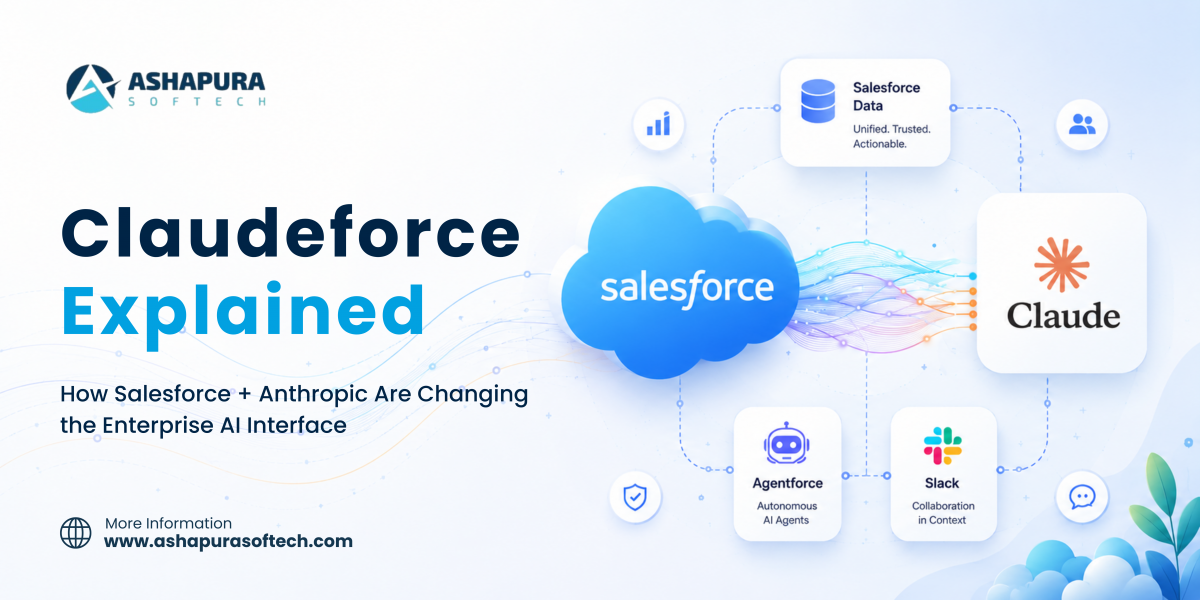
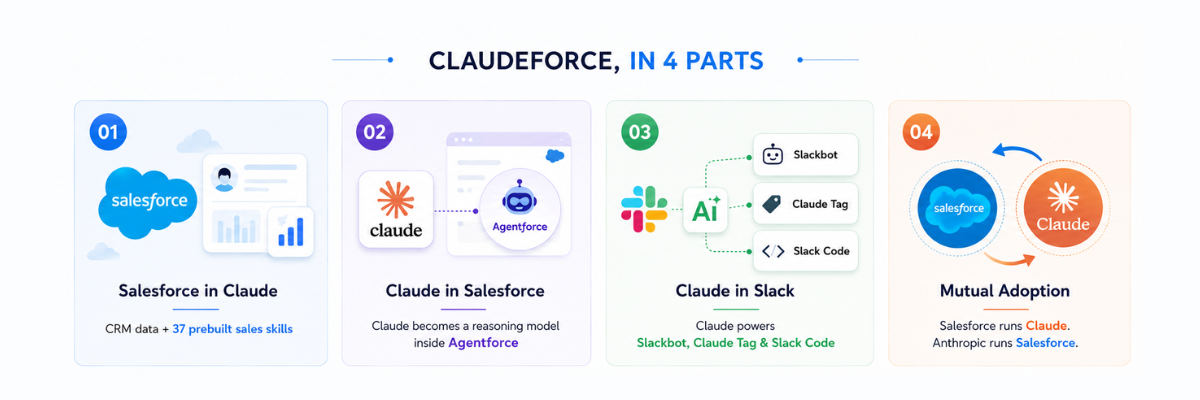
When Salesforce put its CRM inside Claude in August 2026, the reaction focused on the plugin. The more interesting question is why it was possible at all. The answer is a piece of architecture Salesforce announced four months earlier, and it deserves more attention than it got.
Headless 360 is the reason an external AI agent can read your pipeline, update an opportunity and respect your sharing rules without anyone opening a Salesforce tab.
What Headless 360 actually is
Salesforce’s own definition: “an architectural transformation that exposes every capability Salesforce has built over 25 years directly as an API, a Model Context Protocol (MCP) tool, or a CLI command.”
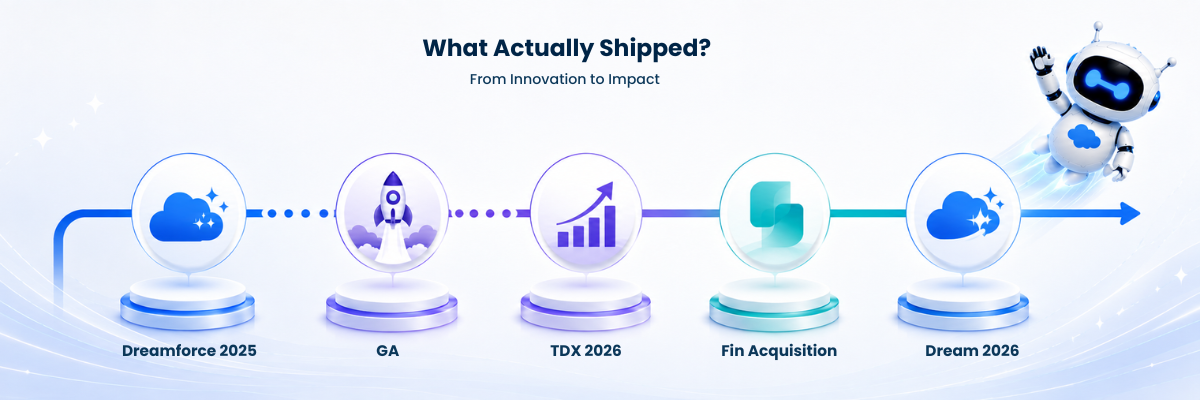
It was announced on 15 April 2026 at TDX 2026 in San Francisco, under the headline “No Browser Required.”
The framing from the announcement is the clearest statement of intent Salesforce has made about where the platform is going:
In the agentic enterprise, humans aren’t the only ones navigating. Agents are too, and they don’t go to a browser or click through UIs.
The scale involved: 4,000+ existing APIs, 220+ CLI commands, 60+ MCP tools and 30+ prebuilt coding skills, all reachable by an agent that has never rendered a Salesforce page.
One thing it is not, in Salesforce’s own words: “Headless 360 does not replace the Salesforce interface you work in every day.” The panic in some admin communities after the “no browser required” headline was understandable and misplaced.
The four pillars
| Pillar | What it provides |
|---|---|
| Skills | 30+ prebuilt skills giving coding agents such as Claude Code, Cursor and Windsurf the knowledge to discover, understand and act on Salesforce natively |
| MCP and APIs | 60+ MCP tools plus the full suite of Salesforce APIs |
| Metadata | Org-aware grounding, so an agent understands your objects, fields and configuration rather than guessing |
| Headless Experience Layer | A rendering layer that surfaces Salesforce experiences into Slack, Teams, WhatsApp and voice |
The metadata pillar is the one that separates this from a generic API integration. An agent hitting a REST endpoint knows the schema. An agent grounded in org metadata knows that your Stage picklist has a value called “Verbal Commit” that means something specific in your business.
The MCP servers Salesforce has shipped
Salesforce’s hosted MCP servers reached general availability on 29 April 2026. The current catalogue:
| Server | Status | What it exposes |
|---|---|---|
| SObject All | GA | Full CRUD plus query and search across all Salesforce objects |
| SObject Reads | GA | Read and query only, no mutations |
| SObject Mutations | GA | Create and update, no delete |
| SObject Deletes | GA | Delete only |
| Data 360 | GA | Query unified customer data, roughly 200 Data 360 APIs |
| Headless 360 | Beta | Salesforce Setup and platform capabilities via Discover, Describe and Dispatch |
| Tableau Next | GA | Semantic models, KPI queries, analytics execution |
| Marketing Engagement | GA | Journeys, campaigns, data extensions, content |
| Slackbot MCP Client | GA | Connects Slackbot to Salesforce and 20+ partner apps |
The separation of reads, mutations and deletes into distinct servers is a deliberate governance decision, and a sensible one. Activating SObject Reads alone lets an agent answer questions without ever being able to change anything.
The Headless 360 MCP server itself
Still in beta as of July 2026, and narrower than the name suggests. It exposes exactly four tools:
- discover – semantic search across a vector index of APIs and skills, returning ranked candidates
- describe – returns the technical contract: APIs, parameters, dependencies and the ordered steps
- dispatch – invokes the skill, routes to the endpoint and enforces user access guards
- dispatch_readonly – the same, restricted to GET operations
Roughly 100 skills at launch, focused on Setup tasks for admins: user management, password operations, permission assignment, Apex trigger management, platform events, Change Data Capture, event relays and named credential configuration. Salesforce says thousands more are in development.
Worth being clear about the beta status. This is a Beta Service under Salesforce’s beta terms, and the skill library is thin relative to the ambition of the announcement.
How your permissions survive the trip
This is the part that determines whether Headless 360 is a governance breakthrough or a security incident waiting to happen.
Salesforce’s clearest statement, from the beta announcement:
If you can’t do it in Salesforce, your agent can’t do it through the MCP server.
Every transaction runs as the authenticated user, scoped through an external client app holding the mcp_api scope. Authentication is per-user OAuth 2.0 with PKCE.
Salesforce describes four enforcement layers on every call:
- Identity – the agent acts as a specific user, not an anonymous service account
- Access – sharing rules, field-level security and permission sets apply
- Invocation scope – only explicitly exposed tools and actions are available
- Governance – validation rules, triggers, approval chains and governor limits all fire
Patrick Stokes, Salesforce’s president of applications and marketing, put it bluntly when describing the Claude plugin: if you don’t own a record or have permission to see it, the MCP server doesn’t either.
The sentence every admin should read twice
From Salesforce’s own admin blog:
When an agent acts on behalf of a user, it can do anything that user is permitted to do.
That is the whole risk model in one line. Permission inheritance is only a safety feature if the permissions are correct. Every over-provisioned profile in your org – the one that got view-all on a standard object during go-live because it was the fastest fix – has just become an agent-reachable surface.
It was survivable when exploiting it required someone to log in and know where to look. It is materially less survivable when a colleague can ask a question in plain English and an agent will go and find the answer.
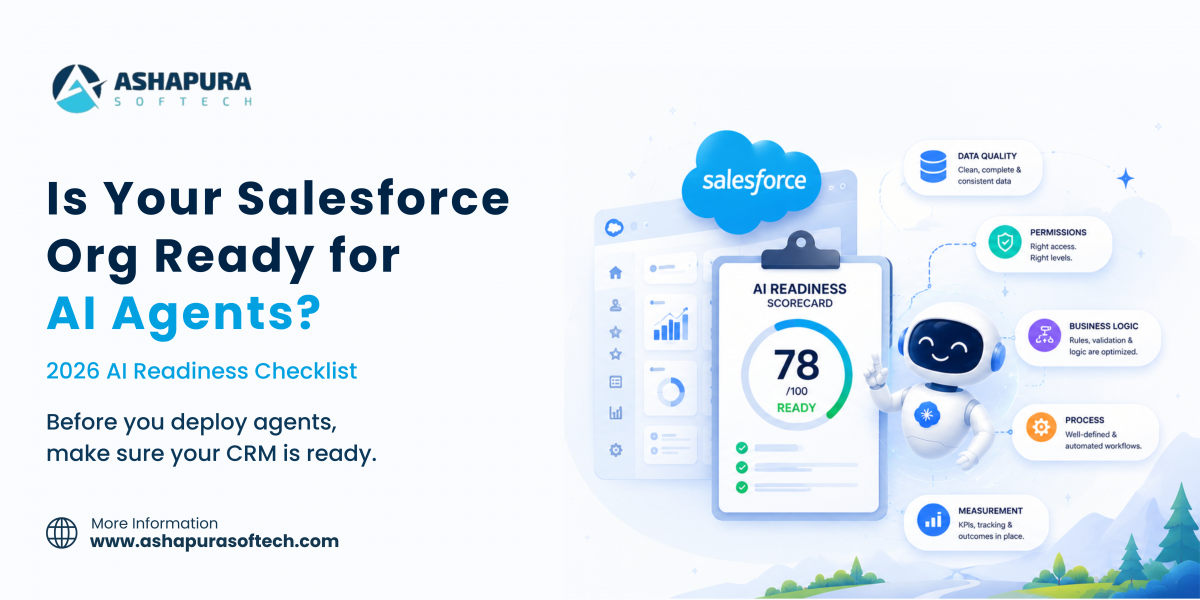
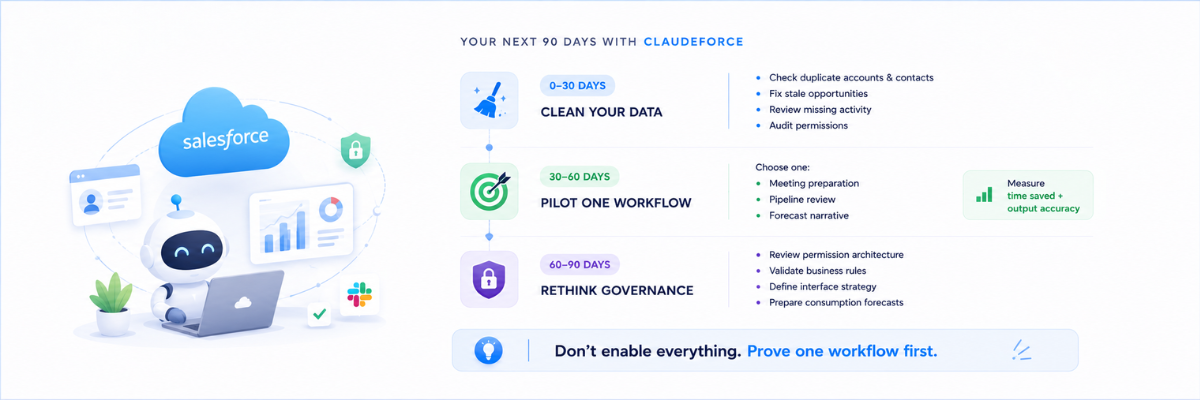
This is why a permission-model audit is no longer housekeeping. It is a security control, and it belongs before the pilot rather than after it. Our Agentforce readiness checklist covers exactly what that audit should look for, and our Claudeforce breakdown explains why it became urgent this quarter.
Salesforce also documents a client-side control worth using: MCP clients support tool-level restrictions that require human approval before an agent action executes. Salesforce’s own recommendation is to configure these before allowing configuration changes or data modification, and to test in a sandbox first.
What it actually takes to switch on
Standard MCP servers are inactive by default. Four steps to get an external agent connected:
1. Activate the server. Setup, search for “MCP Servers,” open the Salesforce Servers tab, select the server and click Activate. Copy the API name (drop the platform prefix) and the server URL.
2. Create an External Client App. Setup, External Client App Manager, New External Client App. Then:
- Enable OAuth
- Set the callback URL your client expects
- Add exactly two scopes: “Perform requests at any time” (refresh_token, offline_access) and “Access Salesforce Hosted MCP Servers” (mcp_api)
- Uncheck “Require secret for Web Server Flow” and “Require secret for Refresh Token Flow”
- Check “Require Proof Key for Code Exchange (PKCE)” and “Issue JWT-based access tokens for named users”
- Collect the consumer key and secret from OAuth Settings
3. Connect the client using its MCP add command with the server URL, consumer key and callback port, then authenticate and grant access.
4. Test before you trust it. Salesforce recommends Postman for a smoke test.
Server URLs follow the pattern https://api.salesforce.com/platform/mcp/v1/<SERVER-NAME> for production, with /sandbox/ inserted for sandbox and scratch orgs. API version 67.0 or later is required.
Two gotchas practitioners report that Salesforce’s guide does not mention: PKCE may need enabling globally first under Setup, OAuth and OpenID Connect Settings, and a newly created External Client App can take up to 30 minutes to become usable.
Where the gaps are
Headless 360 is a genuine engineering achievement with three honest weaknesses worth knowing before you plan around it.
Salesforce built the access layer, not the governance layer. There are no quality checks on agent-generated code, no technical-debt assessment, no naming-convention enforcement, no automation-chain validation. Salesforce shipped Testing Center, Custom Scoring Evals, Observability and Session Tracing, which help, but observation is not the same as control. General-purpose code scanners cannot see Salesforce-native concerns such as governor limits, Flow complexity or metadata dependencies.
The builder gap is real. Vernon Keenan’s TDX coverage made the sharpest version of this argument: pro-code developers gained a substantial agentic toolkit while admins and Flow builders got very little, with no visible bridge programme to retool the existing ecosystem. If your Salesforce capability sits mostly with admins rather than developers, Headless 360 does not currently meet you where you are.
Testing headless agents is harder than testing Flows. The debugging habits built around Flow and Apex do not transfer cleanly, which is precisely why Salesforce had to build separate evaluation tooling. Budget for the learning curve.
Bulk operations deserve specific attention. A user with delete rights can, in principle, instruct an agent to delete records at scale. Mitigate with Transaction Security Policies, or by activating SObject Reads rather than SObject All, or by blocking delete tools client-side.
What it costs
Salesforce has published no Headless 360 rate card, and this is the single least documented part of the story.
What is officially stated: MCP access “is included with Enterprise Edition and above – there’s no separate SKU required,” the MCP server “will use your existing API limits,” and “Flex Credits apply when you invoke Agentforce actions, run Data 360 queries, or use Prompt Builder.”
What is not stated: any per-API-call or per-MCP-call price. When CIO asked how API and MCP interactions under Headless 360 are currently billed, Salesforce declined to comment. Salesforce’s CRO said publicly that the company will work with customers “to find the right ways in a fair way to monetize those new interactions.”
The practical read: assume existing API-limit accounting plus Flex Credits on downstream agent work, and get whatever you are told in writing before you scale. Our Agentforce pricing breakdown covers the credit rate card in detail.
How this connects to the rest of the platform
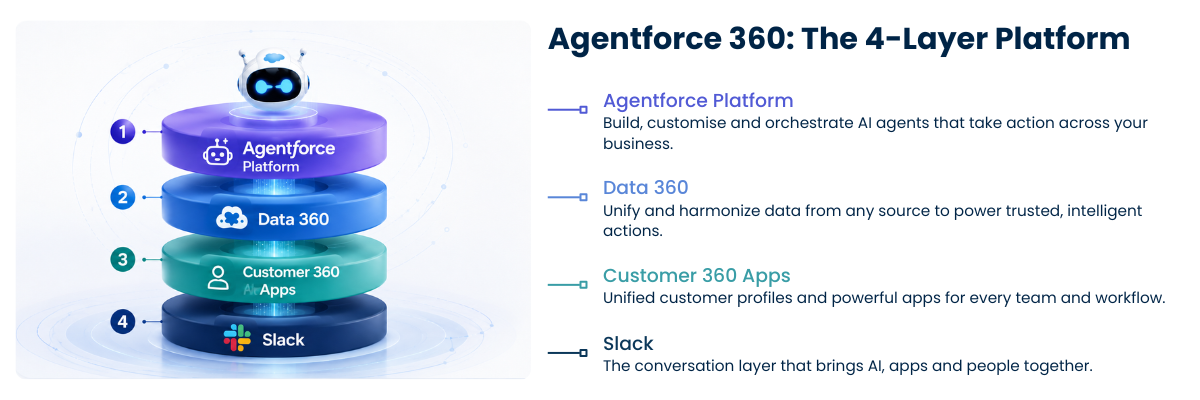
Headless 360 sits inside the wider architecture Salesforce now describes as five systems: Agentforce as the system of agency, Slack as the system of engagement, Tableau as the system of insight, Customer 360 as the system of record, and Data 360 as the system of context.
Two clarifications worth making because commentary keeps blurring them:
Agentforce and MCP are complementary, not competing. Agentforce is where you choose the model and build the agent. MCP is what exposes skills and knowledge to an agent, wherever that agent lives.
Salesforce has not published a link between Headless 360 and the Atlas Reasoning Engine. No primary source connects the two, and Salesforce’s Atlas documentation does not mention Headless 360. The honest framing is that Headless 360 is the access and invocation layer while Atlas is the reasoning layer inside Agentforce. How, or whether, Atlas plans over Headless 360 skills is not documented.
There is also a naming inconsistency worth noting. The Claudeforce press release attributes the plugin’s foundation to AIforce, described as “Salesforce’s enterprise harness that connects business data and workflows to agents through MCP servers, APIs, and CLI tools” – which is Headless 360’s description in substance, under a different name. Salesforce has not published a statement equating them.
What to do about it
If you are an admin: audit your permission model before anything else. Profiles and permission sets with broader access than anyone remembers granting are now the highest-priority item on your list. Then activate the narrowest server that does the job – SObject Reads before SObject All.
If you are a developer: start with the Salesforce DX MCP Server locally and the hosted servers in a scratch org. The Trailhead module and the developer workshop are both current and worth the hour.
If you own the platform: the questions to get answered before a production rollout are what gets logged, what gets retained, where, and how consumption will be billed as volume grows.
If you are a partner or SI: the governance layer between Salesforce’s access layer and a production deployment is not built. That gap is billable work – permission architecture, MCP scoping, agent testing strategy and consumption forecasting. Firms with offshore delivery capacity to staff it have more addressable scope than they did a quarter ago.
Frequently asked questions
What is Salesforce Headless 360?
Headless 360 is a Salesforce architecture that exposes the platform’s capabilities as APIs, Model Context Protocol tools and CLI commands, so AI agents can use Salesforce data, workflows and governance rules without a user interface. It was announced on 15 April 2026 at TDX 2026.
Does Headless 360 replace the Salesforce UI?
No. Salesforce states directly that Headless 360 does not replace the Salesforce interface, which is not going away. It adds a second way in for agents.
How does Headless 360 handle permissions?
Every call runs as the authenticated user via OAuth 2.0 with PKCE. Sharing rules, field-level security, permission sets, validation rules, triggers, approval chains and governor limits all apply. Salesforce’s summary is that if you cannot do it in Salesforce, your agent cannot do it through the MCP server.
What MCP servers does Salesforce offer?
SObject All, SObject Reads, SObject Mutations, SObject Deletes, Data 360, Tableau Next and Marketing Engagement are generally available. The Headless 360 MCP server is in beta. A Slackbot MCP Client is generally available and requires Enterprise Edition or above.
What does Headless 360 cost?
Salesforce has published no separate rate card. MCP access is included on Enterprise Edition and above, calls use existing API limits, and Flex Credits apply when an Agentforce action, Data 360 query or prompt runs. Salesforce declined to comment when asked how API and MCP interactions are currently billed.
Is Headless 360 what powers Salesforce in Claude?
Reporting on the Claudeforce launch says the plugin is built on Headless 360. Salesforce’s own press release attributes it to “AIforce,” described in almost identical terms. The two are very likely the same substrate under different names, but Salesforce has not published a statement equating them.
Sources
- Salesforce Headless 360 – product page
- Introducing Salesforce Headless 360. No Browser Required. – Salesforce, 15 April 2026
- Headless 360 MCP Server reference – Salesforce Developers
- Connect Claude with Salesforce Hosted MCP Servers – Salesforce Developers
- Introduction to Salesforce Headless 360 for Admins – Salesforce Admins
If you are looking at the non Salesforce route, the same permission and data questions come up in what your ERP and CRM must provide before you build a Claude commerce agent.
Ashapura Softech is a certified Salesforce implementation partner. If you want your org’s permission model audited before you expose it to agents, book a CRM health check. See also our Salesforce DevOps services and Salesforce cloud services.