
A leading home furnishings and interior décor retailer replaced manual, error-prone quoting for custom furniture orders with Salesforce Sales Cloud and CPQ — and deployed Agentforce as an AI design consultation assistant that recommends room packages, checks production timelines, and helps reps close larger orders faster.
Project Overview
Our client is a leading home furnishings and interior décor retailer operating both a direct-to-consumer eCommerce storefront and a B2B trade program serving interior designers, architects, and hospitality procurement teams across regional markets in the United States.
Their product catalog includes made-to-order furniture with complex configuration options: customer-specified dimensions, fabric grades and colors, wood and metal finishes, and production lead times that vary by manufacturing queue. Every custom order is, in effect, a unique product — and their sales team was managing this complexity entirely in spreadsheets and a disconnected HubSpot CRM.
Ashapura Softech was engaged to unify sales, service, and marketing onto a single Salesforce platform — replacing the spreadsheet quoting process with CPQ, deploying Agentforce as an AI design assistant, and integrating the Adobe Commerce storefront with Data Cloud to drive personalized marketing journeys based on how customers interact with the virtual room planner and room inspiration boards.
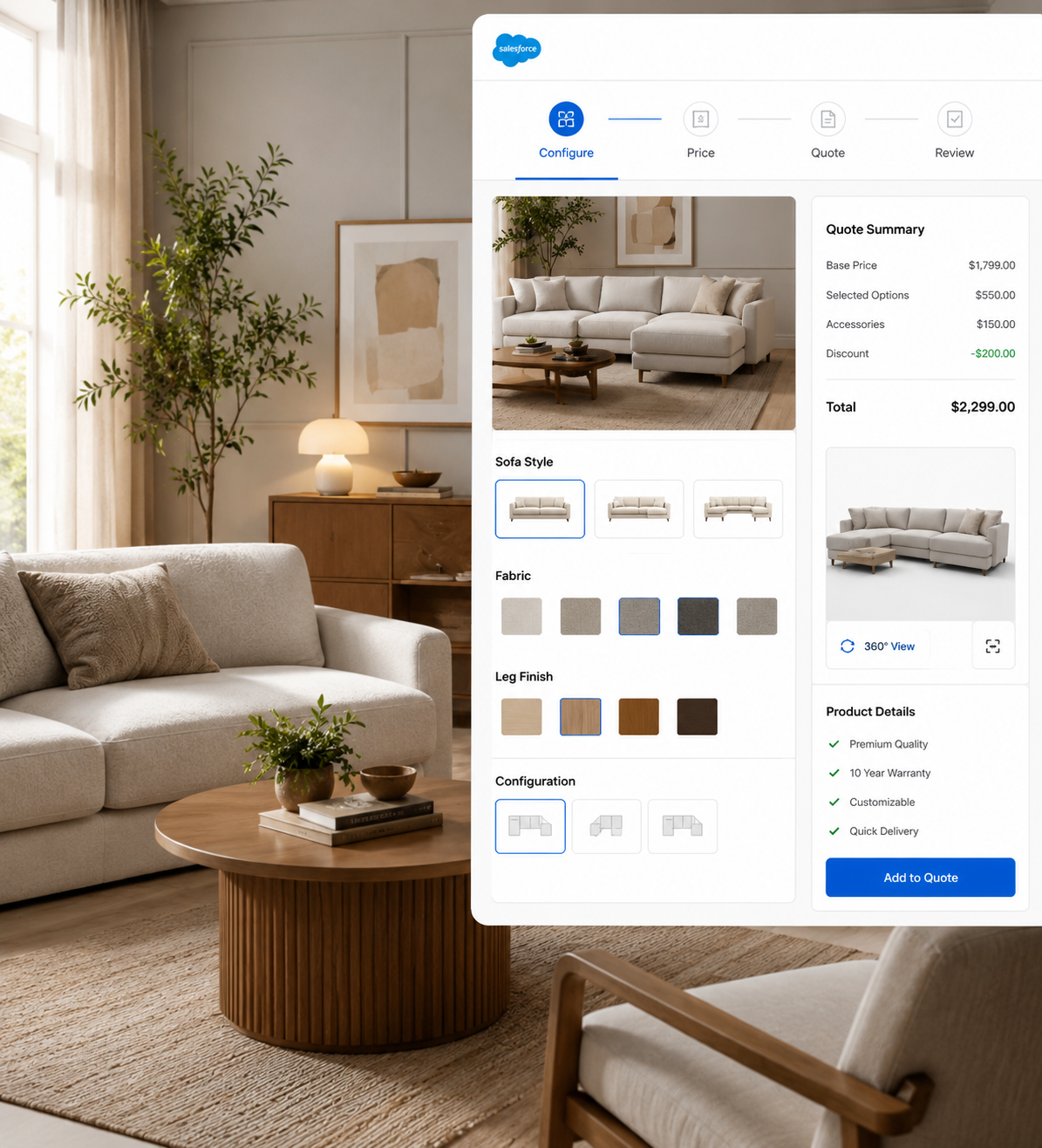
"Our reps were spending 45 minutes building a single custom quote in a spreadsheet — and still getting dimensions or lead times wrong. Now the same quote takes under 10 minutes, and Agentforce checks the production schedule from Odoo in real time so we can actually commit to a delivery date."— VP of Sales, Home Furnishings & Interior Décor Retailer
The Business Challenge
Custom furniture retail is operationally demanding: every order is unique, every customer expects a precise delivery commitment, and the sales team must be as knowledgeable as a trained designer. The legacy stack was failing on all three fronts.
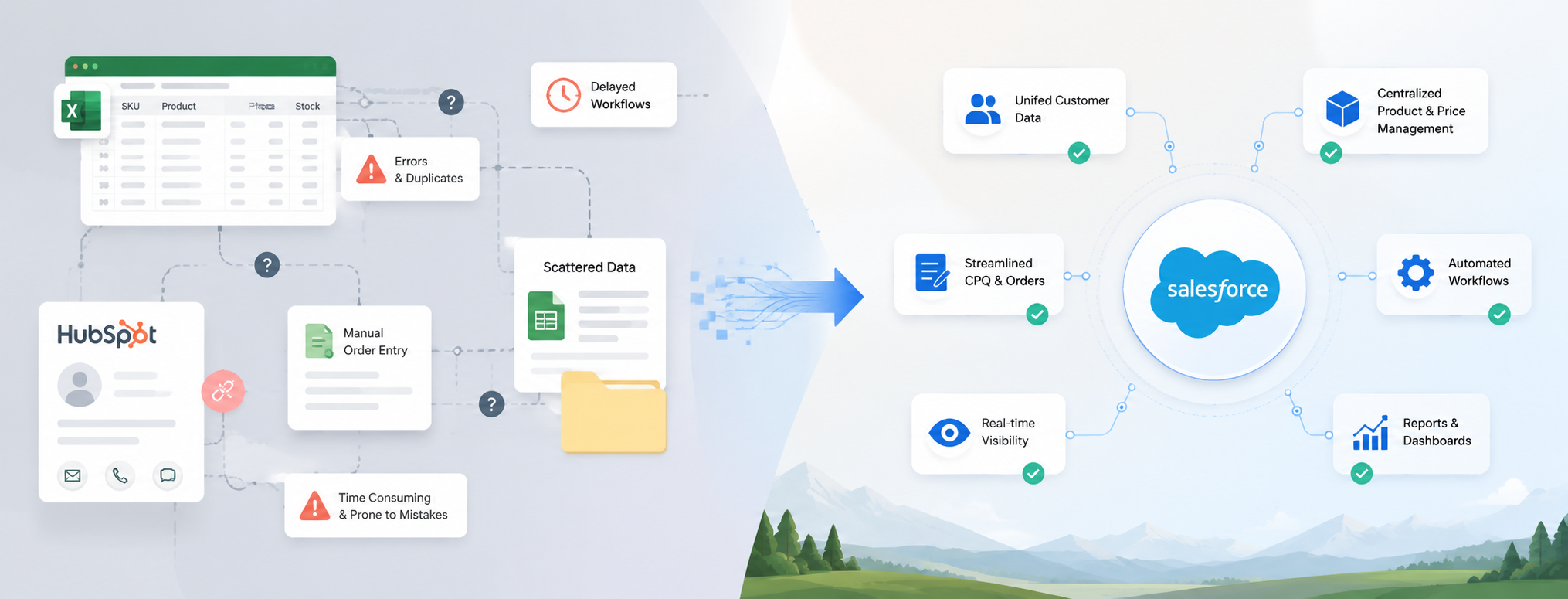
Sales reps assembled custom furniture quotes line by line in spreadsheets — manually calculating pricing for dimension upgrades, fabric grades, and finish options. The process took 45 minutes per quote on average, and configuration errors were frequent enough to require rework after order confirmation.
When customers called to ask about delivery timelines, reps had to email or call the warehouse separately. There was no live connection between the CRM and Odoo ERP — so delivery date commitments were educated guesses, and inaccurate lead times generated a high volume of inbound service contacts.
Interior designers, architects, and hospitality procurement teams — the company's highest-value accounts — were tracked in a separate spreadsheet pipeline with no connection to the consumer eCommerce platform or order history. A designer who also shopped the website as a consumer appeared as two completely different people.
Customers reporting delivery damage emailed a shared inbox. There was no case creation, no SLA enforcement, no visibility into open claims for management, and no connection between the damage claim and the original order record. Claims fell through the cracks, requiring customers to follow up multiple times.
The marketing team had no insight into which customers had saved room inspiration boards, added items to wish lists, or spent time in the virtual room planner. Every promotional email went to the full list with the same content — regardless of whether the recipient had been browsing mid-century modern sofas or Scandinavian dining sets.
Amazon Home and Wayfair orders were processed through separate channel interfaces with no synchronization into HubSpot. A customer who purchased on Wayfair and then called for service appeared as a new contact with no order history — making every support interaction start from scratch.
The Solution
Ashapura Softech designed a platform where every custom furniture order, every customer design interaction, and every post-sale service request flows through a single unified Salesforce environment — connected to Odoo ERP, Adobe Commerce, and marketplace channels.
Salesforce Sales Cloud | CPQ | Agentforce Design Consultation Agent | Odoo ERP Integration | Einstein Lead Scoring
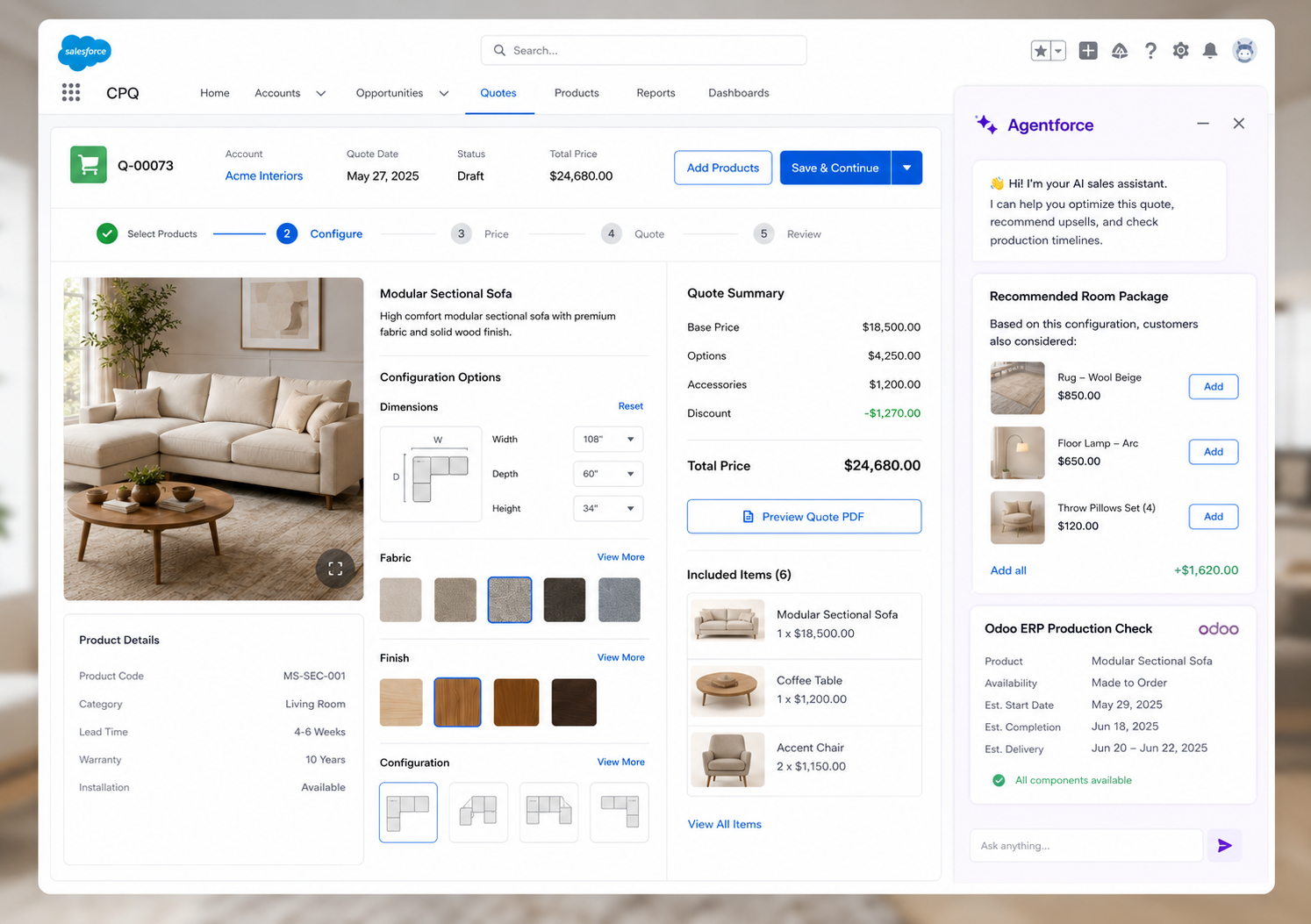
The centerpiece of the implementation is Salesforce Sales Cloud with CPQ, configured to handle the full complexity of made-to-order furniture quoting. Each configurable product is modeled as a CPQ product bundle — with options for dimensions, fabric grades, finish selections, and lead time tiers. Configuration rules enforce valid combinations, and pricing rules automatically calculate the cost of upgrades without any manual calculation by the rep.
Alongside CPQ, Ashapura Softech deployed an Agentforce design consultation agent embedded directly in the quote workflow. The agent draws on the full product catalog, the customer's purchase history, and their room inspiration board activity to:
Quotes that previously took 45 minutes to assemble — with multiple configuration errors requiring rework — now take under 10 minutes, with accurate lead times and pricing guaranteed by CPQ rules.
Adobe Commerce (Magento) | Salesforce Data Cloud | Marketing Cloud | Journey Builder | Multi-Language (EN/ES)
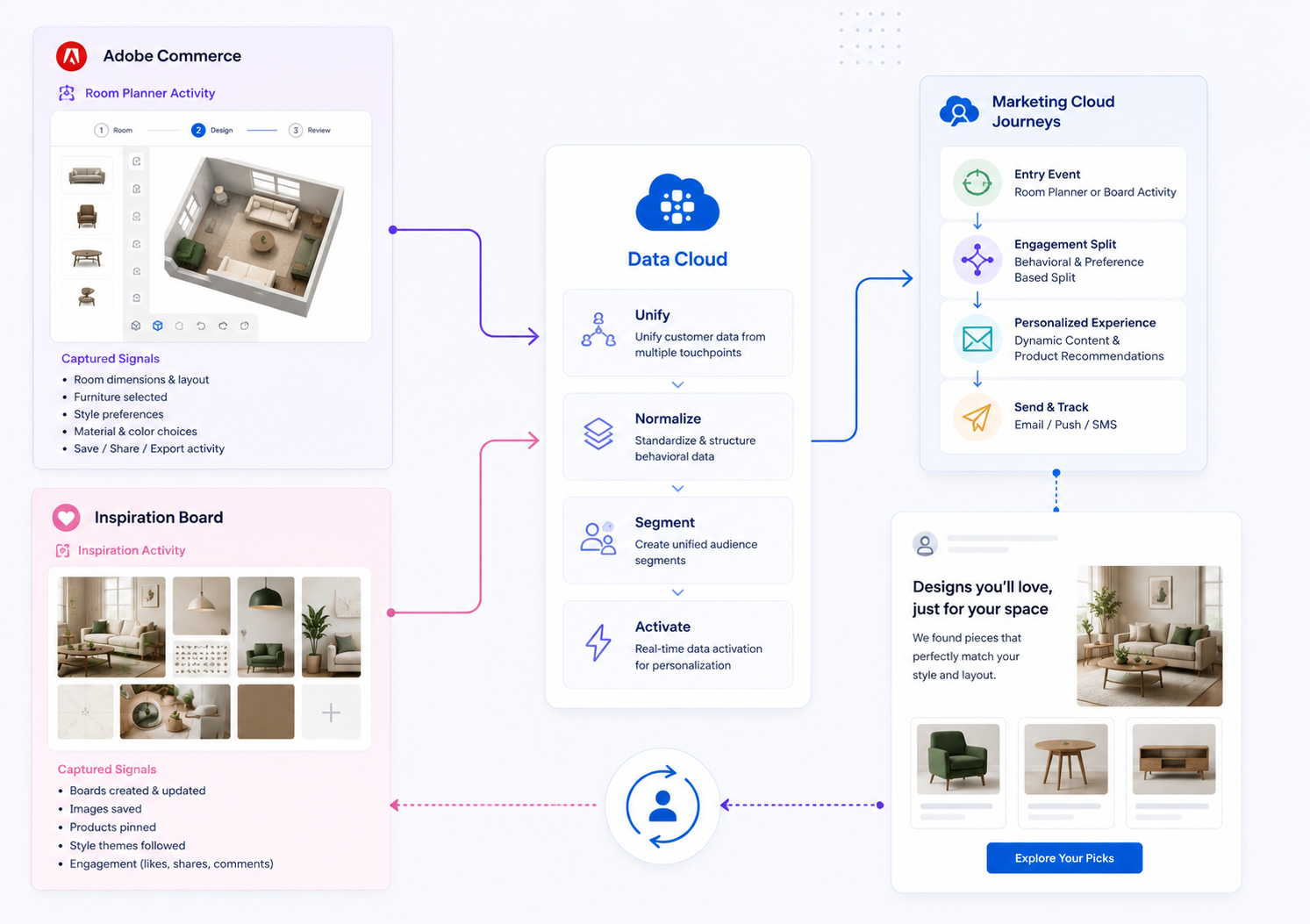
The Adobe Commerce (Magento) storefront integration with Salesforce Data Cloud captures behavioral signals that were previously invisible to the marketing team. Every customer action on the storefront is streamed into Data Cloud:
Data Cloud structures these signals into unified customer profiles and creates behavioral segments — for example, customers who have saved a living room design containing a specific sofa style within the past 30 days. These segments drive Marketing Cloud journeys with pinpoint relevance:
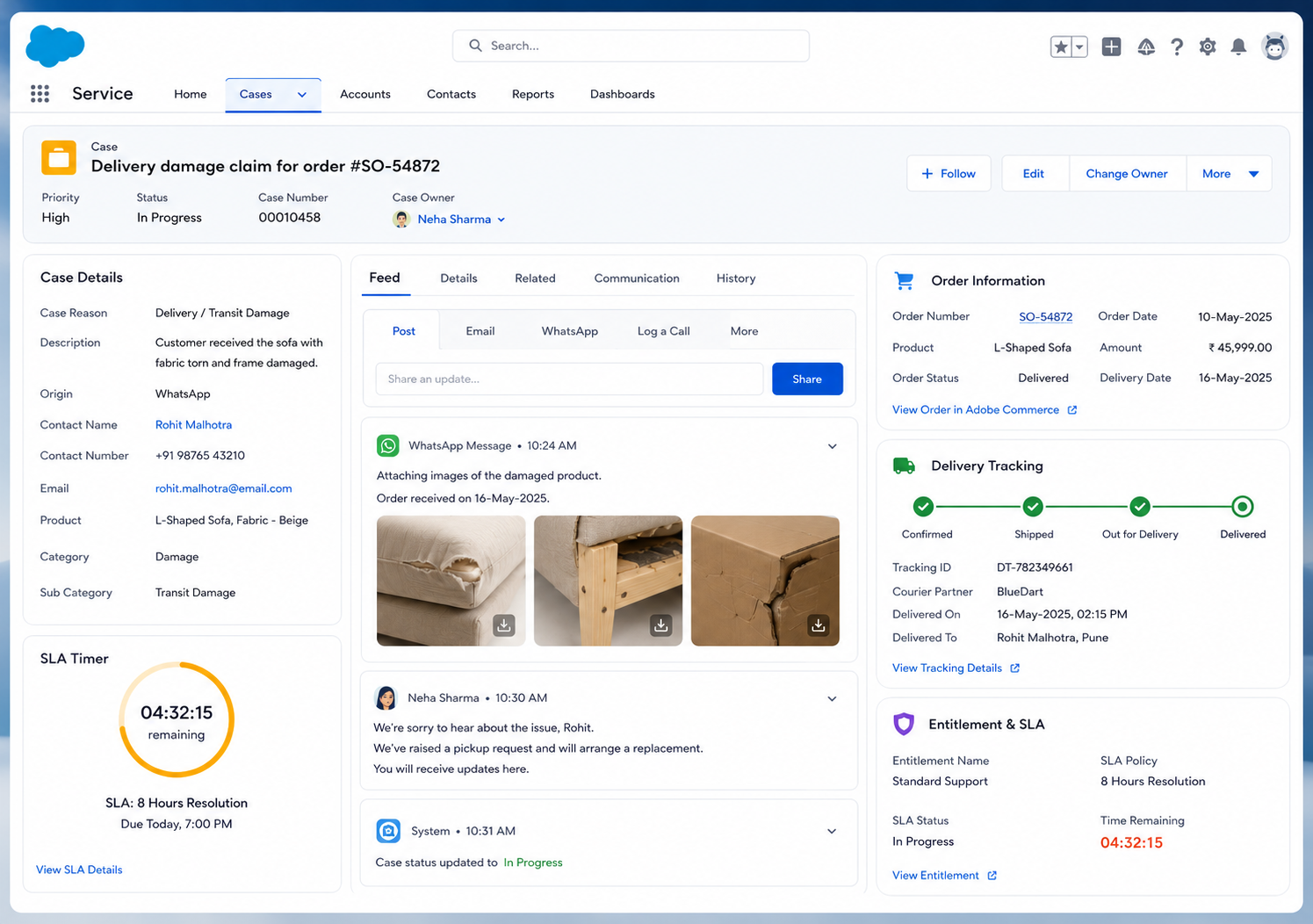
Salesforce Service Cloud | Digital Engagement | WhatsApp, Email, SMS | Delivery Tracking Integration | Case Management
Post-delivery support was one of the most visible pain points for customers. Delivery damage claims went into a shared email inbox with no tracking and no SLA, assembly support requests were answered inconsistently, and delivery tracking questions consumed disproportionate rep time because there was no live data in the CRM.
Ashapura Softech implemented Salesforce Service Cloud with full omnichannel routing across WhatsApp, email, and SMS. Every inbound contact — regardless of channel — creates a linked Service Cloud case with the customer's complete order history attached:
Salesforce Sales Cloud | Einstein Lead Scoring | Channel Engine | Amazon Home | Wayfair | Odoo ERP
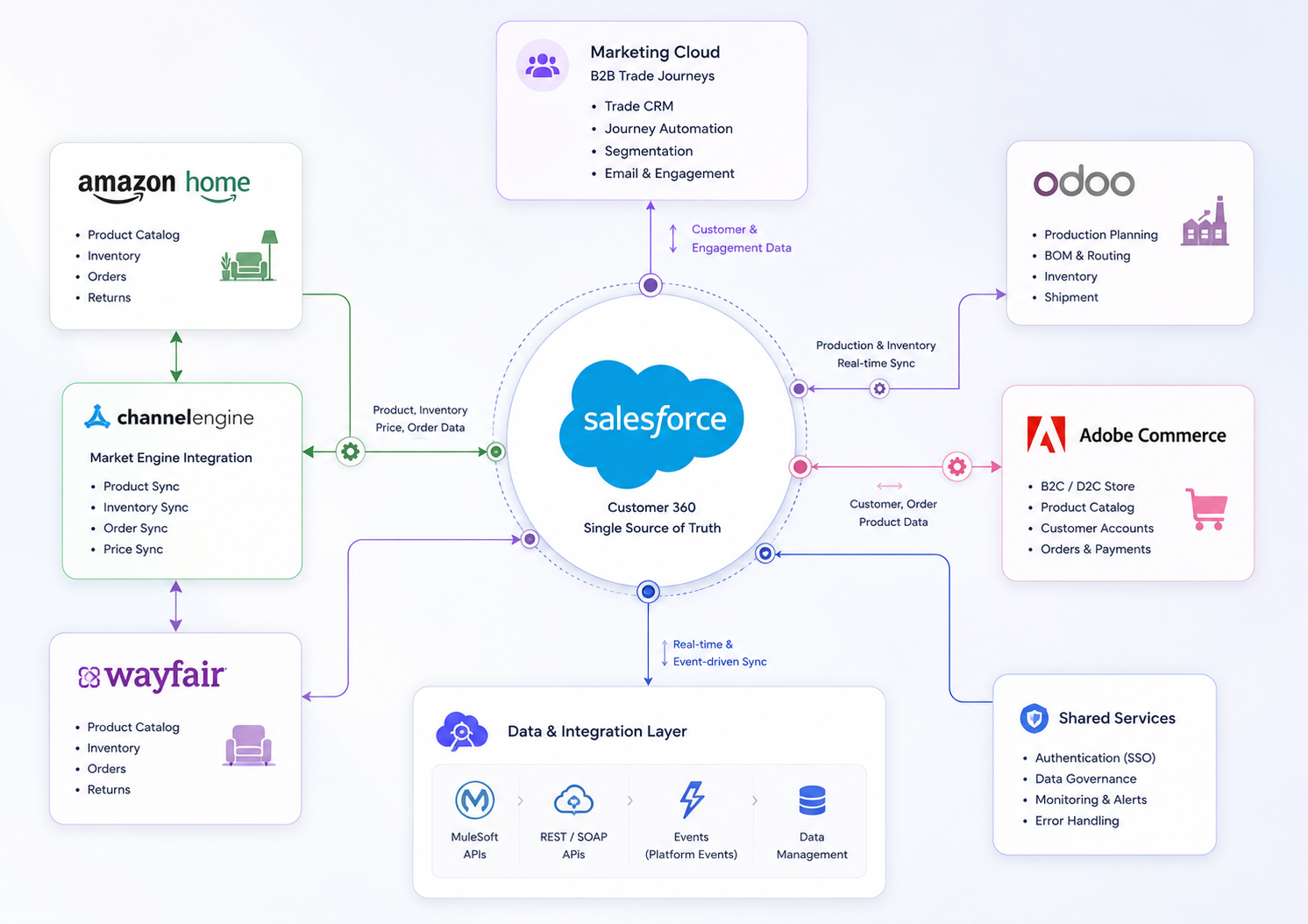
Interior designers, architects, and hospitality procurement teams — the retailer's B2B trade accounts — generate a disproportionate share of revenue but were managed in a separate spreadsheet pipeline with no connection to the consumer platform. A designer who ordered from the website as a consumer and also managed trade orders for clients appeared as two unrelated contacts.
Ashapura Softech built a unified B2B trade pipeline inside Salesforce Sales Cloud, with account hierarchies linking individual designers to their firm and their client projects. The trade pipeline sits alongside consumer order data in a single platform — so the sales team sees the full relationship value of each trade account, not just individual transactions.
The Migration Challenge
Migrating from HubSpot CRM and a custom order management tool to Salesforce required solving a problem that standard migration tooling cannot handle: preserving the full BOM structure of 85,000 custom furniture orders as CPQ product bundle configurations.
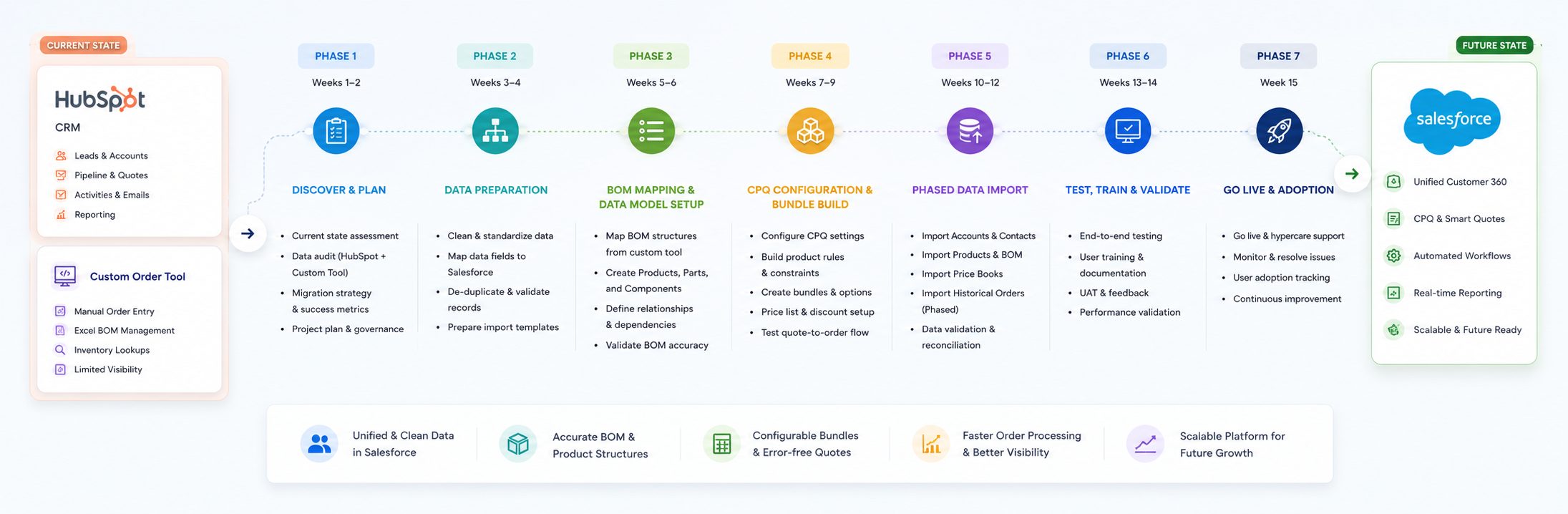
The most technically complex challenge in the migration was not the record volume — it was the structure of historical custom order data. Each order in the legacy system contained a bill-of-materials record with configuration attributes: dimensions (width, depth, height), fabric grade code, finish selection, and production tier. These attributes had no direct equivalent in Salesforce's standard data model. Ashapura Softech built the entire CPQ product catalog — product bundles, option groups, configuration rules, and pricing rules — in Salesforce before any data was imported. Only after the catalog was in place were historical orders mapped to the correct bundle configurations and imported as order records with their full attribute data preserved in CPQ option fields.
Importing 85,000 orders with multi-line CPQ configurations triggers automatic price recalculation on every record. For a furniture retailer with average order lines well above three — dimensions, fabric, and finish each adding a line — this would have consumed Salesforce's per-day API allocation many times over in a single bulk import. The solution: disable the CPQ calculation engine entirely during the data load, then re-enable it and process recalculations in daily batches of 1,000 to 2,000 orders — staying within 50% of the API limit at all times and completing the full recalculation pass within the project timeline.
200,000+ email activity records from HubSpot — including sequences, one-off sales emails, and marketing communications — needed to transfer to Salesforce with full body content and original send timestamps preserved. Salesforce's bulk data loader does not support email body import in a single pass. Ashapura Softech built a custom Python script to handle this in two phases: import all email records with headers, subject lines, contact relationships, and timestamps in the first pass; then re-open each record and attach the email body in a second pass — preserving the original send date as the activity date so the historical activity timeline looks identical to what reps saw in HubSpot.
40,000 support tickets from the legacy email-based system were migrated to Salesforce Service Cloud cases — with each case linked to the corresponding order record where the ticket could be matched by order number. Tickets without a clear order match were imported as standalone cases with a data quality flag for team review. Damage claim tickets were categorized separately so the claims team could immediately see historical claim rates by product line after go-live. All original email threads were preserved as case comments with their original timestamps.
Technology Architecture
| Salesforce Product / Integration | Role in the Implementation |
|---|---|
| Sales Cloud + CPQ | End-to-end custom furniture quoting with dimension, fabric, finish, and lead time configuration; multi-tiered pricing logic; approval workflows for custom discount requests |
| Agentforce (Design Consultation Agent) | AI agent embedded in CPQ quote workflow: recommends complementary pieces, surfaces room planner activity, checks Odoo production timelines, suggests room package upsells |
| Einstein Lead Scoring | Scores and ranks inbound B2B trade inquiries from interior designers, architects, and hospitality accounts by conversion probability; daily priority queue for the trade sales team |
| Service Cloud | Omnichannel case management for delivery damage claims, assembly support, and delivery tracking queries across WhatsApp, email, and SMS with full order history attached to every case |
| Marketing Cloud | Behavioral journey automation triggered by room planner activity and Data Cloud segments; abandoned room design re-engagement; price drop alerts; B2B trade nurture sequences; multi-language (EN/ES) campaign delivery |
| Data Cloud | Unified customer profile from Adobe Commerce behavioral data; segments room inspiration board savers, wish list adders, and virtual room planner sessions for Marketing Cloud journey triggers |
| Adobe Commerce (Magento) | eCommerce storefront — bidirectionally integrated with Data Cloud (behavioral data in) and Marketing Cloud (personalized journeys out); Agentforce chatbot handles pre-sales product questions |
| Odoo ERP | Production schedule and material availability data — surfaced live inside CPQ and trade account opportunity records via API integration; enables accurate delivery date commitment without leaving Salesforce |
| Channel Engine | Automatic order sync from Amazon Home and Wayfair into Salesforce; marketplace customers appear in the CRM with full order history for service and marketing continuity |
| Digital Engagement | Omnichannel routing of WhatsApp, email, and SMS contacts into Service Cloud with automatic case creation and customer profile matching |
Outcomes & Business Impact
The Salesforce transformation delivered measurable impact across quoting speed, delivery accuracy, trade account management, and marketing relevance — not just technology consolidation.
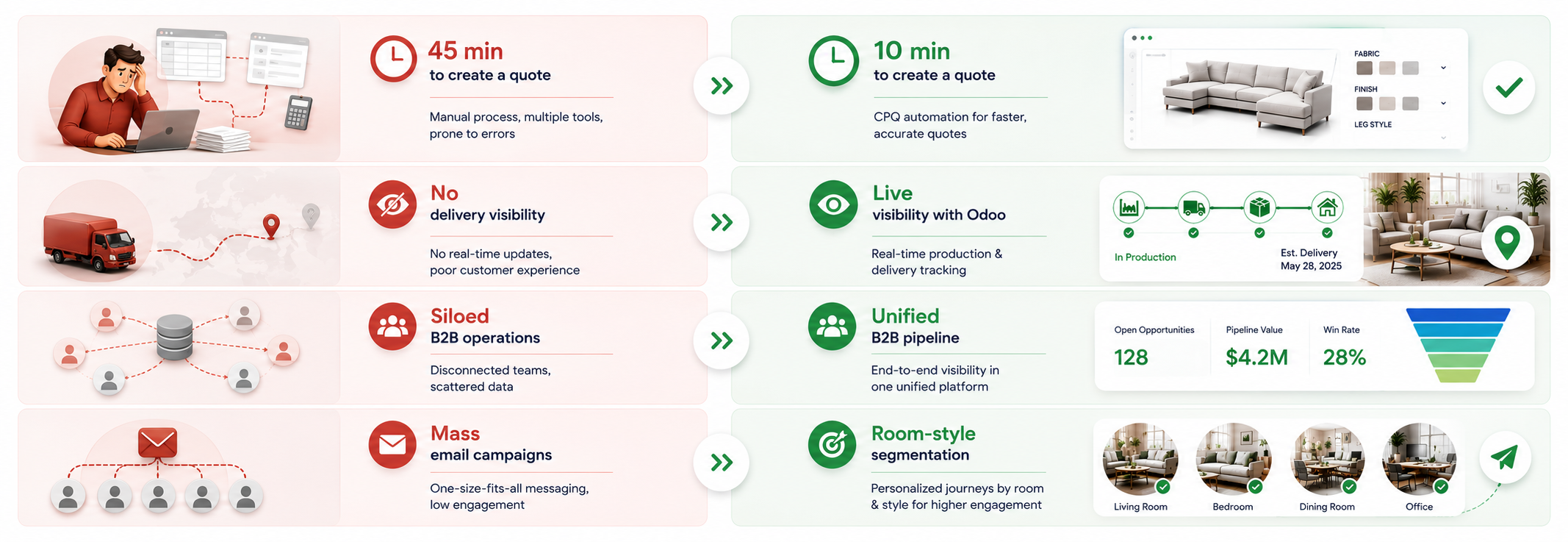
Custom furniture quotes that required manual spreadsheet assembly — checking dimension pricing tables, selecting fabric grade codes, and looking up lead times — now take under 10 minutes with CPQ handling all configuration logic and Agentforce surfacing relevant upsell suggestions in context. Configuration errors requiring post-confirmation rework have been eliminated.
Reps can now quote production and delivery dates during the sales conversation, with production schedule data from Odoo ERP visible inside the CPQ quote screen. Customers receive an accurate delivery window at point of sale rather than a follow-up email hours later — reducing the volume of delivery status enquiries that previously consumed service team time.
Interior designers, architects, and hospitality procurement teams are now managed inside the same Salesforce platform as consumer orders — with account hierarchies linking individual designers to their firm and active client projects. The trade sales team can see the full revenue relationship of each trade account, not just individual order transactions.
Delivery damage claims submitted via WhatsApp, email, or SMS now create a Service Cloud case automatically with the original order pre-linked and SLA clock started. The claims team has a real-time dashboard of open claims, and management can track resolution time by product line — turning a reactive process into a managed operational workflow.
Click-through rates on promotional emails improved after shifting from single-list blasts to room-style-based segments derived from Data Cloud. Customers who had saved mid-century modern room designs receive different content than those browsing coastal or industrial styles — with abandoned room design re-engagement and wish list price alerts running automatically.
Marketplace orders from Amazon Home and Wayfair sync automatically into Salesforce via Channel Engine. A customer who purchased on Wayfair and calls for assembly support is recognized immediately, with their order details, delivery records, and any prior contacts visible to the service agent before the conversation begins.
Agentforce room package recommendations, surfaced in context during the quote workflow, give reps a natural starting point for upselling complementary pieces. Reps with no formal interior design training can reference the same room pairing logic that a seasoned designer would apply — without slowing down the conversation to consult a catalog.
Spanish-language customers in regional markets now receive campaign emails in their preferred language automatically — routed by the language preference attribute in their Data Cloud profile. The marketing team manages a single campaign setup with two language variants, and delivery routing happens without any manual list split or export.
Frequently Asked Questions
Salesforce CPQ manages complex furniture configurations through product bundles and option groups. Each configurable furniture line is set up as a CPQ product bundle, with option groups representing each attribute category — dimensions, fabric grade, finish, and any custom hardware selections. Configuration rules enforce valid combinations (for example, fabric grades that are only available for specific frame styles), and pricing rules calculate the cost of each upgrade automatically without manual input. Lead times can be embedded as a product attribute that updates based on the selected configuration tier — so a rep selecting an oversized custom dimension automatically sees the extended lead time reflected in the quote without calling the warehouse. When the CPQ bundle is connected to an ERP like Odoo via API, live production queue data can also surface inside the quote screen, enabling accurate delivery date commitment at the time of sale.
Agentforce is Salesforce's platform for deploying autonomous AI agents. For a home furnishings retailer, an Agentforce agent can be trained on the product catalog, room style taxonomy, and complementary product relationships — then deployed inside the CPQ quote workflow as a design consultation assistant. During a customer conversation, the agent surfaces recommendations for complementary pieces that pair with what the customer is configuring, suggests room package upsells by pulling from what the customer has saved in their room planner or wish list, and checks live production timelines from an integrated ERP to help the rep commit to an accurate delivery window. For service teams, Agentforce can power a pre-sales chatbot on the eCommerce storefront that handles product questions, finish comparisons, and lead time enquiries before routing to a human agent if needed.
Salesforce Data Cloud connects to Adobe Commerce (Magento) via a streaming data connector that captures behavioral events from the storefront in real time. For a home furnishings retailer, this means room inspiration board saves, wish list additions, virtual room planner sessions, product detail page views, and abandoned room designs are all streamed into Data Cloud as they happen. Data Cloud structures these events into unified customer profiles — resolving identity across anonymous browsing sessions, logged-in storefront activity, and CRM records — and creates behavioral audience segments. These segments are passed to Marketing Cloud, which triggers personalized journeys: a customer who saved a living room design but has not added any items to cart for 14 days receives an abandoned room design re-engagement email; a customer whose wish-listed sofa goes on promotion receives a price drop alert. The entire process is automated — no manual list pull or export is required.
Migrating custom furniture order data with BOM (bill of materials) configuration attributes into Salesforce CPQ requires a specific sequencing that standard data migration tools do not handle out of the box. The correct approach is: first build the complete CPQ product catalog in Salesforce — all product bundles, option groups, configuration rules, and pricing rules — before importing any historical order data. Only once the catalog exists can historical orders be mapped to the correct bundle configurations and imported with their attribute data assigned to the correct CPQ option fields. During the bulk import, the CPQ price recalculation engine should be temporarily disabled to prevent API limit exhaustion from triggering recalculation on every imported record. After import, recalculation is re-enabled and run in controlled daily batches until complete. Orders referencing discontinued configurations are preserved as read-only historical records with configuration attributes stored in custom fields.
Salesforce Service Cloud with Digital Engagement provides omnichannel case management for all post-delivery support scenarios. Delivery damage claims submitted via WhatsApp — including photo attachments — are automatically routed to the claims team and created as Service Cloud cases with the customer's order and delivery details pre-linked from the Salesforce order record. Assembly support requests submitted by email or SMS are categorized and routed to product specialists. Delivery tracking status can be integrated from the logistics carrier into the case record, enabling agents to answer tracking questions without switching to a carrier portal. Case resolution updates are sent back to the customer via their preferred channel — WhatsApp, email, or SMS — automatically based on their contact preference in Salesforce. Management dashboards show open claims volume, average resolution time, SLA compliance, and claim rates by product line — providing operational visibility that a shared email inbox cannot deliver.
Ashapura Softech brings 12+ years of Salesforce implementation experience with specialized expertise in retail eCommerce, B2B trade account management, and ERP integration. Their team has successfully configured Salesforce CPQ for complex made-to-order product catalogs, integrated Data Cloud with Adobe Commerce for behavioral marketing personalization, and deployed Agentforce AI agents for both sales assistance and customer service — across businesses operating consumer and trade channels simultaneously. The Irving + India delivery model provides U.S.-based project management and senior consulting with cost-effective offshore execution. Ashapura Softech is rated 4.7 on Clutch with 100+ clients served across North America since 2012.
About the Partner
Founded in 2012 and headquartered in Irving, Texas, Ashapura Softech is a certified implementation partner for Salesforce, Zoho, Microsoft, and Odoo — serving 100+ businesses across North America. Our team of certified consultants has handled every phase of digital transformation: from requirements discovery and system design through data migration, user training, and long-term support.
We specialize in retail, eCommerce, and B2B trade environments where the complexity of product configuration, multi-channel order management, and personalized marketing demands an implementation partner with deep hands-on experience across the full Salesforce product portfolio — including CPQ, Agentforce, Data Cloud, and Adobe Commerce integration.
Our Irving + India delivery model provides U.S.-based project management and senior consulting with cost-effective offshore execution — without compromising quality, responsiveness, or accountability.
Ready to Start?
Whether you are replacing a legacy quoting process with Salesforce CPQ, deploying Agentforce AI for your sales team, or connecting your eCommerce platform to Marketing Cloud — let us have a 15-minute conversation about what is possible for your business.