Categories
Agentforce

Claudeforce vs Agentforce: What Is Actually Different

Quick answer

They are not competitors. Agentforce is the Salesforce platform for building and running AI agents. Claudeforce is the Salesforce and Anthropic partnership announced on 26 August 2026 that brings Claude in as a reasoning model across Salesforce, and puts Salesforce data inside Claude through a plugin carrying 37 prebuilt sales skills. You deploy Agentforce. Claudeforce decides which model reasons underneath, and where your team ends up working.

Update (14 Sep 2026): On 11 Sep 2026 Salesforce announced a new portfolio of named, job-ready Agentforce agents built for specific high-value work: Casey (customer service), Paige (IT and HR service), Carter (shopper agent for e-commerce), Marshall (supply chain orchestration), Piper (inbound lead generation) and Fin (complex customer experience), all generally available now, plus Hunter (outbound sales), in pilot with general availability expected November 2026. The release also adds long-horizon runtime so agents can pursue goals over days or weeks rather than single interactions, AI Skills for teaching agents new tasks (pilot now, GA October 2026), multi-agent orchestration across workflows, and an Agent Optimizer for continuous performance tuning (GA October 2026). This sits on top of the Core, Advanced and Max editions Salesforce introduced in early September.

Claudeforce vs Agentforce is the question we now get on almost every Salesforce AI call, and the reason is simple: the two names sound like variations of the same product, and they are not. One brings Salesforce data into Claude. The other runs autonomous agents inside Salesforce. They point in opposite directions, they serve different people, they are bought differently, and only one of them has published pricing.

This is the long version, including the part that trips up most teams, a worked example of what Agentforce actually costs, and the governance question nobody asks until it is late.

Claudeforce vs Agentforce, in one line each

Agentforce is Salesforce’s AI agent platform. You build agents that act on your behalf inside Salesforce surfaces: resolving service cases, qualifying leads, answering employee requests, scheduling appointments, handling IT tickets. The work happens in your org, and the people it serves are usually your customers or your employees. Salesforce describes it as the platform for 24/7 autonomous support at enterprise scale.

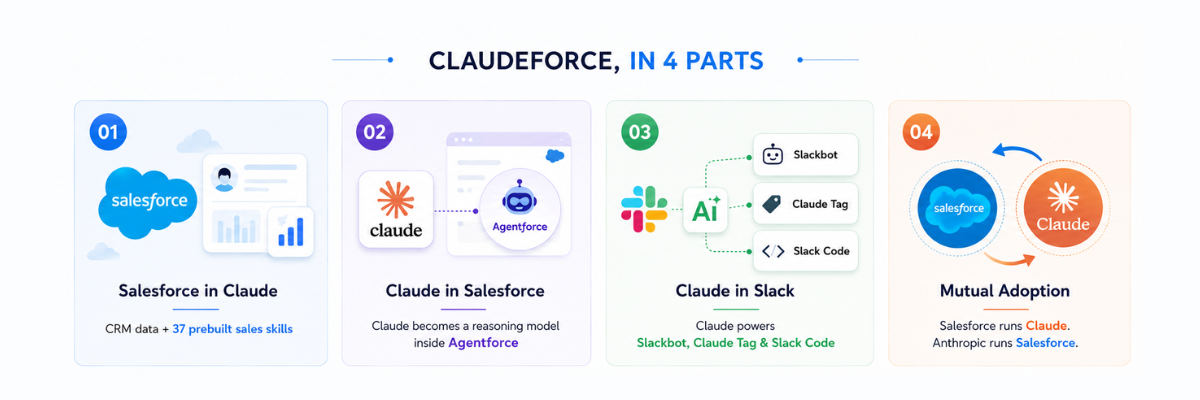
Claudeforce is the Salesforce and Anthropic partnership. Its first deliverable, Salesforce in Claude, puts your CRM data inside Claude with 37 pre-built sales skills covering prospecting through close. The work happens in Claude, and the person it serves is your seller. Salesforce sets this out on the official Claudeforce page.

So the cleanest way to hold the difference: Agentforce sends an agent to your customer, Claudeforce brings your CRM to your employee. Everything else in this article follows from that one sentence.

The comparison table
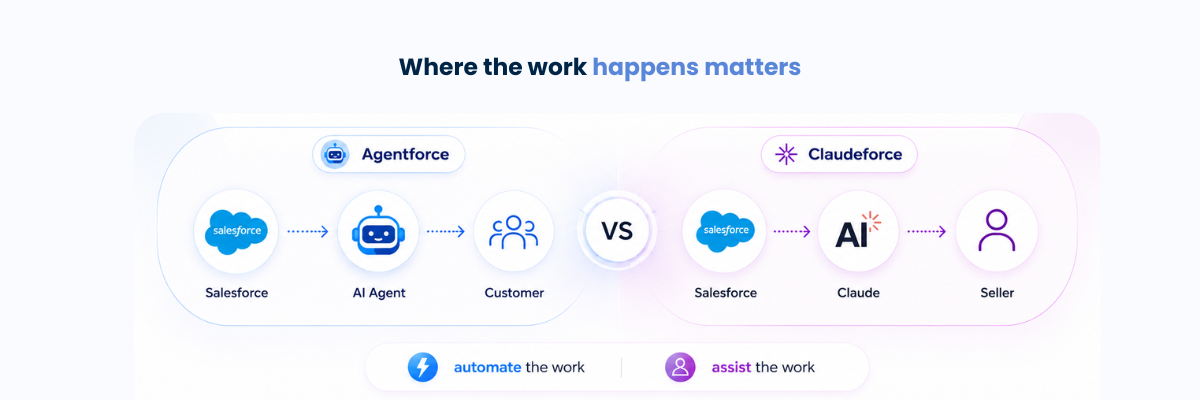
Claudeforce vs Agentforce: Agentforce automates the work for your customer, Claudeforce assists your seller inside Claude
Where the work happens is the whole difference: Agentforce automates a task for your customer, Claudeforce assists your seller.

Einstein sits in this conversation too, because a lot of the “do we already have this?” confusion comes from there.

AgentforceClaudeforceEinstein
What it isAgent platformSalesforce and Anthropic partnershipPredictive and generative layer
Where the work happensInside Salesforce surfaces and channelsInside ClaudeInside Salesforce, embedded in the platform
Who it servesYour customers and employeesYour sellers, todayYour users, in the flow of work
Autonomous?Yes, that is the pointNo, a person drives itNo, it assists
How you build itAgent Builder, low code, plus Apex and MuleSoft where neededPre-built skills, 37 at launchConfiguration, embedded features
Who sets it upAdmin and build team, per agentAdmin connects once for the whole teamAdmin, per feature
AvailabilityGenerally availablePilot customers, open beta September 2026Generally available
Pricing published?YesNoBundled or by edition

Where Claude actually appears in the Salesforce stack

Before comparing the two, it helps to know that Claude now shows up in three separate places. Most of the confusion in the Claudeforce vs Agentforce debate comes from collapsing these into one.

  1. Claude as the default model in Slack. Claude powers Slackbot and is the default model there
  2. Claude as the reasoning model inside Agentforce. Claude is integrated as the reasoning model for the Atlas Reasoning Engine and is available in Agent Builder. Your agent still lives in Salesforce, it just thinks with Claude
  3. Salesforce in Claude. The new one. Your CRM data, permissions and workflows become available inside Claude itself

Only the third is what people mean when they say Claudeforce as a product. The first two have existed alongside it.

The part that confuses everyone: Claude in Agentforce is not Claudeforce

This is where most of the Claudeforce vs Agentforce confusion actually comes from, and it is worth slowing down on.

Claude as the reasoning model inside Agentforce is a model choice. Your agent reasons using Claude instead of another model, but the agent still lives in Salesforce, still runs in your channels, and still serves your customer. Nothing about who uses it changes.

Salesforce in Claude is the reverse. Nothing runs in Salesforce. Your seller opens Claude, and Salesforce data, permissions and workflows are available to them there. The user changes from your customer to your employee, and the surface changes from your org to a third party application.

If someone tells you “we already have Claudeforce, we switched our agent to Claude,” they have almost certainly done the first thing, not the second. Worth checking before you plan a budget around it.

What Salesforce in Claude actually does, day to day

The 37 skills at launch cover the sales cycle from prospecting through close. Salesforce names meeting prep, deal health review and pipeline review among them. In practice the seller is doing three kinds of thing:

  • Reading. Reasoning over live revenue context rather than pulling a report. Asking what changed on an account, which deals slipped, what a call should cover
  • Writing back. Automating pipeline updates without opening the CRM, which is where most CRM hygiene problems start
  • Acting. Taking governed action from inside Claude, with the action routed back through Salesforce so business rules still apply

Two details matter more than the skill count. First, onboarding reads your enterprise context and builds a tailored dashboard of accounts, pipeline and live data, so the seller is not starting from a blank prompt. Second, and this is the one admins care about, an admin connects it once. Authentication and permissions are managed centrally, every seller on the team gets access from day one, and there is no per-user setup and no new permissions model to build.

That last point is worth reading twice if you have ever rolled out a Salesforce tool user by user.

What Agentforce actually does, day to day

Agentforce is the opposite shape of work. Instead of assisting one person, it removes a person from a queue. The published use cases are:

  • Resolving customer service cases and answering questions across self-service portals and messaging channels
  • Processing employee requests such as leave approvals and HR queries
  • Scheduling appointments and managing field service
  • Qualifying leads and managing opportunities
  • Handling IT help desk tickets and system administration

Underneath, the Atlas Reasoning Engine breaks a prompt into smaller tasks, evaluates at each step, and proposes a plan for how to proceed. You assemble the agent in Agent Builder, which is low code, and drop to flows, prompts, Apex or MuleSoft APIs where configuration cannot reach.

The design decision that costs people money later is how much of that they build in code. Configuration survives platform upgrades. Custom code becomes your maintenance bill.

What each one costs

Agentforce has published pricing. Salesforce sets out several buying mechanisms on its Agentforce pricing page, and that page carries its own caveat that the figures are for information only and are subject to change. Here is the rate card as it stood when we last checked it on 3 September 2026.

MechanismPublished priceWhat you get
Salesforce Foundations$0Agentforce Builder, Prompt Builder, Agent Script, Agentforce Coworker and Agentforce Vibes, so you can build before you buy
Flex Credits$500 per 100,000 creditsConsumption pricing for customer-facing and employee-facing agents, voice included
Agentforce User License$5 per user per monthCompany-wide employee access, metered, with Flex Credits bought separately
Agentforce add-ons$125 per user per monthUnmetered employee agent usage for Sales, Service and Field Service
Agentforce Industries add-ons$150 per user per monthThe same, for the Industries Clouds
Agentforce 1 EditionsFrom $550 per user per monthThe add-on included, plus 2.5 million Flex Credits per org per year
ConversationsNot publishedA per-conversation model for customer-facing agents. Salesforce lists the mechanism but prints no price against it, so this figure has to come from your account team

What a Flex Credit actually buys

A Flex Credit works out at half a cent. Salesforce meters each agent action rather than each interaction, and it publishes the action rates: a standard Agentforce action is 20 Flex Credits, an Agentforce Voice action is 30. So a standard action costs ten cents and a voice action fifteen.

Salesforce puts its own worked examples on the same page, and they are worth reading because they show how the shape of the workload matters more than the rate itself.

  • An employee agent answering 20 requests a day at 40 credits each comes to about $120 a month
  • A service agent handling 3 cases a day at 60 credits, across 100 users, comes to about $1,800 a month
  • A field service agent booking 3 appointments a day at 100 credits, across 10 reps, comes to about $300 a month
  • An onboarding agent answering 5 questions each for 20 new employees at 20 credits comes to about $10 a month
  • Agentforce Voice at 120 credits across 300 calls a month comes to about $180 a month

A worked example, so the numbers mean something

Take a service desk handling 5,000 customer conversations a month. What it costs depends entirely on how many actions each conversation triggers, and this is the part teams underestimate. At the published rate of 20 credits per action:

Actions per conversationCredits per monthCost per month
4 (a simple lookup and reply)400,000$2,000
8 (a lookup, a check, an update)800,000$4,000
15 (multi-step reasoning, several systems)1,500,000$7,500
25 (long chains across several systems)2,500,000$12,500

The action counts are ours for illustration, not Salesforce figures. The rates are published. The point is that the same 5,000 conversations can cost $2,000 or $12,500 depending on how the agent is designed. That is an architecture decision your team controls, not a discount you negotiate.

This is also why we tell clients to pilot with a small cohort and measure real consumption for a few weeks before signing anything org wide. We have written the full arithmetic up in our Agentforce pricing and Flex Credits breakdown.

Claudeforce has no published price. That is the honest answer, and it is worth saying plainly because a lot of the guides circulating right now quietly guess around it. There is no price list, no packaging and no per-seat figure. What we would expect to matter commercially is that Anthropic is a separate vendor, so the inference is not obviously something Salesforce resells inside your existing licence. Treat that as a reasonable question to put to your account team, not as a published fact.

The governance question, and why it differs for each

Security review is where these two diverge most sharply, and it is usually the last thing anyone looks at.

For Agentforce the question is what the agent can see and act on, and on whose behalf. An agent inherits a permission model you designed for humans, and it will use every bit of access you leave open. The work is a proper permission and sharing review before the agent goes near production data, plus a named owner for the kill switch when it answers something wrongly. Not if. When.

For Salesforce in Claude the shape is different. Setup is centralised: the admin connects once, authentication and permissions are managed centrally, and actions route back through Salesforce so business rules are enforced when an action is taken. That removes a lot of per-user risk. What it does not remove is the question your security team will ask, which is what happens to data displayed in a surface that sits outside Salesforce, and how you audit it. Salesforce has not published that detail at the level a regulated buyer will want.

If you work in healthcare, financial services or anything with a data residency clause, put that question on the pilot call rather than after it.

Which one do you actually need

Choose Agentforce if the problem is volume you cannot staff: a service queue that never clears, repetitive employee requests, lead qualification that nobody gets to. You want work done without a person in the loop, and you are prepared to own the permission model and watch consumption after go live. Our Agentforce readiness checklist covers what to test before you commit, and what to ask an implementation partner before you sign.

Wait for Claudeforce if the problem is that your sellers avoid the CRM. You are not trying to remove the human, you are trying to remove the interface friction. There is nothing to buy yet, so the sensible move is to get into the beta and measure with your own data rather than plan a rollout around a product with no commercial terms.

Look at Einstein first if you have not turned on what you already pay for. Einstein is natively embedded in the platform and provides insights, predictions and generated content from CRM and external data. Plenty of the “can AI do this?” questions we get are answered by embedded features sitting unused in the org. That is the cheapest win available and it costs a configuration session, not a new contract.

These are not mutually exclusive. For most organisations the end state is all three, and the order matters more than the choice.

Five mistakes we see teams make on this decision

  1. Treating Claudeforce as an Agentforce replacement. They solve different problems for different people. Nothing in Salesforce’s material positions one as retiring the other
  2. Budgeting for one pricing mechanism. Teams model Flex Credits, then get billed on conversations, or the reverse. Model both against your own agent design
  3. Automating the whole service desk as phase one. Platform wide rollouts as a first project are how pilots become write-offs. One workflow, one user group, measured
  4. Skipping the permission audit because the demo worked. A demo runs on clean data with a generous profile. Production does not
  5. Waiting for Claudeforce instead of fixing the data. Whatever you eventually run, it reads your CRM. Bad data produces a confident wrong answer faster than a human would

What is still unknown about Claudeforce

We would rather list the gaps than paper over them:

  1. Price. Nothing published, and the launch material notes pricing is subject to change
  2. Packaging. Whether it lands as an add-on, an edition, or a separate Anthropic contract
  3. Scope beyond sales. Service, Marketing, Commerce, Revenue, Field Service, Tableau, MuleSoft, Data 360, Headless 360 and Industries are listed as coming, without dates. More prebuilt skills are expected late 2026
  4. Governance detail. How audit and monitoring work when the surface your data is used in sits outside Salesforce
  5. What happens at renewal. Whether adoption inside Claude changes how your Salesforce seats are counted

Anyone giving you confident numbers on these today is guessing. Our fuller write up is here: what Claudeforce actually is, and what it changes.

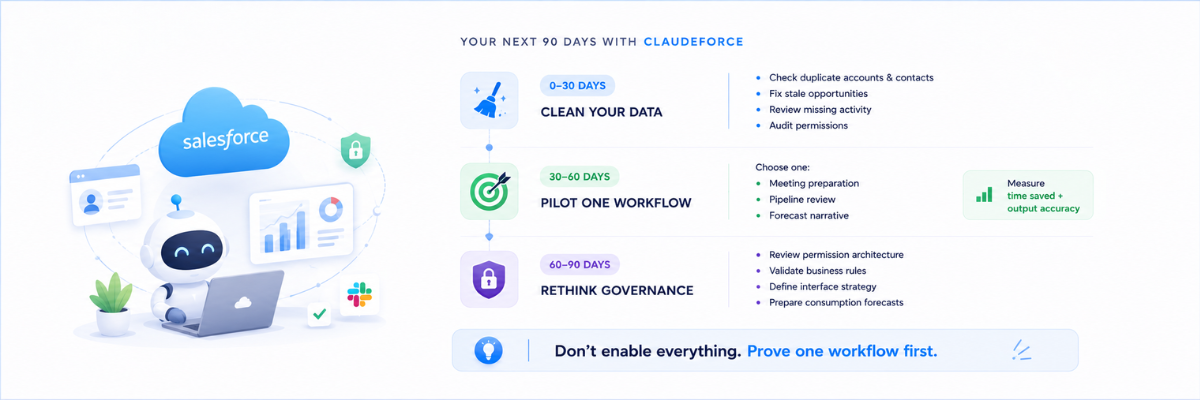
What to do in the next 90 days

  1. Name the problem first. Queue volume points at Agentforce. CRM avoidance points at Claudeforce. Unused platform features point at Einstein
  2. Register for the Claudeforce open beta through your account team if sales adoption is your issue. It costs nothing to be in the queue
  3. Run one Agentforce workflow, not a department. A defined user group, a metric agreed before the build, consumption tracked from day one
  4. Do the permission and data quality review now. It is required for either path and it is the work that does not depend on a pricing announcement
  5. Model both pricing mechanisms against your own expected action counts before any commercial conversation

Where our view comes from

We are a certified Salesforce implementation partner, based in Irving, Texas with a delivery team in Ahmedabad, working since 2012. We are also certified for Zoho, Microsoft Dynamics and Odoo, which is usually why clients ask us this question in the first place: they want someone who is not obliged to answer “Agentforce” every time.

Our most recent Agentforce delivery embedded an agent directly into the quote workflow for a custom furniture retailer, grounded on Data Cloud, checking live production timelines from their Odoo ERP before committing a date. Quote build time went from 45 minutes to under 10, a 78 per cent improvement, across a migration of more than 120,000 contacts and 85,000 custom orders with zero data loss. The full write up is here: Salesforce CPQ and Agentforce for a custom furniture retailer. We have also covered where Agentforce helps with sustainability reporting and where it stops.

On Claudeforce we have no delivery experience, because nobody has. It is in pilot. Everything written above about it is drawn from Salesforce’s own published material, and we have said plainly where the gaps are. If you want a reference before you talk to us, ask on the call and we will tell you straight where we are.

Ashapura Softech
2201 W Royal Ln, Irving, Texas 75063
+1 214-935-9893
Certified Salesforce implementation partner. Founded 2012.

Frequently asked questions

Is Claudeforce replacing Agentforce?
No. Salesforce positions Claudeforce as a partnership framework, not a replacement, and continues to ship Agentforce. They solve different problems: autonomous work for your customers versus CRM access for your sellers.

Can we use both?
Yes, and for most organisations that is the likely end state. Agents handling volume inside Salesforce, sellers working with CRM data inside Claude, Einstein doing the embedded predictive work underneath both.

Which is cheaper, Claudeforce vs Agentforce?
Unanswerable today. Agentforce has published rates. Claudeforce has none. Any comparison you read that puts a figure on Claudeforce is inventing it.

Do we need Data Cloud for either?
Grounding quality is what separates a useful agent from a confident wrong one, and in practice that is where Data Cloud earns its place on Agentforce projects. Whether it is strictly required depends on your build, so treat it as a design question rather than a fixed prerequisite.

Is Einstein being retired?
There has been no such announcement. Salesforce describes Einstein as natively embedded in the platform, providing insights, predictions and generated content from CRM and external application data.

How do we get into the Claudeforce beta?
Salesforce lists pilot access now and an open beta from September 2026. Register interest through your account team rather than waiting for general availability.

Does Salesforce in Claude need a new permissions model?
No. Salesforce states that an admin connects it once, authentication and permissions are managed centrally, and every seller on the team gets access from day one with no per-user setup.

Does any of this apply if we are building on Anthropic’s own blueprint instead? Partly. The commercial questions are the same but the integration burden sits with you rather than with Salesforce. We have written up what your ERP and CRM must provide before you build a Claude commerce agent.

What happens to our agents if we change partners?
Agent definitions built in Agent Builder stay in your org. Custom code and undocumented prompt logic are the parts that travel badly, which is a good argument for configuring rather than coding wherever you can.

Can you work alongside our existing Salesforce partner?
Yes. We are often brought in for a specific layer, such as the integration or the readiness work, alongside an incumbent.

Both products now sit under a wider banner. Salesforce grouped Claudeforce, Slackforce and the Agentforce Coworker together as AIforce at Dreamforce 2026, which changes how you choose between them rather than what each one does. Here is what AIforce covers and where each piece fits.
Categories
Agentforce

How to Choose an Agentforce Implementation Partner

Update (14 Sep 2026): On 11 Sep 2026 Salesforce announced a new portfolio of named, job-ready Agentforce agents built for specific high-value work: Casey (customer service), Paige (IT and HR service), Carter (shopper agent for e-commerce), Marshall (supply chain orchestration), Piper (inbound lead generation) and Fin (complex customer experience), all generally available now, plus Hunter (outbound sales), in pilot with general availability expected November 2026. The release also adds long-horizon runtime so agents can pursue goals over days or weeks rather than single interactions, AI Skills for teaching agents new tasks (pilot now, GA October 2026), multi-agent orchestration across workflows, and an Agent Optimizer for continuous performance tuning (GA October 2026). This sits on top of the Core, Advanced and Max editions Salesforce introduced in early September.

Most Agentforce pilots do not stall because the model underperforms. They stall because the data was not ready, the permission model was never audited, or nobody was watching consumption until the invoice arrived. All three are partner selection problems, not technology problems.

This is what to ask an Agentforce implementation partner before you sign, and what a proposal should contain if they have actually shipped an agent into production.

What an Agentforce implementation partner actually does

There are four workstreams. Most proposals cover two.

WorkstreamWhat it involvesWhy it gets skipped
Readiness assessmentData quality, permission model, process fitSlows down the sale
Agent design and buildTopics, actions, instructions, groundingRarely skipped, it is the visible part
Permission and data governanceWhat the agent can see, and on whose behalfAssumed to be someone else’s job
Consumption managementMonitoring Flex Credits or conversation spend after go-liveNot billable, so not offered

The fourth is where budgets go wrong. An agent that runs a multi-step reasoning chain on every enquiry costs a different amount from one that answers a lookup, and the difference only shows up at volume. We wrote the full rate card up in our Agentforce pricing breakdown, and Salesforce publishes the current rates on its Agentforce pricing page.

Nine questions to ask before you sign

These are the questions we would ask if we were sitting on your side of the table. Each one has an answer that tells you the partner has done this work before, and an answer that tells you they are learning on your budget. The difference is usually specificity.

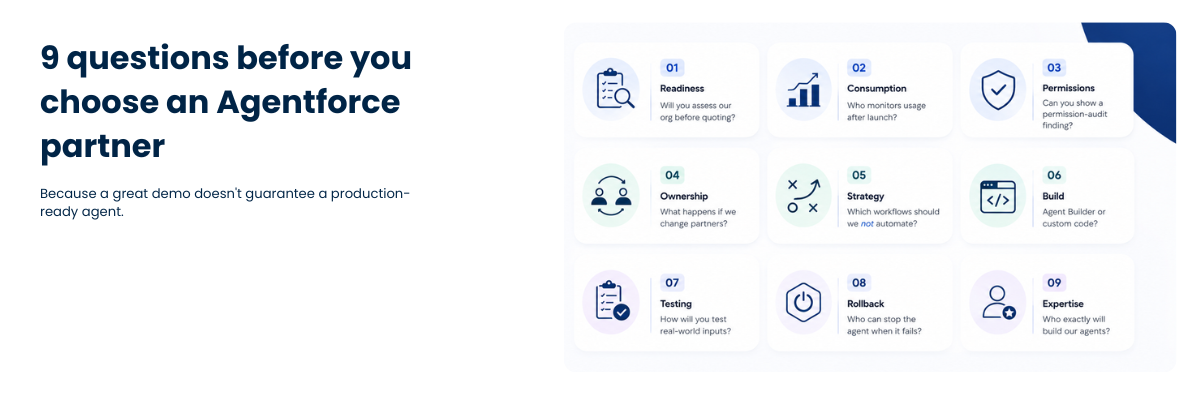
Nine questions to ask an Agentforce implementation partner: readiness, consumption, permissions, ownership, strategy, build approach, testing, rollback and expertise
The nine questions, at a glance. Each one is worth asking before the commercial conversation starts.

1. Will you run a readiness assessment before quoting, or quote first?

Agentforce cost is driven by consumption, and consumption is driven by how many actions your workflows trigger. Nobody can know that number before looking at your org. A fixed price offered before anyone has opened your data model is a guess with a margin attached, and the margin exists because the partner is carrying risk they have not measured.
A good answer sounds like: a short paid discovery, two to three weeks, that produces a data quality report, a permission map and a consumption estimate with a range rather than a single number.
A weak answer sounds like: a firm price on the first call, or a free assessment that turns out to be a sales workshop with no written output.

2. Who owns consumption monitoring after go-live?

Flex Credits meter every action. A standard Agentforce action draws 20 credits and a voice action 30, so an agent that quietly starts running eight actions where it used to run three doubles your bill without a single new user. Somebody has to watch that, and the month you find out from an invoice is the month it has already happened.
A good answer sounds like: Digital Wallet configured before launch, a named person reviewing consumption weekly for the first quarter, and an agreed threshold that triggers a conversation.
A weak answer sounds like: “you will be able to see it in the dashboard.” That is true and it is not an owner.

3. How do you scope the permission audit, and can you show a sample finding?

An agent inherits the permissions of the context it runs in. If your permission model has drifted over five years of admin changes, and most orgs of that age have, the agent will surface records to people who should not see them, at machine speed, in writing.
A good answer sounds like: a redacted sample finding from real work. Partners who have run permission audits have examples they can show with the client details stripped out.
A weak answer sounds like: a description of a methodology. Anyone can describe a process. Findings come from having done it.

4. What happens to our agents if we change partners?

This is a fair question to ask politely at the start rather than angrily at the end. Agent definitions built in Agent Builder live in your org and stay with you. Custom Apex, undocumented prompt logic and orchestration held in a partner’s own tooling are a different matter.
A good answer sounds like: a clear statement of what is configuration in your org, what is custom code in your repo, and a commitment that prompt logic is documented in your instance rather than in their internal wiki.
A weak answer sounds like: reassurance that the question will never come up.

5. Which of our workflows would you tell us not to automate?

This is the single most useful question on the list, because it is the only one where the right answer costs the partner revenue. A partner who has watched an agent fail in production knows which workflows are a bad fit: the ones with ambiguous inputs, the ones where being wrong is expensive, the ones where the process is genuinely undecided and the agent would simply automate the confusion.
A good answer sounds like: two or three specific examples from your own process, named on the call.
A weak answer sounds like: “all of them are good candidates.” That is a sales position, not advice.

6. Agent Builder or custom code?

Both are legitimate. The question is whether the partner can explain the trade in your terms rather than theirs. Configuration in Agent Builder survives platform releases and can be maintained by your own admin. Custom code does things configuration cannot, and every line of it becomes a maintenance cost you carry after the partner has gone.
A good answer sounds like: a default of configuration, with custom code proposed only where a named requirement cannot be met otherwise, and an estimate of what maintaining it will cost you per year.
A weak answer sounds like: a custom build proposed before anyone has checked whether the standard capability covers it.

7. How do you test an agent before it touches a customer?

Traditional testing checks whether code does the same thing every time. An agent does not, which is the point of it. Testing an agent means testing a range of inputs, including the messy and the adversarial, and deciding in advance what an unacceptable answer looks like.
A good answer sounds like: a test set of real historical cases, an internal cohort using the agent before any customer does, and written pass criteria agreed with you rather than assessed by the partner alone.
A weak answer sounds like: “we test thoroughly.” Ask to see the test approach, not the assurance.

8. What is the rollback plan when an agent answers wrongly?

Not if, when. An agent will get something wrong in front of a customer, and the thing that separates an incident from a crisis is how quickly it can be stopped and who is allowed to stop it.
A good answer sounds like: a named kill switch, a named owner on your side who can use it without escalating, a defined path for the affected records, and a commitment on how the failure gets reviewed.
A weak answer sounds like: a support SLA. An SLA tells you when somebody will reply. It does not tell you who turns the agent off.

9. Which Agentforce credentials does the team hold, and who specifically is on our project?

Partner tier is a company attribute. It reflects volume and revenue across every client the firm has, and it tells you almost nothing about the four people who will actually build your agents. Credentials sit with individuals, and individuals get reassigned.
A good answer sounds like: named people, their certifications, the Agentforce work they have personally delivered, and a written commitment that a change of team is a change you get told about.
A weak answer sounds like: a badge on a slide and a promise that the whole team is certified.

Red flags in an Agentforce proposal

None of these is proof of a bad partner on its own. Each one is worth putting directly to the Agentforce implementation partner in front of you before the commercial conversation goes further, because the explanation is usually more revealing than the flag.

  • A fixed price with no readiness assessment in scope. Either they have priced risk they cannot see, or they intend to raise it later through change requests.
  • No mention of Flex Credits or consumption anywhere in the commercial section. The build is a one-off cost. Consumption is the cost you carry every month afterwards, and a proposal that ignores it has left out the larger number.
  • “We will automate your entire service desk” as phase one. Scope like this fails in a way that is hard to recover from, because when it goes wrong you cannot tell which part went wrong.
  • No permission audit line item. The agent inherits whatever your permission model currently allows, including the parts nobody has looked at since 2019.
  • No named rollback owner or kill switch. If the proposal cannot say who stops the agent, the answer in practice is a support ticket.
  • Agent design with no grounding strategy for your data. An agent with no defined sources will answer from whatever it can reach, confidently, and you will find out from a customer.
  • Success measured in agents deployed rather than in a business number. Six agents live is an output. Handle time, resolution rate or quote turnaround is an outcome, and only one of those is worth paying for.

What to get in writing before you sign

Most disputes we see later trace back to something that was agreed verbally and never written down. This is the short list worth insisting on in the statement of work, whoever you choose.

What to ask forWhy it matters later
The readiness findings as a written documentIt becomes the baseline you measure the build against, and the record of what was known at the time
A consumption estimate with a stated range and the assumptions behind itYou can check the assumptions against reality after month one instead of arguing about the total
The business metric each agent is meant to moveWithout it, phase two gets scoped on enthusiasm rather than on results
Named team members and a notice clause if they changeCredentials belong to people, not to the logo on the proposal
Prompt logic and agent documentation stored in your orgIt is the difference between switching partners and rebuilding
A named kill switch owner on your sideIt turns a live incident into a decision somebody is allowed to make
Stopping conditions for the pilot, agreed before it startsBoth “this worked” and “this did not” have to be permitted outcomes, or the pilot is theatre

What a realistic first engagement looks like

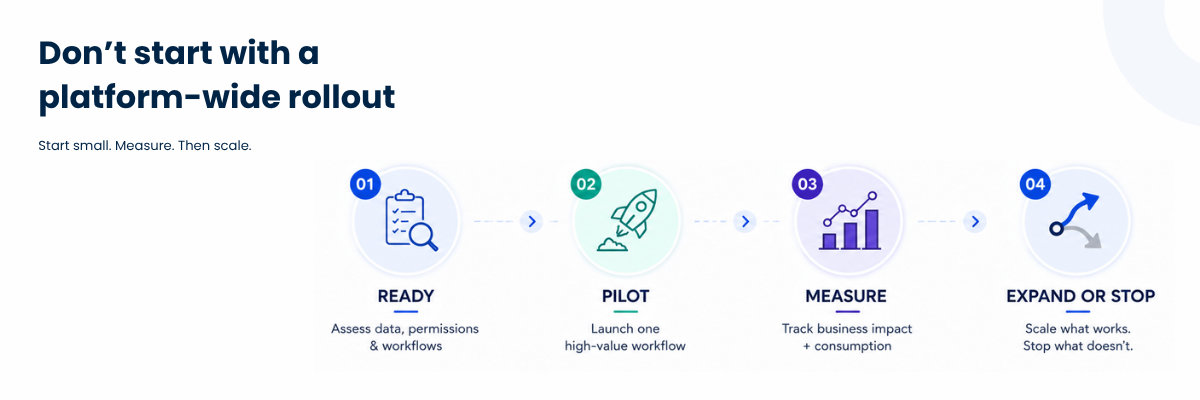
A realistic Agentforce rollout: assess readiness, pilot one workflow, measure business impact and consumption, then expand or stop
Start small, measure, then scale. The four phases an Agentforce implementation partner should propose.

Phase 0: Readiness. Data quality assessment, permission model review, and a shortlist of workflows worth automating. Output is a go or no-go with reasons, not a proposal.

Phase 1: One workflow pilot. A single agent, a defined user group, and a measurement plan agreed before build. Consumption tracked from day one.

Phase 2: Measure. Against the metric agreed in phase 1, not against a demo.

Phase 3: Expand, or stop. Both are valid outcomes. A partner who cannot describe the conditions under which they would recommend stopping has not thought about it.

Platform-wide rollouts as phase one are how pilots become write-offs. Our Agentforce readiness checklist covers what phase 0 should actually test.

Where our Agentforce experience comes from

We are a certified Salesforce implementation partner, based in Irving, Texas with a delivery team in Ahmedabad, working since 2012. Our work as an Agentforce implementation partner sits alongside Zoho, Microsoft Dynamics and Odoo certifications, which means we are able to tell you when Agentforce is not the right tool for the job.

Our most recent Agentforce work was for a custom furniture retailer selling to both consumers and trade accounts. We embedded an Agentforce agent directly into the quote workflow, grounded on Data Cloud, so it could recommend complementary pieces, surface saved room inspirations, and check live production timelines from their Odoo ERP before committing a date.

What the project involved:

  • Salesforce Sales Cloud and CPQ with configurable furniture bundles
  • Agentforce agent embedded in the quote workflow
  • Data Cloud for behavioural tracking and unified customer profiles
  • Service Cloud Omnichannel across WhatsApp, email and SMS
  • Adobe Commerce and Odoo ERP integrations

Migration scale and results:

  • 120,000+ contacts migrated
  • 85,000+ custom orders unified
  • 200,000+ email activities and 40,000 support tickets brought across
  • Quote build time reduced from 45 minutes to under 10 minutes, a 78% improvement
  • Zero data loss through the migration

The full write-up is here: Salesforce CPQ and Agentforce for a custom furniture retailer.

We have also written up what Agentforce does and does not automate in sustainability reporting, which is a useful read if you are weighing up where an agent earns its keep.

Ashapura Softech
2201 W Royal Ln, Irving, Texas 75063
+1 214-935-9893
Certified Salesforce implementation partner. Founded 2012.
Before you shortlist partners, it helps to know which agent you want first. See our breakdown of Agentforce use cases by team, including Agentforce Contact Center and Voice.

Frequently asked questions

Is an Agentforce consultant the same as an implementation partner?
Not always. An Agentforce consultant is usually engaged for advice: a readiness review, a second opinion on a proposal you have been sent, or a single architecture decision. An implementation partner takes the build and the consumption monitoring as well. Agentforce consulting on its own is often the cheaper first step if you are still deciding whether a workflow is worth automating at all.

Do we need a partner at all, or can we do this in-house?
If you have a Salesforce admin with capacity, clean data and an appetite to own consumption monitoring, a small internal pilot is reasonable. The work that usually needs an Agentforce implementation partner is the permission audit and the integration grounding, because those are the parts that fail quietly.

How long before an Agentforce pilot shows results?
That depends entirely on whether phase 0 finds your data ready. Where readiness work is needed first, the pilot starts after it, not alongside it. Any partner quoting a result date before looking at your data is guessing.

What does an Agentforce readiness assessment include?
Data quality against the fields the agent will read, a permission and sharing model review, a shortlist of candidate workflows, and an estimate of consumption for each. See our readiness checklist.

Is Agentforce included in our Salesforce licence?
No. Agentforce is metered separately through Flex Credits or per-conversation pricing on top of your existing licences, as Salesforce sets out in its Agentforce pricing documentation. The pricing breakdown covers the four billing mechanisms.

Can a partner help reduce Flex Credit consumption?
Yes, mostly through agent design rather than negotiation. Narrower topic scope, fewer reasoning hops, and better grounding all reduce spend per interaction.

What is the difference between Agentforce and Claudeforce?
Agentforce is Salesforce’s agent platform. Claudeforce is the Salesforce and Anthropic partnership that puts Salesforce data inside Claude and makes Claude the default model in Agentforce surfaces. We covered the distinction in our Claudeforce breakdown.

Can you work alongside our existing Salesforce partner?
Yes. We are often brought in for a specific layer, such as the integration or the readiness work, alongside an incumbent.

Partner selection also comes down to delivery model, and how many hours of your day the team actually overlaps. We break down onshore, nearshore and offshore in choosing a Salesforce consulting partner.

Editions note, September 2026: since Agentforce is now bundled into the Core, Advanced and Max editions, partner selection and edition selection are the same conversation. Our breakdown of the new Salesforce editions and what they include covers the pricing and the Flex Credit allocations.

Related reading: if commerce is in scope, the systems side matters as much as the partner side. Our ERP and CRM readiness checklist for Claude Commerce Agents covers the connector landscape platform by platform.

One thing to check before scoping a build: the prebuilt sales skills released under AIforce may already cover part of what you were planning to configure from scratch. The AIforce announcement breakdown lists what ships ready to use.

Before scoping a custom build, check the seven named agents against your requirement list. Some of it may already ship configured.

Categories
Salesforce Health Cloud

Salesforce Health Cloud Implementation Services

Most Salesforce Health Cloud implementation projects run late for the same two reasons: the EHR integration gets scoped after the CRM work, and nobody agrees who owns patient data quality before go-live.

We are a certified Salesforce implementation partner working with US organisations from Irving, Texas, with a delivery team in Ahmedabad. Our published work in regulated US data environments, covering credit repair, debt settlement and mortgage platforms, is where our compliance-first approach comes from: strict permission models, audit trails, and data handling that survives review.

For a Salesforce Health Cloud implementation we bring that same discipline plus the standards work below. If you want a Health Cloud reference before you talk to us, ask on the call and we will tell you straight where we are.

The EHR integration routes we work with

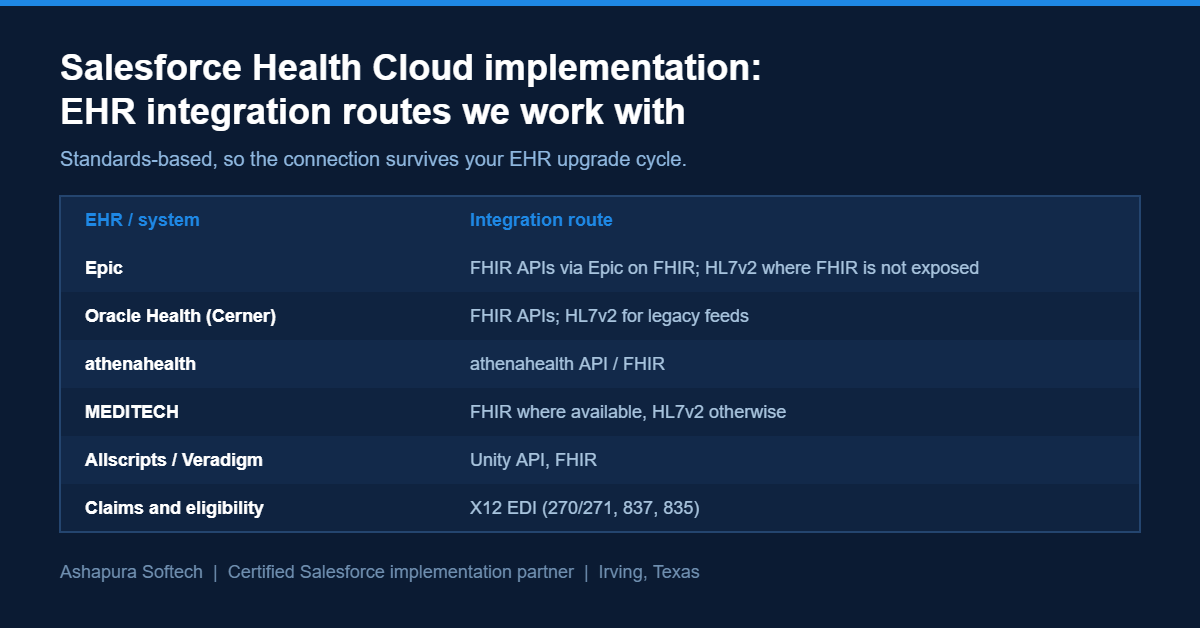
Salesforce Health Cloud implementation EHR integration routes for Epic, Cerner, athenahealth, MEDITECH and Allscripts via FHIR, HL7v2 and X12 EDI
EHR integration routes used in a Salesforce Health Cloud implementation.

Health Cloud is only as useful as the clinical data flowing into it. We integrate through the HL7 FHIR and HL7v2 interoperability standards rather than point-to-point custom code, so the connection survives your EHR’s upgrade cycle.

EHR / systemIntegration route
EpicFHIR APIs via Epic on FHIR; HL7v2 where FHIR resources are not exposed
Oracle Health (Cerner)FHIR APIs; HL7v2 for legacy feeds
athenahealthathenahealth API / FHIR
MEDITECHFHIR where available, HL7v2 otherwise
Allscripts / VeradigmUnity API, FHIR
Claims and eligibilityX12 EDI (270/271, 837, 835)

We have written both of these up in detail: how to integrate Health Cloud with EHR systems and the integration challenges that come up most often.

Four questions we ask before quoting an integration

  1. Which FHIR resources does your EHR actually expose, and at what version?
  2. One-way into Salesforce, or bi-directional write-back?
  3. What latency is acceptable: real time, near real time, or nightly batch?
  4. Who owns the interface engine, and is there capacity on that team?

If the first two cannot be answered yet, a fixed scope is not realistic. We propose a discovery sprint rather than quoting around the uncertainty.

HIPAA controls we configure

Health Cloud is HIPAA-capable, not HIPAA-compliant out of the box. Compliance is what you configure and what you sign.

  • BAA with Salesforce in place before any PHI enters the org. Salesforce sets out which products it will cover on its HIPAA compliance page
  • Salesforce Shield where the risk assessment calls for it: Platform Encryption, Event Monitoring, Field Audit Trail
  • Field-level security and sharing rules mapped to minimum-necessary access
  • Consent management modelled properly, including revocation
  • Audit trail retention aligned to your retention policy
  • Sandbox data masking so PHI never sits in a dev or partial sandbox
  • Integration user permissions scoped down rather than left broad
  • Access review cadence documented and handed over

Full detail in our HIPAA checklist for Health Cloud integration.

How we run the engagement

Every Salesforce Health Cloud implementation we scope runs through the same five stages, and nothing is quoted as fixed price until discovery is done.

Discovery: current-state review, EHR interface inventory, data quality assessment, compliance gap review, success metrics agreed.

Design: data model, integration architecture, security and sharing model, care management design, migration approach.

Build: configuration first, code only where configuration cannot reach. Integrations built and tested against a sandbox with masked data.

Migrate and test: data migration in waves with reconciliation at each wave. UAT with real operations users, not just admins.

Go-live and hypercare: cutover, monitoring, and daily triage through the first weeks.

Timelines depend on the number of source systems, whether write-back is in scope, and the state of your data. We scope that in discovery rather than quoting a number we cannot stand behind.

What moves the price

Five things move the cost of a Salesforce Health Cloud implementation more than anything else on the list.

  1. Number of EHR and source systems: one integration versus four is not a linear difference
  2. Bi-directional versus read-only: write-back into a clinical system carries governance overhead
  3. Data volume and quality: migrating 50,000 clean records is not migrating two million dirty ones
  4. Salesforce Shield: needed or not, based on your risk assessment
  5. Custom versus configured: every custom object added is a maintenance cost later

Where our delivery experience comes from

We are a certified Salesforce implementation partner, and also certified for Zoho, Microsoft Dynamics and Odoo: which means we can tell you when Health Cloud is not the right answer.

Our published case studies in regulated US data environments:

  • Credit repair platform
  • Debt settlement agency platform
  • U.S. mortgage brokerage

These are financial services, not healthcare. The overlap is the part that matters for a Health Cloud project: US regulatory constraints, strict permission models, audit requirements, and data migration that has to reconcile.

Ashapura Softech
2201 W Royal Ln, Irving, Texas 75063
+1 214-935-9893
Certified Salesforce implementation partner. Founded 2012.

Who these services fit

Health Cloud is sold as one product, but the implementation looks different depending on who is running it. These are the situations where the work we do maps cleanly onto the problem.

Organisation typeWhat the Health Cloud work usually involves
Multi-site provider groupsPulling patient records out of separate practice management systems into one record, so a care coordinator stops opening three applications to answer one call.
Payers and TPAsMember service teams work cases, not opportunities. The build centres on case routing, entitlements and a member timeline rather than a sales pipeline.
Behavioural health and home healthCare teams spend the day outside the clinic, so mobile access, visit scheduling and offline capable data entry matter more than dashboards.
Life sciences and medical devicesPatient support programmes, enrolment and adherence tracking, usually with a consent model that has to hold up under audit.
Digital health platformsReplacing a self built patient CRM that has become expensive to maintain, where the migration plan matters more than the configuration.

When Health Cloud is not the right answer

We would rather say this before a contract than after one. There are four situations where we tell prospects not to buy Health Cloud yet.

Nobody in the organisation works cases. Most of the value in Health Cloud sits in the care team model, the patient timeline and case management. If the actual requirement is appointment reminders for a small patient list, the scheduling module inside the existing EHR is cheaper and faster.

The EHR interface is not available. Integration cost is driven by what the EHR vendor will expose. If HL7 or FHIR access is not in the current contract, or the vendor charges per interface, that negotiation decides the project budget long before any Salesforce work starts. Settle it first.

Sales Cloud already covers it. An organisation running Sales Cloud that needs three or four healthcare specific objects can often extend what it has. Health Cloud earns its licence cost when the clinical data model, the care plan structure and the compliance controls are all genuinely needed.

Data governance has not been decided. Health Cloud will happily hold protected health information. Who is allowed to see which fields, how long records are retained, and who signs off access reviews are policy questions, not configuration questions, and a build cannot substitute for them.

Frequently asked questions

Can Health Cloud integrate with Epic?
Yes, through Epic on FHIR, with HL7v2 for feeds not exposed as FHIR resources. What matters is which FHIR resources your Epic instance exposes and whether write-back is in scope.

Is Salesforce Health Cloud HIPAA compliant?
Health Cloud can be configured to support HIPAA compliance, and Salesforce will sign a BAA. Compliance is a property of your configuration, your policies and your signed agreements: not a checkbox on the platform.

Do we need Salesforce Shield?
Not always. Shield adds Platform Encryption, Event Monitoring and Field Audit Trail. Whether you need it comes out of your risk assessment. We will not add it by default.

Health Cloud, or build on Sales Cloud?
Health Cloud ships the healthcare data model, care management objects and consent structures. Building the equivalent on Sales Cloud means maintaining that model yourself. For most healthcare organisations the licence difference is smaller than the maintenance difference.

Do you have a healthcare reference we can speak to?
Ask us on the call and we will tell you exactly what we can and cannot share.

Can you work alongside our existing Salesforce partner?
Yes. We are often brought in for the integration layer specifically, alongside an incumbent partner.

If you are still deciding between platforms rather than planning a rollout, we compare the options in Salesforce Health Cloud vs Epic.

Categories
Agentforce Salesforce

What Is Salesforce Headless 360? The Architecture Behind Agentic CRM

Quick answer

Headless 360 is the API driven layer Salesforce announced at TDX 2026 that lets AI agents read, write and reason over Salesforce data without opening the Salesforce interface. It does not replace your org. It exposes the same data, workflows and business rules to an agent through MCP servers, under the permissions that user already has. It is also the foundation the Claudeforce partnership is built on.

Update (14 Sep 2026): On 11 Sep 2026 Salesforce announced a new portfolio of named, job-ready Agentforce agents built for specific high-value work: Casey (customer service), Paige (IT and HR service), Carter (shopper agent for e-commerce), Marshall (supply chain orchestration), Piper (inbound lead generation) and Fin (complex customer experience), all generally available now, plus Hunter (outbound sales), in pilot with general availability expected November 2026. The release also adds long-horizon runtime so agents can pursue goals over days or weeks rather than single interactions, AI Skills for teaching agents new tasks (pilot now, GA October 2026), multi-agent orchestration across workflows, and an Agent Optimizer for continuous performance tuning (GA October 2026). This sits on top of the Core, Advanced and Max editions Salesforce introduced in early September.

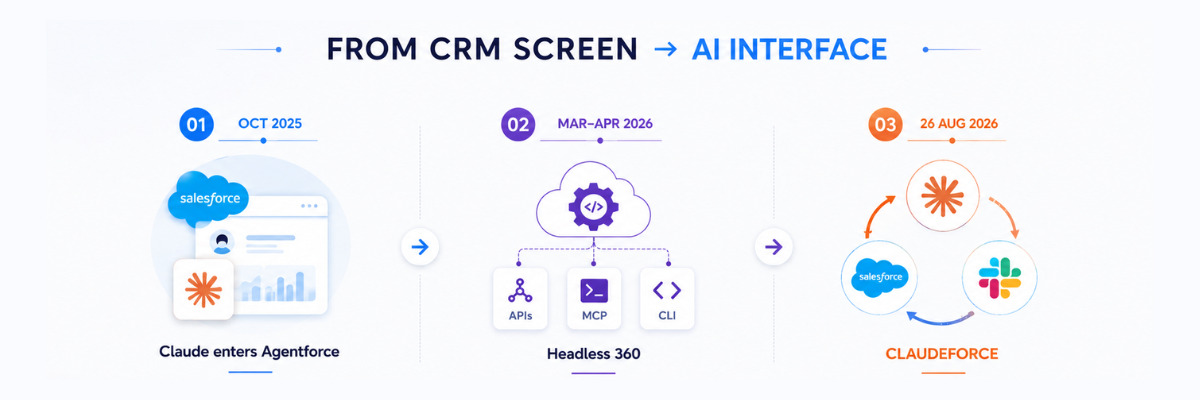
When Salesforce put its CRM inside Claude in August 2026, the reaction focused on the plugin. The more interesting question is why it was possible at all. The answer is a piece of architecture Salesforce announced four months earlier, and it deserves more attention than it got.

Headless 360 is the reason an external AI agent can read your pipeline, update an opportunity and respect your sharing rules without anyone opening a Salesforce tab.

What Headless 360 actually is

Salesforce’s own definition: “an architectural transformation that exposes every capability Salesforce has built over 25 years directly as an API, a Model Context Protocol (MCP) tool, or a CLI command.”

It was announced on 15 April 2026 at TDX 2026 in San Francisco, under the headline “No Browser Required.”

The framing from the announcement is the clearest statement of intent Salesforce has made about where the platform is going:

In the agentic enterprise, humans aren’t the only ones navigating. Agents are too, and they don’t go to a browser or click through UIs.

The scale involved: 4,000+ existing APIs, 220+ CLI commands, 60+ MCP tools and 30+ prebuilt coding skills, all reachable by an agent that has never rendered a Salesforce page.

One thing it is not, in Salesforce’s own words: “Headless 360 does not replace the Salesforce interface you work in every day.” The panic in some admin communities after the “no browser required” headline was understandable and misplaced.

The four pillars

PillarWhat it provides
Skills30+ prebuilt skills giving coding agents such as Claude Code, Cursor and Windsurf the knowledge to discover, understand and act on Salesforce natively
MCP and APIs60+ MCP tools plus the full suite of Salesforce APIs
MetadataOrg-aware grounding, so an agent understands your objects, fields and configuration rather than guessing
Headless Experience LayerA rendering layer that surfaces Salesforce experiences into Slack, Teams, WhatsApp and voice

The metadata pillar is the one that separates this from a generic API integration. An agent hitting a REST endpoint knows the schema. An agent grounded in org metadata knows that your Stage picklist has a value called “Verbal Commit” that means something specific in your business.

The MCP servers Salesforce has shipped

Salesforce’s hosted MCP servers reached general availability on 29 April 2026. The current catalogue:

ServerStatusWhat it exposes
SObject AllGAFull CRUD plus query and search across all Salesforce objects
SObject ReadsGARead and query only, no mutations
SObject MutationsGACreate and update, no delete
SObject DeletesGADelete only
Data 360GAQuery unified customer data, roughly 200 Data 360 APIs
Headless 360BetaSalesforce Setup and platform capabilities via Discover, Describe and Dispatch
Tableau NextGASemantic models, KPI queries, analytics execution
Marketing EngagementGAJourneys, campaigns, data extensions, content
Slackbot MCP ClientGAConnects Slackbot to Salesforce and 20+ partner apps

The separation of reads, mutations and deletes into distinct servers is a deliberate governance decision, and a sensible one. Activating SObject Reads alone lets an agent answer questions without ever being able to change anything.

The Headless 360 MCP server itself

Still in beta as of July 2026, and narrower than the name suggests. It exposes exactly four tools:

  • discover – semantic search across a vector index of APIs and skills, returning ranked candidates
  • describe – returns the technical contract: APIs, parameters, dependencies and the ordered steps
  • dispatch – invokes the skill, routes to the endpoint and enforces user access guards
  • dispatch_readonly – the same, restricted to GET operations

Roughly 100 skills at launch, focused on Setup tasks for admins: user management, password operations, permission assignment, Apex trigger management, platform events, Change Data Capture, event relays and named credential configuration. Salesforce says thousands more are in development.

Worth being clear about the beta status. This is a Beta Service under Salesforce’s beta terms, and the skill library is thin relative to the ambition of the announcement.

How your permissions survive the trip

This is the part that determines whether Headless 360 is a governance breakthrough or a security incident waiting to happen.

Salesforce’s clearest statement, from the beta announcement:

If you can’t do it in Salesforce, your agent can’t do it through the MCP server.

Every transaction runs as the authenticated user, scoped through an external client app holding the mcp_api scope. Authentication is per-user OAuth 2.0 with PKCE.

Salesforce describes four enforcement layers on every call:

  1. Identity – the agent acts as a specific user, not an anonymous service account
  2. Access – sharing rules, field-level security and permission sets apply
  3. Invocation scope – only explicitly exposed tools and actions are available
  4. Governance – validation rules, triggers, approval chains and governor limits all fire

Patrick Stokes, Salesforce’s president of applications and marketing, put it bluntly when describing the Claude plugin: if you don’t own a record or have permission to see it, the MCP server doesn’t either.

The sentence every admin should read twice

From Salesforce’s own admin blog:

When an agent acts on behalf of a user, it can do anything that user is permitted to do.

That is the whole risk model in one line. Permission inheritance is only a safety feature if the permissions are correct. Every over-provisioned profile in your org – the one that got view-all on a standard object during go-live because it was the fastest fix – has just become an agent-reachable surface.

It was survivable when exploiting it required someone to log in and know where to look. It is materially less survivable when a colleague can ask a question in plain English and an agent will go and find the answer.

This is why a permission-model audit is no longer housekeeping. It is a security control, and it belongs before the pilot rather than after it. Our Agentforce readiness checklist covers exactly what that audit should look for, and our Claudeforce breakdown explains why it became urgent this quarter.

Salesforce also documents a client-side control worth using: MCP clients support tool-level restrictions that require human approval before an agent action executes. Salesforce’s own recommendation is to configure these before allowing configuration changes or data modification, and to test in a sandbox first.

What it actually takes to switch on

Standard MCP servers are inactive by default. Four steps to get an external agent connected:

1. Activate the server. Setup, search for “MCP Servers,” open the Salesforce Servers tab, select the server and click Activate. Copy the API name (drop the platform prefix) and the server URL.

2. Create an External Client App. Setup, External Client App Manager, New External Client App. Then:

  • Enable OAuth
  • Set the callback URL your client expects
  • Add exactly two scopes: “Perform requests at any time” (refresh_token, offline_access) and “Access Salesforce Hosted MCP Servers” (mcp_api)
  • Uncheck “Require secret for Web Server Flow” and “Require secret for Refresh Token Flow”
  • Check “Require Proof Key for Code Exchange (PKCE)” and “Issue JWT-based access tokens for named users”
  • Collect the consumer key and secret from OAuth Settings

3. Connect the client using its MCP add command with the server URL, consumer key and callback port, then authenticate and grant access.

4. Test before you trust it. Salesforce recommends Postman for a smoke test.

Server URLs follow the pattern https://api.salesforce.com/platform/mcp/v1/<SERVER-NAME> for production, with /sandbox/ inserted for sandbox and scratch orgs. API version 67.0 or later is required.

Two gotchas practitioners report that Salesforce’s guide does not mention: PKCE may need enabling globally first under Setup, OAuth and OpenID Connect Settings, and a newly created External Client App can take up to 30 minutes to become usable.

Where the gaps are

Headless 360 is a genuine engineering achievement with three honest weaknesses worth knowing before you plan around it.

Salesforce built the access layer, not the governance layer. There are no quality checks on agent-generated code, no technical-debt assessment, no naming-convention enforcement, no automation-chain validation. Salesforce shipped Testing Center, Custom Scoring Evals, Observability and Session Tracing, which help, but observation is not the same as control. General-purpose code scanners cannot see Salesforce-native concerns such as governor limits, Flow complexity or metadata dependencies.

The builder gap is real. Vernon Keenan’s TDX coverage made the sharpest version of this argument: pro-code developers gained a substantial agentic toolkit while admins and Flow builders got very little, with no visible bridge programme to retool the existing ecosystem. If your Salesforce capability sits mostly with admins rather than developers, Headless 360 does not currently meet you where you are.

Testing headless agents is harder than testing Flows. The debugging habits built around Flow and Apex do not transfer cleanly, which is precisely why Salesforce had to build separate evaluation tooling. Budget for the learning curve.

Bulk operations deserve specific attention. A user with delete rights can, in principle, instruct an agent to delete records at scale. Mitigate with Transaction Security Policies, or by activating SObject Reads rather than SObject All, or by blocking delete tools client-side.

What it costs

Salesforce has published no Headless 360 rate card, and this is the single least documented part of the story.

What is officially stated: MCP access “is included with Enterprise Edition and above – there’s no separate SKU required,” the MCP server “will use your existing API limits,” and “Flex Credits apply when you invoke Agentforce actions, run Data 360 queries, or use Prompt Builder.”

What is not stated: any per-API-call or per-MCP-call price. When CIO asked how API and MCP interactions under Headless 360 are currently billed, Salesforce declined to comment. Salesforce’s CRO said publicly that the company will work with customers “to find the right ways in a fair way to monetize those new interactions.”

The practical read: assume existing API-limit accounting plus Flex Credits on downstream agent work, and get whatever you are told in writing before you scale. Our Agentforce pricing breakdown covers the credit rate card in detail.

How this connects to the rest of the platform

Headless 360 sits inside the wider architecture Salesforce now describes as five systems: Agentforce as the system of agency, Slack as the system of engagement, Tableau as the system of insight, Customer 360 as the system of record, and Data 360 as the system of context.

Two clarifications worth making because commentary keeps blurring them:

Agentforce and MCP are complementary, not competing. Agentforce is where you choose the model and build the agent. MCP is what exposes skills and knowledge to an agent, wherever that agent lives.

Salesforce has not published a link between Headless 360 and the Atlas Reasoning Engine. No primary source connects the two, and Salesforce’s Atlas documentation does not mention Headless 360. The honest framing is that Headless 360 is the access and invocation layer while Atlas is the reasoning layer inside Agentforce. How, or whether, Atlas plans over Headless 360 skills is not documented.

There is also a naming inconsistency worth noting. The Claudeforce press release attributes the plugin’s foundation to AIforce, described as “Salesforce’s enterprise harness that connects business data and workflows to agents through MCP servers, APIs, and CLI tools” – which is Headless 360’s description in substance, under a different name. Salesforce has not published a statement equating them.

What to do about it

If you are an admin: audit your permission model before anything else. Profiles and permission sets with broader access than anyone remembers granting are now the highest-priority item on your list. Then activate the narrowest server that does the job – SObject Reads before SObject All.

If you are a developer: start with the Salesforce DX MCP Server locally and the hosted servers in a scratch org. The Trailhead module and the developer workshop are both current and worth the hour.

If you own the platform: the questions to get answered before a production rollout are what gets logged, what gets retained, where, and how consumption will be billed as volume grows.

If you are a partner or SI: the governance layer between Salesforce’s access layer and a production deployment is not built. That gap is billable work – permission architecture, MCP scoping, agent testing strategy and consumption forecasting. Firms with offshore delivery capacity to staff it have more addressable scope than they did a quarter ago.

Frequently asked questions

What is Salesforce Headless 360?

Headless 360 is a Salesforce architecture that exposes the platform’s capabilities as APIs, Model Context Protocol tools and CLI commands, so AI agents can use Salesforce data, workflows and governance rules without a user interface. It was announced on 15 April 2026 at TDX 2026.

Does Headless 360 replace the Salesforce UI?

No. Salesforce states directly that Headless 360 does not replace the Salesforce interface, which is not going away. It adds a second way in for agents.

How does Headless 360 handle permissions?

Every call runs as the authenticated user via OAuth 2.0 with PKCE. Sharing rules, field-level security, permission sets, validation rules, triggers, approval chains and governor limits all apply. Salesforce’s summary is that if you cannot do it in Salesforce, your agent cannot do it through the MCP server.

What MCP servers does Salesforce offer?

SObject All, SObject Reads, SObject Mutations, SObject Deletes, Data 360, Tableau Next and Marketing Engagement are generally available. The Headless 360 MCP server is in beta. A Slackbot MCP Client is generally available and requires Enterprise Edition or above.

What does Headless 360 cost?

Salesforce has published no separate rate card. MCP access is included on Enterprise Edition and above, calls use existing API limits, and Flex Credits apply when an Agentforce action, Data 360 query or prompt runs. Salesforce declined to comment when asked how API and MCP interactions are currently billed.

Is Headless 360 what powers Salesforce in Claude?

Reporting on the Claudeforce launch says the plugin is built on Headless 360. Salesforce’s own press release attributes it to “AIforce,” described in almost identical terms. The two are very likely the same substrate under different names, but Salesforce has not published a statement equating them.

Sources

If you are looking at the non Salesforce route, the same permission and data questions come up in what your ERP and CRM must provide before you build a Claude commerce agent.

Ashapura Softech is a certified Salesforce implementation partner. If you want your org’s permission model audited before you expose it to agents, book a CRM health check. See also our Salesforce DevOps services and Salesforce cloud services.

Categories
Agentforce Salesforce

Is Your Salesforce Org Ready for AI Agents? A 2026 Readiness Checklist

Update (14 Sep 2026): On 11 Sep 2026 Salesforce announced a new portfolio of named, job-ready Agentforce agents built for specific high-value work: Casey (customer service), Paige (IT and HR service), Carter (shopper agent for e-commerce), Marshall (supply chain orchestration), Piper (inbound lead generation) and Fin (complex customer experience), all generally available now, plus Hunter (outbound sales), in pilot with general availability expected November 2026. The release also adds long-horizon runtime so agents can pursue goals over days or weeks rather than single interactions, AI Skills for teaching agents new tasks (pilot now, GA October 2026), multi-agent orchestration across workflows, and an Agent Optimizer for continuous performance tuning (GA October 2026). This sits on top of the Core, Advanced and Max editions Salesforce introduced in early September.

Most Agentforce pilots do not fail because the model is not good enough. They fail because the org underneath it was never built for something that reads everything, believes what it reads, and acts on it in seconds.

This is the assessment we run before any agentic rollout. It takes about a week for a mid-sized org, it is mostly reporting rather than development, and it will tell you whether you are eight weeks from a pilot or eight months.

Why readiness got harder in 2026

Two things changed this year, and both raise the cost of a messy org.

Salesforce shipped Headless 360 in April, exposing the platform as APIs and MCP tools that external agents can call without a browser. Then in August, Claudeforce put a Salesforce plugin inside Claude with 37 prebuilt sales skills.

Both inherit each user’s existing Salesforce permissions. Salesforce presents that as the security story, and it is a good one – but read the sentence from Salesforce’s own admin blog carefully:

When an agent acts on behalf of a user, it can do anything that user is permitted to do.

Permission inheritance is only a safety feature if the permissions are correct. That is the whole readiness argument in one line.

Pillar 1: Data quality

An agent cannot tell the difference between a stale record and a current one. It will read your pipeline exactly as it stands and produce a confident, fluent, wrong answer.

Run these five reports before anything else. All are standard reporting, none require development.

CheckWhat good looks likeWhat it breaks
Duplicate account and contact rateUnder 2%Account planning, customer health, stakeholder mapping
Open opportunities with a close date in the pastUnder 5%Every forecast narrative the agent produces
Open opportunities with no activity in 30 daysUnder 15%Deal health scoring, pipeline review
Opportunities with an empty next stepUnder 10%Close planning, daily briefings
Contacts with no role on the opportunityUnder 20%Stakeholder mapping, meeting prep

If 30% of your open opportunities have a close date in the past, a forecast narrative generated from that pipeline does active harm. It reads as authoritative, and someone will act on it.

The fix is rarely a data cleanse. It is usually a validation rule and a process change, because the same conditions will regenerate within two quarters otherwise. Clean once, then enforce.

The field that lies

Every org has fields that are mandatory in process but optional in the schema. A rep is told to fill in Competitor and Loss Reason, nobody enforces it, and 60% are blank.

A human reading the record knows to discount the field. An agent asked “why are we losing to competitor X” will answer from the 40% that is populated and present it as the picture. Selection bias, delivered with total confidence.

List every field your business treats as required and check whether the schema agrees. Where it does not, either enforce it or stop treating the field as a source of truth.

Pillar 2: Permissions

This is the pillar that moved from housekeeping to security control, and it is where we find the most serious findings in almost every assessment.

What to pull:

  • Every profile and permission set with View All or Modify All on a standard object
  • Every profile with Export Reports
  • Sharing rules granting broader access than the role hierarchy implies
  • Integration users with elevated permissions and no owner
  • Users with permissions inherited from a role they no longer hold

What you will find, in our experience of running this: at least one profile that got View All on a standard object during the original go-live because it was the fastest way to unblock a deadline, and which nobody has revisited since.

That was survivable when exploiting it required logging in and knowing exactly where to look. It is much less survivable when any user with that profile can ask a plain-English question and have an agent go and find the answer across every record they technically can see.

The remediation sequence:

  1. Inventory the over-provisioned profiles
  2. Find out who actually uses the access, from login and report-export history
  3. Move genuine needs into a narrow permission set
  4. Remove the blanket grant
  5. Retest the affected workflows before you go near an agent

Budget three to four weeks for a mid-sized org. This is the item that most often turns an “eight week” pilot into a quarter, and skipping it is not an option once agents are reading on a user’s behalf.

Pillar 3: Business logic

When work starts in Claude or Slack and finishes in Salesforce, your page layouts stop being where behaviour is governed.

Anything you enforced through interface design – a field that only appears at a certain stage, a button that only some users see, a required field on a specific record type – has to be re-enforced somewhere an agent will encounter it. That means validation rules, flows and the sharing model.

The audit:

  • List every business rule currently enforced only by a page layout or a Lightning component
  • Check each one has an equivalent validation rule or flow
  • Identify flows that assume a human is present – screen flows, confirmation prompts, anything waiting on input
  • Find automations that fire on field update and could loop when an agent writes at speed

That last one matters more than it sounds. Automation chains built for human-paced data entry behave differently when something writes forty records in a minute. Governor limits do fire on agent traffic, which is a protection, but hitting them mid-workflow produces partial states nobody designed for.

If your business logic lives in a mix of Apex, flows and process builders accumulated over years, this is the right moment to consolidate it. That is Salesforce DevOps work – version control, a release process, a test suite – and it is the difference between a platform an agent can be trusted with and one it cannot.

Pillar 4: Process

Two questions decide whether a pilot produces a budget line or an anecdote.

Which single workflow are you piloting? Not which platform. One skill, with a measurable before-and-after. Meeting prep and pipeline review are the strongest candidates because both have a time cost you can measure this week without instrumentation.

How will you know it worked? Establish the baseline before you turn anything on:

  • Minutes per rep per week on the task today, from a sample of five reps over one week
  • The same measurement after four weeks of agent use
  • An accuracy check by a sales manager on a sample of twenty outputs
  • Whether reps still do the task manually as well, which is the failure mode nobody reports

Resist enabling everything at once. A pilot proving one workflow converts into a budget. A pilot enabling 37 skills produces enthusiasm that evaporates at the next quarterly review. The same principle applies to Sales Cloud ROI work: one workflow, one baseline, one number.

Pillar 5: Measurement and governance

Adoption metrics change meaning. If sellers begin their day in Claude or Slack, Salesforce login counts stop being a proxy for usage. Decide now what replaces them, or you will spend Q1 arguing about a metric that no longer measures anything.

Training changes shape. You are teaching prompting and verification rather than navigation. The most important skill you can build in a sales team is the habit of checking an agent’s output against the record before acting on it. That habit is easy to build in week one and nearly impossible to retrofit after someone has been burned.

Consumption needs an owner. Agentforce meters on Flex Credits, and credits expire at the order end date with no rollover. Somebody has to watch the burn rate monthly. Our Agentforce pricing breakdown covers the rate card and where budgets typically go wrong.

The regulated-industry additions

If you are in financial services, healthcare or life sciences, three more items apply, and they should start before procurement rather than after.

Get the data flow diagram for each deployment path. A single request may touch the model provider, Amazon Bedrock and Salesforce. Ask where data rests and where it is processed at each hop. Salesforce’s Trust Boundary answers this for the Agentforce path by running inference inside its own virtual private cloud. It does not obviously answer it for an external plugin path.

Ask what is logged and retained, and for how long. Then check that answer against your own retention policy rather than assuming they align.

Reuse your existing review template. If you have integrated an EHR or a core banking system, you already have the muscle for this. Teams running Salesforce Health Cloud under HIPAA will recognise most of the questions.

The checklist, condensed

Print this. It is the whole assessment on one page.

Data

  • Duplicate account and contact rate measured
  • Open opportunities with past close dates measured
  • Open opportunities with no 30-day activity measured
  • Empty next-step fields measured
  • Process-required but schema-optional fields listed
  • Validation rules added so the same problems do not regenerate

Permissions

  • All View All and Modify All grants inventoried
  • Report-export permissions reviewed
  • Sharing rules checked against the role hierarchy
  • Integration users audited and given owners
  • Over-provisioned access narrowed into permission sets
  • Affected workflows retested after remediation

Business logic

  • Rules enforced only by page layouts identified
  • Equivalent validation rules or flows in place
  • Human-dependent flows flagged
  • Automation loops on rapid writes tested
  • Business logic under version control

Process

  • One pilot workflow chosen
  • Baseline measured before enabling anything
  • Accuracy review assigned to a named manager
  • Success threshold agreed in advance

Measurement

  • Replacement adoption metric agreed
  • Prompting and verification training planned
  • Consumption owner named
  • Monthly credit burn review scheduled

Regulated industries

  • Data flow diagram obtained for each deployment path
  • Logging and retention confirmed against your own policy
  • Security review completed pre-purchase

How long this actually takes

For a mid-sized org with a Salesforce implementation more than three years old:

PhaseDurationWho
Data quality assessment3-5 daysAdmin or analyst, reporting only
Permission audit1 week to assess, 3-4 weeks to remediateAdmin plus security review
Business logic review1-2 weeksDeveloper or architect
Pilot design and baseline1 weekRevOps
Pilot run4 weeksOne team

Roughly eight to ten weeks from start to a pilot with a defensible number attached. Orgs that have kept their permission model tight can do it in five.

The permission remediation is the long pole, and it is also the item most likely to be skipped under deadline pressure. Do not skip it. It is the one whose failure mode is a data exposure rather than a disappointing demo.
Once your org is ready, the next question is where to start. Our guide to Salesforce Agentforce use cases shows what companies have put live in sales, service, marketing, commerce and the contact center.

This checklist matters even if you never build a custom agent. Agentforce Coworker, the AI assistant in the Salesforce search bar, has been switched on automatically in many orgs since August 2026, and it answers questions from whatever your sharing rules allow. See our Agentforce Coworker guide for eligibility, cost and the opt out setting.

Readiness also depends on the release you are on. Our guide to the Salesforce Winter ’27 release lists the 15 changes to test before GA, including Flow Test Mode and new Agentforce quality scoring.

Frequently asked questions

What is an Agentforce readiness assessment?

A structured review of whether a Salesforce org can support AI agents safely and usefully. It covers data quality, permission architecture, business logic placement, pilot design and consumption governance. It is mostly reporting and analysis rather than development work.

How clean does CRM data need to be for Agentforce?

Cleaner than most orgs are. As practical thresholds: duplicates under 2%, open opportunities with past close dates under 5%, and open opportunities with no 30-day activity under 15%. Beyond those levels, agent output degrades in ways that are hard to spot because it still reads fluently.

Why does the permission model matter more with AI agents?

Because agents inherit each user’s existing Salesforce permissions. Salesforce’s own admin guidance states that an agent acting on a user’s behalf can do anything that user is permitted to do. Over-provisioned access that was survivable when it required manual effort becomes reachable through a plain-English question.

How long does it take to get ready for Agentforce?

Eight to ten weeks for a typical mid-sized org, of which permission remediation is three to four. Orgs with a well-maintained permission model can be ready in about five weeks.

Should we pilot every Agentforce skill at once?

No. Pick one workflow with a measurable time cost, baseline it before you enable anything, and have a sales manager review a sample of outputs for accuracy. One proven workflow converts into budget. Thirty-seven enabled at once produces anecdotes.

What changes for Salesforce admins when agents arrive?

The interface stops being the control surface. Anything enforced through page layouts or component visibility has to move into validation rules, flows and the sharing model. That is more admin work, not less, and it is harder to skip.

Sources

Ashapura Softech is a certified Salesforce implementation partner. Once the readiness gaps are clear the next step is vetting the vendor, and our list of nine questions to ask an Agentforce partner covers what to put in front of them. We run this assessment as a fixed-scope CRM health check covering data quality, permission architecture and automation debt – book one here. See also our CRM software development and Salesforce cloud services, or the delivery work in our case studies.

Editions note, September 2026: Agentforce now ships inside every tier of Salesforce’s new Core, Advanced and Max editions rather than as an add on, which changes what a readiness conversation has to cover. See what replaced Enterprise and Unlimited.

Related reading: readiness is not only an org question, it is a systems question. See the ERP and CRM readiness checklist for Claude Commerce Agents, including which platforms have connectors today.

Categories
Agentforce Salesforce

Agentforce Pricing Explained (2026): Flex Credits, Conversations and Pay-Per-Resolution

Quick answer

There is no single Agentforce price. Flex Credits are sold at $500 per 100,000 credits, which works out to $0.10 for a standard agent action and $0.15 for a voice action on the Salesforce rate card effective 21 April 2026. The older $2 per conversation model is still live, applies only to customer facing agents, and cannot run in the same org as Flex Credits. Sandbox usage is discounted by 20%, and Data 360 usage is metered separately.

Update (14 Sep 2026): On 11 Sep 2026 Salesforce announced a new portfolio of named, job-ready Agentforce agents built for specific high-value work: Casey (customer service), Paige (IT and HR service), Carter (shopper agent for e-commerce), Marshall (supply chain orchestration), Piper (inbound lead generation) and Fin (complex customer experience), all generally available now, plus Hunter (outbound sales), in pilot with general availability expected November 2026. The release also adds long-horizon runtime so agents can pursue goals over days or weeks rather than single interactions, AI Skills for teaching agents new tasks (pilot now, GA October 2026), multi-agent orchestration across workflows, and an Agent Optimizer for continuous performance tuning (GA October 2026). This sits on top of the Core, Advanced and Max editions Salesforce introduced in early September.

Update, September 2026: Core, Advanced and Max replaced these editions

On 3 September 2026 Salesforce replaced Enterprise, Unlimited and Agentforce 1 with three new editions: Core at $195 per user per month with 500,000 Flex Credits, Advanced at $395 with 1 million, and Max at $550 with 2.75 million. Agentforce 1 customers can move to Max at no extra cost, and existing customer pricing on legacy editions is unchanged. The credit mechanics described below still apply, but the edition names and allocations above are the current ones. Full breakdown in our guide to the Core, Advanced and Max editions.

Agentforce pricing has changed three times in eighteen months, and most of the guides available online are describing a version of it that no longer applies. Some are also repeating a metering rule that Salesforce’s own documentation contradicts.

This is the current picture as of August 2026, with every figure taken from Salesforce’s published pricing page, rate cards and help documentation. Where something is not disclosed, we say so rather than estimating.

The four ways Salesforce charges for Agentforce

There is no single Agentforce price. There are four billing mechanisms, and most customers end up on two or three of them at once.

ModelWhat triggers a chargeList priceBest fit
Flex CreditsEach action, prompt, query or voice minute an agent consumes$500 per 100,000 creditsVariable volume, employee-facing agents, voice
ConversationsEach customer-facing conversation session$2 per conversationHigh-action conversations where a flat session price wins
Pay-per-resolutionOnly when the Help Agent resolves an issue end to end$2 per resolutionCustomer self-service where deflection is the goal
Per-user add-onsNamed user, flat monthly$125/user/month, $150 for IndustriesPredictable internal use by a defined team

The first thing to understand is that Flex Credits did not replace the $2 conversation model. Both are live on Salesforce’s pricing page today and the buyer chooses. Conversations are restricted to customer-facing agents; Flex Credits cover customer-facing, employee-facing and voice.

Agentic Work Units are not a price

This is worth stating plainly because a large amount of commentary has it wrong, including some that quotes executives loosely.

Salesforce’s own definition: an Agentic Work Unit is “a platform-level metric that captures the breadth of activity happening across the Agentic Enterprise, from Agentforce to Slack.” It counts “one discrete task accomplished by an AI agent” – a prompt processed, a reasoning chain completed, or a tool invoked.

It is a disclosure metric, used in earnings reporting and marketing. Salesforce has published no price per AWU, and no conversion between AWUs and Flex Credits. If you see a blog quoting a dollar figure per Agentic Work Unit, it is somebody’s arithmetic, not Salesforce’s price.

The nearest billable analogue to “one discrete task” is a Flex Credit action at 20 credits, but Salesforce has never equated the two, and neither should you when building a budget.

The Flex Credits rate card, in full

Flex Credits launched in May 2025 at $500 per 100,000 credits – half a cent per credit. Salesforce’s published rate card, effective 21 April 2026:

Usage typeProductionSandbox
Standard action20 credits16
Custom action20 credits16
Standard voice action30 credits24
Custom voice action30 credits24
Starter prompt2 creditsn/a
Basic prompt2 creditsn/a
Standard prompt4 creditsn/a
Advanced prompt16 creditsn/a
Speech-to-text150 credits per hour transcribedn/a
Text-to-speech6,000 credits per 1M charactersn/a
Translation4,000 credits per 1M charactersn/a
Voice minutes60 credits per minute48

At $0.005 a credit, that makes a standard agent action 10 cents, a voice action 15 cents, and a minute of Agentforce Voice 30 cents, rounded up to the next full minute.

Sandbox usage runs at a 20% discount, and Salesforce confirms the sandbox multiplier “applies to pre-production environments, which include sandboxes as well as scratch orgs.”

Data 360 usage is metered separately on a tiered multiplier that resets on the first day of each calendar month, so heavy query volume gets progressively cheaper per row. Queries start at 3 credits per million rows at the base tier and fall to 0.6 at the top tier. Unification is far more expensive at 75,000 credits per million rows. Sandbox Data 360 does not use the tiers.

Two rules that cost people money

Credits expire. Salesforce’s terms are explicit: Flex Credits “must be used before the Order End Date set forth in the Usage Details table on the Order Form, and no rollover will be permitted.” Buying a large pre-purchase block against optimistic adoption forecasts means paying for capacity you then forfeit.

Prompts are chunked, actions are not. Prompt usage is counted in 2,000-token chunks, rounded up – Salesforce’s own worked example is that 6,500 tokens counts as four prompts. Verbose system prompts and over-retrieved knowledge chunks therefore cost real money.

Actions work differently, and this is where a widely repeated claim goes wrong.

The 10,000-token myth

Several well-circulated pricing guides state that an agent action exceeding 10,000 tokens is billed as multiple actions – 15,000 tokens as two actions, 20,001 as three – and attribute this to Salesforce documentation.

Salesforce’s current help documentation on Flex Credits billable usage types says the opposite:

Currently, every standard action called by the agent is metered as one standard action, irrespective of the number of tokens processed.

The 2,000-token chunking rule applies to prompts, not actions. The most likely explanation is that the two rules got conflated, or that those guides are citing a superseded version of the page – note Salesforce’s own hedge in the word “currently.”

Either way, if you have modelled your Agentforce budget on token-multiplied action costs, your forecast is wrong in a direction that will surprise your finance team pleasantly, and you should redo it against the actual rate card before your next renewal conversation.

What you need before you can buy anything

ItemRequirement
Salesforce FoundationsFree, on Enterprise Edition and above. Includes Agentforce Builder, Prompt Builder, Agent Script, Agentforce Coworker and Agentforce Vibes at no cost
Free creditsEnterprise Edition and above get 100,000 Flex Credits free
Agentforce User Licence$5 per user per month, requires Flex Credits, limited CRM object access
Agentforce add-ons$125 per user per month for Sales, Service or Field Service; unmetered employee usage
Agentforce Industries$150 per user per month
Agentforce 1 EditionFrom $550 per user per month, includes an add-on plus 2.5 million Flex Credits per org per year

The practical floor is Enterprise Edition. Below that, the conversation does not start.

Note the internal inconsistency in Salesforce’s own help documentation about the minimum edition for Service Agent specifically – some pages say Enterprise and above, an older page says Performance, Unlimited and Developer. Confirm your exact entitlement with your account executive rather than with a documentation page.

Pay-per-resolution: the model that actually changes the risk

Announced in June 2026 and generally available from July, the Agentforce Help Agent charges $2 per resolution, and only when the agent resolves the issue autonomously from start to finish.

Salesforce’s stated terms: “If a customer gives negative feedback or asks for human escalation, there is no charge.” Both Data 360 and Agentforce actions are unmetered during the interaction.

The headline number is the same $2 as the conversation model, but the risk transfer is completely different. Under conversations you pay whether or not the agent helped. Under pay-per-resolution, a failed interaction costs you nothing.

What counts as one resolution, per Salesforce’s metering definitions:

  • Email – one resolved interaction
  • Enhanced chat and portal – up to two hours of interaction
  • Third-party messaging – up to two hours of interaction
  • Voice – a ten-minute duration limit per resolution

For a service organisation with a well-maintained knowledge base, this is the most defensible Agentforce commercial model available right now, because the vendor carries the quality risk rather than the customer.

Flex Credits or conversations? Do the arithmetic

At 20 credits per action and $0.005 per credit, an action costs 10 cents. A flat conversation costs $2. The break-even therefore sits around twenty actions per conversation.

  • Below twenty actions per conversation, Flex Credits are cheaper
  • Above twenty, the flat conversation price wins

That is straightforward arithmetic on Salesforce’s published rates, not a Salesforce recommendation, and it is worth running against your own transcript data before you sign. Pull a sample of a hundred real service conversations, count the discrete tool calls each would require, and you will know which model to negotiate.

Where budgets actually go wrong

Salesforce publishes rates. It does not publish the behaviour that generates them. Five patterns account for most overruns:

Voice is a different economy. A voice action costs 30 credits rather than 20, and Agentforce Voice also meters at 60 credits per minute, rounded up. A three-minute call is 180 credits before any actions are counted. Agentforce Voice also sits on top of Service Cloud Voice licensing, which is easy to leave out of a business case entirely.

Sandbox iteration compounds. Sandbox is 20% cheaper per action, but a hundred test scenarios at five actions each is 8,000 credits a pass, and nobody tests once. Budget for the build as well as the run.

Guardrail failures burn credits with nothing to show. Every off-topic request that slips through and triggers an action is 20 credits spent on a non-answer.

Retrieval bloat inflates prompt costs. Prompts bill in 2,000-token chunks. An over-eager knowledge retrieval that stuffs eight chunks into context where two would do is a permanent tax on every single interaction.

Nobody has modelled agent-to-agent traffic. Salesforce has not documented how agent-to-agent invocations meter, and we could find no substantive practitioner reporting on it either. If your architecture involves agents calling agents, treat this as an open question to raise in your contract negotiation rather than an assumption to build on.

Headless 360 and Salesforce in Claude: what is and is not priced

With Claudeforce announced in August 2026, the pricing question extends beyond the Salesforce UI.

Headless 360 has no published rate card. Salesforce states that MCP access “is included with Enterprise Edition and above – there’s no separate SKU required,” that the MCP server “will use your existing API limits,” and that “Flex Credits apply when you invoke Agentforce actions, run Data 360 queries, or use Prompt Builder.”

So officially there is no new meter. API calls draw on existing entitlements, and downstream agent work consumes Flex Credits at the standard rate. There is no published per-API-call or per-MCP-call price, and Salesforce declined to comment when CIO asked how these interactions are currently billed. The full architecture is covered in our guide to what Salesforce Headless 360 is.

Salesforce in Claude pricing is not disclosed. The announcement carries only the standard line that “pricing and packaging are subject to change.” Whether it is bundled into an existing entitlement, sold as an add-on, or metered per action has not been stated. Anyone building a business case on it today is guessing.

How to negotiate this properly

Three buying models are available: Pre-Purchase (pay upfront for a fixed block), Pre-Commit (commit to a baseline, billed monthly in arrears) and PayGo (no commitment, monthly in arrears).

The order in which you negotiate matters more than which one you pick.

  1. Model your traffic in credits before you build anything. Estimate actions per interaction, prompt sizes, voice minutes and Data 360 query volume. A spreadsheet built on the rate card above takes an afternoon and changes the shape of the deal.
  2. Negotiate consumption before seats. Seat counts are the easy part of the conversation. Consumption rates and caps are where the money moves.
  3. Get a capped unit rate written into the order form, for the contract term, not the current quarter.
  4. Scope per-user charges to actual users. The $125 add-on is unmetered for that user, which is excellent value for heavy users and pure waste for occasional ones.
  5. Ask what happens to unused credits. They expire at the order end date with no rollover, so the pre-purchase block should be sized to a realistic ramp, not an optimistic one.

If you are running this alongside a broader platform programme, the same discipline that keeps a Salesforce CRM development project on budget applies here: forecast the consumption, then instrument it, then review it monthly. It is also the first thing we check in an Agentforce readiness assessment.

The numbers Salesforce is reporting

For context on how fast this is moving, from Salesforce’s own earnings releases:

MetricQ1 FY27Q2 FY27
Agentforce ARR$1.2B, +205% YoYOver $1.5B, +240% YoY
Agentforce + Data 360 ARRNearly $3.4BNearly $3.9B, +210% YoY
Agentic Work Units (cumulative)3.8B7.0B
Agentic Work Units (in quarter)+111% QoQ3.2B, +97% QoQ

One caveat Salesforce discloses and most coverage omits: “Effective Q2 FY27, Agentforce ARR includes our AI offerings, Slackbot and Headless 360.” The Q1 to Q2 jump is therefore partly demand and partly a definitional change, and Salesforce has not published the split.

One Agentforce feature that often costs nothing extra is Agentforce Coworker: searching CRM data and Slack is included for users on eligible Unmetered seats, while Data 360 answers consume credits. The details are in our Agentforce Coworker guide.

Frequently asked questions

How much does Agentforce cost?

There is no single price. Flex Credits cost $500 per 100,000 credits, which makes a standard agent action about 10 cents. Customer-facing conversations can instead be bought at $2 each. The Agentforce Help Agent charges $2 per autonomously resolved issue. Per-user add-ons are $125 per user per month, or $150 for Industries editions.

What is a Flex Credit worth?

Half a cent. Salesforce sells them at $500 per 100,000 credits. A standard or custom agent action consumes 20 credits, a voice action 30, and a minute of Agentforce Voice 60.

Do Flex Credits expire?

Yes. They must be used before the order end date, and Salesforce permits no rollover.

Is Agentforce free on any edition?

Salesforce Foundations is free on Enterprise Edition and above, and includes Agentforce Builder, Prompt Builder, Agent Script, Agentforce Coworker and Agentforce Vibes. Enterprise Edition and above also receive 100,000 Flex Credits at no cost.

What is an Agentic Work Unit worth in dollars?

Nothing, because it is not a billing unit. Agentic Work Units are a platform-level disclosure metric Salesforce uses in earnings reporting. No price per AWU and no AWU-to-credit conversion has been published.

Is an agent action billed more if it uses more tokens?

No. Salesforce’s documentation states that every standard action is metered as one standard action regardless of tokens processed. The token-chunking rule applies to prompts, which bill in 2,000-token chunks rounded up.

What does Headless 360 cost?

Salesforce has published no separate price. MCP access is included on Enterprise Edition and above, calls draw on existing API limits, and Flex Credits apply when an Agentforce action, Data 360 query or prompt runs.

How much does Salesforce in Claude cost?

Not disclosed. Salesforce has said only that pricing and packaging are subject to change.

Sources

Ashapura Softech is a certified Salesforce implementation partner. If you are budgeting an Agentforce rollout and want the consumption modelled before you sign, book a CRM health check. We cover data quality, permission architecture and consumption forecasting. If you have not shortlisted a vendor yet, start with how to choose an Agentforce implementation partner. You can also browse our Salesforce cloud services.

Connector note: before budgeting agent work, check whether your CRM or ERP actually has a Claude connector. We listed what is and is not on the directory in what your ERP and CRM have to give a Claude commerce agent.

Flex Credits did not stay a standalone line item. At Dreamforce in September 2026 Salesforce folded the credit allowances into its new Core, Advanced and Max editions, so an org pricing Agentforce today is really pricing an edition. Our breakdown of what AIforce actually changed sets out which allowance comes with which tier.

If you are building the business case, our Agentforce implementation partner team can model credit consumption against your real case volumes before you sign.

Categories
Agentforce Salesforce

What Is Claudeforce? Salesforce and Anthropic’s 2026 Partnership Explained

Quick answer

Claudeforce is the expanded Salesforce and Anthropic partnership announced on 26 August 2026. Its first product, Salesforce in Claude, is a Claude plugin with 37 prebuilt sales skills covering meeting preparation, deal health reviews and pipeline reviews, running inside the Salesforce permissions a user already has. It was with pilot customers at announcement, with open beta planned for September 2026.

Update (18 Sep 2026): At Dreamforce on 15 Sep 2026 Salesforce gave this whole direction a name, AIforce, and put Claudeforce inside it alongside Slackforce and Agentforce Coworker. Salesforce also repackaged its editions into Core, Advanced and Max, at 195, 395 and 550 dollars per user per month, each bundling Flex Credits. Full breakdown in What is AIforce.

Update (14 Sep 2026): On 11 Sep 2026 Salesforce announced a new portfolio of named, job-ready Agentforce agents built for specific high-value work: Casey (customer service), Paige (IT and HR service), Carter (shopper agent for e-commerce), Marshall (supply chain orchestration), Piper (inbound lead generation) and Fin (complex customer experience), all generally available now, plus Hunter (outbound sales), in pilot with general availability expected November 2026. The release also adds long-horizon runtime so agents can pursue goals over days or weeks rather than single interactions, AI Skills for teaching agents new tasks (pilot now, GA October 2026), multi-agent orchestration across workflows, and an Agent Optimizer for continuous performance tuning (GA October 2026). This sits on top of the Core, Advanced and Max editions Salesforce introduced in early September.

On 26 August 2026, alongside its Q2 FY27 earnings, Salesforce announced Claudeforce, an expanded partnership with Anthropic that puts Salesforce data inside Claude and puts Claude inside Salesforce. The headline Salesforce chose for the official press release was “The #1 AI Meets the #1 AI CRM.” Marc Benioff’s framing around the launch was blunter: “The UI is the AI.”

Dario Amodei, Anthropic’s CEO and co-founder, described the value differently, and his version is the more useful one for anyone evaluating this: “Through this partnership, companies can point Claude at the customer information and business context that they’ve been building in Salesforce for decades.” The asset is the decades of context. The model is the new way to reach it.

Most coverage so far has re-typed the press release. This piece does something different. We break down what is actually shipping, what is still a slide, how Claudeforce differs from the Anthropic partnership Salesforce announced in October 2025, what it does to your licensing, and what a Salesforce customer should do about it in the next 90 days.

If you have been following the platform’s direction through 2026, this will slot straight onto what we covered in our Dreamforce 2026 breakdown of what Salesforce actually shipped. Claudeforce is the next move in the same strategy, not a departure from it.

Claudeforce in four parts: Salesforce in Claude, Claude in Salesforce, Claude in Slack, and mutual adoption
The four components of Claudeforce, announced 26 August 2026.

What is Claudeforce, in one paragraph

Claudeforce is the brand name for an expanded Salesforce and Anthropic partnership announced on 26 August 2026. It has four parts: a Salesforce plugin inside Claude with 37 prebuilt sales skills, Claude as the reasoning model inside Agentforce, Claude as the default model across Slack, and a mutual customer arrangement where Salesforce runs on Claude and Anthropic runs on Salesforce. The plugin is in pilot now, with an open beta expected in September 2026.

Part 1: The four components of Claudeforce, decoded

ComponentWhat it means in practiceStatus as of 27 Aug 2026
Salesforce in ClaudeA plugin that exposes CRM data, workflows and governance rules inside the Claude interface. Ships with 37 prebuilt sales skills.Select pilot customers. Open beta expected September 2026.
Claude in SalesforceClaude serves as a reasoning model for the Atlas Reasoning Engine, powers Agentforce Vibes and Agentforce Coworker by default, and is selectable in Agent Builder via Amazon Bedrock inside the Salesforce Trust Boundary.Shipping.
Claude in SlackClaude becomes the default model for Slack, powering Slackbot, Claude Tag and Slack Code.Shipping.
Mutual adoptionSalesforce adopts Claude as its preferred AI assistant; Anthropic adopts Salesforce as its preferred CRM.In force.

1. Salesforce in Claude, and the 37 sales skills

This is the piece that got the attention, and it deserves it. Instead of asking a seller to open Salesforce, Salesforce is handing the seller’s workflow to Claude and keeping the data, permissions and audit trail on its own side.

The 37 skills are not features in the CRM sense. They are prewritten instructions that tell Claude how a competent seller handles a specific job, and Salesforce describes them as grounded in 27 years of its own sales experience. On the Claudeforce product page they group into five families:

  • Daily planning: daily briefing, pipeline review, forecast narrative
  • Deal strategy: stakeholder mapping, close planning, objection handling
  • Account growth: account planning, lead triage, customer health
  • Meeting preparation: call prep, conversation summaries, scheduling
  • Action and governance: win-loss review, activity logging, data hygiene

Anyone who has run a Salesforce Sales Cloud rollout will recognise that list. It is the same set of jobs that dashboards, list views and reports were built to serve, delivered through conversation instead of navigation.

Two design decisions matter more than the skill list itself.

One admin connects it, once. Salesforce’s framing is that an admin connects Salesforce in Claude a single time and the whole team has it from day one. Anyone who has tried to roll out per-user MCP server configuration across a 200-seat sales org will recognise why that sentence exists. Setup friction is what killed most 2025-era agent pilots before they reached a second sprint.

There is no new permissions model. The connection inherits each user’s existing Salesforce permissions. A rep who cannot see an account in Salesforce cannot see it through Claude either, and every write action routes back through Salesforce so validation rules, approvals and field history still apply. This is the single most important technical claim in the announcement, and it is the one to test hardest during beta.

Here is why that claim carries so much weight. In a traditional integration, the connecting application holds its own service account and its own idea of who may see what. That is how CRM data leaks: not through the model, but through an over-permissioned integration user. By routing every read and write back through Salesforce’s own sharing engine, Claudeforce keeps a single source of truth for authorisation. Your org’s sharing model becomes the security boundary, which is excellent news if that model is deliberate and a serious problem if it is fifteen years of accumulated exceptions.

2. Claude inside Salesforce

The second component is less visible but has wider blast radius. Claude is now a reasoning model for the Atlas Reasoning Engine, the planning layer under Agentforce, and it is the default model behind Agentforce Vibes (the natural-language build tool) and Agentforce Coworker (the assistant Salesforce put into the search bar across its apps, and into Slack, Teams and ChatGPT, earlier in 2026).

For regulated customers, the deployment path is the part worth reading twice: Claude is available through Amazon Bedrock inside the Salesforce Trust Boundary. That means inference runs inside Salesforce’s virtual private cloud rather than sending records to a public model endpoint. Financial services, healthcare and life sciences customers have been blocked on exactly this question since 2023. If you run Salesforce Health Cloud under HIPAA obligations, the Trust Boundary is the difference between a compliance conversation you can win and one you cannot start.

This component also changes what Agentforce is. Until now, a customer building an agent chose a model and accepted the reasoning quality that came with it. Making Claude the default reasoning model for Atlas raises the floor for every agent built on the platform, including ones already in production. We covered how these agents are assembled in our guide to setting up agentic AI in Sales Cloud, and the build process does not change. The quality of the planning step does.

3. Slack becomes the front door

Claude is now the default model for Slack, powering Slackbot, the Claude Tag and Slack Code. Combined with the MCP servers Salesforce shipped for Slack this quarter, which connect Headless 360 to Slackbot, the practical effect is that a CRM update can begin and end in a Slack thread.

Salesforce is using itself as the proof point. It says Slackbot has driven 8.1 million hours of annualised productivity gains for its own employees, up more than 2x quarter over quarter. Treat that as a vendor-reported internal figure rather than an audited number, but the direction is real and the internal adoption is unusually deep for a first-party claim.

The strategic point is easy to miss. Slack was acquired in 2021 and spent four years as a collaboration product attached to a CRM company. Under Claudeforce it becomes the conversational surface where CRM work happens, which is a far more defensible position than competing with Teams on channels and huddles.

4. Mutual adoption

Salesforce runs Claude. Anthropic runs Salesforce. This is partly commercial theatre, and partly a genuine signal: Salesforce Ventures has invested in Anthropic across multiple rounds, and reporting in mid-2026 put the value of that stake at roughly $5 billion. Salesforce’s Q2 FY27 GAAP EPS came in at $4.29, up 119% year over year, and coverage of the quarter attributed part of that jump to gains on the Anthropic investment. When you read Salesforce’s enthusiasm for Anthropic, read the balance sheet alongside it.

Part 2: Claudeforce is not the October 2025 partnership. Here is what changed.

A lot of the confusion in the last 24 hours comes from people conflating this with the earlier deal. Salesforce and Anthropic have announced three separate things in eleven months, and each one goes further than the last.

DateAnnouncementThe actual scope
14 Oct 2025Anthropic and Salesforce expanded partnershipClaude available inside Agentforce for regulated industries, deployed via Amazon Bedrock in the Salesforce Trust Boundary. Slack MCP server. Salesforce adopts Claude Code internally. Named customers included CrowdStrike and RBC Wealth Management.
15 Apr 2026Headless 360, announced at TDX 2026The plumbing. APIs, MCP servers and CLI tools that let any external agent call Salesforce data, workflows and governance rules with no Salesforce UI involved.
26 Aug 2026ClaudeforceClaude becomes the default reasoning model across Agentforce and Slack, and Salesforce ships a first-party plugin that runs the seller’s day inside Claude.
Claudeforce timeline: Claude enters Agentforce in October 2025, Headless 360 in 2026, Claudeforce on 26 August 2026
How Salesforce got from the October 2025 partnership to Claudeforce.

Read in sequence, the story is clear. October 2025 made Claude available in Salesforce. TDX 2026 removed the requirement for a Salesforce interface at all. Claudeforce is what those two decisions were building toward.

Headless 360 is the part practitioners keep underrating. It is not a product you buy. It is a consumption architecture, and it is why the Claude plugin could be built in the first place. We have written a separate guide to what Salesforce Headless 360 is and how it enforces permissions. Without an API-and-MCP layer that carries permissions and business rules with it, “Salesforce inside another vendor’s chat window” would have been a security review that never ended.

How Agentforce, Agentforce Coworker and Salesforce in Claude differ

These three names are being used interchangeably in a lot of commentary, and they are not the same thing.

What it doesWho it servesWhere it runs
AgentforceAutonomous agents that complete work end to end, including work that touches your customersExternal customers, and internal processesSalesforce platform
Agentforce CoworkerAn assistant embedded in the search bar of Salesforce and other apps, for asking and acting on CRM dataInternal employeesSalesforce, Slack, Teams, ChatGPT
Salesforce in ClaudeA plugin with prebuilt skills that runs a seller’s daily workflow from inside ClaudeInternal knowledge workers, sellers firstClaude

Salesforce’s own positioning is that Agentforce handles autonomous work touching end customers, while Salesforce in Claude handles knowledge-worker assistance for internal teams. In practice these overlap, and the boundary will move. Treat the table as today’s positioning rather than a permanent architecture.

That table covers the three names inside the Salesforce and Anthropic announcement. If what you want is Claudeforce set against Agentforce and Einstein, including where each one runs, what it costs and how you build on it, we have put the full side by side into its own guide: Claudeforce vs Agentforce vs Einstein.

Part 3: What “the UI is the AI” does to your Salesforce licence

Salesforce President Patrick Stokes framed the strategy plainly in interviews around the launch, reported in detail by VentureBeat: the value of Salesforce sits in the data and the metadata, not in the interface. That is a defensible position, and it is also an admission that the interface is no longer where the money is.

Follow the consequences.

Access shifts from seats to consumption. Salesforce says MCP access needs no separate SKU on Enterprise Edition and above, that calls draw on your existing API limits, and that Flex Credits are consumed when an agent action, a Data 360 query or a prompt actually runs. The meter is on actions, not on named users.

Agentforce consumption is priced in Flex Credits at $500 per 100,000 credits, with a standard agent action costing 20 credits, or roughly 10 cents. Our full Agentforce pricing breakdown covers the whole rate card.

Separately, Salesforce reports platform activity in Agentic Work Units. This one is worth getting right, because a lot of commentary has it wrong. An AWU is a disclosure metric, not a billing unit. Salesforce has published no price per AWU and no AWU-to-credit conversion. Its Q2 FY27 results reported 3.2 billion work units delivered in Q2 alone, up 97% quarter over quarter, on a cumulative 7.0 billion. The company also acquired m3ter, a metering and usage-based pricing platform, in the same quarter. Nobody buys a metering company unless they intend to meter a great deal more.

You will likely have two bills. Salesforce charges for platform access and actions. Anthropic charges for inference. Coverage of the launch indicated customers contract separately with each, which changes both procurement and forecasting. If your finance team currently models Salesforce as a fixed annual seat cost, that model is about to stop describing reality.

No public pricing exists for Salesforce in Claude yet. This is the biggest unanswered commercial question of the announcement. Whether it is bundled into an existing Agentforce entitlement, sold as an add-on, or metered per action has not been disclosed. Do not build a business case on assumed pricing until beta terms are published.

For teams renewing in the next two quarters, the practical advice is unglamorous: model your expected agent traffic in units before you build anything, and negotiate consumption rates and caps in the same conversation as seats, not after it. Agent-to-agent calls, retries and voice actions are the line items that blow up forecasts, because they are invisible in a seat-based mental model. This is the same discipline that separates a controlled Salesforce CRM development programme from one that overruns, applied to a new cost driver.

There is a second-order effect worth naming. If interface access stops being the unit of value, the internal case for buying seats for occasional users weakens. Finance teams will notice. Expect a wave of licence rationalisation conversations in 2027 renewals, and expect Salesforce to have priced consumption on the assumption that those conversations happen.

Part 4: The numbers behind the Claudeforce announcement

Claudeforce landed on earnings day, which was not an accident. The Q2 FY27 results gave it a strong backdrop.

MetricQ2 FY27Change
Total revenue$11.3B+11% YoY
Subscription & support revenue$10.8B+12% YoY
cRPO$33.5B+14% YoY in constant currency
Agentforce ARROver $1.5B+240% YoY
Agentforce + Data 360 ARR~$3.9B+210% YoY
Agentic Work Units (Q2)3.2B+97% QoQ
Data 360 records ingested104 trillion+355% YoY
Non-GAAP operating margin34.1%Not comparable
FY27 revenue guidance$46.1B to $46.4BRaised

One caveat that most write-ups skipped. The Agentforce ARR definition has expanded over the past year to take in Slackbot and Headless 360 consumption. A 240% growth rate on a broadening definition is partly demand and partly accounting, and Salesforce has not published the split. The growth is real; the multiple is not directly comparable to last year’s figure.

The number that deserves more attention than ARR is the work-unit count. Agentic Work Units are the closest public proxy for actual agent usage rather than agent purchasing, and 3.2 billion in a quarter, nearly doubling sequentially, says agents are running in production rather than sitting in sandboxes. That is the metric to watch next quarter, because it is much harder to inflate through repackaging than an ARR definition is.

Part 5: Five things we still do not know about Claudeforce

Any vendor announcement is worth judging by the questions it leaves open. These are the five that will decide whether Claudeforce becomes standard practice or a well-received demo.

  1. Pricing and packaging for Salesforce in Claude. Undisclosed. Everything downstream of this is guesswork until beta terms land.
  2. Data residency across three boundaries. A single request may touch Claude, Amazon Bedrock and Salesforce. EU, UK, India and Gulf customers need a documented map of where data rests and where it is processed at each hop. The Trust Boundary answers this for the Agentforce path; it does not obviously answer it for the plugin path.
  3. Model opt-out. If Claude is the default model for Slackbot and Agentforce Coworker, what is the mechanism for a customer with an existing standard on a different model, and what does opting out cost in capability?
  4. Skill customisation and governance. The 37 skills encode Salesforce’s view of good selling. Enterprises with their own methodology will want to edit them, version them and audit changes. How that works has not been detailed.
  5. What happens to the admin’s control surface. When work starts in Claude and finishes in Salesforce, page layouts and Lightning components stop being the place behaviour is governed. Validation rules, the sharing model and flows become far more load-bearing than they already are.

Part 6: What to do about Claudeforce in the next 90 days

Claudeforce 90 day plan: clean your data, pilot one workflow, then rethink governance
A realistic 90 day sequence for most Salesforce customers.

The mistake to avoid is treating this as a September to-do. The mistake on the other side is buying anything before beta terms are public. Here is a sequence that works for most Salesforce customers.

Next 30 days: get honest about your data

Every agentic feature Salesforce has shipped since 2024 fails the same way, and it is never the model’s fault. It is duplicate accounts, stale opportunity stages, empty next-step fields and a sharing model nobody has audited since the original implementation. Claude reasoning over a pipeline where 30% of open opportunities have a close date in the past will produce a confident, useless forecast narrative.

Before any pilot, run a specific check:

  • Duplicate account and contact rate
  • Percentage of open opportunities with a past close date
  • Percentage of open opportunities with no activity in 30 days
  • Fields that are mandatory in process but optional in the schema
  • Profiles and permission sets with broader access than anyone remembers granting

That last item becomes materially more important under Claudeforce. Permission inheritance is a feature only if the permissions are correct. Our Agentforce readiness checklist sets out the full assessment, including the thresholds to measure against. Most orgs we assess through CRM data and platform work have at least one profile that grants view-all on a standard object because it was the fastest fix during go-live years ago. That was survivable when access required logging in and knowing where to look. It is less survivable when a model can be asked a question in plain English.

Days 30 to 60: pick one workflow, not a platform

Choose a single skill with a measurable before-and-after. Meeting prep and pipeline review are the obvious candidates because both have an existing time cost you can measure this week. Instrument it: minutes per rep per week before, minutes after, and an accuracy check by a sales manager on a sample of outputs.

Resist the urge to enable everything in beta. A pilot that proves one workflow converts into a budget line. A pilot that enables 37 skills at once produces anecdotes. We have written before about where the measurable returns sit in Sales Cloud ROI work, and the discipline is identical here: one workflow, one baseline, one number.

Days 60 to 90: decide your interface posture

This is the strategic question, and it belongs to the RevOps or CRM owner rather than to IT. If sellers begin their day in Claude or Slack rather than in Salesforce, three things follow:

  • Adoption metrics change meaning. Salesforce login counts stop being a proxy for usage.
  • Training changes shape. You are teaching prompting and verification, not navigation.
  • Governance moves down the stack. Anything you enforced through UI design has to be re-enforced in validation rules, flows and the sharing model. That is Salesforce DevOps territory, and it needs version control and a release process rather than ad-hoc changes in production.

If you are in a regulated industry

Get your security and compliance teams into the Trust Boundary architecture now, while you are pre-purchase and have leverage. Ask for the data flow diagram for each of the three deployment paths (Agentforce via Bedrock, the Claude plugin, Slack), and ask what is logged, retained and where. Teams running Salesforce Health Cloud or a financial services org already have this muscle from EHR and core banking integrations. Use the same review template.

If you are a Salesforce partner or implementation firm

The delivery mix shifts. Less time building interfaces, more time on data readiness, permission architecture, MCP and API design, and consumption forecasting. Firms whose value proposition was “we build the screens” have a repositioning problem within 18 months. Firms that can do data engineering and governance have a larger addressable scope than they did last week, and the constraint becomes delivery capacity rather than demand, which is where offshore delivery capacity starts to matter.

The evidence for this is already visible in delivery work. In our Salesforce CPQ and Agentforce rollout for a custom furniture retailer, the agent configuration was the fast part. Product data, pricing rules and approval logic were where the schedule went. Claudeforce does not change that ratio. It raises the cost of getting it wrong, because a clean interface no longer hides a messy model.

Claudeforce brings Salesforce into Claude. Inside Salesforce itself, the matching piece of AIforce is Agentforce Coworker in the search bar, which also reaches Slack, Teams and ChatGPT. Our Agentforce Coworker guide covers what it can access, what it costs and how to turn it on.

Frequently asked questions about Claudeforce

What is Claudeforce?

Claudeforce is the name of the expanded partnership between Salesforce and Anthropic announced on 26 August 2026. It covers a Salesforce plugin inside Claude with 37 prebuilt sales skills, Claude as a reasoning model inside Agentforce, Claude as the default model for Slack, and mutual adoption of each other’s products.

When will Salesforce in Claude be available?

It is available to select pilot customers now. Salesforce expects an open beta in September 2026, with additional prebuilt skills for other departments in late 2026.

How much does Claudeforce cost?

Salesforce has not published pricing for Salesforce in Claude. Reporting around the launch indicates customers contract separately with Salesforce for platform access and with Anthropic for model usage.

Is my CRM data safe if it is accessed through Claude?

The plugin inherits each user’s existing Salesforce permissions and routes actions back through Salesforce, so sharing rules, validation and audit trails still apply. For Agentforce, Claude runs through Amazon Bedrock inside the Salesforce Trust Boundary, meaning inference happens within Salesforce’s cloud rather than at a public endpoint. Confirm the specific data flow for your region before rollout.

What are the 37 sales skills in Salesforce in Claude?

They are prebuilt instruction sets covering daily planning, deal strategy, account growth, meeting preparation, and action and governance. Named examples include daily briefing, pipeline review, forecast narrative, stakeholder mapping, close planning, objection handling, account planning, lead triage, call prep, win-loss review and data hygiene.

How is Claudeforce different from the Anthropic partnership announced in 2025?

The October 2025 partnership made Claude available inside Agentforce for regulated industries and added a Slack MCP server. Claudeforce goes further: Claude becomes the default reasoning model across Agentforce and Slack, and Salesforce ships a first-party plugin that runs a seller’s daily work inside Claude.

What is Headless 360 and why does it matter for Claudeforce?

Headless 360, announced on 15 April 2026 at TDX 2026, is the set of APIs, MCP servers and CLI tools that let external agents call Salesforce data, workflows and governance rules without a Salesforce interface. It is the architecture that makes the Claude plugin possible. Salesforce says MCP access requires no separate SKU on Enterprise Edition and above; calls use your existing API limits, and Flex Credits apply when an Agentforce action, a Data 360 query or a prompt runs.

Does Claudeforce replace Agentforce?

No. Salesforce positions Agentforce as autonomous work that touches end customers, and Salesforce in Claude as knowledge-worker assistance for internal teams such as sellers. In practice the two will overlap, and the boundary is likely to move.

Will Salesforce still need admins after Claudeforce?

More than before, and in a different way. When the interface stops being the control surface, correctness has to live in the data model, the sharing model, validation rules and flows. That is admin work, and it becomes harder to skip.

Where Claudeforce actually lands

Salesforce has made a defensible bet. Its moat was never the screen. It was 27 years of data model, permissions, business logic and audit trail, and none of that is reproduced by pointing a model at a database. Letting Claude be the interface while keeping governance on the Salesforce side is a reasonable way to stay essential in an agentic world.

The risk is equally clear. If the interface commoditises, pricing power tends to move to whoever owns the intelligence. Salesforce is betting it can hold the data and governance layer while the reasoning layer belongs to someone else. That is a bet on the durability of enterprise plumbing, and it is not an obviously wrong one.

For customers, none of that changes the near-term work. The organisations that will get value from Claudeforce in the first year are the ones whose CRM data is clean, whose permission model is deliberate, and whose business logic sits in the platform rather than in the habits of the people using it. That work was worth doing before this announcement. It is now worth doing on a deadline.

Sources and further reading

Ashapura Softech is a certified Salesforce implementation partner. If you are evaluating vendors for agentic work, see what to ask an Agentforce implementation partner before the commercial conversation starts. If you want a read on whether your org is ready for agentic workflows, book a CRM health check covering data quality, permission architecture and automation debt. You can also browse our full range of Salesforce cloud services or see the delivery work in our case studies.

If you are planning agents on top of this, our Agentforce consulting team can scope the first use case and the data work it depends on.

Categories
Microsoft

SharePoint Development Services: What US Businesses Actually Need in 2026

Most companies do not set out to buy SharePoint. They arrive at it sideways.

Someone needs a place to put contracts where the whole team can find them. Someone else needs an approval that stops living in email. A third person needs the field crew to fill in a form on a phone. Each of these gets solved on its own, and eighteen months later there are four systems, three sets of permissions and one shared drive nobody will admit to still using.

SharePoint is usually already sitting there, paid for, inside a Microsoft 365 subscription. The question is rarely whether to use it. The question is what it takes to make it work properly — and that is what SharePoint development services actually cover.

SharePoint in 2026: what it has become

It helps to be precise about what is being discussed, because “SharePoint” now covers several very different things.

SharePoint Online is the cloud version bundled with most Microsoft 365 business plans. It updates itself, it connects natively to Teams, OneDrive, Power Automate and Copilot, and it is where the overwhelming majority of new work happens.

SharePoint Server is the on-premises version. Subscription Edition is still supported and still runs in plenty of regulated environments — healthcare, defence suppliers, financial services — where data residency rules make cloud storage a longer conversation. Mainstream support for SharePoint Server 2016 and 2019 has ended, which is why migration work has picked up sharply.

SharePoint Embedded is newer and less understood: it lets a company use SharePoint’s document engine inside its own application, without users ever seeing a SharePoint interface. For a software team that needs versioning, co-authoring and retention without building it from scratch, it is a serious option.

Most real projects touch more than one of these.

The five problems companies actually bring

Across the work we see, requests cluster into five shapes.

1. Migration off file shares, Dropbox or an old SharePoint version

This is the most common and the most underestimated. Moving files is trivial. Moving structure is not.

A ten-year-old file share carries a decade of habits: folders nested nine levels deep, permissions granted to individuals who left in 2019, four copies of the same contract with names like Final_v3_USE_THIS. Lift all of it into SharePoint unchanged and the new system inherits every one of those problems, plus a search index that now surfaces them to everybody.

Migration work that goes well spends most of its time before the move — deciding what gets archived, what gets restructured, and what metadata replaces the folder hierarchy. The copy itself is usually the easy weekend.

2. Intranet and employee portal builds

The modern SharePoint communication site is genuinely good, and the out-of-the-box templates get a company further than they did five years ago. Where custom work earns its place is in the connective tissue: pulling HR data so a new joiner’s page is populated on day one, surfacing the right policy documents by department, targeting announcements by region so the Dallas office is not reading about a Pune holiday.

The failure mode here is predictable. An intranet gets built, launched, and then nobody owns it. Six months later it is a graveyard of stale news posts. Any serious intranet project has to answer who updates what, and how, before the design conversation starts.

3. Custom applications on top of SharePoint

This is where SharePoint stops being a document library and starts being a platform. Lists as a backend, Power Apps as the interface, Power Automate for the workflow, and SharePoint Framework (SPFx) web parts where the standard components will not do.

Typical builds: equipment inspection forms that work offline on a phone, contract approval chains with conditional routing, vendor onboarding that collects documents and checks them against a compliance list, project trackers that roll up across departments.

The advantage over building something standalone is that the identity, the permissions, the audit trail and the storage already exist. The constraint is that SharePoint lists have real limits — the 5,000 item view threshold catches teams out constantly — and a genuine transactional system with heavy write volume belongs in a proper database, not a list. Knowing where that line sits is most of the value a development partner brings.

4. Permissions, governance and the cleanup nobody wants

Ask a company how many of its SharePoint sites are shared externally and you will usually get a guess. Ask how many “Anyone with the link” sharing links are live and you will usually get silence.

Permission sprawl is the single most common problem in a mature SharePoint tenant, and it is rarely anybody’s fault in particular. It accumulates. Site owners grant access to unblock someone. Someone breaks inheritance on a folder to hide one file. Multiply by three years.

Governance work means auditing what exists, rebuilding permissions around groups rather than individuals, applying sensitivity labels and retention policies, and — critically — putting a provisioning process in place so new sites are created from a template with rules already attached, instead of by whoever clicks the button.

This is unglamorous and it is the work that most reduces risk.

5. Getting ready for Copilot

Microsoft 365 Copilot answers questions using what a user can already see. That is the whole design, and it is why Copilot readiness has turned into a SharePoint project rather than an AI project.

If permissions are loose, Copilot will cheerfully summarise a salary review for someone who technically had access to the folder and never realised it. If content is stale, it will answer from a 2021 policy with total confidence. If documents have no metadata, retrieval quality drops.

Companies that get value from Copilot almost always did the permissions and content cleanup first. Companies that skip it tend to switch it off within a quarter.

What a SharePoint project usually costs in time

Rough shapes, assuming a mid-sized US business: a tenant and permissions audit runs one to two weeks; a file share migration under 1 TB, properly restructured, four to eight weeks; an intranet build with department targeting, six to ten weeks; a single Power Apps plus Power Automate workflow, two to four weeks; an SPFx custom web part, two to three weeks each; and Copilot readiness remediation, three to six weeks.

The variable that moves these numbers most is not technical. It is how quickly the business can decide what its content structure should be. Projects stall in workshops, not in code.

Choosing a SharePoint partner: what to ask

Four questions separate a partner who will build something durable from one who will hand over a demo.

“Show me a permissions model you designed.” Anyone can build a page. The permissions architecture is where experience shows.

“What did you decide not to build in SharePoint?” A partner who has never pushed back on a SharePoint list being used as a transactional database has not worked on enough of them.

“Who owns this after go-live?” The answer should include a handover plan and documentation, not just a support retainer.

“What happens when Microsoft changes something?” SharePoint Online ships changes continuously. A partner should have a view on how your customisations survive that.

Where this fits alongside the rest of the Microsoft stack

SharePoint rarely stands alone. It sits next to Teams for conversation, Power BI for reporting, and often a CRM or ERP holding the transactional records. A document approval that ends without writing anything back to the system of record is a workflow that solved half a problem.

For companies building their own products, SharePoint is one component inside a wider enterprise software development programme rather than the centre of it.

Getting started

If you are not sure where you stand, the cheapest useful first step is an audit rather than a project: what sites exist, who can reach them, what is being shared externally, and how much of the content has not been opened in two years. That report almost always reorders the priority list, and it usually costs a fraction of what the project people expected to start with.

Ashapura Softech is a certified Microsoft partner working with US businesses from Irving, Texas, with a development centre in Ahmedabad. Our SharePoint development services cover migration, intranet builds, custom applications on the Power Platform, permissions and governance work, and Copilot readiness — and for teams that need ongoing capacity rather than a fixed project, the same work is available through offshore staffing.

If you would like a look at your current tenant before committing to anything, that is a conversation worth having first.

Categories
Salesforce

Dreamforce 2025 to Dreamforce 2026: What Salesforce Promised, What Actually Shipped, and What’s Coming in September

Every enterprise software conference makes promises. The interesting question is never what got announced. It’s what survived contact with a real customer’s data model eleven months later.

At Dreamforce 2025, Salesforce stood on stage at Moscone Center and told 50,000 people that the Agentic Enterprise had arrived. Agentforce 360 launched, voice agents shipped, Slack got repositioned as an operating system, and every major cloud in the portfolio was renamed around the word “agent.” It was the most aggressive repositioning the company has attempted since the Lightning migration.

Dreamforce 2026 runs 15-17 September, and it lands in a very different room. The vision has already been sold. This year Salesforce has to show receipts: production deployments, governance models, and numbers that hold up when a CFO asks what the agent actually did.

Below is the full record. Everything announced in October 2025, everything that has shipped since, and a grounded view of what to expect in September. If you run Salesforce, sell Salesforce services, or are deciding whether Agentforce deserves a budget line, this is the context to have before the keynote.

Quick answers

When is Dreamforce 2026?

15-17 September 2026, Moscone Center, San Francisco. Virtual attendance via Salesforce+ is free.

What was the biggest Dreamforce 2025 announcement?

Agentforce 360, a four-layer platform combining the Agentforce Platform, Data 360 (formerly Data Cloud), Customer 360 apps, and Slack. It went generally available worldwide on 14 October 2025.

Has Agentforce actually sold?

Yes. In Q1 FY27, the quarter ended 30 April 2026, Agentforce and Data 360 reached a combined $3.4 billion ARR, up more than 200% year on year. Agentforce alone hit $1.2 billion ARR.

What is Dreamforce 2026’s theme?

The Agentic Enterprise again, but the framing has moved from vision to production accountability.

What will Salesforce announce?

Nothing is confirmed beyond product areas. Expect proof-of-deployment case studies, agent governance tooling, Headless 360 expansion, and the Fin acquisition story.

Dreamforce 2026 dates, pricing and session details
Dreamforce 2026 runs 15-17 September at Moscone Center, San Francisco.

Part 1: What Salesforce announced at Dreamforce 2025

Dreamforce 2025 ran 14-16 October at Moscone Center in San Francisco. Roughly 45,000 to 50,000 people attended in person, with Salesforce claiming more than 180,000 including the Salesforce+ virtual audience. The speaker list mixed enterprise and entertainment: Marc Benioff, Sundar Pichai, Andrew Ng, Starbucks CEO Brian Niccol, Matthew McConaughey, Ellen Pompeo, America Ferrera. Metallica and Benson Boone headlined Dreamfest.

The product news mattered more than the celebrity list, and there was a lot of it.

Agentforce 360, the flagship launch

Agentforce 360 four-layer platform: Agentforce Platform, Data 360, Customer 360 Apps and Slack
The four layers of Agentforce 360, generally available since 14 October 2025.

Agentforce 360 became generally available on 14 October 2025. Salesforce said it was built on lessons from more than 12,000 Agentforce implementations, which is a useful detail. It means this was a v2 shaped by real deployment failures rather than a greenfield product.

It has four layers:

LayerWhat it does
Agentforce 360 PlatformAgent build and runtime, hybrid reasoning, voice
Data 360Rebrand of Data Cloud. Turns structured and unstructured data into context an agent can reason over
Customer 360 AppsAgents embedded directly into sales, service, marketing and commerce workflows
SlackThe conversational surface where humans and agents actually meet

The architectural argument behind this explains most of what followed. Salesforce’s position is that agents fail for one of three reasons: they can’t see the right data, they behave unpredictably, or nobody knows where to talk to them. Data 360 addresses the first problem, Agent Script the second, and Slack the third.

Agentforce Voice

Voice agents were the most demo-able launch of the event. Agentforce Voice handles inbound and outbound calls with low enough latency to feel conversational, transcribes in real time, and lets a human take over mid-call with full visibility of what the agent has already said and done.

It integrates with Amazon Connect, Five9, NiCE and Vonage, which was a deliberate choice. Salesforce didn’t try to replace the contact center infrastructure enterprises already own. It layered on top of it, and that is a far shorter sales cycle than a rip-and-replace.

The developer and admin stack

Four launches here, and together they are the most consequential part of Dreamforce 2025 for anyone who actually builds on the platform.

Agent Script is a new agent-definition language written in human-readable JSON. It lets a developer specify exactly when an agent should follow deterministic logic and when it’s allowed to use LLM reasoning. This is Salesforce’s answer to the biggest enterprise objection to agents: you cannot put something non-deterministic in front of a customer and a compliance team at the same time.

Agentforce Builder was rebuilt around conversation. Instead of the old topic-action-instruction workflow, you describe what you want and refine it in three views: a natural-language editor, a low-code canvas, and a script view. A live simulator explains why the agent behaved the way it did.

Agentforce Vibes is a conversational coding assistant that generates Lightning Web Components and Apex logic, running inside VS Code and Code Builder, with 50 premium calls per day per org.

Setup Powered by Agentforce entered pilot. It brings natural-language administration to creating custom objects, building record-triggered and schedule-triggered flows, fixing permissions, and summarizing existing flows. If you have ever inherited an org with 400 undocumented flows, the summarization feature alone is worth the attention.

Data 360 and the context problem

The Data Cloud rename to Data 360 was not cosmetic. Two capabilities came with it. Intelligent Context lets agents reason over unstructured content such as PDFs, call transcripts and knowledge articles, rather than only structured records. Tableau Semantics enforces one consistent business vocabulary across the platform, so “active customer” means the same thing to an agent that it means in a Tableau dashboard.

Anyone who has run a data migration knows why this matters. An agent that pulls the wrong definition of “churned” doesn’t produce a slightly worse answer. It produces a confidently wrong one.

Slack as the agentic operating system

Slack was repositioned as the place work happens, with a reimagined Slackbot and, more importantly, support for Model Context Protocol (MCP). MCP support means third-party AI tools and agents from outside the Salesforce ecosystem can interoperate inside Slack. That is an unusually open move for Salesforce, and a clear signal that they would rather own the interface layer than fight every other agent vendor for it.

The great rebrand

Salesforce renamed its core product line around agents:

BeforeAfter
Sales CloudAgentforce Sales
Service CloudAgentforce Service
Marketing CloudAgentforce Marketing
Data CloudData 360

Renaming products your customers have said out loud for fifteen years is not a decision anyone makes lightly. It tells you how completely Salesforce has bet the company on this positioning.

Acquisitions and partnerships

Apromore was acquired, a process intelligence company. The logic is straightforward. Before you can automate a workflow with an agent, you need to know what the workflow actually is, as opposed to what the process documentation claims it is. Apromore maps that gap.

OpenAI expanded its partnership. GPT-5 became available inside the Salesforce platform, Agentforce 360 data became queryable from ChatGPT, and Agentforce Commerce landed inside ChatGPT using the Agentic Commerce Protocol, enabling checkout without leaving the chat. A ChatGPT app for Slack and Codex access came with it.

Anthropic signed a new strategic partnership making Claude the preferred model for regulated industries including financial services, healthcare and life sciences, with bi-directional Claude and Slack integration. Running two frontier model partnerships in parallel, positioned at different industries, is a hedge against betting the platform on any single vendor. That hedge tilted in August 2026, when the two companies announced Claudeforce, making Claude the default reasoning model across Agentforce and Slack.

PwC launched an agentic contact center built on Agentforce Service.

Away from product, Salesforce announced a $15 billion, five-year investment in San Francisco.

Part 2: The audit, or what actually shipped

Salesforce Agentforce timeline from Dreamforce 2025 through GA, TDX 2026 and the Fin acquisition to Dreamforce 2026
From announcement to shipped product: the Agentforce timeline across four events.

This is the section most Dreamforce coverage skips, and it’s the one that should inform your budget decisions.

The revenue evidence

Agent products either sell or they don’t, and the filings are unambiguous.

MetricQ4 FY26 (ended Jan 2026)Q1 FY27 (ended 30 Apr 2026)
Total revenue$11.2B$11.1B (+13% YoY)
Agentforce ARR~$800M$1.2B (+205% YoY)
Agentforce + Data 360 ARRnot disclosed$3.4B (+200%+ YoY)
Informatica Cloud ARRnot disclosed$1.1B
Agentic work units deliverednot disclosed3.8B (+111% QoQ)
Tokens processed (cumulative)not disclosed28.6 trillion (+152% QoQ)
Salesforce Q1 FY27 results: $1.2B Agentforce ARR, $3.4B including Data 360, 3.8B agentic work units and 28.6 trillion tokens processed
The four numbers that matter from Q1 FY27, ended 30 April 2026.

Salesforce guided FY27 revenue to $45.9 to $46.2 billion and authorized a $50 billion buyback. Benioff’s framing on the Q1 call: “Agentic AI is the biggest growth opportunity for our customers, and for Salesforce.”

Two of those metrics deserve a closer look. Agentic work units and tokens processed are not standard SaaS disclosures. They are consumption metrics, and Salesforce putting them into quarterly reporting is a strong hint about where pricing is heading. If your Agentforce contract is currently seat-based, it is worth modeling what a consumption-based renewal would cost at your actual volumes.

TDX 2026 proved the developer story was real

Salesforce’s developer conference in March 2026 shipped the follow-through on the Dreamforce 2025 developer promises, which is the clearest available signal that the platform work wasn’t just keynote material.

Agent Script was open-sourced and published to GitHub. Announced in October, in public hands by March.

Agentforce Vibes 2.0 reads enterprise metadata through the Unified Catalog and supports both Claude Sonnet and GPT-5.

Agentforce Experience Layer (AXL) lets you define an interactive component once and deploy it to web, mobile, Slack and voice.

Agent Script for Voice extends the same deterministic control to voice channels.

Agentforce Mobile SDK brings native iOS and Android with push-to-talk voice.

Headless 360 runs Salesforce as an agent backend behind someone else’s front end.

Agentforce Labs and the Agent Development Life Cycle (ADLC) added safety reviews, deployment tooling and production observability.

AgentExchange grew to 10,000 Salesforce apps, 2,600+ Slack apps and 1,000+ agents.

Session Trace OTel API entered beta, returning full agent session traces as OpenTelemetry spans. The A/B Testing API entered pilot, and Testing Center enhancements went GA in May.

The ADLC and observability work is the tell. You don’t build production tracing and safety review tooling for a product still living in demos. You build it because customers have agents in production and are asking hard questions about what those agents did at 3am.

The Fin acquisition

In June 2026, Salesforce signed a definitive agreement to acquire Fin, formerly Intercom, for approximately $3.6 billion, expected to close in Q4 FY27. Fin’s proprietary Apex model reportedly resolves around 76% of support volume without human involvement.

The positioning is an admission about Agentforce’s weakness. Agentforce is a platform for enterprise-scale custom transformation, and platforms take months to deploy. Fin is packaged and fast. Salesforce buying it says plainly that the mid-market was never going to wait through a six-month implementation, and that plenty of buyers want an agent that works on Thursday rather than one perfectly modeled on their data by Q3.

What’s still thin

An honest audit has to include the parts that haven’t landed.

Adoption remains harder than the headline ARR suggests. The deployments most often cited as successes, including PenFed’s 76-agent system and UCLA Health, involved substantial data cleanup, integration work, process redesign and testing before any agent went live. That work is not optional and it is not fast.

Setup Powered by Agentforce was announced as a pilot in October 2025 and has not made a loud arrival since. Governance frameworks for agent accountability are still largely something each customer builds for themselves. And the honest answer to “which workflows are safe to hand to an autonomous agent” is still a shorter list than most vendor decks imply.

None of that makes Agentforce a bad bet. It makes it a project rather than a purchase.

Part 3: Dreamforce 2026, the confirmed facts

  • Dates: 15-17 September 2026
  • Venue: Moscone Center, San Francisco
  • Theme: “Where every business becomes an Agentic Enterprise”
  • Virtual: Free via Salesforce+, with 400+ sessions and 72 hours of programming

Scale

  • 1,600+ expert-led breakout sessions
  • 50+ visionary and product keynotes
  • 150+ hands-on training sessions
  • 240+ community roundtables
  • Live product demos across Slack, Agentforce, Data 360, Tableau, Customer 360 and Headless 360

Speakers confirmed so far

Marc Benioff delivers the opening keynote. The name that matters most this year is Dario Amodei, co-founder and CEO of Anthropic.

The rest of the confirmed list mixes enterprise and entertainment: Roland Busch, President and CEO of Siemens AG; H.E. Omar Sultan Al Olama, the UAE Minister of State for AI; Linda A. Hill of Harvard Business School; Alessandra Sala of UNESCO’s Women for Ethical AI; Allie K. Miller; Travis Kalanick; the All-In hosts Chamath Palihapitiya, Jason Calacanis and Dave Friedberg; and on the entertainment side Sterling K. Brown, Sheryl Lee Ralph and Reese Witherspoon. Salesforce is still adding names.

Dreamfest now has its headliners too: Usher and Gwen Stefani, playing the ballpark in support of UCSF Benioff Children’s Hospitals.

Amodei on a Salesforce main stage is the detail worth reading into. Less than three weeks before the conference, Salesforce made Claude the default reasoning model behind Agentforce. Putting Anthropic’s CEO on the keynote stage turns that from a press release into a position. If you are weighing up Agentforce, watch closely what these two say about who owns the interface.

Registration and pricing

PassPriceStatusLaunch Special$999ExpiredEarly Bird$1,499ExpiredLast Chance$1,899Through 20 August 2026Full Price$2,299After 20 August

Group registration of three or more brings it to $999 per pass, which is the cheapest route available by a wide margin and cheaper than the original launch special. The Trailblazer Bootcamp on 12-14 September can be added for $1,499 against a $2,299 list price. Discounted hotel blocks close on 21 August 2026.

One free certification exam is included per attendee. Registration requires a free Trailblazer account, attendees must be 18 or over, and Agenda Builder opens in August for session reservations.

Part 4: What to expect at Dreamforce 2026

Salesforce has confirmed dates, theme, session counts and product areas. Everything below is informed expectation based on the shipping pattern since October 2025, not company commitments.

  1. Proof replaces vision. The 2025 keynote sold a concept. The 2026 keynote has to defend an $11 billion quarter and a product line renamed around a promise. Expect named customers with hard before-and-after numbers rather than staged demos.
  2. Governance becomes a product, not a slide. The ADLC and observability work from TDX points toward a packaged agent governance layer covering testing, monitoring, escalation paths and audit trails. The market question has moved from “can an agent do this” to “who is accountable when it does it wrong,” and that is a gap Salesforce needs to close before regulated buyers commit.
  3. Agentic work units get formalized. Once a metric appears in quarterly earnings, it usually appears on a pricing page within a year. Watch for consumption-based packaging.
  4. Headless 360 expands. Salesforce as an agent backend behind a customer’s own interface is a real strategic shift. It means Salesforce is willing to give up the UI to keep the data and the logic.
  5. The Fin story gets told properly. The deal is expected to close in Q4 FY27, so it will likely still be pending during the event. Expect a clean split: Fin for fast-deployment SMB service, Agentforce for enterprise custom builds.
  6. Industry clouds get an agent layer. Financial services, healthcare, retail and manufacturing, with the Anthropic partnership doing visible work in the regulated verticals.
  7. Multi-model positioning gets louder. Claude for regulated industries, OpenAI for commerce and code. Salesforce has spent a year avoiding single-vendor dependency and will want credit for it.

Part 5: What this means for you

The right response to Dreamforce depends entirely on where you’re standing.

If you already run Salesforce

Your immediate concern isn’t the keynote. It’s the rebrand and the pricing signal. Sales Cloud is now Agentforce Sales. Service Cloud is now Agentforce Service. That renaming will eventually show up in your renewal paperwork, your admin training, and your internal documentation.

Three things to get clear before September.

  • Your data readiness. Data 360 is the dependency for everything else. If your org has duplicate accounts, inconsistent picklists and eight definitions of “active customer,” an agent will surface that problem faster and more publicly than any dashboard ever did.
  • Your consumption exposure. Work out what agentic work units mean at your transaction volumes before a consumption-based renewal arrives.
  • One workflow worth testing. Not your most important one. Pick something high volume, low risk and well documented, such as order status lookups, tier-one password resets, or lead qualification. Prove the model where a mistake is recoverable.

If you’re a Salesforce partner or consultancy

The demand signal is real and the capacity problem is worse. Agentforce implementations need data engineering, integration work, process mapping and test design. That is a wider skill mix than a standard Sales Cloud rollout, and one most boutique consultancies don’t have sitting idle.

The three weeks after Dreamforce are historically the heaviest inbound period of the year, because clients return from the keynote with a list of things they now want built. If your delivery capacity is already committed through Q4, that is a decision to make in August, not on 18 September.

If you haven’t started

Ignore the ARR numbers. They describe Salesforce’s business, not yours.

The useful benchmark is the deployment pattern. Organizations getting value spent significant time on data quality and process definition before they built anything. The ones that didn’t ended up with an agent confidently giving customers wrong answers from bad records.

Start with an honest assessment of what is actually in your CRM. It is less exciting than an agent pilot, and it is the reason the agent pilot will or won’t work.

Pre-Dreamforce readiness checklist

Work through this before 15 September and the sessions will be considerably more useful.

  • Audit data quality in the objects an agent would touch first: accounts, contacts, cases, orders
  • Document your top five customer-facing workflows as they actually run, not as the process doc describes them
  • Identify one candidate workflow that is high volume, low risk and clearly documented
  • Review your current Salesforce contract for renewal dates and consumption clauses
  • Confirm who in your organization owns agent governance, including testing, monitoring and escalation
  • Register for Salesforce+ even if you’re not travelling, and reserve sessions once Agenda Builder opens
  • Map your existing integrations. Agentforce is only as capable as the systems it can reach

Frequently asked questions

When and where is Dreamforce 2026?

15-17 September 2026 at Moscone Center in San Francisco. Free virtual attendance is available through Salesforce+ with 400+ sessions across 72 hours of programming.

How much does a Dreamforce 2026 ticket cost?

$1,899 through 20 August 2026, rising to $2,299 after that. Groups of three or more pay $999 per pass. Virtual attendance is free.

What was announced at Dreamforce 2025?

Agentforce 360 was the headline launch, alongside Agentforce Voice, Agent Script, Agentforce Builder, Agentforce Vibes, and the Data Cloud rebrand to Data 360. Salesforce also acquired Apromore, expanded its OpenAI partnership, signed a new partnership with Anthropic, and renamed Sales Cloud, Service Cloud and Marketing Cloud around Agentforce.

What is Agentforce 360?

A four-layer agent platform combining the Agentforce 360 Platform, Data 360, Customer 360 apps and Slack. It became generally available on 14 October 2025 and was built on learnings from more than 12,000 prior Agentforce implementations.

What is the difference between Data Cloud and Data 360?

Data 360 is the renamed Data Cloud, with two additions. Intelligent Context lets agents reason over unstructured data, and Tableau Semantics enforces consistent business definitions across the platform.

Is Agentforce actually being adopted?

Yes, at scale. Agentforce reached $1.2 billion ARR in the quarter ended 30 April 2026, up 205% year on year, with 3.8 billion agentic work units delivered that quarter. Adoption still requires meaningful data and process work before deployment.

What is Salesforce likely to announce at Dreamforce 2026?

Salesforce has not confirmed specific announcements. Based on the shipping pattern since October 2025, expect production case studies, agent governance tooling, Headless 360 expansion, consumption-based pricing signals, and integration positioning around the pending Fin acquisition.

Do I need to attend in person to see the announcements?

No. Salesforce+ streams the keynotes and 400+ sessions free. In-person value is concentrated in hands-on training, certification and networking rather than the announcements themselves.

Where to go from here

The pattern across the last eleven months is consistent. Agentforce works when the underlying data and processes are in order, and produces expensive disappointment when they aren’t. The technology is no longer the constraint. Implementation readiness is.

If you’re weighing an Agentforce project, or you’re already mid-implementation and the data layer is proving harder than the pitch suggested, a structured assessment before September is a cheap way to avoid an expensive detour.

Ashapura Softech offers a free 30-minute CRM health check. You get a written one-page findings document covering your data readiness, integration gaps, and the workflows most likely to succeed as a first agent deployment. There is no pitch deck and no obligation.

Book your CRM health check