Categories
Salesforce

Salesforce vs Odoo: Choosing the Best CRM for Your Business

Introduction –

In the rapidly evolving landscape of e-commerce, selecting the right Customer Relationship Management (CRM) platform is critical for businesses to effectively manage customer interactions, drive sales, and optimize operations. Salesforce and Odoo stand out as leading CRM solutions, each offering unique features and functionalities tailored to the diverse needs of Ecommerce Services.

This detailed comparison aims to provide e-commerce entrepreneurs with an exhaustive analysis of Salesforce and Odoo, enabling them to make well-informed decisions that align with their business objectives and growth strategies.

Understanding Salesforce Ecommerce Cloud Services –

Salesforce, a frontrunner in cloud-based CRM solutions, offers a comprehensive suite of ecommerce services through its renowned Commerce Cloud platform.Salesforce Ecommerce Services equips online retailers with advanced tools and capabilities to create personalized shopping experiences, optimize sales channels, and foster customer engagement. Key features of Salesforce Commerce Cloud include AI-powered personalization, predictive analytics, omnichannel commerce integration, and seamless scalability. The platform empowers ecommerce businesses to deliver tailored product recommendations, targeted promotions, and dynamic content across various digital touchpoints, thereby enhancing customer satisfaction and driving conversion rates.

Moreover, Salesforce ECommerce Cloud Services facilitates seamless integration with third-party ecommerce platforms and marketplaces, enabling businesses to expand their reach and maximize sales opportunities. With features such as predictive analytics, real-time inventory management, and omnichannel commerce integration, Salesforce Commerce Cloud provides ecommerce businesses with the agility and scalability needed to thrive in today’s competitive market landscape.

Exploring Odoo Ecommerce Services

Odoo, an all-in-one ERP and CRM platform, offers a flexible and customizable ecommerce solution tailored to the needs of small to medium-sized businesses. Odoo’s ecommerce module provides entrepreneurs with an intuitive platform to launch and manage online stores with ease.

Unlike traditional CRM platforms, Odoo’s modular architecture allows businesses to customize and extend the platform according to their specific requirements, ensuring a tailored solution that aligns with their unique business objectives.

From responsive website design to integrated payment gateways and multi-channel sales capabilities, Odoo’s ecommerce offering provides a comprehensive yet accessible platform for entrepreneurs looking to establish a strong online presence.

With its user-friendly interface and affordable pricing plans, Odoo’s ecommerce module is particularly well-suited for startups and SMBs seeking a cost-effective CRM solution without compromising on functionality or scalability.

Feature Comparison –

Conducting a thorough feature comparison between Salesforce and Odoo is essential to understand the strengths and weaknesses of each platform. Salesforce Commerce Cloud boasts advanced features such as AI-powered personalization, predictive analytics, and real-time inventory management, making it an ideal choice for medium to large-scale ecommerce businesses with complex requirements. On the other hand, Odoo’s ecommerce module stands out for its affordability, flexibility, and ease of use, catering to the needs of small to medium-sized retailers seeking a customizable yet accessible CRM solution.

By examining key features such as customization options, integration capabilities, and scalability, ecommerce entrepreneurs can determine which platform aligns best with their business objectives and growth aspirations.

Service and Price-wise Comparison –

Service and price are crucial factors for ecommerce businesses when choosing a CRM platform. Salesforce Commerce Cloud offers comprehensive services, including AI-driven personalization, predictive analytics, and omnichannel commerce integration, making it suitable for medium to large-scale enterprises. However, these advanced features come at a higher price point, with subscription fees and additional costs for customization and integrations. In contrast, Odoo’s ecommerce module provides a more affordable option for small to medium-sized businesses, offering customizable features, responsive website design, and integrated payment gateways. While Odoo may lack some of the advanced functionalities of Salesforce Commerce Cloud, its flexible pricing plans and open-source framework make it an attractive choice for budget-conscious entrepreneurs.

Benefits of Salesforce Ecommerce Services –

Salesforce Commerce Cloud Services offers a plethora of benefits for ecommerce businesses looking to elevate their online presence and drive revenue growth. The platform’s scalability and reliability ensure a seamless shopping experience for customers, even during peak traffic periods. By leveraging Salesforce’s AI-driven personalization capabilities, ecommerce businesses can deliver targeted product recommendations, promotions, and marketing campaigns, leading to increased conversion rates and customer satisfaction. Additionally, Salesforce Commerce Cloud’s seamless integration with other Salesforce products enables businesses to streamline operations, improve collaboration, and deliver consistent experiences across all digital channels.

With features such as predictive analytics, real-time inventory management, and omnichannel commerce integration, Salesforce Commerce Cloud empowers ecommerce businesses to stay ahead of the competition and achieve long-term success in today’s dynamic market landscape.

Benefits of Odoo Ecommerce Services –

Odoo’s ecommerce module offers several distinct advantages for small to medium-sized businesses seeking an affordable and customizable CRM solution. With its modular architecture and user-friendly interface, Odoo empowers entrepreneurs to launch and manage online stores with ease, without the need for extensive technical expertise or upfront investment. Additionally, Odoo’s flexible pricing plans and open-source framework provide businesses with the flexibility to scale their ecommerce operations according to their evolving needs and budget constraints.

By leveraging Odoo’s extensive suite of business management applications, ecommerce businesses can streamline operations, optimize workflows, and drive efficiency across the organization, ultimately enhancing productivity and driving growth in the competitive ecommerce landscape.

Support and Community –

Salesforce

Salesforce is known for its extensive support services, including extensive documentation, user forums, and professional support services. The Salesforce community, known as the Trailblazer Community, is very active and offers collaboration, networking, and learning resources. Salesforce also offers more structured support and training through its official channels.

Odoo

Odoo’s support structure comes largely from its active community. Because it’s open source, it has a large network of developers and users who contribute to forums, offer troubleshooting, and share custom modules. Official Odoo support is available but may vary by service plan.

Use Cases and Industry Verticals –

Salesforce Commerce Cloud and Odoo’s e-commerce module cater to a diverse range of industry verticals, each offering tailored solutions to meet the unique needs and challenges of ecommerce businesses. Salesforce Commerce Cloud is widely adopted across industries such as retail, consumer goods, fashion, electronics, and B2B commerce, thanks to its advanced features and scalability. Conversely, Odoo’s e-commerce module finds favor among startups, niche markets, and local businesses seeking an accessible and customizable CRM solution that aligns with their specific requirements and budget constraints.

By examining real-world use cases and industry-specific applications, ecommerce entrepreneurs can gain valuable insights into how Salesforce and Odoo can address their business needs and drive success in their respective markets.

Conclusion –

In conclusion, the decision between Salesforce Commerce Cloud and Odoo’s ecommerce module requires careful consideration of various factors, including business size, budget, customization requirements, and growth objectives.

Salesforce Commerce Cloud excels in providing advanced features, scalability, and innovation, making it an ideal choice for medium to large-scale ecommerce businesses seeking to stay ahead of the competition. On the other hand, Odoo’s e-commerce module offers affordability, flexibility, and ease of use, making it particularly well-suited for small to medium-sized retailers seeking a customizable and accessible CRM solution.

By carefully evaluating these factors and considering real-world use cases, e-commerce entrepreneurs can select the CRM platform that best aligns with their business goals and positions them for success in the dynamic and competitive e-commerce landscape.

Reasons Businesses Are Transitioning to Salesforce in 2024 –

Businesses are increasingly considering a transition to Salesforce in 2024 for several key reasons.

1. Advanced Technology Integration:

Salesforce’s strong focus on integrating advanced technologies such as artificial intelligence and machine learning provides businesses with state-of-the-art tools for data analysis and customer relationship management.

2. Scalability:

Salesforce’s cloud-based infrastructure offers unparalleled scalability, making it suitable for businesses of all sizes and enabling seamless growth and expansion.

3. Comprehensive CRM Solutions:

Salesforce offers a more complete and integrated approach to CRM, with a wide range of features and tools designed to improve all aspects of customer relationship management.

4. Robust Ecosystem:

The Salesforce ecosystem, including its comprehensive AppExchange marketplace, provides businesses with a variety of applications and integrations that improve operational efficiency and connectivity.

5. Proactive Innovation:

Salesforce’s commitment to innovation and staying ahead of industry trends makes it the future choice for businesses looking to take advantage of the latest technology developments.

To know more about Salesforce and Odoo CRM contact Ashapura Softech Team via [email protected] our experts guide you through which is the best CRM for your business.

If you decide Odoo is the better fit, our Odoo implementation company team can scope the rollout, data migration and integrations for US businesses.
Categories
Salesforce

What Does Salesforce Marketing Cloud Actually Do?

Meaning

Salesforce Marketing Cloud provides digital marketing automation and analytics software and services.

Salesforce Cloud Marketing brings several opportunities & Gives permission the users to connect any interaction from any channel on their terms & conditions.

Marketing Cloud Salesforce intrigues boost into your business with an integrated setup to focus on your social media, e-mail, web advertising, mobile and data interpretations. It helps businesses boost their overall sales & growth.

Salesforce Marketing Cloud automation is a platform that receives the highest praise and boasts the greatest number of features of any product of it is kind. This business is offering one to one customized connections for enhancing customer experience. It also offers unique insights into the customer’s journeys.

Here, Are the major features with the help of Salesforce Marketing Cloud, you can revamp how your customers perceive your company…

Salesforce Marketing Cloud Essential Features

1. Multi-Channel Messaging

E-Mails and SMS routes can be created by using this Salesforce Cloud Marketing Journey builder. Multi-channel messaging comes with myriad of application including:

Service And Support Communication

Customer Content that is related to service & support by SMS/E-Mail to provide more current information.

Post-Purchase Communication

Post-Purchase Messages, such as product shipping status, delivery information, registration details and so on. These are sent by SMS and E-mail

Financial Communication

Financial Communication can be used to send information about credit limits or loan status. For instance, SMS messages are effective on the day of the due date to ensure the customer doesn’t forget their due date. However, E-Mails can be used to remind customers upcoming payments due on loans or credit card.

2. Data-Driven Messaging

Salesforce Marketing Cloud is that the companies can utilize this tool to send out messages to every customer based on the information and details they already have, and then design new messages based on the way in which the customer’s data evolves and how it interacts in real-time. It is possible to make decisions in any of the branches within a customer’s journey, based on below factors:

Contact Data

In the marketing Cloud contacts are the information you give to a specific person. Its changes determine which option to choose. For instance, a person who is in the journey branch searching for potential customers becomes a customer. Thus, the customers could be automatically transferred to the new customer’s journey branch due to the Marketing Cloud Salesforce contact data modification.

Journey Data

Information that can be related to contact involvement in an organization like Salesforce Promoting cloud venture is referred to as venture information. For example, A customer may receive multiple E-Mails like welcome E-Mail, new or existing product registration E-Mail, etc. Following the purchase.

Salesforce Cloud Marketing can determine whether or not customers respond to any E-Mails. For instance, if a person isn’t able to open the registration E-Mail following a set period of a time, the system will deliver it again, or send them the next E-Mail reminder when they have opened the E-Mail and then acted upon it.

3. Dynamic Components

Some of the Dynamic Components that are part of Salesforce Marketing Cloud deployment can provide customised E-Mail service experiences that increase engagement. These are just a few of them:

Profiles for Dynamic Sending

It is possible to create a unique E-Mail I’d for sending E-Mails. For instance, creating an E-Mail with a distinct sender based on a how you interact with your receiver as a salesperson is a typical application for Dynamic E-Mail profiles.

Dynamic Content

Dynamic Content is Making highly personalised topics and content dependent on an individual’s traits as well as the data and the rules that are used to create them. The content for a message will differ for each receiver. This means that you will be able to deliver an experience that is unique and does not come appearing as boring.

Benefits of Salesforce Marketing cloud

  • Salesforce Cloud Marketing can collect and trigger data from first, second and third-party sources.
  • Marketing Cloud Salesforce connect data from various gadgets and sources to combine client data. Also helps to improve the efficiency of marketing by integrating the information with them.
  • Salesforce Marketing Cloud can track customer experiences across different channels and devices by using AI along with Google Analytics 360.
  • Salesforce Cloud Marketing users can utilize AI to handle interactions by combining data and Einstein Technology.
  • Marketing Cloud Salesforce help to map customer journeys across multiple channels, devices, and customer life cycle stages all in one software.
  • Salesforce Marketing Cloud can be integrated with other platforms like Salesforce CRM, Salesforce Sales Cloud and other platforms.

The Key Components of Salesforce Marketing Cloud

Marketing Cloud Salesforce has sophisticated tools and features that let you identify & get to know your clients individually. Salesforce Cloud Marketing allows you to reach them through E-Mail, social media & E-Commerce, Mobile Ads and many other more channels. With the Salesforce Cloud Marketing integration, it is possible to design the right content for each customer & maintain a one-to-one relationship with them. Let’s take a look at each Salesforce Marketing Cloud components in details

1. Journey Builder

Journey Builder is a visual mapping via Marketing Cloud Salesforce. It allows you to push notifications, E-Mails as well as social media advertisements & the web to build every customer journeys.

2. E-Mail Studio

Salesforce Cloud Marketing, E-Mail Studio enables marketers to develop relationships with their customers and increase an engagement.

3. Information Studio

Salesforce Marketing Cloud, Information Studio allows you to collaborate with various distributors and advertisers to provide amazing customer experiences and boost revenue.

4. Social Studio

Marketing Cloud Salesforce Social Studio can help you improve the effectiveness of your marketing on social media networks by listening to your followers, monitoring, and engaging with them.

5. Advertising Studio

Salesforce Marketing Cloud Ad Studio enables you to start large scale ads right through Journey Builder.

6. Mobile Studio

Salesforce Cloud Marketing, Mobile Studio is the most efficient way to send immediate messages to devices that users are using the most.

7. Interaction Studio

Marketing Cloud Salesforce manages online & offline customer interactions with real-time interaction management.

Conclusion

Salesforce Marketing Cloud provides a complete set of beautiful & fascinating tools. In this blog, we have discussed the meaning of Marketing Cloud Salesforce, The Main Marketing Cloud essential features, the benefits of a Salesforce Marketing Cloud and The Key components of Salesforce Cloud marketing. Ashapura Softech Inc is a Salesforce Consulting provider that has experience in the field of Salesforce Marketing Cloud. Ready to harness the power of Salesforce Marketing Cloud’s top features for your business? Partner with Ashapura Softech for tailored solutions that drive results. Contact us today at [email protected] to elevate your marketing strategy!

Categories
Salesforce

Unlocking Salesforce Service Cloud for Business Success

Why investing in salesforce service cloud?

Before utilizing a product, business users frequently consider the return on their investment. The Salesforce Service Cloud offerings are no different. What makes Salesforce Service Cloud worth my money, then?

Businesses can provide a comprehensive and integrated experience thanks to Salesforce Care Apps for customer service, self-service, contact centers, field centers, and staff centers. The extensive Salesforce Service Cloud features enable you to provide customers with individualized and proactive solutions, elevate your agents to the status of your most trusted advisors, and guarantee unqualified customer success. Your consumers are more likely to make further purchases when you provide them with satisfying customer service experiences.Salesforce Service Cloud enables you to:

  • Give your employees the tools they need to provide customer care via any channel and device, including social media, live chat, email, phone, SMS, and self-service websites.
  • To automatically assign cases to agents, automate procedures and processes. Through the Service Console, agents can access comprehensive client data, including their history, behavior, preferences, recent purchases, and more, on a single dashboard, increasing the number of cases that are resolved and the pleasure of the consumers.
  • Make your agents the most dependable counsel for your clients. The Salesforce Support Cloud platform brings together the divisions of sales, marketing, and customer service under one roof, enabling reps to examine all necessary user data and then provide customized solutions, incentives, and special offers based on their purchasing patterns.
  • Salesforce Service Cloud self-service site and portal solutions make it simple for customers to self-service their inquiries and discover answers to their questions. Create branded self-service websites using the Experience Builder templates and provide solutions by utilizing Salesforce Einstein’s AI capabilities.
  • Delivering linked solutions from the phone to the field requires connecting your on-site and off-site personnel to view user journeys using the Salesforce Field Service mobile app.
  • Create macros in the Salesforce Service Console to bring together a few monotonous manual procedures and automate them so they can be executed with a single click.

That’s not all, either! The advantages and functionality of Salesforce Service Cloud go much beyond what has been mentioned thus far. Nevertheless, you now have a general understanding of the Salesforce Service Cloud console, its use, and recommended practices.

8 tips to use Salesforce service cloud in right way

1. Get all of your customer data in one place by using integrations

CRM Integrative offer assistance to supply networks between CRM programs and third-party applications such as customer service program. With the assistance of this include, any interaction between the client benefit computer program can be naturally recorded and captured in your CRM.

2. Utilize customer information and personalization

To construct a great relationship with clients, Salesforce lets you collect and analyze a part of client information inside a single stage. With the assistance of this, you’ll send personalized emails to clients. This makes a difference in building client connections by coming to out to them at the correct time.

3. Enhanced Client Services

Whereas being a highly adaptable stage, Salesforce Service Cloud Experts makes a difference all your current needs when your client base is developing. The client benefit group runs exceptionally effectively with this highly integrated stage of Salesforce.

4. Recognize the reason why clients are taking off

Clients are profitable resources whereas also opening the way to more prominent development openings. They advance the item or benefit to other clients, and thus, offer assistance your company to construct up a awesome client base. Typically, the reason why you should continuously make efforts to know the reason in case you see a decrease within the client base.

5. Utilize social media to reach your clients

If you can’t answer your consumers’ questions on social media, your rate of customer churn will rise by 15%, claims some research. The annual percentage rate at which customers discontinue using a product or service is referred to as the “churn rate.” You must be responsive on social media platforms and available to your customers. Successful social media integration with Salesforce Service Cloud can make this happen.

6. Coordinated Salesforce along with your Client Service Platform

Managing with client complaints successfully has to become an extraordinary portion of the after-sales portion. According to a study, 55% of clients halt utilizing the item or benefit on the off chance that their complaints are not managed appropriately, and instantly. To minimize it, Salesforce has given the option to integrate the information along with your Client service Stage. This encouragement empowers the client service group to have access to all client information and make any doubt to timely resolve client issues.

7. Re-Engage your Inactive Subscribers by identifying them

You should first identify your inactive subscribers after tracking consumer contact as mentioned in the previous step. After that, you can send them customized emails with deals, promotions, or contests. Additionally, this will assist in re-engaging them with you.

8. Convey superior Analytics for better services

Salesforce introduced Salesforce Einstein for its cloud-based analytics. Salesforce Support Cloud makes use of a variety of Einstein Analytics technologies to improve customer service. You can utilize these capabilities to interact with your consumers more effectively and smoothly.

To entirety up, service Cloud makes a difference for you to construct superior client maintenance with overhauled client service. This stage, given by Salesforce, gives you all the conveniences to assist you to form your client base endless. In the event that you’re looking forward to Salesforce Service Cloud Implementation for your trade, you’ve got come to the correct place! Ashapura Softech could be a Salesforce service Cloud Partner and can completely assist you to execute Salesforce service Cloud in the right way so that you simply can utilize its services to their fullest potential.

Effective Benefits of Salesforce Service Cloud

1. Most Recently technology innovation adoption

Salesforce service cloud is continuously adjusted and upgraded with the most recent advances. Lightning Service Console makes a difference the clients to get the right data at whatever point required. Clients can keep all the desired data inside a centralized area. Clients can track valuable KPIs for organizations with the assistance of Service Wave Analytics. Service Cloud gives a 360 view of the clients to know their touchpoints and way better serve them.

2. The Complete Customer Data in One place

The Service Cloud gathers all customer-related data under one roof so you can immediately access crucial data, as opposed to being dispersed among three separate binders, countless Excel sheets, and a OneNote app on your phone. This includes everything from queue management to case management files and multi-channel consumer access. It also contains features like routing and escalation, pre-built integration apps, support ticketing, and connectivity with older systems.

In other words, because everything relevant is put away in an orderly and effective manner, obtaining obscure client data won’t be like searching for a needle in a haystack.

3. Offering Personalization for the Company

The more an organization can get it clients, the more personalized services can be advertised. For this case, live Specialists can give chat back to the guests when they come to the site. Each client should be treated interestingly, so Sales agents should keep all the data around them to provide them a personalized encounter and increment the change rate. Salesforce service cloud performs these tasks exceptionally successfully to supply an upgraded and personalized client involvement.

4. Customer first accroach and support from anywhere

The best feature of cloud services is that you may conduct your business wherever you are. Your agents will be able to respond to consumer inquiries from their homes, the field, or even the office. At the same time, they will be able to monitor specific problems, check client comments, and, if required, link the client with the rest of the company.

5. Help customers with their issues

During the previous two years, self-service was more important than ever, and this isn’t going to shift any time soon. Your customers may resolve their own problems using Service Cloud; they won’t even need to wait for an agent to do it for them.

Additionally, they can interact in groups, give each other power, share challenges and solutions, and even work together when appropriate. Through surveys and quizzes, they can also keep you informed about the things they like and dislike.

6. A Higher Perspective of Things

Salesforce Service Cloud enables you to make a client service stage with your long-term and short-term objectives in intellect. You’ll at that point work towards these goals while keeping an eye on the current patterns and real-time data in client care. Things like KPI dashboards will assist you in keeping track of your measurements, which will to offer assistance your client service group in getting their side of the work done more effortlessly.

7. Collaboration make easier and simple for clients

This platform permits offices, groups, the trade as an entirety, and clients to all interface and share data. Operators will get the leading possible preparation based on contemporary patterns and arrangements, permitting them to form consistent, personalized arrangements for client issues. Not as it were will client intelligence show up common and spontaneously, but they get to real-time information will o make it simpler for other zones of the business to operate.

Conclusion

Embracing Salesforce Service Cloud is a strategic move that can propel your business toward greater efficiency, customer satisfaction, and long-term success. With its robust features, such as case management, omnichannel support, and AI-driven insights, Salesforce Service Cloud empowers your team to deliver personalized, efficient service at every touchpoint. By streamlining your customer service operations and providing a 360-degree view of your customers, you can respond to inquiries faster, resolve issues more effectively, and build stronger, lasting relationships with your clients. At Ashapura Softech, we understand the unique challenges your business faces, and we are here to help you leverage Salesforce Service Cloud to its full potential. Our expert team will work closely with you to tailor a solution that aligns with your business goals and drives meaningful results. Ready to take your customer service to the next level? Contact us today at [email protected] and let Ashapura Softech guide your business to the right path with Salesforce Service Cloud.

Categories
Salesforce eCommerce

Outsourcing in Salesforce E-Commerce: Benefits & Drawbacks

Pros Of ECommerce Outsourcing

1. Focus On Core Operations

Being in charge of every aspect of the business alone is difficult. When you outsource your Salesforce E-commerce cloud operation, you will do fewer non-core duties, giving you more time and resources to concentrate on your main business.

2. Affordable Workforce Expansion

Hiring internal workers is far more expensive than hiring e-commerce cloud outsourcing. You may increase your personnel through outsourcing without investing in new furniture or facilities.

3. Best Practice Recommendations

By addressing the most recent consumer needs, outsourcing partners guarantee service standards that promote client loyalty. They can help you discover the areas that need development for a greater ROI by drawing on their extensive knowledge across a variety of sectors.

4. Increase Productivity

Maintaining an efficient supply chain, responding quickly to issues when they inevitably happen, and effectively managing orders are all tasks that may impair productivity. The complex nuances of international eCommerce are certainly beyond your area of expertise, therefore, outsourcing these tasks allows you to focus on what you do best and ultimately boosts productivity.

5. Staff Expertise

Employees of outsourcing organizations have received rigorous training in their specialties to represent clients. They make sure you have professional customer support, strong brand ambassadors, and IT specialists to manage the entire business with ease.

6. Access To The Best Technology

You won’t need to spend more money on new technology or follow trends since outsourcing service providers will take care of it on your behalf by employing the best tools and machinery.

7. Reduce Business Risks

Since you already know that your outsourced personnel is skilled at dealing with clients and other businesspeople, the chance of a badly handled customer engagement is lowered. Therefore, outsourcing your eCommerce business provides security from a number of hazards.

8. Keep Up With Industry Trends

Brands seek individualized experiences in order to regain control and ownership of the client experience. Additionally, the eCommerce outsourcing partners make sure the companies stand out from the crowd by continuously incorporating the most recent customer demands into new trends.

9. Disaster Preparedness

If a crisis strikes your location, the operations you outsourced to an overseas partner will continue. Additionally, outsourcing helps you and your company during erratic economic times avoid the impacts of any localized tragedy. So, by outsourcing to other countries, you may optimize your profits.

10. Long-Term Profitability

eCommerce outsourcing supports your growth and keeps your operations streamlined over the long term so you may continually develop most profitably.

Cons Of ECommerce Outsourcing

1. Lose Some Control

When you outsource a part of your company, you give up some control over how that function is managed and carried out. This won’t be a major problem if you select a reputable service provider with a positive brand reputation.

2. Data Security Risks

As an online retailer, the information you provide about your company, including payment information and client profiles, is particularly sensitive. You should choose a partner that can provide data security because outsourcing your e-commerce business will require you to give your service provider access to this sensitive information.

3. Miscommunication/Mishap

Without face-to-face connection, it might be challenging to communicate since your distant outsourced workers can misinterpret your signals.

4. Overlooking Your Local Community

Since your company mostly works online, this conundrum and misunderstanding arise from the fact that you do not present local opportunities.

The impact of outsourcing your firm will heavily depend on your choices and approach. The majority of the disadvantages listed above may be avoided if you select the correct service to provide.

Top 5 Salesforce Commerce Cloud Facts You Need To Know

Here are five things to consider before choosing Salesforce B2B Commerce Cloud. Continue reading to find out how these may drive the growth of your company via engaging eCommerce buying experiences.

1. An Integrated Platform Offers A 360-Degree Perspective Of The Client

To stand out in the market and win the favor of digital customers. You may address your customer Since integrating your ordering platform with Salesforce can provide you access to a 360-degree picture of your customers, The fact that it smoothly takes into account all of your buyer’s wants is its finest feature. To increase sales, guarantee client retention, and enhance conversion rates, firms may develop consistent customer experiences.

2. A Quicker Time For Marketing

Businesses are increasingly searching for products that provide thorough and ready-to-use connections. Integrations with processes, data, and applications fall under this category. Organizations place an increasing emphasis on faster time to go live in addition to flawless interfaces. Solutions for Salesforce QuickStart installation offer precisely that.

3. Enhanced Business Growth

Salesforce Commerce Cloud enables businesses to grow quickly. Businesses may use their cloud capabilities to develop more quickly and explore new areas. Because of this, expanding a firm is as easy as pressing a button. Additionally, businesses may customize their digital storefronts to work in a variety of languages, currencies, and geographical regions, depending on the needs of the market. Sellers may easily manage several businesses from a single framework, further integrating the system with more efficient and optimized processes.

4. Self-Service CRM Software For Your Businesses

Salesforce CRM makes use of its already-existing footprint and expertise in commerce cloud technologies. By utilizing a vibrant ecosystem of innovation, it allows them to easily offer a self-service extension for your CRM. Therefore, it provides an organic motivation to expand more by incorporating B2B into the same ecosystem.

5. Whole Software In Just 1 Click

Without writing a single line of code, Salesforce Commerce Cloud’s declarative programming makes customization easy and improves business functionality. This development technique covers business user ownership as well as data, objects, fields, analytics, websites, apps, and processes.

Nowadays, many businesses want a tool that may be supported and maintained by the business unit rather than IT. The Salesforce commerce cloud is one of the greatest options for these businesses. With limited control over business users, it seamlessly converts outmoded, database-driven, and non-configurable technology. All the more reason why your company will benefit greatly from using this strong platform.

Conclusion

Outsourcing in Salesforce E-Commerce can be a strategic move that offers numerous benefits, such as cost savings, access to specialized expertise, and increased flexibility. However, it also comes with potential drawbacks, like communication challenges and the need for careful vendor management. Weighing these pros and cons is crucial for making an informed decision that aligns with your business goals. Contact us at [email protected] to explore how we can tailor our services to meet your unique needs.

Categories
Salesforce

Salesforce Marketing Cloud: A Complete Guide Of Power Marketing Platform

Salesforce marketing cloud is a Customer Relationship Management (CRM) platform for marketers to build a single customer view platform to create and manage marketing relationships and run campaigns with customers.

Marketing Cloud Salesforce is a platform that covers all marketing activity in one single platform. marketer is learning Salesforce Cloud Marketing to run a business easily and grow their business.

Marketing Cloud in Salesforce is a professional online marketing to allows the brand to build customized relationships with customers, Marketing Cloud in Salesforce uses various communication channels and social networking throughout platforms & devices. Marketing Cloud Salesforce includes a predictive analytics marketing platform.

Salesforce Cloud Marketing allows marketers to create and manage marketing relationships and campaigns with customers. And built to identify leads and guide them toward your products and services.

Salesforce Marketing Cloud is a one-to-one customer journey, that sends personalized Mail, guides the exceptional social experience, Delivers personalized content, aligns advertising, automates content delivery, targets specific customers and specific segments, and Reach Customers Anytime and Anywhere. So, there are some features of Salesforce Marketing Cloud to attract marketers to the Marketing Cloud.

Salesforce Marketing Cloud is a Marketing Platform that integrates solutions for the customer Journey Management Builder, Mobile studio, E-mail studio, Social Media Studio, Web Personalization Studio, Advertising Studio, container creation, container management, Data Analysis, and Predictive Analytics.

Marketing Cloud Salesforce Make a strong connection with your customer from the start of the interaction. With the help of Marketing Cloud in Salesforce, you can interact with your customers in real time. Marketing Cloud Salesforce helps to Engage customers via E-Mail, Mobile Messages, and Social Media throw.

Here are some benefits that attract marketers and customers why they choose the Salesforce Marketing Cloud Platform. And how easily they run their marketing platform.

Benefits Of Salesforce Marketing Cloud :

1. Learn From A Customer View:

Always learn from your customers; they guide you for better future opportunities. Marketing Cloud salesforce is built to understand the importance of collecting customer data and presenting it in a meaningful and insightful way. It allows you to create more relevant and targeted content that speaks directly to their pain points and business points.

Significantly, Salesforce Cloud Marketing doesn’t just shaw your past target audience actions, performance & behaviors – it will show you what they do in future & prospects of customers.

2. Create Customers Personalised Experiences:

Marketers know that personalization is a strong key to performance. Gaining an improved understanding of the right customers means engaging them effectively. Marketing Cloud in Salesforce can be the driving force behind your personalization efforts. Salesforce Cloud Marketing is a driving force behind your personalization efforts.

Marketing Cloud Salesforce allows you to set up triggers for prospects that prompt an array of actions. Create a path to purchase – accompanied by tailored messaging & designed to guide Customers. For example, if a customer abandons their cart during the checkout process, opens an email, or downloads an E-book, the marketing team can automatically follow up with targeted messaging.

3. Use Customers Contentment To Guide Communication:

Personalization is not just an understanding of a goal; timing plays a big part too. It doesn’t matter how good your marketing communication is if you are delivering them at the wrong time. It is relevant when it comes to upselling & cross-selling for existing customers. Marketing Cloud in Salesforce has become a very easy factor tool when planning your late marketing activity.

Salesforce Marketing Cloud platform helps to plan your marketing activity with the help of customer satisfaction level. Marketing Cloud Platform automatically adjusts based on signals displayed by key accounts, pausing any communication to a specific customer until the issue they are encountering gets resolved.

4. Take Control Of Your Customer Experience:

With the help of Customer Experience, every marketer achieves their business goals. However, the whole process depends on customers’ previous actions and behaviors.

For instance, if a specific customer buys items that are on sale, wouldn’t make sense to ensure that they always receive updates for your late promotional moment. Salesforce Marketing Cloud helps with predictive analytics.

5. Build One Source Of Truth For Customer Data:

Marketing Cloud Salesforce Allows you to build one single customer view for all potential touchpoints. By Customer profiles, Privacy Management, Marketing journeys, and combining user data. A common single ID runs through your CRM & other data sources, that key can be matched up to a single customer. All the information is gathered together in one single platform, creating a single source of truth for customers. Removing confusion & ensuring that all the customers are on the same page.

Marketing Cloud in Salesforce helps to keep all single data secure in one single platform. And with the help of Marketing Cloud Salesforce reach every single customer individually & make a plan or strategy for that. Salesforce Marketing Cloud is built to manage all of this with great cleverness. And easily manage customer’s needs.

Conclusion

Salesforce Marketing Cloud is a powerful marketing platform that offers a comprehensive set of tools to help businesses connect with their customers in meaningful ways. From personalized email campaigns to data-driven insights and seamless customer journeys, this platform empowers you to maximize your marketing efforts and drive significant business growth. By fully leveraging the capabilities of Salesforce Marketing Cloud, you can elevate your marketing strategy, enhance customer engagement, and achieve better ROI. At Ashapura Softech, we’re dedicated to helping you harness the full potential of Salesforce Marketing Cloud. Whether you’re new to the platform or looking to optimize your current setup, our team of experts is here to guide you every step of the way. Contact us at [email protected] to learn how we can tailor solutions to meet your unique business needs.

Categories
Salesforce

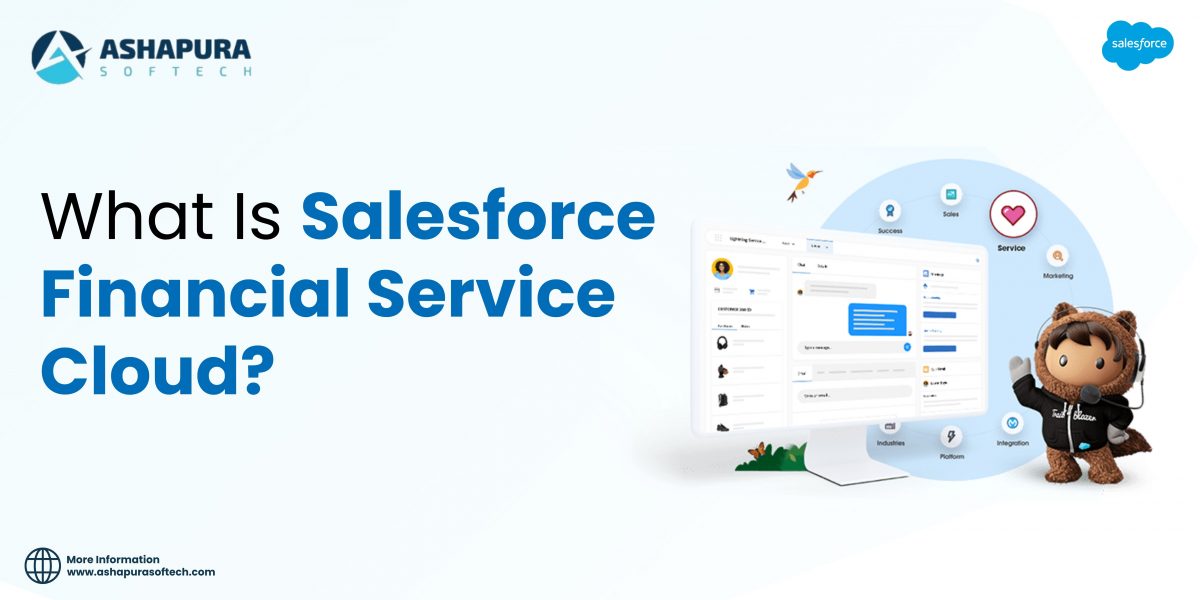
What is Salesforce Financial Service Cloud?

What is the Salesforce Financial Service Cloud?

Purpose-built for financial services companies, Salesforce Financial Services Cloud is a customer relationship management (CRM) system that helps companies manage customer relationships more dexterously, grow faster, and unlock deep insight. of their customers.

It is an industry-specific Salesforce product with pre-built workflows and data models tailored for the financial services industry. It provides relevant information at every stage of a customer’s lifecycle. Insurance, banking, mortgages, wealth management, and other sectors of the financial industry widely use this Salesforce product.

Salesforce Financial Services Cloud Features

Financial Services Cloud is built on the Salesforce Customer Success Platform, has features specifically designed for customer engagement, and was designed with the needs of advisors in mind. One of the key benefits of the Financial Services Cloud is its ability to transform the way wealth and wealth management, finance and insurance companies interact with and serve their customers. Some other features include:

Complete customer and household views

Customer loyalty and productivity

Customer data management

Advantages Of Using Salesforce Financial Services Cloud

Financial Services Cloud enables employees and individuals to have deep and efficient conversations and workflows, reducing friction and increasing efficiency.

Intuitive customer service and relationship: The Financial Services Cloud can help your business in many ways when customers expect more from businesses, including helpful advice, quick responses, and 24/7 communication.

By matching customers to households, trusts, and business organizations, you can find high-quality customers and relationships.

Visualize and capitalize on new opportunities arising from layers of critical relationships and information already in place.

With Salesforce Financial Services Cloud, you can provide your customers with a seamless and intuitive experience.

Improved visibility into financial accounts and total: Salesforce Financial Services Cloud offers several financial accounts, including insurance policies, bank accounts, and investment accounts. The Financial Account object has predefined record types for various financial accounts. Financial goals help advisors formulate investment plans that meet their clients’ financial goals. This helps you get a complete overview of your client’s accounts and assets to provide the best product and service recommendations.

Transparent case notifications, tracking, and approvals: The Financial Services Cloud eliminates communication gaps between team members. To achieve specific goals, it automates key tasks that can be automatically assigned to the right team members based on their profiles. With the help of Lead Tracking Financial Services Cloud, you can closely monitor leads and referrals. Track your clients’ approval status with a personalized approval process, easy document capture, and the ability to link financial accounts, clients, and families to records.

Improved customer retention: Salesforce Financial Services Cloud improves engagement, whether with stakeholders, teams, or end users. It opens up a wealth of new perspectives and its powerful features provide businesses with exceptional digital engagement. Capture and illustrate your customers’ important life and professional milestones, such as introducing a new product or moving to a new place. Additionally, this platform provides reliable and trustworthy insights by leveraging AI, ultimately enabling businesses to make better decisions.

Intelligent routing of referrals: including routing, insights, and scoring, Financial Service Cloud allows you to prioritize customer relationships and work across multiple enterprise silos. AI-powered referral scoring and routing help you manage and prioritize relationships more effectively. You can create a smooth communication flow to track and convert referrals after developing a referral pipeline. Now that you have successfully converted these referrals, the system will automatically create an opportunity and account.

Business Intelligence and Advisor Analytics: Financial advisors can provide their clients with more informed decisions using the Salesforce Financial Services Cloud analytics dashboard and data, helping their growth and revenue. Pre-built templates tailored exclusively for the financial services industry provide instant information at your fingertips. This platform is more reliable and accurate for making smarter financial decisions because its analytics are powered by innovative artificial intelligence technology. That’s why the Salesforce Financial Services Cloud is a powerful tool for wealth managers, banking professionals, insurance consultants, and business and IT managers. It allows them to make faster, smarter decisions, increasing productivity. Insurance agents can offer any customer a customized product on a variety of devices using the Salesforce cloud for financial services. Your agents can gain in-depth knowledge of the entire pipeline, from streamlined service flows to the ability to track new opportunities. Financial Services Cloud has all the capabilities needed to provide customers with a satisfying customer experience and a smooth onboarding process. That said, it’s important to recognize that a tool is only effective if the user uses it. So finding the best professional help from Salesforce is just as important.

Conclusion

Salesforce Financial Services Cloud is a specialized platform designed to meet the unique needs of financial institutions. It offers a 360-degree view of clients, enabling personalized and proactive service that fosters trust and loyalty. With features like wealth management, insurance, and banking solutions, it empowers financial advisors to deliver exceptional client experiences and streamline operations. At Ashapura Softech, we specialize in implementing Salesforce Financial Services Cloud to help you drive growth and efficiency in your financial business. Whether you’re looking to enhance client relationships or improve operational workflows, our team is here to support you. Contact us at [email protected] to discover how we can tailor Salesforce solutions to fit your financial services needs.

If you need Financial Services Cloud expertise without adding headcount, you can hire certified Salesforce developers who have configured FSC data models and compliance settings before.

Categories
Salesforce

Salesforce Sales Cloud V/S Salesforce Marketing Cloud

Salesforce Sales Cloud V/S Salesforce Marketing Cloud

Salesforce Sales Cloud and Salesforce Marketing Cloud are two different cloud computing platforms, both developed by Salesforce and each with its unique features. But what exactly does that mean? This article will help you better understand the differences between these two robust sales and marketing tools to choose the one that best fits your needs. Let’s start with the meaning of what is sales cloud and what is marketing cloud.

Sales Cloud vs Marketing Cloud: the short answer

Sales Cloud is where your sales team works. Marketing Cloud is where your marketing team works. They sit either side of the same customer, and the confusion usually starts because both of them touch leads and both of them send email.

 Salesforce Sales CloudSalesforce Marketing Cloud
Who lives in itSales reps, sales managers, sales opsMarketers, campaign and lifecycle teams
Core jobMove a known opportunity through a pipeline to a closeReach an audience at scale and bring qualified demand in
Main recordsLeads, Accounts, Contacts, Opportunities, Cases via Service CloudContacts and Subscribers held in Data Extensions
How it talks to peopleOne to one: a rep sends the email or makes the callOne to many: journeys, segments, scheduled and triggered sends
Email built forA handful of personal emails a day per repMillions of sends, deliverability tooling, preference management
Reporting answersWhat is in the pipeline and will we hit the numberWhich campaign and channel produced the demand
Bought whenYour sales process lives in spreadsheets and inboxesYour marketing has outgrown a basic email tool

If you only need one of them, the honest test is which side of the funnel is actually leaking. A sales team losing track of open deals needs Sales Cloud. A marketing team that cannot segment, schedule or measure needs Marketing Cloud. Most companies buy Sales Cloud first, because pipeline visibility is easier to justify.

What Is Salesforce Sales Cloud?

Salesforce Sales Cloud was designed to interact with prospective and potential customers via sales forecasting as well as contact and management of opportunities. It is a compelling instrument to track and create revenue throughout the sales cycle, allowing customers to manage their customer relationships efficiently. Sales Cloud primarily focuses on the sales aspects of customer relationship management (CRM) and how users manage Leads, Contacts, Accounts, and Opportunities instead of providing customer support. Sales Cloud cuts down on time spent on administrative tasks by offering automated features so that Sales teams can concentrate on closing Opportunities!

What Is Salesforce Marketing Cloud

It is a single marketing platform that can understand consumers, connect with them, and tailor their experience. Marketing automation via email connects customers across any device or channel and integrates customer information and their behavior to send timely, relevant messages.

Marketing Cloud offers exciting services suitable for customers who are B2B (when customers are a different business) and B2C companies (when your product/service is direct to the finalcustomer or consumer). The real benefits are the unification of data sources and the ability to customize every channel, as well as the capability to engage with customers at any point in the customer-to-customer relationship and the measurement of the campaign’s results.

Which Salesforce Cloud Product Is Best For My Business?

Salesforce Cloud CRM Solution for Your Company’s Needs

Salesforce Sales Cloud: The primary goal is to increase the speed and quality of the funnel sales to make more sales and earn more revenue.

Salesforce Marketing Cloud: The primary goal is to reach the correct audience by delivering the correct message to the appropriate channels to identify trustworthy leads.

Salesforce Sales Cloud + Salesforce Marketing Cloud: Most importantly, they seek integrated software that provides greater control over the process of generating leads and negotiating deals.

Difference Between Salesforce Sales Cloud V/S Salesforce Marketing Cloud

General Differences:

The cloud sales force is focused on sales reps, while Marketing Cloud is focused on marketers.

It is built to manage and execute deals, while Marketing Cloud is built to build and nurture leads.

The core of the Sales Cloud is about CRM (Customer Relationship Management), while that of the Marketing Cloud is about marketing automation and analytics.

The Sales Cloud is a software-as-service (SaaS) solution, while the Marketing Cloud is an on-premises solution.

It is used to sell any product or service, while the marketing cloud is only for marketing campaigns and lead nurturing.

Difference in Features:

Salesforce Sales Cloud –

Salesforce Marketing Cloud –

Campaign Management

Journey Builder

Leads Management

Email Studio

Accounts Management

Data Studio

Contacts Management

Social Studio

Opportunities Management

Advertising Studio

Cases Management

Mobile Studio

Reports and Dashboards

Interaction Studio

Difference In Benefits Offered By These Two Salesforce Cloud Services

Benefits of Salesforce Sales Cloud

Sales Forecasting: The sales team can now easily forecast and predict how many deals they will close over a given time, which helps them plan their activities accordingly.

Increase your leads: The sales team can now track their lead sources and quickly identify new opportunities to increase their pipeline of deals.

Boost your productivity with AI: Artificial Intelligence (AI) can now be used to help sales reps find new opportunities, save time, and close more deals faster than ever before.

Increase your revenue by connecting to other cloud apps: The sales team can now connect their CRM data to other cloud apps they use, like Marketo or ServiceMax, to better understand their customers and prospects and increase their revenues.

Benefits of Salesforce Marketing Cloud

Create a customized and targeted customer journey: The marketing team can now create and manage personalized campaigns for each prospect, which will help them convert more leads into customers.

Deliver cross-channel and cross-functional marketing campaigns: The marketing team can now create multi-channel, multi-touchpoint campaigns orchestrated across all of their marketing channels, from email to social media to direct mail.

Impact analysis: The marketing team can now measure and analyze how their campaigns are performing and make changes to improve them over time.

Gain real-time insights into your customers: The marketing team can now gain real-time insight into their prospects and customers, including who they are, what they are interested in, and how to best engage with them.

Conclusion

The key takeaway to notice here is that there’s no hard and fast rule on which cloud to use in every situation. But if you follow and consider these guidelines, you should be able to figure out which tool is best for each scenario. The Sales Cloud is most useful when talking with prospective clients and during pipeline-building activities (i.e., prospecting and lead generation). At the same time, Marketing Cloud products are great for building relationships and generating buzz about your product with existing customers.Contact us at [email protected] to discover how we can help you maximize the potential of Salesforce for your business success.

Data Cloud vs Marketing Cloud: a different question entirely

This one comes up constantly and the two are not alternatives. Salesforce Data Cloud, now branded Salesforce Data 360, is not a marketing tool. It is the layer underneath that unifies customer data from every system you run, resolves it into a single profile per person, and then makes those profiles available to the tools that act on them, Marketing Cloud included.

 Salesforce Data Cloud (Data 360)Salesforce Marketing Cloud
What it isA customer data platform that unifies and resolves recordsAn engagement platform that sends and orchestrates
What it holdsData from CRM, web, commerce, support, warehouses and filesSubscribers, content, journeys and send history
What it producesOne unified profile per person, plus calculated insights and segmentsEmails, SMS, push, ads and multi step journeys
Who uses itData and RevOps teams, plus anyone building segmentsMarketers running campaigns
Without the otherGreat profiles that nobody acts onCampaigns built on whatever data happens to be in the platform

So do you need Data Cloud as well?

Not always, and it is worth being blunt about that. Data Cloud earns its cost when customer data genuinely lives in several places at once, for example a CRM, an e-commerce platform, a support desk and a warehouse, and you cannot answer a simple question like how many distinct customers you have without exporting three files and matching them by hand. If everything already sits in one Salesforce org and the data is clean, Marketing Cloud alone will do the job.

How the three fit together

Data Cloud unifies the record. Marketing Cloud engages the person. Sales Cloud closes the deal and writes back what happened. Activity flows in both directions, so a purchase recorded in Sales Cloud can suppress someone from an acquisition journey in Marketing Cloud, and an engagement score built in Data Cloud can tell a rep which account to call first.

If unified profiles are the gap in your stack, our Salesforce Data Cloud consulting page covers how a Data 360 implementation is scoped, what drives consumption and how it feeds Salesforce Marketing Cloud segments.

Frequently asked questions

Can I use Marketing Cloud without Sales Cloud?

Yes. Marketing Cloud is a separate platform with its own data model and runs perfectly well on its own. What you lose is the closed loop, because without a CRM behind it you can see who engaged but not which of them turned into revenue.

Is Marketing Cloud Account Engagement the same as Marketing Cloud?

No, and this trips people up regularly. Marketing Cloud Account Engagement is the product formerly called Pardot, built for B2B lead nurture and tightly coupled to Sales Cloud. Marketing Cloud Engagement is the larger B2C platform for high volume multi channel journeys. B2B companies are usually pointed at Account Engagement.

Does Sales Cloud send marketing emails?

It can send email, but it is not a marketing email platform. There is no journey builder, no serious deliverability tooling and no subscription management. Using it for campaigns is how sending domains get reputations they cannot recover from.

Which costs more, Sales Cloud or Marketing Cloud?

Sales Cloud is priced per user per month, so its cost tracks headcount. Marketing Cloud is priced on contacts, sends and the components you switch on, so its cost tracks audience size. A twenty person sales team with a two million contact database will find Marketing Cloud the larger line item, and a hundred person sales team with a small list will find the opposite.

What is Salesforce Data 360?

It is the current name for Salesforce Data Cloud. The product is the same customer data platform, and older documentation and job posts still use the Data Cloud name, so you will see both in circulation.

Conclusion

Sales Cloud and Marketing Cloud are not competitors, they are two halves of the same customer relationship, and the real decision is which half is costing you more right now. Data Cloud is a third question that only becomes urgent once your customer data is spread across systems that disagree with each other.

Ashapura Softech Inc. is a certified Salesforce implementation partner based in Irving, Texas. If you are weighing these platforms against each other, a scoping conversation before the licences are bought is worth more than any comparison table, this one included.

Categories
Salesforce

Salesforce’s Illuminate Approach: Digital Strategy & CRM Success

Did your heartbeat rise a bit when you heard the peer businesses going digital due to the unstable pandemic situation around you? The arrow coming out of the blue from nowhere known, it isn’t easy to stand up and start going digital with a successfully running company or organization in place. However, the fact is, if you don’t get on your toes for the present moment and start planning for a digital transformation, your business may come to a standstill soon without you realizing it. It is the need of an hour, and not acting quickly at the right time may lead to losses and closure, as per the available data of the shut businesses due to not taking a plunge into the digital world.

Accept The Fact,

Take A Deep Breath,

And Start Making A Digital Transformation Plan Right Away.

(Disclaimer: Don’t use a pen and paper to jot down the strategies- Strictly use digital tools! Remember, you just planned to go digital in all places, and this is the place to initiate with) And before you start, trust us, it’s easy once done! It isn’t the first time businesses are going through a transformation. It did when the Industrial Revolution took place and again when the print was replaced by the web, subsequently introducing the internet.

It all settles over time!

PATHWAY TO FOLLOW FOR BUILDING A STRONG DIGITAL STRATEGY

If you are about to start your digital strategy building, make sure you adopt a circular and holistic approach, as once built and approved, it can go through minor tweaks but no significant changes. Keep the following points sorted:

Revise your mission and vision statement, keeping the digital growth prediction in mind

Define your goals clearly and concisely while planning the strategy

What does it take to reach the ultimate goal? define both big and small steps. (Tip: Plan it weekly, monthly, and year-wise.)

Frameworks to adopt and align with to stay engrossed and parallel with the decided plan.

Decide the structure of the monthly reports with the involved stakeholders in advance.

Jot down the digital software needed for strategy execution.

Write down the roles and expertise necessary for the implementation and prepare a defined plan for the hiring process. Also, list down the mentors and advisors needed to head the transformation plan.

Define the communication channel wisely and clearly.

Setting up an e-commerce store or website to list the products and services online.

Plan an order-tracking system

Define the steps of after-sales service

Prepare a team to handle customer grievances and feedback.

Where Java Is Used?

Android apps:  Java is used for making Android apps, which automatically turns a large pool of Java developers into Android programmers. While Android uses Android SDK instead of JDK, the code is still written in Java.

Software products: It is used to create OpenOffice, Gmail, and many more.

Finance programs: It is used both on the server- and client side to build reliable, fast, and simple websites. It’s also used for data simulations and modeling.

Big data programs: Java is used to make the most popular tools, like Hadoop. Scala, Kafka, and Spark use JVM

The points mentioned earlier are just the beginning ones, and as the plan starts to execute, there will be further segregation of services and departments.

Reading this, are you thinking about how the entire work will be done and how the systems will be handled? Well, most companies are taking the more accessible ways for planning, tracking, and reporting by adopting good Customer Relationship Management (CRM) software that helps them understand the customer needs and keep them happy with the services in return at all times.

Here, we recommend the top software adopted during digital transformation by most companies: SALESFORCE CRM.

HOW IS SALESFORCE CRM HELPFUL?

In simple and understandable words, the customer is king, and Salesforce CRM helps you maintain the tantrums of the king.

Salesforce CRM has a designed and designated cloud for maintaining each activity with ease, and as and when needed, it is just a few clicks away for ready access. It helps you manage the everyday working of the company with all its internal and external stakeholders, including the support system.

It best caters to startups, mid-level companies, and large organizations. The software comes with handy customization features, and it can be designed as per the firm’s convenience and needs.

Salesforce Professional Services are divided into eight broad categories, and each one can be added and used when needed.

1. Salesforce Sales Cloud

Sales Cloud helps you maintain the records of potential leads, convert them into regular customers, and nurture them to get recurring revenue.

2. Salesforce Marketing Cloud

Salesforce Marketing cloud focuses on taking your product to the right customers in the right way with the help of digital assets in hand. Activities including reaching the customers through email, mobile, pitching, presentations, online and offline meetups, content and copy creation, content management, and complete reporting and analytics are done in one go at one place.

3. Salesforce Service Cloud

Service Cloud is mainly designed to provide 360-degree customer support. It helps initiate customer conversations through various social media channels with wide-scale case tracking.

4. Salesforce Community Cloud

Community cloud is designed to interact with customers and third-party partners within the organization. As a result, the members can transfer data, images, videos and important notices safely within the community and maintain privacy from the external parties.

5. Salesforce Commerce Cloud

Commerce Cloud is your own e-commerce platform to track the customer’s lifetime value from buying to the end sales stage and post-sales services. It eliminates location barriers and helps you reach masses with hassle-free tracking and shipping.

6. Salesforce Analytics Cloud

Analytics Cloud helps you convert large data files into pictorial and graphical formats for easy analysis and understanding.

7. Salesforce IOT Cloud

IoT cloud lets you store extensive data grabbed from multiple points like sensors, websites, customers, apps, etc.

8. Salesforce App Cloud

Within App Cloud, you can seamlessly make customized applications within Salesforce CRM and use them to offer your products to your target audience.

To help your business grow digitally, Salesforce has launched its illuminate approach, which allows the company to reach its success points by following it religiously.

Conclusion

Successfully executing your digital strategy requires more than just the right tools; it requires a comprehensive approach that aligns with your business goals. Salesforce’s Illuminate approach is designed to guide organizations through digital transformation with clarity and precision. By focusing on key areas such as customer engagement, operational efficiency, and innovation, Illuminate helps businesses navigate the complexities of the digital landscape. With its data-driven insights and strategic frameworks, Salesforce ensures that your digital initiatives are not only implemented effectively but also deliver measurable results. At Ashapura Softech, we leverage Salesforce’s Illuminate approach to help businesses like yours achieve digital success. Our team of experts will work closely with you to tailor a strategy that drives growth and maximizes ROI. Ready to illuminate your path to digital success? Contact us at [email protected] to learn how we can help you execute your digital strategy with Salesforce’s Illuminate approach.

Categories
Salesforce

Master Salesforce Marketing Cloud: Expert Consulting Services

The Salesforce Marketing Cloud is the leading CRM platform for digital marketing automation and data analysis. Use the various possibilities to interact with your customers across channels and devices and reach your target group with automated advertising campaigns. With the Salesforce Marketing Cloud consultation, you can create individual customer journeys across all digital channels. In this way, you can easily develop new ways of communicating with your customers and win new customer segments for your company. Accompany your customers along the entire customer journey and always deliver the right offer at the right time via the preferred channel, regardless of whether B2C or B2B. Analyze your campaigns that have led to successful deals to see what works and what doesn’t optimize your campaigns and increase your marketing success.

Accompany Your Customers Along Their Customer Journey:

In today’s connected world, every single customer interaction counts. Individual customer journeys create the basis for permanent, personal customer relationships and optimized sales marketing. The Salesforce Marketing Cloud combines customer data from sales, marketing, and service, which is constantly enriched with further information. This makes it possible to analyze real customer behavior along the entire customer journey and to react appropriately. All available data sources are linked to individual contact data records. This means that all the information is available that is required for highly personalized and relevant cross-channel and cross-device communication. By personalizing your customer approach, you create positive, unforgettable shopping experiences with the help of the Salesforce Marketing Cloud.

What Can Salesforce Marketing Cloud Do?

Salesforce Marketing Cloud consultation offers extensive opportunities for increasing personalization and effectiveness. Carried out marketing campaigns across all digital channels. This enables you to accompany leads through the customer life cycle from the first contact to the purchase and to provide helpful information for decision-making at the right time on the way from potential to real customers. Thanks to the integration with the Salesforce Marketing Cloud, sales representatives can now email addresses directly from the Salesforce Sales Cloud shipout or customers through social media. With the help of sophisticated algorithms and the artificial intelligence based on them,

Features Of The Salesforce Marketing Cloud:

The Marketing Cloud is the world’s leading CRM platform for email marketing, mobile marketing, social media marketing, online advertising, and marketing automation. The Salesforce Marketing Cloud is made up of different components that help you create specific target groups and combine data from any source in order to deliver marketing messages in a more targeted manner. Learn how Salesforce Combines marketing via email, social networks, and mobile devices in a central digital marketing platform. Create excellent e-mail campaigns and increase customer interactions with personalized landing pages and forms. Calculate the marketing ROI and gain valuable insight, into what your customers do on the way from first click to completion. The Salesforce Marketing Cloud is made up of different components and consists of the following modules.

Customer Journey Builder

Accompany your customers across all devices and channels on a personalized customer journey, Pick up each customer according to their needs in the right marketing channel. With the customer journey Builder of the Salesforce Marketing Cloud, They network your marketing and sales team with every touch point and get to the customers your business contacts. To support you in setting up a journey, you can choose from many predefined, partially configured journey templates based on common use cases and known marketing best practices.

Audience Builder

Seamlessly integrate any data into the Marketing Cloud and use it effectively. The Audience Builder of the Salesforce Marketing Cloud enables target groups to be segmented quickly and easily using drag-and-drop from various data sources and to address them individually. In this way, meaningful information can be obtained from complex data, such as from the Salesforce Sales Cloud, the Service Cloud, social networks, or website analysis, and segmented in a data-based manner. With the Audience Builder, you address certain segments individually and guide customers through a personalized customer journey.

Email Studio

Create convincing and effective email campaigns and newsletters. The Email Studio is one of the central features of the Salesforce Marketing Cloud. Send your customers dynamic messages and tailored content that inspires them to engage with your company. Thanks to responsive design, you can reach your customers on any device and communicate with each customer in real time throughout the entire customer journey. Email Studio offers the right functions for numerous use cases, from simple newsletters to complex, multi-level e-mail campaigns and dynamic landing pages. This is how you create close, long-term customer relationships and inspire your customers with a unique customer experience.

Personalization Builder

The Personalization Builder helps collect data on behavior in order to adapt content based on the derived interests and preferences and to design personalized offers. Regardless of whether you want to collect data on behavior, design your next content dynamically, or send personalized messages across channels and devices, with the Personalization Builder, you can achieve your marketing goals faster and increase your ROI.

Content Builder

The Content Builder is a cross-channel content management tool that enables you to manage images, documents, and other content in the Marketing Cloud. During the increasing importance of marketing automation, the content builder can be used to summarize all content from different channels in one central location. This enables a uniform and convincing appearance of your brand in all digital channels and simplifies the implementation of an individual 1: 1 customer journey.

Social Studio

Observe and interact with your customers on social networks and publish your own contributions using powerful social media marketing tools. Salesforce CRM allows you to align your social media marketing activities with all of your other marketing, customer service, and sales activities. Use your data in the Salesforce Marketing Cloud Consultation to listen to your fans and followers, target new content efficiently and ads to the right target group and analyze the reactions. In this way, you can make social media marketing even more efficient and make social networks an important touch-point within your customers’ customer journey.

Conclusion

Salesforce Marketing Cloud is a powerful platform that can transform your marketing efforts by enabling personalized customer engagement across multiple channels. However, to fully leverage its capabilities, expert guidance and a tailored strategy are essential. A Salesforce Marketing Cloud consultation provides you with the insights and direction needed to optimize your marketing campaigns, improve ROI, and achieve your business goals. From setting up the platform to designing automated workflows and analyzing campaign performance, a consultation ensures that your business maximizes the potential of this robust marketing tool. At Ashapura Softech, we offer specialized Salesforce Marketing Cloud consultation services to help you navigate the complexities of this platform. Our experts will work closely with you to create a strategy that aligns with your objectives and drives measurable results. Ready to elevate your marketing strategy? Contact us at [email protected] to schedule a Salesforce Marketing Cloud consultation and take the first step toward transforming your marketing efforts.