


Introduction
In the age of digital transformation, sales teams are under more pressure than ever to deliver faster, more accurate, and highly personalized buying experiences. Customers expect tailored quotes instantly, pricing that reflects their unique needs, and a seamless journey from the first interaction to contract signing. For many organizations, achieving this level of efficiency and precision requires going beyond spreadsheets, manual approvals, and disconnected systems. This is where Configure, Price, Quote (CPQ) software comes in.
CPQ software is designed to automate and simplify the quoting process. It helps businesses configure complex product offerings, apply accurate pricing logic, and generate professional proposals within minutes. Among the many CPQ solutions available today, Salesforce CPQ has emerged as the industry leader. Unlike standalone systems, Salesforce CPQ is built directly on the Salesforce platform, which means it works hand-in-hand with customer relationship management (CRM software) to provide a seamless sales experience.
The benefits of adopting Salesforce CPQ go far beyond efficiency. It reduces quoting errors, ensures compliance with pricing rules, and frees up sales reps to focus on closing deals instead of fixing spreadsheets. According to Salesforce, organizations using CPQ have reported shortening their sales cycle by up to one-third, improving quote accuracy by more than 95%, and increasing deal size by leveraging guided selling and intelligent upselling features.
In this article, we will explore the essential features of Salesforce CPQ that drive revenue growth and measurable ROI. We’ll look at its seamless integration with CRM software, its advanced pricing rules, implementation best practices, and why it’s especially powerful for enterprises managing complex sales cycles. By the end, you’ll understand how Salesforce CPQ enables businesses not only to sell smarter but also to achieve higher profitability in competitive markets.
What is Salesforce CPQ and How It Fits Into CRM Software
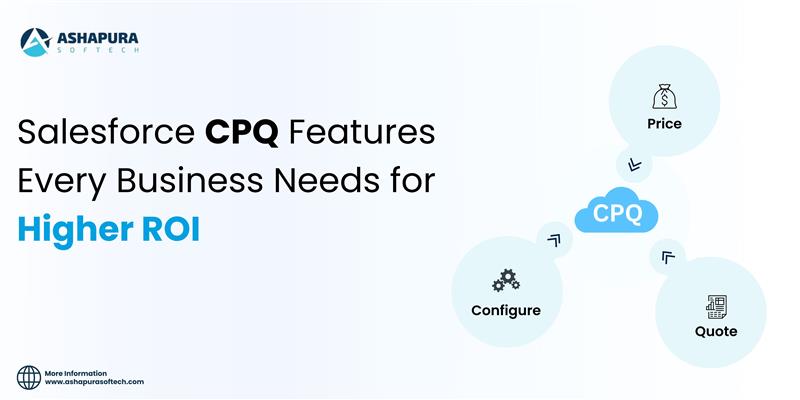
Salesforce CPQ, short for Configure, Price, Quote, is a sales tool that enables companies to generate highly accurate quotes quickly. Unlike manual methods that often involve spreadsheets, email chains, or disjointed systems, Salesforce CPQ automates the entire process of selecting products, applying pricing rules, discounting, and generating proposals. This ensures every quote sent to a customer is both error-free and aligned with company policies.
At its foundation, Salesforce CPQ addresses three core challenges that sales teams face:
- Configuration: Selecting the right mix of products or services, especially when bundles or add-ons are involved.
- Pricing: Applying discounts, promotions, and margin rules without manual guesswork.
- Quoting: Generating a polished, branded quote document quickly for customers.
Because it is built natively on the Salesforce platform, Salesforce CPQ integrates seamlessly with other CRM software, giving organizations a unified sales ecosystem. This alignment provides several key advantages:
- Single source of customer truth: Customer data stored in Salesforce CRM is instantly accessible in CPQ. This ensures reps quote based on the most accurate, up-to-date account and opportunity details.
- End-to-end visibility: From the moment a lead enters the system to the final contract, every step is tracked within one platform. No more juggling between disconnected tools.
- Improved collaboration: Finance, sales, and operations teams can all access the same data, streamlining approvals and reducing bottlenecks.
- Predictive insights: CRM data combined with CPQ automation enables accurate forecasting of revenue, margin, and pipeline health.
According to SalesforceBen, the combination of CRM and CPQ transforms sales teams from order-takers into trusted advisors. Instead of wasting time on administrative work, sales reps can focus on understanding customer needs and offering the best solutions, guided by intelligent product recommendations. major benefit of this CRM-CPQ synergy is scalability. Whether a small business is managing a handful of deals or an enterprise is handling thousands of quotes across multiple regions, Salesforce CPQ can scale effortlessly. Features like multi-currency support, contract renewals, and advanced approval workflows make it equally valuable for startups and global corporations.
Ultimately, Salesforce CPQ is not just a quoting tool—it’s a strategic extension of CRM that empowers companies to deliver better customer experiences, shorten sales cycles, and maximize ROI. By bridging the gap between customer data and sales execution, it ensures every quote is not only accurate but also optimized for profitability.
Best CPQ Features for ROI
One of the biggest reasons companies invest in Salesforce CPQ is its ability to directly improve return on investment (ROI). By automating manual tasks, reducing errors, and providing intelligent selling tools, Salesforce CPQ helps businesses accelerate sales cycles while increasing deal sizes. Let’s explore the key CPQ features that deliver the highest ROI.
1. Guided Selling
Guided selling is a standout feature of Salesforce CPQ that ensures sales reps recommend the right products and services to customers. Instead of relying on memory or flipping through product catalogs, reps are guided through a step-by-step process that suggests options based on customer needs.
This not only reduces mistakes but also encourages upselling and cross-selling opportunities, leading to larger deal values. For example, a rep selling a SaaS subscription may be prompted to include premium support or additional storage options—enhancing customer satisfaction and increasing revenue.
2. Automation of Quotes and Approvals
Manual approval processes can delay deals, especially in enterprises with strict compliance rules. Salesforce CPQ automates approval workflows, ensuring quotes meet business policies while minimizing bottlenecks. Discounts, for instance, can trigger auto-approvals if they fall within pre-set limits, while larger exceptions automatically route to managers.
The impact on ROI is clear: fewer delays, reduced admin overhead, and faster quote-to-cash cycles. Companies adopting automated approval workflows often report significant improvements in deal closure rates.
3. Contract Renewals & Subscription Management
For subscription-based businesses, renewals are a critical driver of long-term ROI. Salesforce CPQ simplifies contract renewals by automatically generating renewal opportunities, pricing them correctly, and flagging upcoming expirations.
This ensures reps never miss a renewal deadline and can proactively engage customers with upsell or cross-sell options. The result? Stronger customer retention and increased lifetime value.
4. Bundling and Advanced Pricing Rules
One of Salesforce CPQ’s most ROI-driven features is its ability to handle complex pricing scenarios. Businesses can create product bundles, apply discounts, or set tier-based pricing automatically. This eliminates human error while building trust with customers who receive consistent and transparent pricing.
Advanced pricing rules also allow companies to experiment with value-based pricing strategies. For instance, a manufacturing company can set bundle discounts for volume purchases, encouraging customers to buy more while still protecting margins.
5. Mobile and Global Scalability
Modern sales don’t happen only at desks—reps are often on the go, negotiating deals in real-time. Salesforce CPQ offers mobile access and supports multi-currency and multilingual quoting. For enterprises operating globally, this ensures consistency across regions while maintaining flexibility in local pricing strategies.
By enabling reps to generate quotes anytime, anywhere, companies reduce delays and keep deals moving forward, which directly impacts revenue growth.
Why These Features Matter for ROI
Each of these Salesforce CPQ features contributes to higher ROI in unique ways:
- Guided selling → larger deal sizes through upselling/cross-selling.
- Automation → faster deal cycles and reduced administrative costs.
- Renewals → improved retention and lifetime value.
- Advanced pricing → accuracy, transparency, and margin protection.
- Scalability → efficiency across mobile, regional, and enterprise-level sales.
According to DealHub, organizations that leverage these features effectively see measurable improvements in sales productivity, quote accuracy, and revenue growth. For businesses seeking the highest ROI, prioritizing these features during CPQ implementation is critical.
Salesforce CPQ Implementation Guide
Implementing Salesforce CPQ is not just a technical project—it’s a strategic initiative that can reshape the way your sales organization operates. A successful implementation requires careful planning, alignment between business and IT teams, and a focus on adoption. Here’s a practical guide to help businesses ensure a smooth CPQ rollout.
1. Define Goals and Requirements
Before starting implementation, companies must clearly outline their objectives. Do you want to shorten sales cycles, increase deal size, or improve pricing accuracy? Documenting requirements such as discount rules, approval workflows, and contract processes helps tailor CPQ to your business model.
2. Prepare Clean Data
Since Salesforce CPQ relies heavily on product catalogs, pricing data, and customer records, poor data quality can derail the project. Ensure product SKUs, pricing tiers, and customer account details are standardized before migrating into CPQ. This prevents errors and improves system reliability from day one.
3. Configure Workflows and Automations
One of the biggest ROI drivers of Salesforce CPQ is its automation capability. During implementation, set up workflows for approvals, discount thresholds, and contract renewals. This reduces manual effort and speeds up deal cycles. It’s also wise to design guided selling flows early so reps can start leveraging intelligent product recommendations.
4. Focus on Training and Adoption
Even the most advanced CPQ system will fail if sales teams don’t use it effectively. Invest in hands-on training, role-based user guides, and ongoing support. Encourage early adoption by showing how CPQ reduces admin work and helps reps close more deals.
5. Measure and Optimize
After go-live, track KPIs such as quote turnaround time, discount compliance, and win rates. Use these insights to fine-tune workflows, pricing rules, and approval paths. Continuous optimization ensures Salesforce CPQ keeps delivering ROI long after implementation.
Enterprise Salesforce CPQ for Large Organizations
Large enterprises face unique challenges in managing complex sales processes, global pricing structures, and multi-layer approval workflows. For these organizations, Salesforce CPQ (Configure, Price, Quote) becomes more than just a sales tool—it’s a critical enabler of scalability and revenue growth.
Why Enterprises Need Salesforce CPQ
In enterprise sales, deals often involve thousands of SKUs, intricate contract terms, and multiple decision-makers. Without automation, sales teams risk delays, pricing errors, and revenue leakage. Salesforce CPQ addresses these challenges by standardizing quoting processes, automating approvals, and ensuring compliance across global teams.
Enterprises can also benefit from consistency at scale. Whether a sales rep is in New York, London, or Singapore, CPQ ensures they follow the same pricing logic and approval paths, creating seamless customer experiences worldwide.
Integration with ERP and CRM Systems
A major advantage of Salesforce CPQ in large organizations is its ability to integrate with ERP (Enterprise Resource Planning) and CRM systems. Enterprises often use ERP for inventory, billing, and supply chain management. By connecting CPQ with ERP, businesses achieve real-time synchronization of product availability, pricing, and financial data.
This integration ensures that quotes generated in Salesforce CPQ reflect accurate stock levels, contract terms, and billing rules, reducing costly discrepancies between sales promises and operational realities.
Scaling Benefits for Global Teams
Enterprises operating across multiple regions must adapt to different currencies, languages, and compliance regulations. Salesforce CPQ supports multi-currency, multilingual quoting, and tax automation, ensuring that local markets are supported without sacrificing global consistency.
For sales leaders, this provides greater visibility into pipeline health and revenue forecasts across regions, enabling smarter strategic decisions.
Case Study Example
Consider a global manufacturing company selling industrial equipment across 30 countries. Before CPQ, their quoting process relied on spreadsheets, leading to long delays and frequent errors. After implementing Salesforce CPQ with ERP integration, they reduced quote turnaround time by 40%, improved pricing accuracy, and increased upsell opportunities.
Such results are not isolated. According to Gartner, enterprises adopting CPQ report faster sales cycles, improved compliance, and measurable ROI within the first 18 months of implementation.
The Enterprise ROI Impact
For large organizations, Salesforce CPQ is not just a convenience—it’s a growth accelerator. By unifying pricing strategies, streamlining approvals, and integrating with ERP and CRM systems, enterprises gain efficiency, accuracy, and scalability. This combination leads to higher revenue, stronger customer trust, and a competitive edge in global markets.
Salesforce CPQ Integration for Seamless Workflows
One of the greatest strengths of Salesforce CPQ lies in its ability to integrate seamlessly with other business systems. For enterprises, quoting does not exist in isolation—it connects with CRM, ERP, billing, e-signature tools, and customer service platforms. When Salesforce CPQ is integrated into this broader ecosystem, businesses achieve faster deal cycles, higher accuracy, and streamlined operations from lead to cash.
Integration with CRM Software
Because Salesforce CPQ is native to the Salesforce platform, it works hand-in-hand with Sales Cloud and Service Cloud. This integration ensures that all customer data—from lead generation to contract renewal—flows into one unified system. Sales reps can pull customer history, pricing agreements, and contract details directly into CPQ without toggling between tools.
This eliminates silos and enables a 360-degree view of the customer, strengthening both sales performance and customer experience.
Integration with ERP and Billing Systems
For enterprises, ERP systems handle critical functions like inventory, order management, and financial reporting. By connecting Salesforce CPQ with ERP platforms (such as SAP or Oracle), quotes automatically reflect real-time product availability, accurate costs, and tax compliance.
Similarly, integration with Salesforce Billing ensures that once a quote is approved, invoicing, payments, and revenue recognition are automated. This reduces manual errors and accelerates the entire order-to-cash process.
E-Signature and Contract Management Tools
Quoting is just the beginning—closing a deal often requires contract approvals and signatures. Salesforce CPQ integrates with DocuSign, Adobe Sign, and Salesforce CLM (Contract Lifecycle Management) to enable faster contract generation and approval workflows. This reduces bottlenecks and ensures deals close faster while maintaining compliance.
Boosting ROI Through Seamless Workflows
Integration is not just about convenience—it’s about measurable ROI. Businesses that connect Salesforce CPQ with CRM, ERP, and billing systems report:
- Shorter sales cycles due to reduced manual processes.
- Improved accuracy in pricing, billing, and inventory.
- Higher customer satisfaction through error-free, consistent experiences.
- Increased sales productivity as reps spend more time selling instead of managing admin tasks.
According to Forrester, organizations that integrate CPQ into their digital sales ecosystem see 20–30% improvements in sales efficiency and reduced revenue leakage.
Measuring Salesforce CPQ ROI
Every business considering Salesforce CPQ wants to know the same thing: what’s the return on investment (ROI)? While CPQ clearly simplifies quoting and pricing, its real value lies in how much it accelerates revenue growth, improves efficiency, and reduces costs. Measuring ROI requires identifying the right KPIs and tracking results over time.
Key KPIs to Track Salesforce CPQ ROI
1. Quote-to-Cash Cycle Time
One of the clearest indicators of CPQ impact is how fast deals move from initial quote to closed revenue. Businesses that automate quoting and approvals with Salesforce CPQ typically reduce cycle times by 20–40%, leading to faster cash flow.
2. Quote Accuracy
Pricing errors, missed discounts, and misconfigured products often erode margins. With CPQ, companies can achieve 95%+ accuracy rates in quotes, reducing revenue leakage and customer dissatisfaction.
3. Sales Productivity
Salesforce CPQ enables reps to spend less time on manual quoting and more time engaging customers. Studies from Forrester show sales teams using CPQ tools experience a 10–20% boost in productivity.
4. Win Rate & Deal Size
By guiding reps with upsell and cross-sell recommendations, CPQ increases both win rates and average deal value. For example, companies often see a 5–10% increase in deal size after implementation.
Post-Implementation Benchmarks
Measuring ROI doesn’t stop after go-live. Enterprises should establish before-and-after benchmarks:
- Average time to generate quotes (pre- vs. post-CPQ).
- Frequency of pricing errors.
- Approval turnaround time.
- Customer satisfaction scores.
- Margin improvements per deal.
Financial ROI Considerations
Beyond productivity, CPQ delivers direct financial ROI by:
- Reducing revenue leakage (preventing unapproved discounts).
- Enabling faster billing and revenue recognition through integration with Salesforce Billing.
- Lowering operational costs by reducing reliance on spreadsheets and manual processes.
How to Measure ROI From Salesforce CPQ Optimization
ROI from CPQ optimization is a different question from ROI on CPQ itself. Optimization ROI shows up after the system is already live, when you go back and tighten pricing rules, discount guardrails, and quote templates that have drifted since the original rollout.
Track it in a few specific places rather than a single “quotes are faster” anecdote: reduced quote-to-close time, meaning the time from an opportunity being ready to quote to a signed order; fewer pricing errors that trigger re-quotes or credit memos; a higher win rate on quotes that go out within your target SLA; and rep time reclaimed from manual pricing lookups and approval chasing.
The practical move is to baseline these four numbers before an optimization project starts, then re-measure the same four 60 to 90 days after. That before-and-after comparison, not a vendor’s general benchmark, is what turns a CPQ optimization spend into a number leadership can actually defend. For the AI-specific side of this, see our guide to AI-driven quote-to-cash with Salesforce CPQ.
Conclusion
Salesforce CPQ is more than a quoting tool—it’s a growth engine that streamlines sales, improves accuracy, and delivers measurable ROI across organizations of every size. From guided selling to ERP integration, the right CPQ features empower businesses to close deals faster, reduce revenue leakage, and scale with confidence. If your goal is higher efficiency and profitability, now is the time to explore Salesforce CPQ. Connect with our experts at Ashapura Softech to start your CPQ journey today. Contact us at [email protected] and unlock your path to scalable ROI.
For scoping and delivery of the features described here, see our Salesforce CPQ implementation services.