Categories
Salesforce

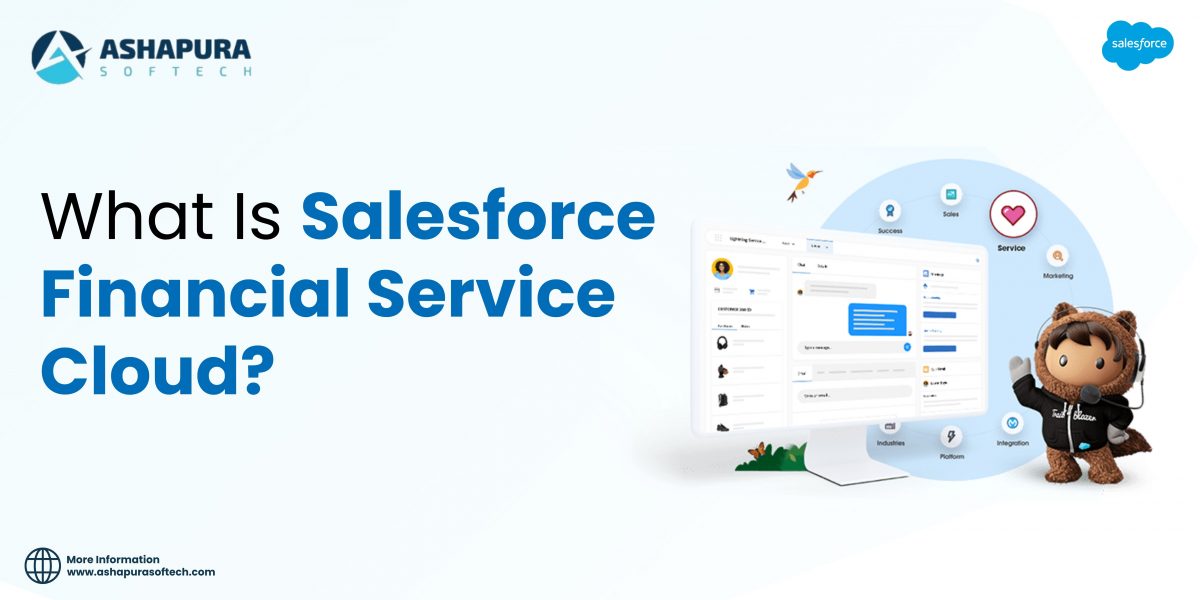
What is Salesforce Financial Service Cloud?

What is the Salesforce Financial Service Cloud?

Purpose-built for financial services companies, Salesforce Financial Services Cloud is a customer relationship management (CRM) system that helps companies manage customer relationships more dexterously, grow faster, and unlock deep insight. of their customers.

It is an industry-specific Salesforce product with pre-built workflows and data models tailored for the financial services industry. It provides relevant information at every stage of a customer’s lifecycle. Insurance, banking, mortgages, wealth management, and other sectors of the financial industry widely use this Salesforce product.

Salesforce Financial Services Cloud Features

Financial Services Cloud is built on the Salesforce Customer Success Platform, has features specifically designed for customer engagement, and was designed with the needs of advisors in mind. One of the key benefits of the Financial Services Cloud is its ability to transform the way wealth and wealth management, finance and insurance companies interact with and serve their customers. Some other features include:

Complete customer and household views

Customer loyalty and productivity

Customer data management

Advantages Of Using Salesforce Financial Services Cloud

Financial Services Cloud enables employees and individuals to have deep and efficient conversations and workflows, reducing friction and increasing efficiency.

Intuitive customer service and relationship: The Financial Services Cloud can help your business in many ways when customers expect more from businesses, including helpful advice, quick responses, and 24/7 communication.

By matching customers to households, trusts, and business organizations, you can find high-quality customers and relationships.

Visualize and capitalize on new opportunities arising from layers of critical relationships and information already in place.

With Salesforce Financial Services Cloud, you can provide your customers with a seamless and intuitive experience.

Improved visibility into financial accounts and total: Salesforce Financial Services Cloud offers several financial accounts, including insurance policies, bank accounts, and investment accounts. The Financial Account object has predefined record types for various financial accounts. Financial goals help advisors formulate investment plans that meet their clients’ financial goals. This helps you get a complete overview of your client’s accounts and assets to provide the best product and service recommendations.

Transparent case notifications, tracking, and approvals: The Financial Services Cloud eliminates communication gaps between team members. To achieve specific goals, it automates key tasks that can be automatically assigned to the right team members based on their profiles. With the help of Lead Tracking Financial Services Cloud, you can closely monitor leads and referrals. Track your clients’ approval status with a personalized approval process, easy document capture, and the ability to link financial accounts, clients, and families to records.

Improved customer retention: Salesforce Financial Services Cloud improves engagement, whether with stakeholders, teams, or end users. It opens up a wealth of new perspectives and its powerful features provide businesses with exceptional digital engagement. Capture and illustrate your customers’ important life and professional milestones, such as introducing a new product or moving to a new place. Additionally, this platform provides reliable and trustworthy insights by leveraging AI, ultimately enabling businesses to make better decisions.

Intelligent routing of referrals: including routing, insights, and scoring, Financial Service Cloud allows you to prioritize customer relationships and work across multiple enterprise silos. AI-powered referral scoring and routing help you manage and prioritize relationships more effectively. You can create a smooth communication flow to track and convert referrals after developing a referral pipeline. Now that you have successfully converted these referrals, the system will automatically create an opportunity and account.

Business Intelligence and Advisor Analytics: Financial advisors can provide their clients with more informed decisions using the Salesforce Financial Services Cloud analytics dashboard and data, helping their growth and revenue. Pre-built templates tailored exclusively for the financial services industry provide instant information at your fingertips. This platform is more reliable and accurate for making smarter financial decisions because its analytics are powered by innovative artificial intelligence technology. That’s why the Salesforce Financial Services Cloud is a powerful tool for wealth managers, banking professionals, insurance consultants, and business and IT managers. It allows them to make faster, smarter decisions, increasing productivity. Insurance agents can offer any customer a customized product on a variety of devices using the Salesforce cloud for financial services. Your agents can gain in-depth knowledge of the entire pipeline, from streamlined service flows to the ability to track new opportunities. Financial Services Cloud has all the capabilities needed to provide customers with a satisfying customer experience and a smooth onboarding process. That said, it’s important to recognize that a tool is only effective if the user uses it. So finding the best professional help from Salesforce is just as important.

Conclusion

Salesforce Financial Services Cloud is a specialized platform designed to meet the unique needs of financial institutions. It offers a 360-degree view of clients, enabling personalized and proactive service that fosters trust and loyalty. With features like wealth management, insurance, and banking solutions, it empowers financial advisors to deliver exceptional client experiences and streamline operations. At Ashapura Softech, we specialize in implementing Salesforce Financial Services Cloud to help you drive growth and efficiency in your financial business. Whether you’re looking to enhance client relationships or improve operational workflows, our team is here to support you. Contact us at [email protected] to discover how we can tailor Salesforce solutions to fit your financial services needs.

If you need Financial Services Cloud expertise without adding headcount, you can hire certified Salesforce developers who have configured FSC data models and compliance settings before.
Categories
Salesforce

Salesforce Sales Cloud V/S Salesforce Marketing Cloud

Salesforce Sales Cloud V/S Salesforce Marketing Cloud

Salesforce Sales Cloud and Salesforce Marketing Cloud are two different cloud computing platforms, both developed by Salesforce and each with its unique features. But what exactly does that mean? This article will help you better understand the differences between these two robust sales and marketing tools to choose the one that best fits your needs. Let’s start with the meaning of what is sales cloud and what is marketing cloud.

Sales Cloud vs Marketing Cloud: the short answer

Sales Cloud is where your sales team works. Marketing Cloud is where your marketing team works. They sit either side of the same customer, and the confusion usually starts because both of them touch leads and both of them send email.

 Salesforce Sales CloudSalesforce Marketing Cloud
Who lives in itSales reps, sales managers, sales opsMarketers, campaign and lifecycle teams
Core jobMove a known opportunity through a pipeline to a closeReach an audience at scale and bring qualified demand in
Main recordsLeads, Accounts, Contacts, Opportunities, Cases via Service CloudContacts and Subscribers held in Data Extensions
How it talks to peopleOne to one: a rep sends the email or makes the callOne to many: journeys, segments, scheduled and triggered sends
Email built forA handful of personal emails a day per repMillions of sends, deliverability tooling, preference management
Reporting answersWhat is in the pipeline and will we hit the numberWhich campaign and channel produced the demand
Bought whenYour sales process lives in spreadsheets and inboxesYour marketing has outgrown a basic email tool

If you only need one of them, the honest test is which side of the funnel is actually leaking. A sales team losing track of open deals needs Sales Cloud. A marketing team that cannot segment, schedule or measure needs Marketing Cloud. Most companies buy Sales Cloud first, because pipeline visibility is easier to justify.

What Is Salesforce Sales Cloud?

Salesforce Sales Cloud was designed to interact with prospective and potential customers via sales forecasting as well as contact and management of opportunities. It is a compelling instrument to track and create revenue throughout the sales cycle, allowing customers to manage their customer relationships efficiently. Sales Cloud primarily focuses on the sales aspects of customer relationship management (CRM) and how users manage Leads, Contacts, Accounts, and Opportunities instead of providing customer support. Sales Cloud cuts down on time spent on administrative tasks by offering automated features so that Sales teams can concentrate on closing Opportunities!

What Is Salesforce Marketing Cloud

It is a single marketing platform that can understand consumers, connect with them, and tailor their experience. Marketing automation via email connects customers across any device or channel and integrates customer information and their behavior to send timely, relevant messages.

Marketing Cloud offers exciting services suitable for customers who are B2B (when customers are a different business) and B2C companies (when your product/service is direct to the finalcustomer or consumer). The real benefits are the unification of data sources and the ability to customize every channel, as well as the capability to engage with customers at any point in the customer-to-customer relationship and the measurement of the campaign’s results.

Which Salesforce Cloud Product Is Best For My Business?

Salesforce Cloud CRM Solution for Your Company’s Needs

Salesforce Sales Cloud: The primary goal is to increase the speed and quality of the funnel sales to make more sales and earn more revenue.

Salesforce Marketing Cloud: The primary goal is to reach the correct audience by delivering the correct message to the appropriate channels to identify trustworthy leads.

Salesforce Sales Cloud + Salesforce Marketing Cloud: Most importantly, they seek integrated software that provides greater control over the process of generating leads and negotiating deals.

Difference Between Salesforce Sales Cloud V/S Salesforce Marketing Cloud

General Differences:

The cloud sales force is focused on sales reps, while Marketing Cloud is focused on marketers.

It is built to manage and execute deals, while Marketing Cloud is built to build and nurture leads.

The core of the Sales Cloud is about CRM (Customer Relationship Management), while that of the Marketing Cloud is about marketing automation and analytics.

The Sales Cloud is a software-as-service (SaaS) solution, while the Marketing Cloud is an on-premises solution.

It is used to sell any product or service, while the marketing cloud is only for marketing campaigns and lead nurturing.

Difference in Features:

Salesforce Sales Cloud –

Salesforce Marketing Cloud –

Campaign Management

Journey Builder

Leads Management

Email Studio

Accounts Management

Data Studio

Contacts Management

Social Studio

Opportunities Management

Advertising Studio

Cases Management

Mobile Studio

Reports and Dashboards

Interaction Studio

Difference In Benefits Offered By These Two Salesforce Cloud Services

Benefits of Salesforce Sales Cloud

Sales Forecasting: The sales team can now easily forecast and predict how many deals they will close over a given time, which helps them plan their activities accordingly.

Increase your leads: The sales team can now track their lead sources and quickly identify new opportunities to increase their pipeline of deals.

Boost your productivity with AI: Artificial Intelligence (AI) can now be used to help sales reps find new opportunities, save time, and close more deals faster than ever before.

Increase your revenue by connecting to other cloud apps: The sales team can now connect their CRM data to other cloud apps they use, like Marketo or ServiceMax, to better understand their customers and prospects and increase their revenues.

Benefits of Salesforce Marketing Cloud

Create a customized and targeted customer journey: The marketing team can now create and manage personalized campaigns for each prospect, which will help them convert more leads into customers.

Deliver cross-channel and cross-functional marketing campaigns: The marketing team can now create multi-channel, multi-touchpoint campaigns orchestrated across all of their marketing channels, from email to social media to direct mail.

Impact analysis: The marketing team can now measure and analyze how their campaigns are performing and make changes to improve them over time.

Gain real-time insights into your customers: The marketing team can now gain real-time insight into their prospects and customers, including who they are, what they are interested in, and how to best engage with them.

Conclusion

The key takeaway to notice here is that there’s no hard and fast rule on which cloud to use in every situation. But if you follow and consider these guidelines, you should be able to figure out which tool is best for each scenario. The Sales Cloud is most useful when talking with prospective clients and during pipeline-building activities (i.e., prospecting and lead generation). At the same time, Marketing Cloud products are great for building relationships and generating buzz about your product with existing customers.Contact us at [email protected] to discover how we can help you maximize the potential of Salesforce for your business success.

Data Cloud vs Marketing Cloud: a different question entirely

This one comes up constantly and the two are not alternatives. Salesforce Data Cloud, now branded Salesforce Data 360, is not a marketing tool. It is the layer underneath that unifies customer data from every system you run, resolves it into a single profile per person, and then makes those profiles available to the tools that act on them, Marketing Cloud included.

 Salesforce Data Cloud (Data 360)Salesforce Marketing Cloud
What it isA customer data platform that unifies and resolves recordsAn engagement platform that sends and orchestrates
What it holdsData from CRM, web, commerce, support, warehouses and filesSubscribers, content, journeys and send history
What it producesOne unified profile per person, plus calculated insights and segmentsEmails, SMS, push, ads and multi step journeys
Who uses itData and RevOps teams, plus anyone building segmentsMarketers running campaigns
Without the otherGreat profiles that nobody acts onCampaigns built on whatever data happens to be in the platform

So do you need Data Cloud as well?

Not always, and it is worth being blunt about that. Data Cloud earns its cost when customer data genuinely lives in several places at once, for example a CRM, an e-commerce platform, a support desk and a warehouse, and you cannot answer a simple question like how many distinct customers you have without exporting three files and matching them by hand. If everything already sits in one Salesforce org and the data is clean, Marketing Cloud alone will do the job.

How the three fit together

Data Cloud unifies the record. Marketing Cloud engages the person. Sales Cloud closes the deal and writes back what happened. Activity flows in both directions, so a purchase recorded in Sales Cloud can suppress someone from an acquisition journey in Marketing Cloud, and an engagement score built in Data Cloud can tell a rep which account to call first.

If unified profiles are the gap in your stack, our Salesforce Data Cloud consulting page covers how a Data 360 implementation is scoped, what drives consumption and how it feeds Salesforce Marketing Cloud segments.

Frequently asked questions

Can I use Marketing Cloud without Sales Cloud?

Yes. Marketing Cloud is a separate platform with its own data model and runs perfectly well on its own. What you lose is the closed loop, because without a CRM behind it you can see who engaged but not which of them turned into revenue.

Is Marketing Cloud Account Engagement the same as Marketing Cloud?

No, and this trips people up regularly. Marketing Cloud Account Engagement is the product formerly called Pardot, built for B2B lead nurture and tightly coupled to Sales Cloud. Marketing Cloud Engagement is the larger B2C platform for high volume multi channel journeys. B2B companies are usually pointed at Account Engagement.

Does Sales Cloud send marketing emails?

It can send email, but it is not a marketing email platform. There is no journey builder, no serious deliverability tooling and no subscription management. Using it for campaigns is how sending domains get reputations they cannot recover from.

Which costs more, Sales Cloud or Marketing Cloud?

Sales Cloud is priced per user per month, so its cost tracks headcount. Marketing Cloud is priced on contacts, sends and the components you switch on, so its cost tracks audience size. A twenty person sales team with a two million contact database will find Marketing Cloud the larger line item, and a hundred person sales team with a small list will find the opposite.

What is Salesforce Data 360?

It is the current name for Salesforce Data Cloud. The product is the same customer data platform, and older documentation and job posts still use the Data Cloud name, so you will see both in circulation.

Conclusion

Sales Cloud and Marketing Cloud are not competitors, they are two halves of the same customer relationship, and the real decision is which half is costing you more right now. Data Cloud is a third question that only becomes urgent once your customer data is spread across systems that disagree with each other.

Ashapura Softech Inc. is a certified Salesforce implementation partner based in Irving, Texas. If you are weighing these platforms against each other, a scoping conversation before the licences are bought is worth more than any comparison table, this one included.

Categories
Salesforce

Salesforce’s Illuminate Approach: Digital Strategy & CRM Success

Did your heartbeat rise a bit when you heard the peer businesses going digital due to the unstable pandemic situation around you? The arrow coming out of the blue from nowhere known, it isn’t easy to stand up and start going digital with a successfully running company or organization in place. However, the fact is, if you don’t get on your toes for the present moment and start planning for a digital transformation, your business may come to a standstill soon without you realizing it. It is the need of an hour, and not acting quickly at the right time may lead to losses and closure, as per the available data of the shut businesses due to not taking a plunge into the digital world.

Accept The Fact,

Take A Deep Breath,

And Start Making A Digital Transformation Plan Right Away.

(Disclaimer: Don’t use a pen and paper to jot down the strategies- Strictly use digital tools! Remember, you just planned to go digital in all places, and this is the place to initiate with) And before you start, trust us, it’s easy once done! It isn’t the first time businesses are going through a transformation. It did when the Industrial Revolution took place and again when the print was replaced by the web, subsequently introducing the internet.

It all settles over time!

PATHWAY TO FOLLOW FOR BUILDING A STRONG DIGITAL STRATEGY

If you are about to start your digital strategy building, make sure you adopt a circular and holistic approach, as once built and approved, it can go through minor tweaks but no significant changes. Keep the following points sorted:

Revise your mission and vision statement, keeping the digital growth prediction in mind

Define your goals clearly and concisely while planning the strategy

What does it take to reach the ultimate goal? define both big and small steps. (Tip: Plan it weekly, monthly, and year-wise.)

Frameworks to adopt and align with to stay engrossed and parallel with the decided plan.

Decide the structure of the monthly reports with the involved stakeholders in advance.

Jot down the digital software needed for strategy execution.

Write down the roles and expertise necessary for the implementation and prepare a defined plan for the hiring process. Also, list down the mentors and advisors needed to head the transformation plan.

Define the communication channel wisely and clearly.

Setting up an e-commerce store or website to list the products and services online.

Plan an order-tracking system

Define the steps of after-sales service

Prepare a team to handle customer grievances and feedback.

Where Java Is Used?

Android apps:  Java is used for making Android apps, which automatically turns a large pool of Java developers into Android programmers. While Android uses Android SDK instead of JDK, the code is still written in Java.

Software products: It is used to create OpenOffice, Gmail, and many more.

Finance programs: It is used both on the server- and client side to build reliable, fast, and simple websites. It’s also used for data simulations and modeling.

Big data programs: Java is used to make the most popular tools, like Hadoop. Scala, Kafka, and Spark use JVM

The points mentioned earlier are just the beginning ones, and as the plan starts to execute, there will be further segregation of services and departments.

Reading this, are you thinking about how the entire work will be done and how the systems will be handled? Well, most companies are taking the more accessible ways for planning, tracking, and reporting by adopting good Customer Relationship Management (CRM) software that helps them understand the customer needs and keep them happy with the services in return at all times.

Here, we recommend the top software adopted during digital transformation by most companies: SALESFORCE CRM.

HOW IS SALESFORCE CRM HELPFUL?

In simple and understandable words, the customer is king, and Salesforce CRM helps you maintain the tantrums of the king.

Salesforce CRM has a designed and designated cloud for maintaining each activity with ease, and as and when needed, it is just a few clicks away for ready access. It helps you manage the everyday working of the company with all its internal and external stakeholders, including the support system.

It best caters to startups, mid-level companies, and large organizations. The software comes with handy customization features, and it can be designed as per the firm’s convenience and needs.

Salesforce Professional Services are divided into eight broad categories, and each one can be added and used when needed.

1. Salesforce Sales Cloud

Sales Cloud helps you maintain the records of potential leads, convert them into regular customers, and nurture them to get recurring revenue.

2. Salesforce Marketing Cloud

Salesforce Marketing cloud focuses on taking your product to the right customers in the right way with the help of digital assets in hand. Activities including reaching the customers through email, mobile, pitching, presentations, online and offline meetups, content and copy creation, content management, and complete reporting and analytics are done in one go at one place.

3. Salesforce Service Cloud

Service Cloud is mainly designed to provide 360-degree customer support. It helps initiate customer conversations through various social media channels with wide-scale case tracking.

4. Salesforce Community Cloud

Community cloud is designed to interact with customers and third-party partners within the organization. As a result, the members can transfer data, images, videos and important notices safely within the community and maintain privacy from the external parties.

5. Salesforce Commerce Cloud

Commerce Cloud is your own e-commerce platform to track the customer’s lifetime value from buying to the end sales stage and post-sales services. It eliminates location barriers and helps you reach masses with hassle-free tracking and shipping.

6. Salesforce Analytics Cloud

Analytics Cloud helps you convert large data files into pictorial and graphical formats for easy analysis and understanding.

7. Salesforce IOT Cloud

IoT cloud lets you store extensive data grabbed from multiple points like sensors, websites, customers, apps, etc.

8. Salesforce App Cloud

Within App Cloud, you can seamlessly make customized applications within Salesforce CRM and use them to offer your products to your target audience.

To help your business grow digitally, Salesforce has launched its illuminate approach, which allows the company to reach its success points by following it religiously.

Conclusion

Successfully executing your digital strategy requires more than just the right tools; it requires a comprehensive approach that aligns with your business goals. Salesforce’s Illuminate approach is designed to guide organizations through digital transformation with clarity and precision. By focusing on key areas such as customer engagement, operational efficiency, and innovation, Illuminate helps businesses navigate the complexities of the digital landscape. With its data-driven insights and strategic frameworks, Salesforce ensures that your digital initiatives are not only implemented effectively but also deliver measurable results. At Ashapura Softech, we leverage Salesforce’s Illuminate approach to help businesses like yours achieve digital success. Our team of experts will work closely with you to tailor a strategy that drives growth and maximizes ROI. Ready to illuminate your path to digital success? Contact us at [email protected] to learn how we can help you execute your digital strategy with Salesforce’s Illuminate approach.

Categories
Salesforce

Master Salesforce Marketing Cloud: Expert Consulting Services

The Salesforce Marketing Cloud is the leading CRM platform for digital marketing automation and data analysis. Use the various possibilities to interact with your customers across channels and devices and reach your target group with automated advertising campaigns. With the Salesforce Marketing Cloud consultation, you can create individual customer journeys across all digital channels. In this way, you can easily develop new ways of communicating with your customers and win new customer segments for your company. Accompany your customers along the entire customer journey and always deliver the right offer at the right time via the preferred channel, regardless of whether B2C or B2B. Analyze your campaigns that have led to successful deals to see what works and what doesn’t optimize your campaigns and increase your marketing success.

Accompany Your Customers Along Their Customer Journey:

In today’s connected world, every single customer interaction counts. Individual customer journeys create the basis for permanent, personal customer relationships and optimized sales marketing. The Salesforce Marketing Cloud combines customer data from sales, marketing, and service, which is constantly enriched with further information. This makes it possible to analyze real customer behavior along the entire customer journey and to react appropriately. All available data sources are linked to individual contact data records. This means that all the information is available that is required for highly personalized and relevant cross-channel and cross-device communication. By personalizing your customer approach, you create positive, unforgettable shopping experiences with the help of the Salesforce Marketing Cloud.

What Can Salesforce Marketing Cloud Do?

Salesforce Marketing Cloud consultation offers extensive opportunities for increasing personalization and effectiveness. Carried out marketing campaigns across all digital channels. This enables you to accompany leads through the customer life cycle from the first contact to the purchase and to provide helpful information for decision-making at the right time on the way from potential to real customers. Thanks to the integration with the Salesforce Marketing Cloud, sales representatives can now email addresses directly from the Salesforce Sales Cloud shipout or customers through social media. With the help of sophisticated algorithms and the artificial intelligence based on them,

Features Of The Salesforce Marketing Cloud:

The Marketing Cloud is the world’s leading CRM platform for email marketing, mobile marketing, social media marketing, online advertising, and marketing automation. The Salesforce Marketing Cloud is made up of different components that help you create specific target groups and combine data from any source in order to deliver marketing messages in a more targeted manner. Learn how Salesforce Combines marketing via email, social networks, and mobile devices in a central digital marketing platform. Create excellent e-mail campaigns and increase customer interactions with personalized landing pages and forms. Calculate the marketing ROI and gain valuable insight, into what your customers do on the way from first click to completion. The Salesforce Marketing Cloud is made up of different components and consists of the following modules.

Customer Journey Builder

Accompany your customers across all devices and channels on a personalized customer journey, Pick up each customer according to their needs in the right marketing channel. With the customer journey Builder of the Salesforce Marketing Cloud, They network your marketing and sales team with every touch point and get to the customers your business contacts. To support you in setting up a journey, you can choose from many predefined, partially configured journey templates based on common use cases and known marketing best practices.

Audience Builder

Seamlessly integrate any data into the Marketing Cloud and use it effectively. The Audience Builder of the Salesforce Marketing Cloud enables target groups to be segmented quickly and easily using drag-and-drop from various data sources and to address them individually. In this way, meaningful information can be obtained from complex data, such as from the Salesforce Sales Cloud, the Service Cloud, social networks, or website analysis, and segmented in a data-based manner. With the Audience Builder, you address certain segments individually and guide customers through a personalized customer journey.

Email Studio

Create convincing and effective email campaigns and newsletters. The Email Studio is one of the central features of the Salesforce Marketing Cloud. Send your customers dynamic messages and tailored content that inspires them to engage with your company. Thanks to responsive design, you can reach your customers on any device and communicate with each customer in real time throughout the entire customer journey. Email Studio offers the right functions for numerous use cases, from simple newsletters to complex, multi-level e-mail campaigns and dynamic landing pages. This is how you create close, long-term customer relationships and inspire your customers with a unique customer experience.

Personalization Builder

The Personalization Builder helps collect data on behavior in order to adapt content based on the derived interests and preferences and to design personalized offers. Regardless of whether you want to collect data on behavior, design your next content dynamically, or send personalized messages across channels and devices, with the Personalization Builder, you can achieve your marketing goals faster and increase your ROI.

Content Builder

The Content Builder is a cross-channel content management tool that enables you to manage images, documents, and other content in the Marketing Cloud. During the increasing importance of marketing automation, the content builder can be used to summarize all content from different channels in one central location. This enables a uniform and convincing appearance of your brand in all digital channels and simplifies the implementation of an individual 1: 1 customer journey.

Social Studio

Observe and interact with your customers on social networks and publish your own contributions using powerful social media marketing tools. Salesforce CRM allows you to align your social media marketing activities with all of your other marketing, customer service, and sales activities. Use your data in the Salesforce Marketing Cloud Consultation to listen to your fans and followers, target new content efficiently and ads to the right target group and analyze the reactions. In this way, you can make social media marketing even more efficient and make social networks an important touch-point within your customers’ customer journey.

Conclusion

Salesforce Marketing Cloud is a powerful platform that can transform your marketing efforts by enabling personalized customer engagement across multiple channels. However, to fully leverage its capabilities, expert guidance and a tailored strategy are essential. A Salesforce Marketing Cloud consultation provides you with the insights and direction needed to optimize your marketing campaigns, improve ROI, and achieve your business goals. From setting up the platform to designing automated workflows and analyzing campaign performance, a consultation ensures that your business maximizes the potential of this robust marketing tool. At Ashapura Softech, we offer specialized Salesforce Marketing Cloud consultation services to help you navigate the complexities of this platform. Our experts will work closely with you to create a strategy that aligns with your objectives and drives measurable results. Ready to elevate your marketing strategy? Contact us at [email protected] to schedule a Salesforce Marketing Cloud consultation and take the first step toward transforming your marketing efforts.

Categories
Salesforce

Find Leading Salesforce Developers for Your Projects

What Does A Salesforce Certified Platform Developer Do?

The Salesforce Certified Developers-I (SFCD-I) has the necessary knowledge, skills, and experience to create custom declarative and programmatic applications on the Force.com developer platform and on the Lightning platform to develop customer-specific interfaces and to expand Salesforce with Apex and Visualforce. The developer must be familiar with the development lifecycle from development to testing and know the available development environments.

What Are Salesforce Certificates?

Salesforce certifications are a measurable indication of the level of skills, experience, and “know-how” of the certified person. In addition, if they are completed in the correct order, they are a perfect guide in the professional development of a developer, administrator, consultant, or architect of this technology. They are a confirmation that a certain specialist can design and implement an optimal solution for a certain scenario.

Salesforce Certified Developers-1 Cloud Marketing Solution

Marketing Cloud Certified Developers have hands-on development experience across the Salesforce platform. Applicants must have experience as a full-time developer for Marketing Cloud and create:

Personalized, dynamic marketing and sales messages;

Home pages;

Fluent in Marketing Cloud Scripting languages;

Have experience in customizing data manipulation:

Experience in expanding segmentation, reporting, and analysis.

The Salesforce Marketing Cloud Developer understands how to manage subscribers across all channels and can handle many programming languages that are utilized to create tactical and strategic email campaigns.

We Offer Competent Salesforce Developers On Request

Experience Levels: Regular (min. 2 years), Senior (min. 5 years) and Lead Developer (min. 7 years),

SFDC Development: Apex, Lightning, Visualforce,

Products / Applications: AppExchange, Sales Cloud, Service Cloud,

Databases: Database.com, Oracle, Microsoft and IBM,

Testing: Selenium, Assure Click, QTP,

Cloud providers: Force.com, Heroku, Amazon AWS, MS Azure, Google,

Remote developer as a scalable solution to the IT skills shortage

Compensate For Missing Resources With Remote Developers At Short Notice

Long-term expansion of IT clout and lower personnel costs,

25 years of experience in setting up, managing, and scaling offshore and nearshore teams,

On request, with German-speaking project management and advice from a certified SAP service partner.

Looking For Certified Salesforce Developers?

Are you looking for Salesforce Certified Developers-I for your company or do you need support in the implementation of individual development work for your Salesforce CRM system? At Ashapura Softech, you get professional help with process modeling, the development of individual applications, and the integration of Salesforce with web services or other applications. Our Salesforce consultants provide you with tailor-made support for your IT challenges or, as proven CRM experts, take on the implementation of complete projects. Just contact us. We will gladly support you! Ashapura Softech is a consulting company for sales cloud, community cloud, professional services, and support based on the Salesforce platform. We implement cloud-based business software, develop individual software solutions, and ensure integration with ERP backend systems. A special focus is the integration of marketing and sales with marketing automation and campaign management software and the Salesforce CRM platform as well as the cooperation between service and sales.

Categories
CRM

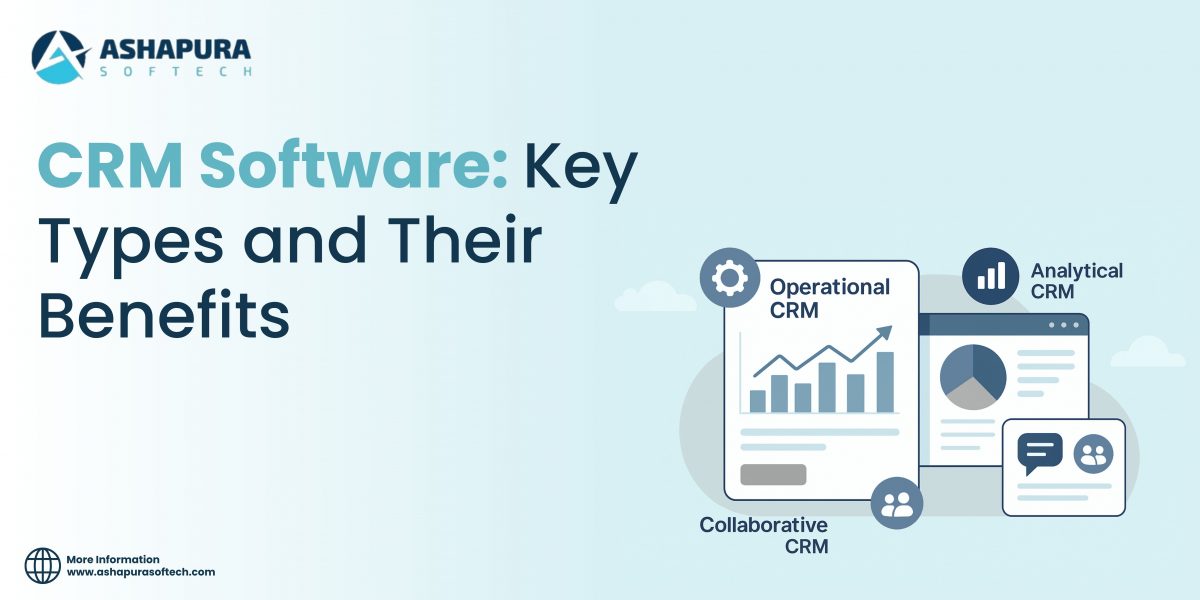
Types of CRM Software: How to Choose the Right One

Customer Relationship Management, or CRM, is a system that may help you grow your business by generating leads and converting them into sales. As a result, there are many types of CRM software for various functions.

1. Customer Relationship Management Software

Customer relationship management software is software that helps customer service teams manage their customer interactions. Not only is this software limited to helping companies with customer service, but it can also provide other features such as marketing automation, sales forecasting, and e-commerce solutions. The main purpose of this type of CRM is to help companies prioritize their customers or sales channels based on certain metrics.

There are different types of CRMs. They range from the simplest one-off contact management solutions to more complex customer experience platforms for e-commerce websites. These platforms are intended to provide an integrated overview of all information about a company’s customers or customers in order to improve the efficiency and effectiveness of the organization.

2. Contact Tracking Software

This software is used to keep track of the contacts you make with potential leads. They can be used to plan, manage, and record information about these people. Contact tracking software is more than just a tool for tracking the people you contact. It can be used to organize your public relations and record data on how effective those efforts have been.

The goal of contact tracking software is usually to make it easier to keep track of all of your contacts and their interactions with you. Different types of contracts require different features such as CRMs or sales automation tools that are tailored to their needs. Before making a purchase decision for a product, you should find out whether certain functions you want are supported by the available contact management software.

3. Marketing Automation Software

Marketers can use marketing automation software to automate and streamline their workflow. Marketing automation software is a set of tools that help run marketing campaigns for small and large businesses. It helps companies save time and money by automating the repetitive tasks involved in running a campaign.

The advantages of marketing automation software are:

  • Time-saving in manual work
  • Generate content automatically
  • Building new customer relationships
  • Tracking campaigns

4. Customer Feedback Systems CRM

A customer feedback system is a software program that tracks customer reactions to products, services, or marketing campaigns. Information about the customer can be gathered from surveys and telephone interviews, as well as from online sources such as reviews. The feedback data is then used by the company to improve its service quality. There are many different types of feedback systems that have been developed over the years. Some are geared towards collecting qualitative data, while others provide quantitative data to analyze trends in customer satisfaction.

One of the most popular ways to collect data about customers is through surveys on social media platforms like Facebook, Google+, LinkedIn, Twitter, and Reddit. There are also other ways to collect feedback, such as closed online surveys or personal speaker groups, where consumers come together and discuss their experiences with a product with an interviewer.

Conclusion:

Which CRM Should I Choose For My Company?

Choosing a CRM is difficult. It depends on your business needs and preferences. However, each CRM must have its advantages and disadvantages. Therefore, consider all the factors that are important for your company before making your final decision. So to check which CRM software is best for your company, you can contact any CRM consulting company, They will research your business, leads, and everything else and then suggest the best-performing software. Choosing the right type of CRM software is crucial for optimizing your business operations and enhancing customer relationships. Need expert guidance on CRM software? Contact us at [email protected] to find the perfect CRM solution for your business.

Why Cloud-Based CRMs Are the Future

One also needs to consider that when it comes to CRM-based solutions, managing customer relationships may be too expensive if one implements products that do not scale easily to higher volumes. Cloud-based CRM services hosted on remote servers via the internet provide unmatched scalability and flexibility. They allow scaling your business with the actual solution rather than having solutions that outgrow your needs.

For instance, there is Salesforce. It’s the gold standard in cloud-based CRMs, allowing businesses to integrate sales, marketing, and customer service into one seamless platform. And here’s the kicker: all you need is a browser and an internet connection.

Key Benefits of Cloud-Based CRMs

Scalability to Match Your Growth

Scaling a business is no small feat, and legacy software can prove to be a roadblock. Cloud-based CRMs allow upgrading the subscription to add new users, functionalities, or data storage. Whether you are a startup or an enterprise, cloud CRMs scale with your needs.

Accessibility and Remote Work Readiness

All cloud-based CRMs can grant every client 24/7 critical customer data accessibility from virtually anywhere. Your support team and all your sales can be somewhere while attending a conference, still on the same page at all times.

Seamless Integration and Customization

Modern businesses function on integration. Cloud-based CRMs integrate perfectly with marketing automation tools, e-commerce platforms, and analytics software. In addition, they provide easy customization to suit your unique workflows and objectives.

Cost Efficiency Without Compromise

Heavy investment in infrastructure is so yesterday. With cloud-based CRMs, you pay for the subscription that carries all the maintenance, upgradation, and security in itself. Also, with minimal IT burden, your team will have adequate time to focus on strategic moves rather than debugging a problem on the server.

Common Cloud-Based CRM Misconceptions

“They’re only for big companies.”

Not necessarily. Cloud-based CRMs have options for businesses of all sizes, including tiered plans for small startups and huge enterprises.

“They’re too difficult to implement.”

Not really. Most vendors provide guided setup and ongoing support to get the transition as smooth as possible.

“Data in the cloud isn’t secure.”

Actually, this is just the opposite of what really is: cloud providers throw lots of money at security measures that oftentimes are superior to in-house systems.

How to Choose the Right Cloud CRM for Your Business

Define Your Needs

Determine which core functions your business needs, which may include lead management or customer support and more.

Scalability Evaluation

Ensure that CRM can scale with your business in terms of features and user capacity.

Integration Capability

Verify if the CRM can be integrated with your existing tools, like ERP systems or email marketing platforms.

Evaluate Vendor Credibility

Evaluate some reviews, case studies, and testimonials to determine their credibility and customer satisfaction.

Categories
CRM

Top CRM Consulting Services for Optimal Results

WHO ARE WE

Ashapura Softech is a CRM software development company specializing in the implementation of Salesforce, the smartest client engagement platform in the world. A platoon of Ashapura Softech professionals that helps you make or integrate a successful CRM software for you to maintain your company relations with guests, using the stylish and most innovative technology but always putting people first. We know how to get you the most out of the stylish technology on request, but we prefer our guests to tell it. Ashapura Softech is one of the TOP CRM Consulting Agencies in the, you might have known about CRM (Client Relationship Operation), a bit important it is all up to your working experience with CRM software. But at the moment we’re going to learn about tools offered during CRM software implementation. These tools help you to get good leads or again help to convert leads to your client.

Enforcing a CRM platform is a process that deserves special attention. This system used by the most stylish and most competitive companies in the world is designed to optimize business conditioning and ensure that associations achieve the loftiest position of marketing and deals strategies. Still, enforcing this type of system is a point that requires further than will on the part of those involved. It’s important that during this process certain former ways are fulfilled that help guarantee the success of the software and for that, you can calculate on a CRM consulting company. Thus, in this composition, we will explain what the value of a CRM consultancy is.

A CRM consulting service is made up of a group of experts in the area who are in charge of helping you plan and carry out the perpetration and deployment of this system, examining the different aspects of the association, and detecting openings and pitfalls to guarantee the success of the design. Unfortunately, some business leaders or directors still misdoing the value of a CRM consultancy and decide to skip this service during perpetration with the false idea that it saves coffers when the reality is the opposite. However, we will explain the value of this service and everything it can help you achieve If your company is about to apply this tool.

Training

One of the main problems faced by companies that avoid the support of expert advisers during the perpetration of a CRM is that their leaders don’t have the tools to educate and train each druggies who are in contact with the tool. When you have a quality consulting service, you have experts devoted to transmitting knowledge to each member of the company or at least to those who use the software. A CRM consulting company handles furnishing all the educational material that’s necessary to ensure that all workers master the system and make the utmost of each of its functionalities.

Take into account that having the support of an acceptable CRM consulting company can help you optimize time and coffers in a perpetration design thanks to its expansive knowledge of the tools, processes, and methodologies to carry it out. Let yourself be guided by a good and devoted company to give you the support you bear ahead, during, and after the perpetration.

Remember that the success of your design depends largely on a good perpetration process and the correct training of your staff in the use of CRM, an educated adviser can help you achieve it. At Ashapura Softech we offer you our consulting service to support you and guarantee the success of your investment. We’re a consulting and perpetration company of Salesforce results for medium and large companies, so we can support you so that you can get the most out of CRM through:

Knowledge About Result

Process Optimization

Quality In Perpetration

Technical Support – CRM Software

Support During and After Preparation

Conclusion

CRM consulting is essential for businesses looking to optimize their customer relationship management processes. Whether you’re implementing a new CRM system or improving an existing one, expert CRM consulting can provide the insights and strategies needed to maximize efficiency, enhance customer interactions, and drive growth. A CRM consultant helps you choose the right platform, customize it to your unique needs, and ensure that your team is fully trained and equipped to use it effectively. With the right guidance, your business can harness the full power of CRM to improve sales, marketing, and customer service. At Ashapura Softech, we specialize in providing comprehensive CRM consulting Services. Our team of experts will work closely with you to understand your business objectives and tailor a CRM strategy that meets your specific needs. Ready to transform your customer relationships? Contact us at [email protected] to learn how our CRM consulting services can help your business thrive.

Categories
ERP System

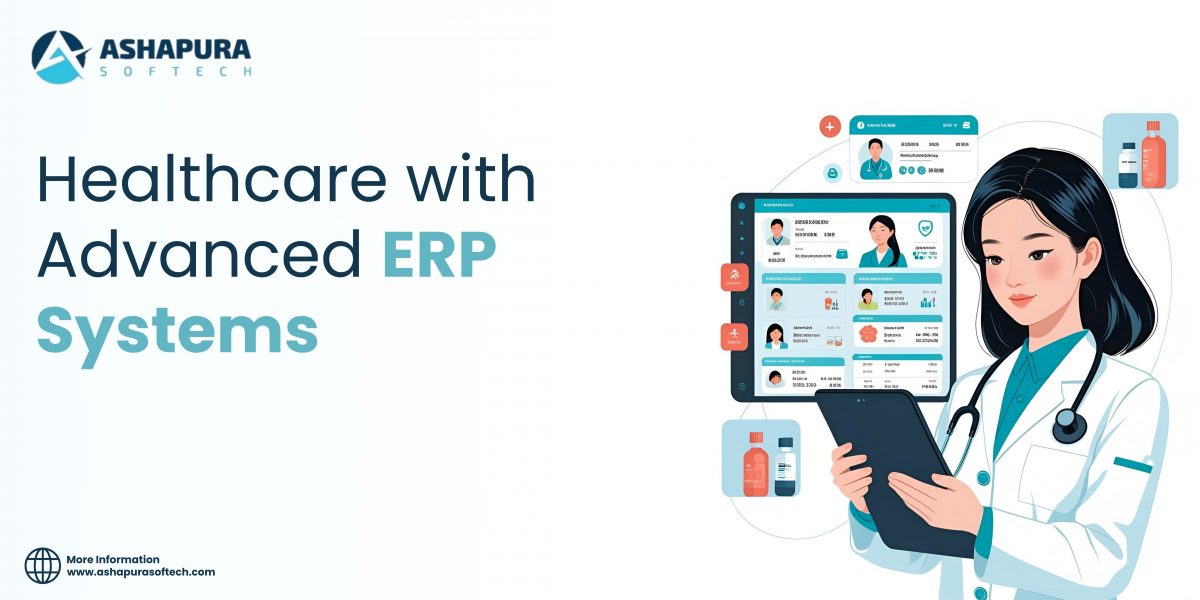
Healthcare with Advanced ERP Systems

What Is ERP?

Before talking about ERP systems in the healthcare industry, I just wanted to give some information about ERP. ERP stands for enterprise resource planning, but what does ERP mean? The simplest way to define ERP is to think about all the core processes needed to run a company: finance, manufacturing, HR, supply chain, services, procurement, and others. At its most basic level, ERP integrates these processes into a single system.

ERP in healthcare industry uses the latest technologies – such as machine learning and artificial intelligence (AI) – to provide intelligence, visibility, and efficiency across every aspect of a business.

Any ERP software will have a long list of features based on the industry they serves. However, all ERPs should have these characteristics:

Up-to-date information and alerts, with self-service reporting across all operations

Visual presentation of the information with analytics to help

The choice of types of ERP, such as cloud, on-premise, or hybrid

Standard and advanced business processes, like, automation with AI and Machine learning,

Configuration tools for processes and users (including customers and suppliers), as well as for business units, locations, and product lines, for example

easy integration with other software solutions, including third-party systems

Technology platform that is fast, proven, and stable for this long-term investment

Technology support for the (IoT), security and privacy, mobile, e-commerce, and other business priorities

Multinational support including languages and business practices, as well as cloud, training, help desk, and implementation services

Benefits Of ERP In Healthcare Industry:

Higher productivity: automate your core business processes to help everyone

Deeper insights: Eliminate information mismatch and get fast answers to mission-critical business questions.

Accelerated reporting: Fast-track business and financial reporting and easily share results. Act on insights and improve performance in real time.

Lower risk: Maximize business visibility and control, ensure compliance with regulatory requirements, and predict and prevent risk.

Improved agility: With efficient operations and ready access to real-time data, you can quickly identify and react to new opportunities.

Due to All of these benefits, ERP is now a Modern-day essential.

The business needs of ERP software in the healthcare industry are no different. Healthcare providers around the world are under intense pressure to achieve two goals: high-quality care and significant cost reductions. To date, healthcare facilities are increasingly investing in the development of their ERP systems to improve the availability and quality of patient care. In addition, reducing clinical errors and increasing the productivity of healthcare providers are key reasons for adopting ERP solutions.

The emergence of more patents and technologies has necessitated the need for hospitals and other healthcare providers to compile a database of patients with important information for doctors and staff. Physicians and nurses need real-time information on their patient’s diagnostic reports to facilitate communication and make their treatments more effective. In addition, various hospital departments require automated solutions to integrate their primary services, support services, and back-office operations. Reducing costs and overwork is one of the main reasons for adopting an ERP solution. Dissemination of information throughout the pharmacy, laboratory system, radiology, imaging and communication system (PACS), and electronic medical records (EMRs) for patients is essential. Patients, on the other hand, gain access to the consolidated information of their medical reports to plan timely appointments and make immediate decisions.

Some Of The Main Benefits Of Using ERP Solutions Are:

Improved patient care: ERP software enables healthcare providers to provide patients with remote access to critical information resources and reports. It helps patients to be informed about treatment and to make quick decisions. Advanced automated software scheduling simplifies follow-up tests and treatment procedures. The ERP solution ensures the availability of critical patient information across multiple systems.

Reduce maintenance costs: ERP as part of automated IT software leads to improved process efficiency. ERP offers a wide variety of services, such as accounting, finance, and human resources, and brings them under a single domain. It helps to perform various backup functions such as staff management, account management, and asset management.

General health care policies: This is achieved by integrating basic services such as patient registration, electronic medical records management, the radiology department, OPD, and emergencies.

Financial Planning: ERP ensures that payments from various operating care providers are fair, which becomes a win-win situation for providers and payers. It helps maintain healthcare facilities and benefits in less expensive patient care.

Following best practices: Health facilities can better manage all policies and procedures related to member benefits, claims, registrations, and provider networks, which will eventually be updated with the best industry practices.

Patient Safety: ERP software gives healthcare providers the ability to improve safety by making the communication between physicians and patients visible. Many organizations view interactive ERP as an organization’s mandate to provide a culture of patient safety.

Conclusion

ERP systems in the healthcare industry are revolutionizing the way medical institutions operate. By integrating various functions such as patient management, billing, supply chain, and human resources, ERP solutions streamline processes, reduce errors, and improve overall efficiency. With real-time data access and improved communication across departments, healthcare providers can enhance patient care, manage resources better, and make more informed decisions. As the industry continues to evolve, adopting an ERP system becomes crucial for staying competitive and delivering high-quality care. At Ashapura Softech, we offer tailored ERP solutions for the healthcare industry, designed to meet the unique needs of medical institutions. Looking to optimize your healthcare operations? Contact us at [email protected] to explore our ERP solutions and take your healthcare services to the next level.