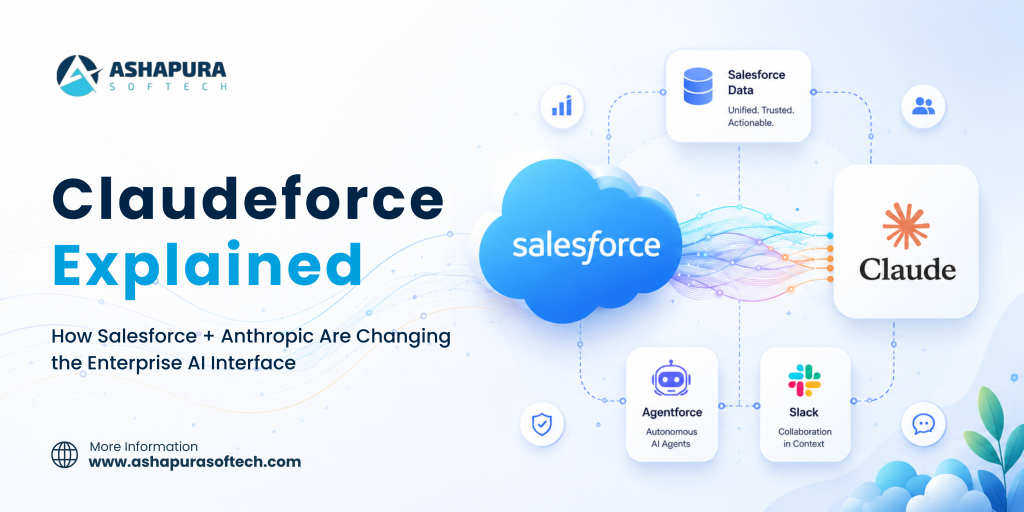


On 26 August 2026, alongside its Q2 FY27 earnings, Salesforce announced Claudeforce, an expanded partnership with Anthropic that puts Salesforce data inside Claude and puts Claude inside Salesforce. The headline Salesforce chose for the official press release was “The #1 AI Meets the #1 AI CRM.” Marc Benioff’s framing around the launch was blunter: “The UI is the AI.”
Dario Amodei, Anthropic’s CEO and co-founder, described the value differently, and his version is the more useful one for anyone evaluating this: “Through this partnership, companies can point Claude at the customer information and business context that they’ve been building in Salesforce for decades.” The asset is the decades of context. The model is the new way to reach it.
Most coverage so far has re-typed the press release. This piece does something different. We break down what is actually shipping, what is still a slide, how Claudeforce differs from the Anthropic partnership Salesforce announced in October 2025, what it does to your licensing, and what a Salesforce customer should do about it in the next 90 days.
If you have been following the platform’s direction through 2026, this will slot straight onto what we covered in our Dreamforce 2026 breakdown of what Salesforce actually shipped. Claudeforce is the next move in the same strategy, not a departure from it.
What is Claudeforce, in one paragraph
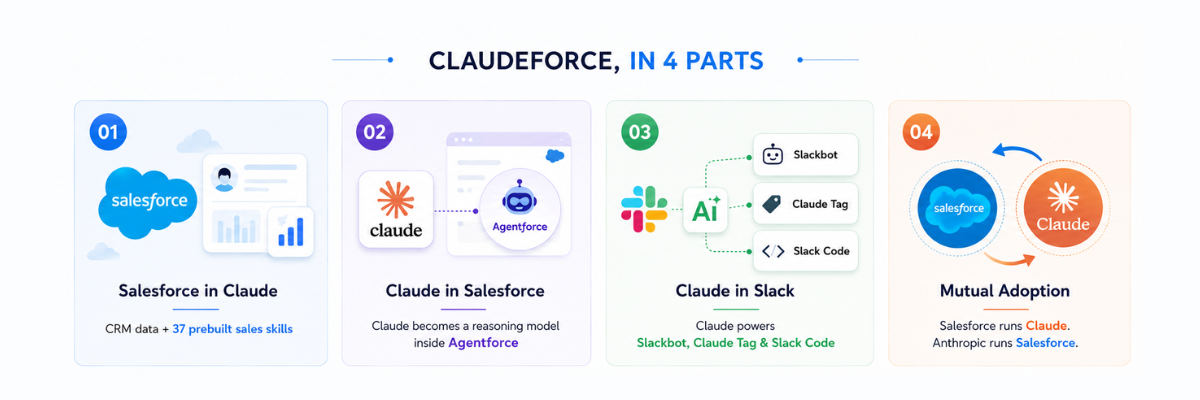
Claudeforce is the brand name for an expanded Salesforce and Anthropic partnership announced on 26 August 2026. It has four parts: a Salesforce plugin inside Claude with 37 prebuilt sales skills, Claude as the reasoning model inside Agentforce, Claude as the default model across Slack, and a mutual customer arrangement where Salesforce runs on Claude and Anthropic runs on Salesforce. The plugin is in pilot now, with an open beta expected in September 2026.
Part 1: The four components of Claudeforce, decoded
| Component | What it means in practice | Status as of 27 Aug 2026 |
|---|---|---|
| Salesforce in Claude | A plugin that exposes CRM data, workflows and governance rules inside the Claude interface. Ships with 37 prebuilt sales skills. | Select pilot customers. Open beta expected September 2026. |
| Claude in Salesforce | Claude serves as a reasoning model for the Atlas Reasoning Engine, powers Agentforce Vibes and Agentforce Coworker by default, and is selectable in Agent Builder via Amazon Bedrock inside the Salesforce Trust Boundary. | Shipping. |
| Claude in Slack | Claude becomes the default model for Slack, powering Slackbot, Claude Tag and Slack Code. | Shipping. |
| Mutual adoption | Salesforce adopts Claude as its preferred AI assistant; Anthropic adopts Salesforce as its preferred CRM. | In force. |
1. Salesforce in Claude, and the 37 sales skills
This is the piece that got the attention, and it deserves it. Instead of asking a seller to open Salesforce, Salesforce is handing the seller’s workflow to Claude and keeping the data, permissions and audit trail on its own side.
The 37 skills are not features in the CRM sense. They are prewritten instructions that tell Claude how a competent seller handles a specific job, and Salesforce describes them as grounded in 27 years of its own sales experience. On the Claudeforce product page they group into five families:
- Daily planning: daily briefing, pipeline review, forecast narrative
- Deal strategy: stakeholder mapping, close planning, objection handling
- Account growth: account planning, lead triage, customer health
- Meeting preparation: call prep, conversation summaries, scheduling
- Action and governance: win-loss review, activity logging, data hygiene
Anyone who has run a Salesforce Sales Cloud rollout will recognise that list. It is the same set of jobs that dashboards, list views and reports were built to serve, delivered through conversation instead of navigation.
Two design decisions matter more than the skill list itself.
One admin connects it, once. Salesforce’s framing is that an admin connects Salesforce in Claude a single time and the whole team has it from day one. Anyone who has tried to roll out per-user MCP server configuration across a 200-seat sales org will recognise why that sentence exists. Setup friction is what killed most 2025-era agent pilots before they reached a second sprint.
There is no new permissions model. The connection inherits each user’s existing Salesforce permissions. A rep who cannot see an account in Salesforce cannot see it through Claude either, and every write action routes back through Salesforce so validation rules, approvals and field history still apply. This is the single most important technical claim in the announcement, and it is the one to test hardest during beta.
Here is why that claim carries so much weight. In a traditional integration, the connecting application holds its own service account and its own idea of who may see what. That is how CRM data leaks: not through the model, but through an over-permissioned integration user. By routing every read and write back through Salesforce’s own sharing engine, Claudeforce keeps a single source of truth for authorisation. Your org’s sharing model becomes the security boundary, which is excellent news if that model is deliberate and a serious problem if it is fifteen years of accumulated exceptions.
2. Claude inside Salesforce
The second component is less visible but has wider blast radius. Claude is now a reasoning model for the Atlas Reasoning Engine, the planning layer under Agentforce, and it is the default model behind Agentforce Vibes (the natural-language build tool) and Agentforce Coworker (the assistant Salesforce put into the search bar across its apps, and into Slack, Teams and ChatGPT, earlier in 2026).
For regulated customers, the deployment path is the part worth reading twice: Claude is available through Amazon Bedrock inside the Salesforce Trust Boundary. That means inference runs inside Salesforce’s virtual private cloud rather than sending records to a public model endpoint. Financial services, healthcare and life sciences customers have been blocked on exactly this question since 2023. If you run Salesforce Health Cloud under HIPAA obligations, the Trust Boundary is the difference between a compliance conversation you can win and one you cannot start.
This component also changes what Agentforce is. Until now, a customer building an agent chose a model and accepted the reasoning quality that came with it. Making Claude the default reasoning model for Atlas raises the floor for every agent built on the platform, including ones already in production. We covered how these agents are assembled in our guide to setting up agentic AI in Sales Cloud, and the build process does not change. The quality of the planning step does.
3. Slack becomes the front door
Claude is now the default model for Slack, powering Slackbot, the Claude Tag and Slack Code. Combined with the MCP servers Salesforce shipped for Slack this quarter, which connect Headless 360 to Slackbot, the practical effect is that a CRM update can begin and end in a Slack thread.
Salesforce is using itself as the proof point. It says Slackbot has driven 8.1 million hours of annualised productivity gains for its own employees, up more than 2x quarter over quarter. Treat that as a vendor-reported internal figure rather than an audited number, but the direction is real and the internal adoption is unusually deep for a first-party claim.
The strategic point is easy to miss. Slack was acquired in 2021 and spent four years as a collaboration product attached to a CRM company. Under Claudeforce it becomes the conversational surface where CRM work happens, which is a far more defensible position than competing with Teams on channels and huddles.
4. Mutual adoption
Salesforce runs Claude. Anthropic runs Salesforce. This is partly commercial theatre, and partly a genuine signal: Salesforce Ventures has invested in Anthropic across multiple rounds, and reporting in mid-2026 put the value of that stake at roughly $5 billion. Salesforce’s Q2 FY27 GAAP EPS came in at $4.29, up 119% year over year, and coverage of the quarter attributed part of that jump to gains on the Anthropic investment. When you read Salesforce’s enthusiasm for Anthropic, read the balance sheet alongside it.
Part 2: Claudeforce is not the October 2025 partnership. Here is what changed.
A lot of the confusion in the last 24 hours comes from people conflating this with the earlier deal. Salesforce and Anthropic have announced three separate things in eleven months, and each one goes further than the last.
| Date | Announcement | The actual scope |
|---|---|---|
| 14 Oct 2025 | Anthropic and Salesforce expanded partnership | Claude available inside Agentforce for regulated industries, deployed via Amazon Bedrock in the Salesforce Trust Boundary. Slack MCP server. Salesforce adopts Claude Code internally. Named customers included CrowdStrike and RBC Wealth Management. |
| 15 Apr 2026 | Headless 360, announced at TDX 2026 | The plumbing. APIs, MCP servers and CLI tools that let any external agent call Salesforce data, workflows and governance rules with no Salesforce UI involved. |
| 26 Aug 2026 | Claudeforce | Claude becomes the default reasoning model across Agentforce and Slack, and Salesforce ships a first-party plugin that runs the seller’s day inside Claude. |
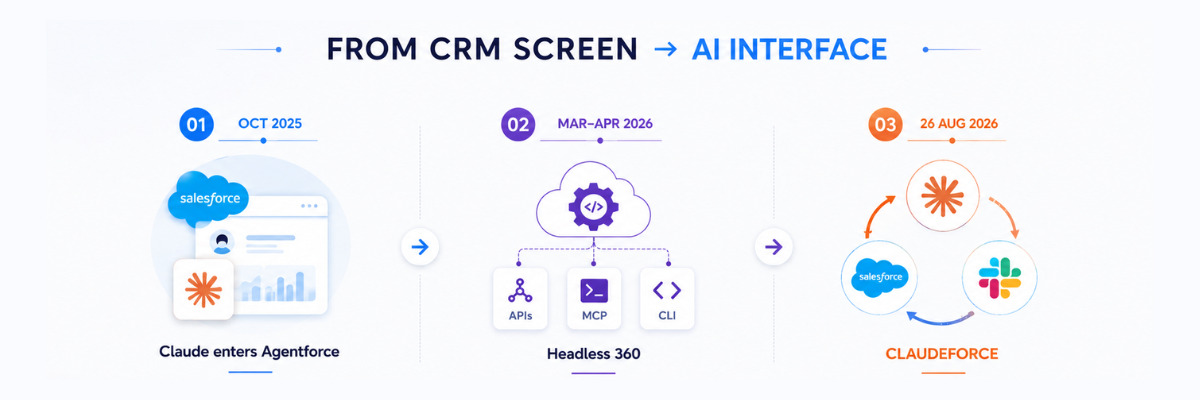
Read in sequence, the story is clear. October 2025 made Claude available in Salesforce. TDX 2026 removed the requirement for a Salesforce interface at all. Claudeforce is what those two decisions were building toward.
Headless 360 is the part practitioners keep underrating. It is not a product you buy. It is a consumption architecture, and it is why the Claude plugin could be built in the first place. We have written a separate guide to what Salesforce Headless 360 is and how it enforces permissions. Without an API-and-MCP layer that carries permissions and business rules with it, “Salesforce inside another vendor’s chat window” would have been a security review that never ended.
Claudeforce vs Agentforce vs Agentforce Coworker
These three names are being used interchangeably in a lot of commentary, and they are not the same thing.
| What it does | Who it serves | Where it runs | |
|---|---|---|---|
| Agentforce | Autonomous agents that complete work end to end, including work that touches your customers | External customers, and internal processes | Salesforce platform |
| Agentforce Coworker | An assistant embedded in the search bar of Salesforce and other apps, for asking and acting on CRM data | Internal employees | Salesforce, Slack, Teams, ChatGPT |
| Salesforce in Claude | A plugin with prebuilt skills that runs a seller’s daily workflow from inside Claude | Internal knowledge workers, sellers first | Claude |
Salesforce’s own positioning is that Agentforce handles autonomous work touching end customers, while Salesforce in Claude handles knowledge-worker assistance for internal teams. In practice these overlap, and the boundary will move. Treat the table as today’s positioning rather than a permanent architecture.
Part 3: What “the UI is the AI” does to your Salesforce licence
Salesforce President Patrick Stokes framed the strategy plainly in interviews around the launch, reported in detail by VentureBeat: the value of Salesforce sits in the data and the metadata, not in the interface. That is a defensible position, and it is also an admission that the interface is no longer where the money is.
Follow the consequences.
Access shifts from seats to consumption. Salesforce says MCP access needs no separate SKU on Enterprise Edition and above, that calls draw on your existing API limits, and that Flex Credits are consumed when an agent action, a Data 360 query or a prompt actually runs. The meter is on actions, not on named users.
Agentforce consumption is priced in Flex Credits at $500 per 100,000 credits, with a standard agent action costing 20 credits, or roughly 10 cents. Our full Agentforce pricing breakdown covers the whole rate card.
Separately, Salesforce reports platform activity in Agentic Work Units. This one is worth getting right, because a lot of commentary has it wrong. An AWU is a disclosure metric, not a billing unit. Salesforce has published no price per AWU and no AWU-to-credit conversion. Its Q2 FY27 results reported 3.2 billion work units delivered in Q2 alone, up 97% quarter over quarter, on a cumulative 7.0 billion. The company also acquired m3ter, a metering and usage-based pricing platform, in the same quarter. Nobody buys a metering company unless they intend to meter a great deal more.
You will likely have two bills. Salesforce charges for platform access and actions. Anthropic charges for inference. Coverage of the launch indicated customers contract separately with each, which changes both procurement and forecasting. If your finance team currently models Salesforce as a fixed annual seat cost, that model is about to stop describing reality.
No public pricing exists for Salesforce in Claude yet. This is the biggest unanswered commercial question of the announcement. Whether it is bundled into an existing Agentforce entitlement, sold as an add-on, or metered per action has not been disclosed. Do not build a business case on assumed pricing until beta terms are published.
For teams renewing in the next two quarters, the practical advice is unglamorous: model your expected agent traffic in units before you build anything, and negotiate consumption rates and caps in the same conversation as seats, not after it. Agent-to-agent calls, retries and voice actions are the line items that blow up forecasts, because they are invisible in a seat-based mental model. This is the same discipline that separates a controlled Salesforce CRM development programme from one that overruns, applied to a new cost driver.
There is a second-order effect worth naming. If interface access stops being the unit of value, the internal case for buying seats for occasional users weakens. Finance teams will notice. Expect a wave of licence rationalisation conversations in 2027 renewals, and expect Salesforce to have priced consumption on the assumption that those conversations happen.
Part 4: The numbers behind the Claudeforce announcement
Claudeforce landed on earnings day, which was not an accident. The Q2 FY27 results gave it a strong backdrop.
| Metric | Q2 FY27 | Change |
|---|---|---|
| Total revenue | $11.3B | +11% YoY |
| Subscription & support revenue | $10.8B | +12% YoY |
| cRPO | $33.5B | +14% YoY in constant currency |
| Agentforce ARR | Over $1.5B | +240% YoY |
| Agentforce + Data 360 ARR | ~$3.9B | +210% YoY |
| Agentic Work Units (Q2) | 3.2B | +97% QoQ |
| Data 360 records ingested | 104 trillion | +355% YoY |
| Non-GAAP operating margin | 34.1% | Not comparable |
| FY27 revenue guidance | $46.1B to $46.4B | Raised |
One caveat that most write-ups skipped. The Agentforce ARR definition has expanded over the past year to take in Slackbot and Headless 360 consumption. A 240% growth rate on a broadening definition is partly demand and partly accounting, and Salesforce has not published the split. The growth is real; the multiple is not directly comparable to last year’s figure.
The number that deserves more attention than ARR is the work-unit count. Agentic Work Units are the closest public proxy for actual agent usage rather than agent purchasing, and 3.2 billion in a quarter, nearly doubling sequentially, says agents are running in production rather than sitting in sandboxes. That is the metric to watch next quarter, because it is much harder to inflate through repackaging than an ARR definition is.
Part 5: Five things we still do not know about Claudeforce
Any vendor announcement is worth judging by the questions it leaves open. These are the five that will decide whether Claudeforce becomes standard practice or a well-received demo.
- Pricing and packaging for Salesforce in Claude. Undisclosed. Everything downstream of this is guesswork until beta terms land.
- Data residency across three boundaries. A single request may touch Claude, Amazon Bedrock and Salesforce. EU, UK, India and Gulf customers need a documented map of where data rests and where it is processed at each hop. The Trust Boundary answers this for the Agentforce path; it does not obviously answer it for the plugin path.
- Model opt-out. If Claude is the default model for Slackbot and Agentforce Coworker, what is the mechanism for a customer with an existing standard on a different model, and what does opting out cost in capability?
- Skill customisation and governance. The 37 skills encode Salesforce’s view of good selling. Enterprises with their own methodology will want to edit them, version them and audit changes. How that works has not been detailed.
- What happens to the admin’s control surface. When work starts in Claude and finishes in Salesforce, page layouts and Lightning components stop being the place behaviour is governed. Validation rules, the sharing model and flows become far more load-bearing than they already are.
Part 6: What to do about Claudeforce in the next 90 days
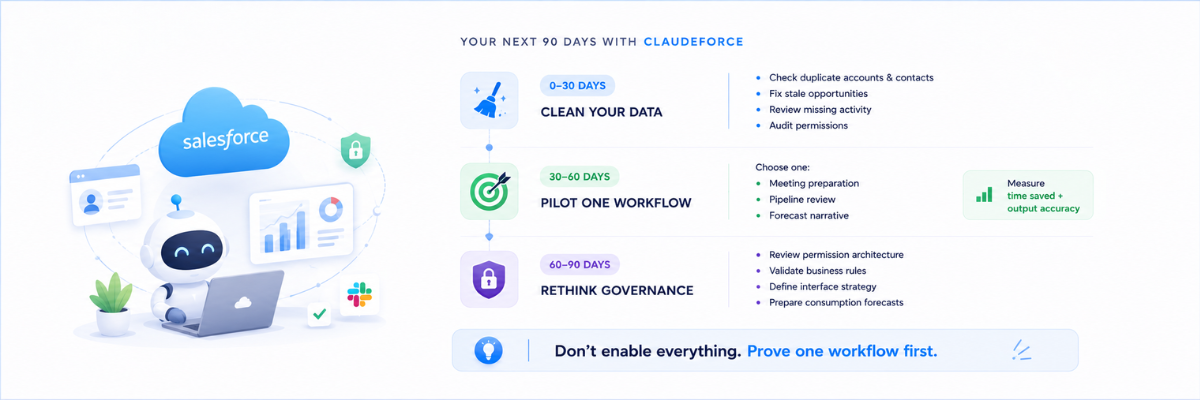
The mistake to avoid is treating this as a September to-do. The mistake on the other side is buying anything before beta terms are public. Here is a sequence that works for most Salesforce customers.
Next 30 days: get honest about your data
Every agentic feature Salesforce has shipped since 2024 fails the same way, and it is never the model’s fault. It is duplicate accounts, stale opportunity stages, empty next-step fields and a sharing model nobody has audited since the original implementation. Claude reasoning over a pipeline where 30% of open opportunities have a close date in the past will produce a confident, useless forecast narrative.
Before any pilot, run a specific check:
- Duplicate account and contact rate
- Percentage of open opportunities with a past close date
- Percentage of open opportunities with no activity in 30 days
- Fields that are mandatory in process but optional in the schema
- Profiles and permission sets with broader access than anyone remembers granting
That last item becomes materially more important under Claudeforce. Permission inheritance is a feature only if the permissions are correct. Our Agentforce readiness checklist sets out the full assessment, including the thresholds to measure against. Most orgs we assess through CRM data and platform work have at least one profile that grants view-all on a standard object because it was the fastest fix during go-live years ago. That was survivable when access required logging in and knowing where to look. It is less survivable when a model can be asked a question in plain English.
Days 30 to 60: pick one workflow, not a platform
Choose a single skill with a measurable before-and-after. Meeting prep and pipeline review are the obvious candidates because both have an existing time cost you can measure this week. Instrument it: minutes per rep per week before, minutes after, and an accuracy check by a sales manager on a sample of outputs.
Resist the urge to enable everything in beta. A pilot that proves one workflow converts into a budget line. A pilot that enables 37 skills at once produces anecdotes. We have written before about where the measurable returns sit in Sales Cloud ROI work, and the discipline is identical here: one workflow, one baseline, one number.
Days 60 to 90: decide your interface posture
This is the strategic question, and it belongs to the RevOps or CRM owner rather than to IT. If sellers begin their day in Claude or Slack rather than in Salesforce, three things follow:
- Adoption metrics change meaning. Salesforce login counts stop being a proxy for usage.
- Training changes shape. You are teaching prompting and verification, not navigation.
- Governance moves down the stack. Anything you enforced through UI design has to be re-enforced in validation rules, flows and the sharing model. That is Salesforce DevOps territory, and it needs version control and a release process rather than ad-hoc changes in production.
If you are in a regulated industry
Get your security and compliance teams into the Trust Boundary architecture now, while you are pre-purchase and have leverage. Ask for the data flow diagram for each of the three deployment paths (Agentforce via Bedrock, the Claude plugin, Slack), and ask what is logged, retained and where. Teams running Salesforce Health Cloud or a financial services org already have this muscle from EHR and core banking integrations. Use the same review template.
If you are a Salesforce partner or implementation firm
The delivery mix shifts. Less time building interfaces, more time on data readiness, permission architecture, MCP and API design, and consumption forecasting. Firms whose value proposition was “we build the screens” have a repositioning problem within 18 months. Firms that can do data engineering and governance have a larger addressable scope than they did last week, and the constraint becomes delivery capacity rather than demand, which is where offshore delivery capacity starts to matter.
The evidence for this is already visible in delivery work. In our Salesforce CPQ and Agentforce rollout for a custom furniture retailer, the agent configuration was the fast part. Product data, pricing rules and approval logic were where the schedule went. Claudeforce does not change that ratio. It raises the cost of getting it wrong, because a clean interface no longer hides a messy model.
Frequently asked questions about Claudeforce
What is Claudeforce?
Claudeforce is the name of the expanded partnership between Salesforce and Anthropic announced on 26 August 2026. It covers a Salesforce plugin inside Claude with 37 prebuilt sales skills, Claude as a reasoning model inside Agentforce, Claude as the default model for Slack, and mutual adoption of each other’s products.
When will Salesforce in Claude be available?
It is available to select pilot customers now. Salesforce expects an open beta in September 2026, with additional prebuilt skills for other departments in late 2026.
How much does Claudeforce cost?
Salesforce has not published pricing for Salesforce in Claude. Reporting around the launch indicates customers contract separately with Salesforce for platform access and with Anthropic for model usage.
Is my CRM data safe if it is accessed through Claude?
The plugin inherits each user’s existing Salesforce permissions and routes actions back through Salesforce, so sharing rules, validation and audit trails still apply. For Agentforce, Claude runs through Amazon Bedrock inside the Salesforce Trust Boundary, meaning inference happens within Salesforce’s cloud rather than at a public endpoint. Confirm the specific data flow for your region before rollout.
What are the 37 sales skills in Salesforce in Claude?
They are prebuilt instruction sets covering daily planning, deal strategy, account growth, meeting preparation, and action and governance. Named examples include daily briefing, pipeline review, forecast narrative, stakeholder mapping, close planning, objection handling, account planning, lead triage, call prep, win-loss review and data hygiene.
How is Claudeforce different from the Anthropic partnership announced in 2025?
The October 2025 partnership made Claude available inside Agentforce for regulated industries and added a Slack MCP server. Claudeforce goes further: Claude becomes the default reasoning model across Agentforce and Slack, and Salesforce ships a first-party plugin that runs a seller’s daily work inside Claude.
What is Headless 360 and why does it matter for Claudeforce?
Headless 360, announced on 15 April 2026 at TDX 2026, is the set of APIs, MCP servers and CLI tools that let external agents call Salesforce data, workflows and governance rules without a Salesforce interface. It is the architecture that makes the Claude plugin possible. Salesforce says MCP access requires no separate SKU on Enterprise Edition and above; calls use your existing API limits, and Flex Credits apply when an Agentforce action, a Data 360 query or a prompt runs.
Does Claudeforce replace Agentforce?
No. Salesforce positions Agentforce as autonomous work that touches end customers, and Salesforce in Claude as knowledge-worker assistance for internal teams such as sellers. In practice the two will overlap, and the boundary is likely to move.
Will Salesforce still need admins after Claudeforce?
More than before, and in a different way. When the interface stops being the control surface, correctness has to live in the data model, the sharing model, validation rules and flows. That is admin work, and it becomes harder to skip.
Where Claudeforce actually lands
Salesforce has made a defensible bet. Its moat was never the screen. It was 27 years of data model, permissions, business logic and audit trail, and none of that is reproduced by pointing a model at a database. Letting Claude be the interface while keeping governance on the Salesforce side is a reasonable way to stay essential in an agentic world.
The risk is equally clear. If the interface commoditises, pricing power tends to move to whoever owns the intelligence. Salesforce is betting it can hold the data and governance layer while the reasoning layer belongs to someone else. That is a bet on the durability of enterprise plumbing, and it is not an obviously wrong one.
For customers, none of that changes the near-term work. The organisations that will get value from Claudeforce in the first year are the ones whose CRM data is clean, whose permission model is deliberate, and whose business logic sits in the platform rather than in the habits of the people using it. That work was worth doing before this announcement. It is now worth doing on a deadline.
Sources and further reading
- Salesforce and Anthropic Announce Claudeforce, Salesforce press release, 26 August 2026
- Claudeforce product page, Salesforce
- Salesforce Delivers Record Second Quarter Fiscal 2027 Results, Salesforce investor relations
- Salesforce FY27 Q2 product releases and corporate announcements, Salesforce
- Anthropic and Salesforce expanded partnership, Anthropic, 14 October 2025
- Salesforce just put its entire CRM inside Claude, VentureBeat
Ashapura Softech is a certified Salesforce implementation partner. If you want a read on whether your org is ready for agentic workflows, book a CRM health check covering data quality, permission architecture and automation debt. You can also browse our full range of Salesforce cloud services or see the delivery work in our case studies.