
A mid-market B2B industrial and commercial supply distributor replaced 15 years of spreadsheet-driven pricing and a legacy on-premise ERP with a fully integrated Salesforce CPQ platform — surfacing live inventory, government contract compliance, and AI-powered substitute SKU recommendations directly inside the quotation workflow.
Project Overview
Our client is a mid-market B2B industrial and commercial supply distributor serving procurement managers, facility managers, and public sector buyers across the United States. Their product catalog spans maintenance, repair, and operations (MRO) supplies, safety equipment, janitorial products, and industrial hardware — sold across commercial, government, and institutional channels.
Despite a well-established customer base and strong account relationships, the business was managing customer-specific contract pricing in spreadsheets that no single person fully understood. Sales reps were quoting delivery timelines based on intuition rather than live inventory data. Government contract accounts carried real compliance and audit exposure. And field sales and inside sales had no shared view of the same customer.
Ashapura Softech was engaged to design and deliver a complete Salesforce transformation — migrating from Salesforce Classic (without CPQ) and a 15-year-old on-premise ERP to a fully integrated Salesforce Lightning platform with CPQ at its core.

“Every rep had their own version of the price spreadsheet. We were losing margin on errors we didn’t even know were happening, and our government account managers were one audit away from a serious problem. Ashapura Softech gave us a system where the rules are enforced automatically before anything leaves the building.”— VP of Sales, Mid-Market B2B Industrial Supply Distributor
The Business Challenge
The issues facing our client were not new problems. They had accumulated over 15 years of growth without a corresponding investment in systems infrastructure — and each one was getting more expensive as the business scaled.
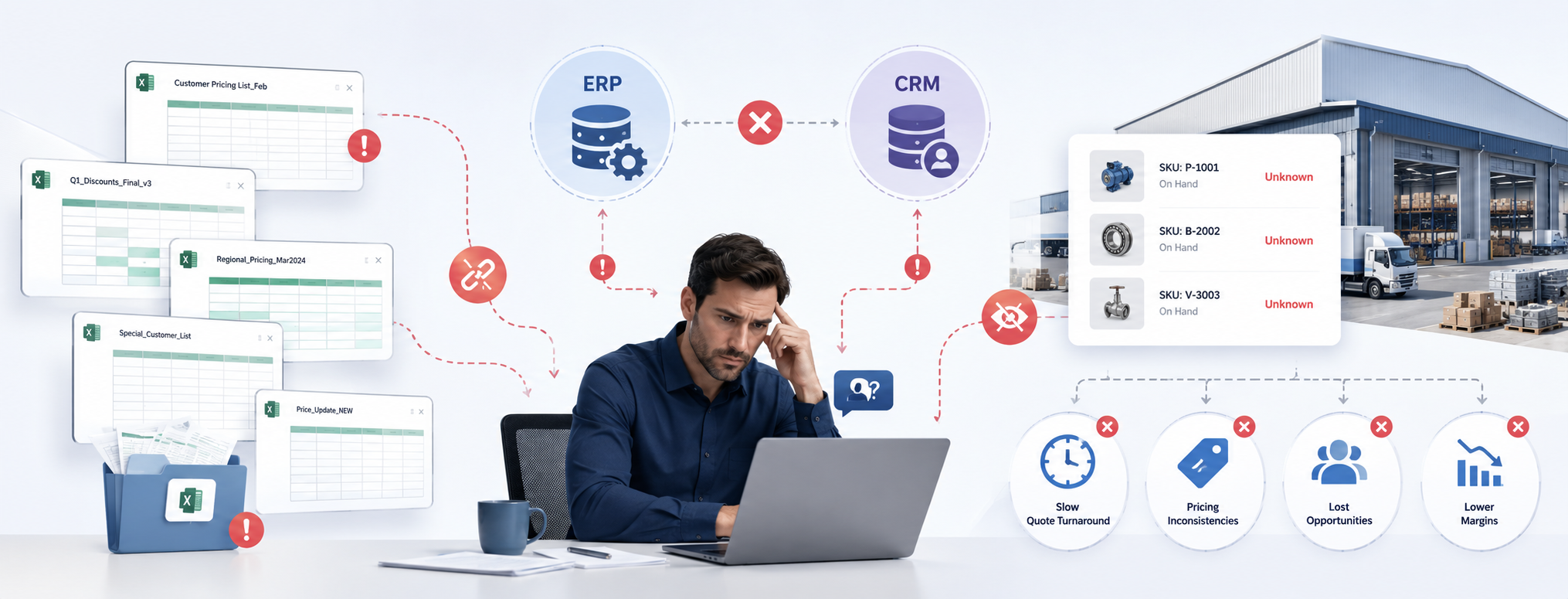
Customer-specific contract rates, volume tiers, and blanket PO pricing existed across dozens of maintained spreadsheets. Different reps used different versions. Pricing errors were discovered after invoicing — creating customer disputes and unrecovered margin leakage that compounded with each contract renewal cycle.
Sales reps had no access to real-time inventory levels, reorder points, or vendor lead times when building quotes. Delivery commitments were made based on experience and estimates — frequently resulting in missed timelines, emergency expedite costs, and customer escalations that damaged long-term account relationships.
Public sector accounts required adherence to specific contract pricing structures — GSA schedules, state cooperative agreements, and municipal contracts. All compliance checks were performed manually by account managers, creating real audit exposure, inconsistent enforcement, and risk that a single quoting error could trigger a contract review.
Onboarding a new commercial or government account required coordinating credit checks, tax exemption certificate collection, contract setup, and price book configuration across multiple people and systems — with no automated workflow to track status, route approvals, or surface bottlenecks to management.
Field reps and inside sales had no shared CRM view of the same accounts. Duplicate outreach happened regularly. Follow-up tasks created by one team were invisible to the other. Customer communications fell through the gaps between two disconnected workflows — with no reporting to surface the problem systematically.
The on-premise ERP was 15 years old and had no API layer. Salesforce Classic lacked CPQ entirely. The result was a disconnected architecture that required manual re-entry of data across systems — consuming hours of administrative time per day and producing a chronic accuracy gap between what was quoted and what was ordered.
The Solution
Ashapura Softech designed a platform where contract pricing is enforced automatically, inventory is visible at the moment of quoting, and compliance is validated before a quote ever leaves the building.
Salesforce Sales Cloud | CPQ | Agentforce Quotation Assistant | Odoo ERP Integration | Avalara | Einstein Lead Scoring
The core of this implementation is Salesforce CPQ configured to handle every pricing structure in the business: standard catalog pricing, volume tier discounts that apply automatically as quantities change, customer-specific price books negotiated at the account level, blanket purchase order rates enforced at the quote line, and government and public sector contract pricing locked against GSA schedules and cooperative purchasing agreements.
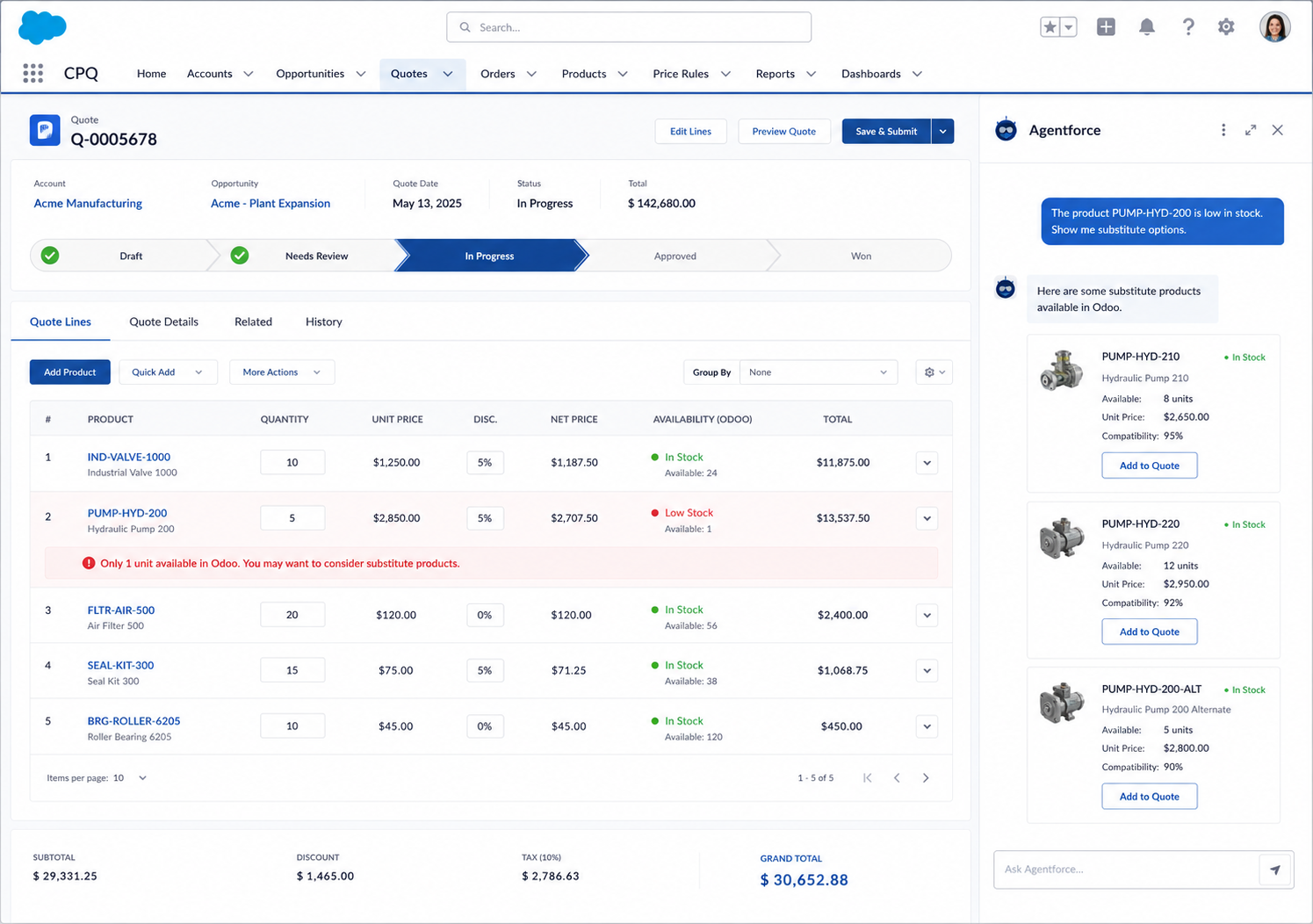
Ashapura Softech built a real-time integration between Salesforce CPQ and the client’s Odoo ERP. When a rep adds a line item to a quote, the integration queries Odoo and surfaces the current on-hand quantity, reorder point status, open vendor PO status, and expected lead time — directly on the quote line. Reps commit to delivery dates based on actual procurement data, not intuition.
Agentforce was deployed as an AI quotation assistant that operates inline during the quote-building process:
Odoo ERP | Salesforce CPQ Integration | Real-Time Inventory API | Vendor Lead Time Sync | Purchase Order Status Feed
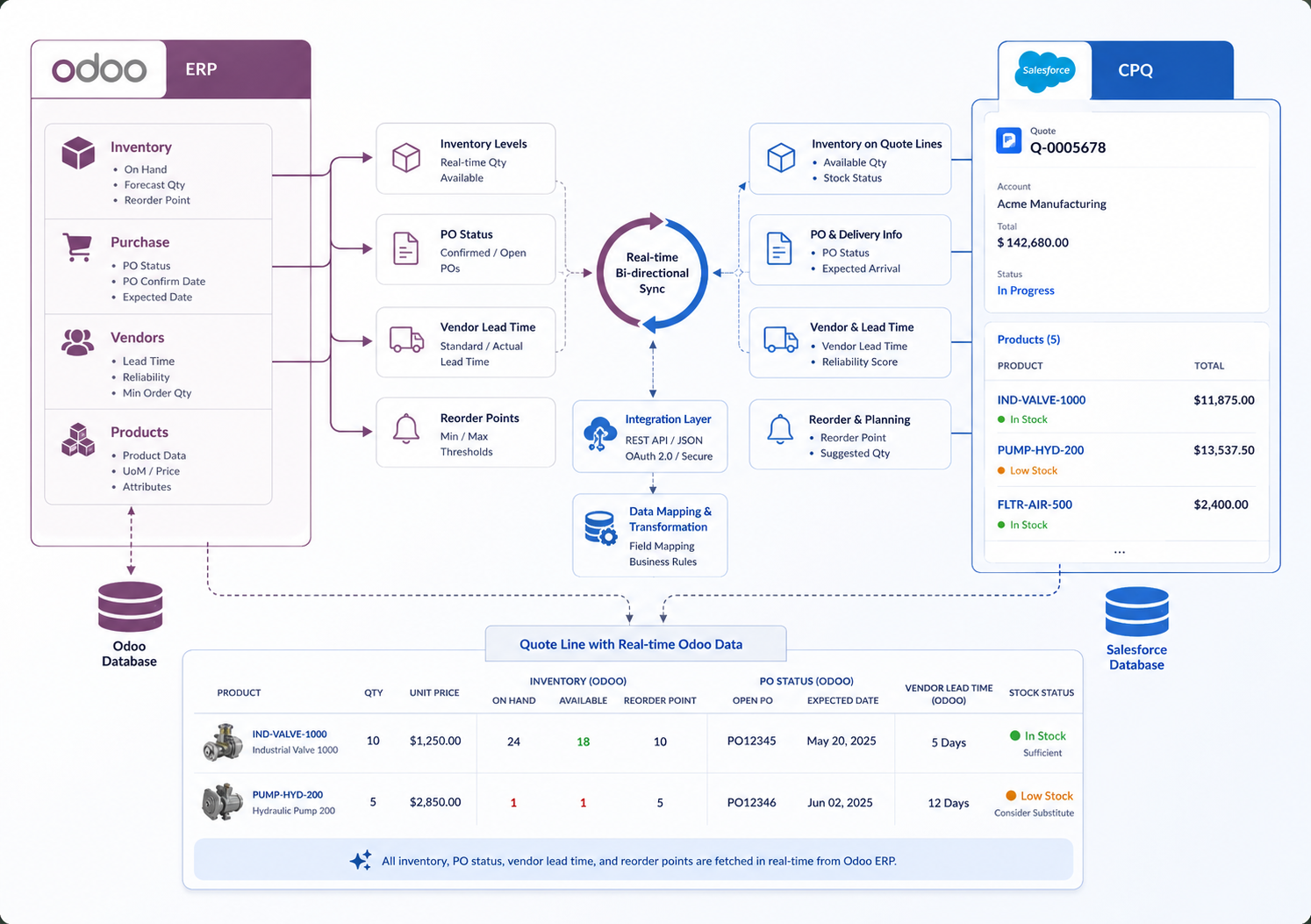
The Odoo ERP integration was the most technically demanding component of this implementation. The legacy on-premise ERP had no native API — Ashapura Softech built a middleware layer that exposes real-time product data to Salesforce without requiring modifications to the underlying ERP, preserving the client’s existing operational workflows during the transition.
The integration is bidirectional: Salesforce CPQ reads inventory and procurement data from Odoo, and confirmed quote-to-order conversions write back to Odoo to initiate the fulfillment workflow automatically. This eliminates the manual re-entry of order data that previously required 20–30 minutes per confirmed order across both systems.
Salesforce Service Cloud | Digital Engagement | EDI Order Status | Marketing Cloud Account Engagement | Procurement Nurture
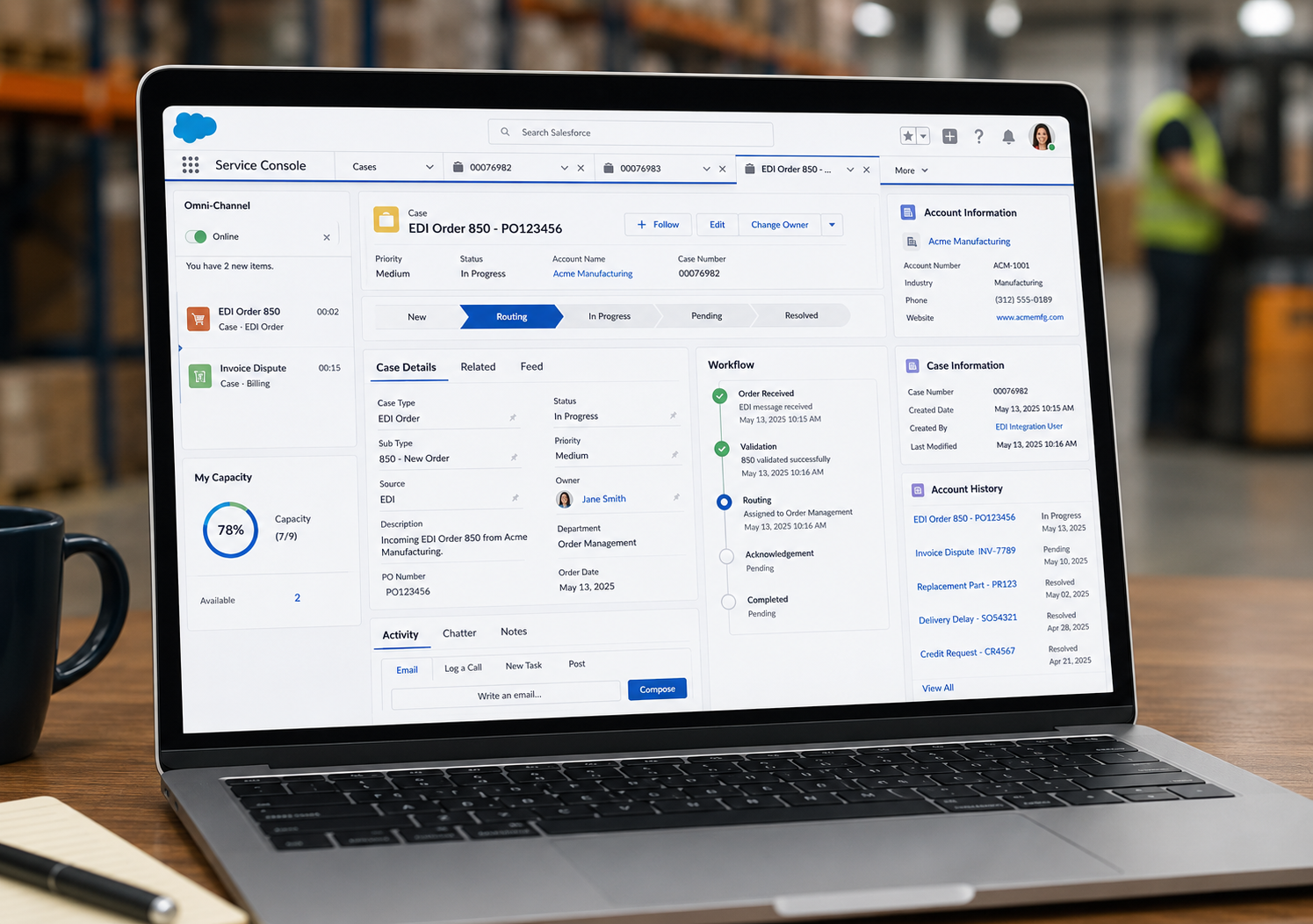
B2B industrial supply buyers do not just purchase — they manage ongoing supplier relationships that require active support: EDI order status queries, invoice disputes, delivery exception handling, and compliance document requests. Ashapura Softech implemented Salesforce Service Cloud as the omnichannel hub for all post-sale interactions.
Service Cloud routes inbound inquiries from email, SMS, and phone into a single queue with full account and order history visible to the handling agent. EDI-originated order status queries are parsed and matched to open orders in Salesforce automatically — reducing the time agents spend on routine status lookups and freeing capacity for higher-value account interactions.
Marketing Cloud Account Engagement handles ongoing nurture for procurement and facility manager contacts — distributing product catalogs, safety data sheets, compliance documentation, and regulatory updates on an automated schedule. Nurture tracks are segmented by product category, customer segment (commercial vs. government), and buying cycle stage to ensure relevance without manual campaign management.
Avalara | Tax Exemption Certificates | Channel Engine | Amazon Business | B2B Procurement Portals
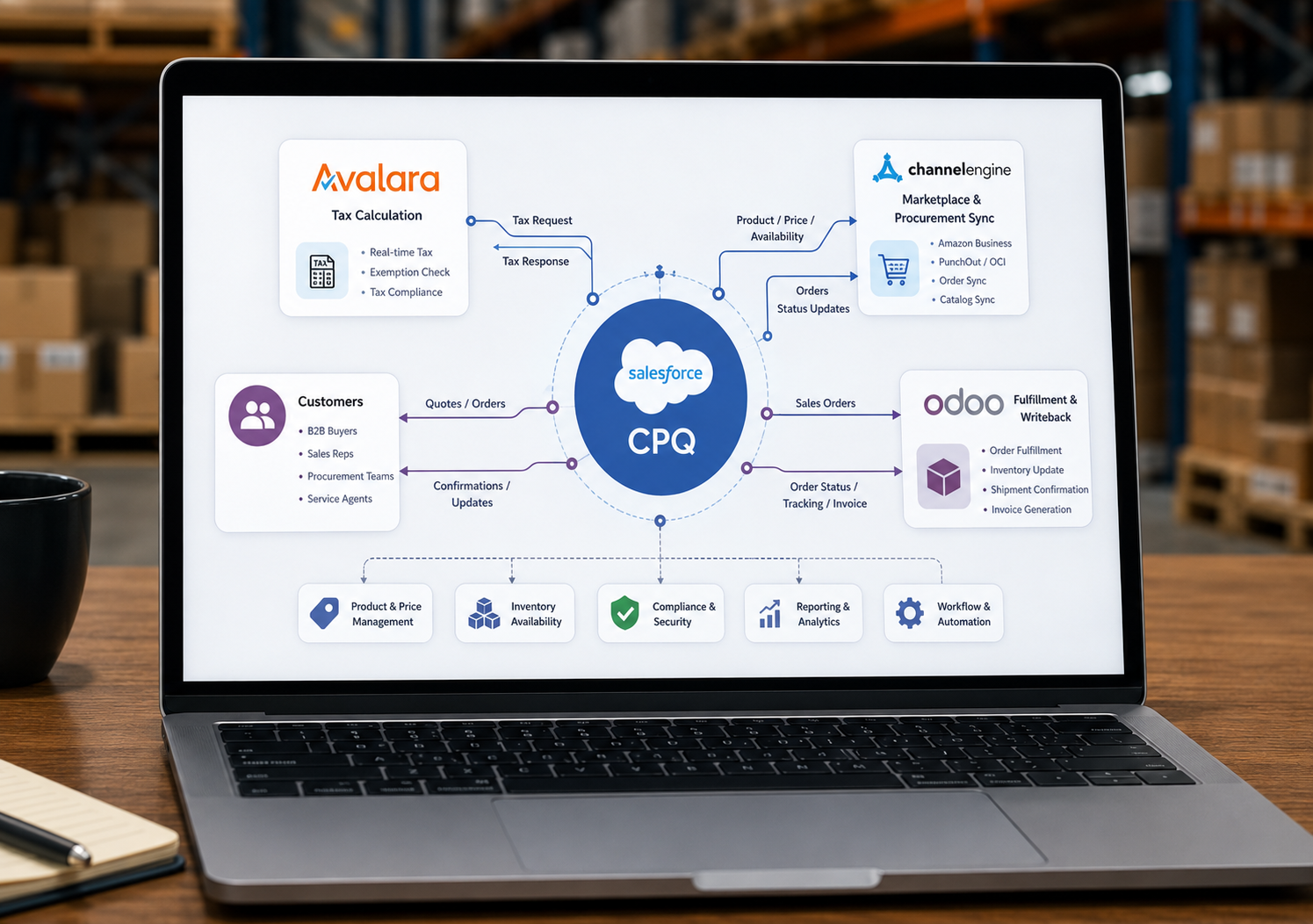
Industrial and commercial supply distribution involves some of the most complex tax scenarios in B2B commerce: sales across multiple states and municipalities, tax-exempt certificate management for government and nonprofit accounts, partial exemptions for mixed-use orders, and use tax obligations on items consumed internally. Avalara was integrated directly into the Salesforce CPQ quote workflow to handle all of these scenarios in real time — without requiring tax expertise from the sales rep building the quote.
Tax-exempt certificates for qualifying government and institutional accounts are stored and managed inside Salesforce — with automated expiration alerts that trigger a renewal workflow before a certificate lapses. This eliminates the manual certificate tracking that previously required a dedicated administrative resource and still produced lapses that created compliance exposure.
The Migration Challenge
Moving from Salesforce Classic and a 15-year-old on-premise ERP to Salesforce Lightning with CPQ required solving data migration challenges that standard tooling could not handle — particularly the volume of customer-specific pricing exceptions that had to be restructured as CPQ price rules without triggering recalculation failures.
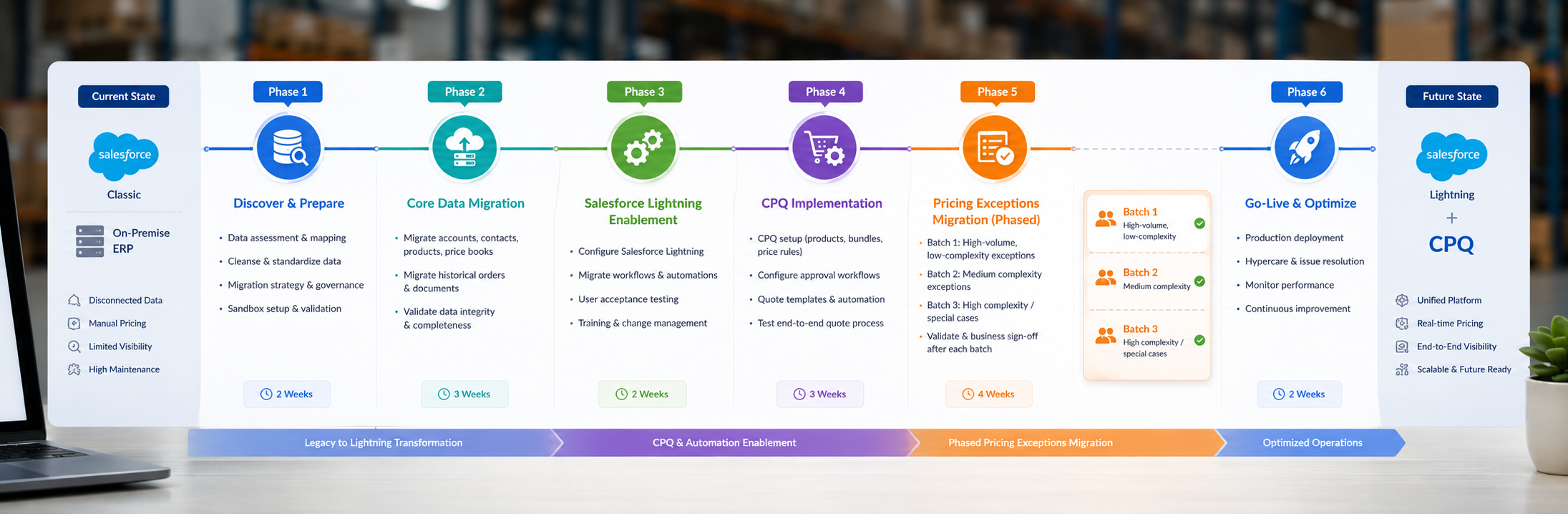
This client had accumulated over 500,000 individual pricing exceptions across 45,000 accounts — stored in spreadsheets that needed to be converted into Salesforce CPQ price rules. Importing these into CPQ at scale triggered automatic price recalculation on every affected quote record. With 1.2 million quote lines, this would have consumed Salesforce’s API limits many times over and caused calculation engine failures across the entire dataset. Ashapura Softech solved this by disabling the CPQ calculation engine during the pricing rule import phase, then re-triggering recalculations in controlled daily batches of 500–1,000 quote records — staying within 50% of the API limit at all times and validating output samples before each subsequent batch was released.
The 15-year-old on-premise ERP had no modern API layer. Standard migration tooling could not connect to it. Rather than attempting to retrofit the legacy system — which would have required significant ERP modification and created operational risk during the migration window — Ashapura Softech built a lightweight middleware service that exposed ERP data through a REST API interface without modifying the underlying application. Quote and order records were extracted, restructured to match Salesforce CPQ’s data model, and imported in phased batches with full referential integrity validation at each stage. ERP-to-Salesforce order number cross-references were maintained so historical records remain traceable in both systems throughout the phased ERP decommission.
The client’s existing Salesforce Classic instance contained years of accumulated customization — custom objects, workflow rules, validation rules, and page layouts that had no Lightning equivalent and no CPQ awareness. Attempting to migrate these directly would have replicated technical debt into the new platform and created maintenance overhead from day one. Ashapura Softech conducted a full audit of all Classic customizations, retained only those with documented ongoing business value, and rebuilt them natively in Lightning using Flow automation and CPQ-native configuration. This reduced the total number of active customizations by approximately 40% while meaningfully improving maintainability and reducing the platform’s reliance on legacy Apex triggers.
Tax exemption certificates for government and nonprofit accounts were stored as scanned PDF files on a shared network drive — with no structured metadata linking certificates to CRM account records. Ashapura Softech built a document processing pipeline to extract account identifiers, certificate numbers, issuing jurisdictions, exemption types, and expiration dates from these files, load the structured data into Salesforce account records as discrete fields, and attach the original PDFs as Salesforce Files for audit purposes. Automated workflow rules were then configured to alert account managers 90 and 30 days before certificate expiration — replacing a manual tracking process that had been producing compliance gaps for years.
Technology Architecture
| Salesforce Product / Integration | Role in the Implementation |
|---|---|
| Salesforce Sales Cloud | Unified opportunity management for field and inside sales teams; account hierarchy management for parent-child distributor relationships; Einstein Lead Scoring for procurement and facility manager contacts |
| Salesforce CPQ | Contract-compliant quote generation with volume tier pricing, blanket PO rates, customer-specific price books, government contract price enforcement, and approval workflow for pricing deviations before submission |
| Agentforce Quotation Assistant | AI agent operating inline in CPQ — recommends substitute SKUs for out-of-stock items, surfaces vendor alternatives with comparative lead times, validates contract compliance before quote submission |
| Salesforce Service Cloud | Omnichannel case management for EDI order queries, invoice disputes, and delivery exceptions routed from email, SMS, and phone with full account and order context visible to agents |
| Marketing Cloud Account Engagement | Automated nurture campaigns for procurement and facility manager contacts — product catalogs, safety data sheets, compliance documentation, and regulatory updates segmented by product category and customer type |
| Einstein Lead Scoring | Scores inbound leads by conversion probability to prioritize inside sales outreach toward the highest-value procurement and facility manager contacts in the active pipeline |
| Odoo ERP Integration | Real-time inventory levels, reorder point status, vendor lead times, and open PO status surfaced on CPQ quote lines; order confirmation writeback from Salesforce to Odoo initiates fulfillment workflow on deal close |
| Avalara | Multi-jurisdiction tax calculation on all CPQ quote lines — federal, state, county, and local taxes; tax exemption certificate storage and automated renewal alerts for government and nonprofit accounts |
| Channel Engine | Automatic order sync from Amazon Business and B2B procurement portals into Salesforce — unified order management and reporting across direct sales and marketplace channels without manual reconciliation |
| Salesforce Lightning | Platform migration from Salesforce Classic — rebuilt custom objects and workflow automation using Flow; CPQ-native configuration replacing legacy Classic customizations, reducing technical debt by approximately 40% |
| Custom Middleware (REST API) | Exposes 15-year-old on-premise ERP data to Salesforce CPQ without modifying the underlying ERP — enables real-time inventory queries and order writeback during the phased ERP decommission period |
Outcomes & Business Impact
The transformation delivered measurable impact across quoting speed, pricing accuracy, compliance posture, and the working relationship between field and inside sales teams.
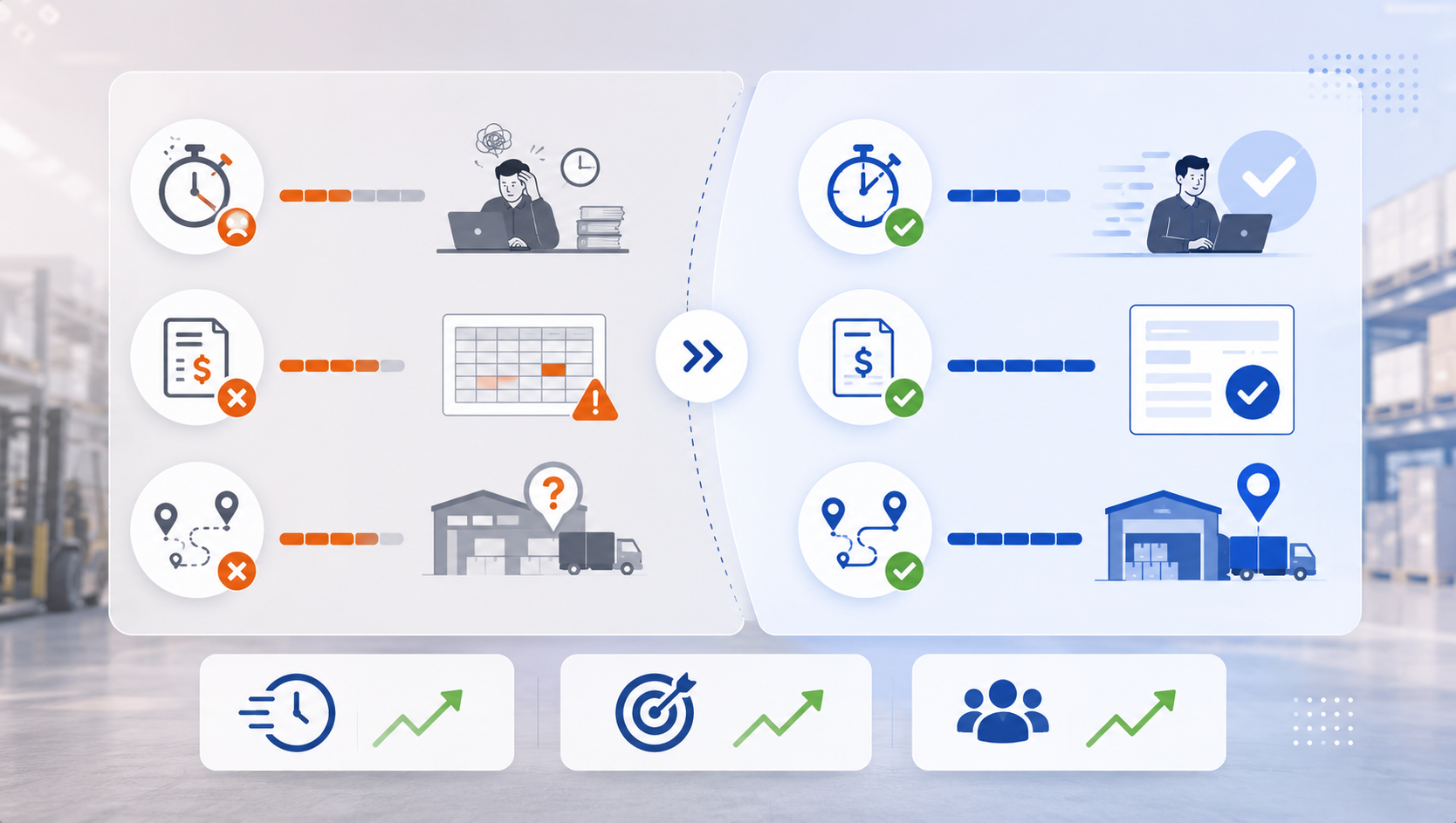
Quote turnaround for standard catalog items dropped from 3–5 days to same-day. Salesforce CPQ generates accurate, contract-compliant quotes in minutes — with pricing, tax, and compliance already validated. Complex custom quotes requiring engineering review follow a structured approval workflow rather than an informal back-and-forth that could stretch across days.
Salesforce CPQ enforces the correct price book for every account before a quote can be submitted. Customer-specific contract rates, volume tiers, and blanket PO pricing apply automatically without rep intervention. Pricing errors that previously resulted in customer disputes and unrecovered margin are no longer structurally possible within the platform.
Public sector accounts are managed with price books that enforce contract-specific pricing automatically. Agentforce validates compliance before quote submission, and approval workflows require documented sign-off for any pricing deviation. The client now has a complete, auditable trail for every government transaction — accessible from the relevant account record in Salesforce.
Reps now see live Odoo inventory levels, reorder point status, and vendor lead times directly on the CPQ quote line. Delivery timelines in quotes reflect actual procurement data. When a primary item is out of stock, Agentforce immediately recommends substitute SKUs with accurate availability dates — so the rep can close the conversation without an internal loop back to warehouse or procurement.
Field reps and inside sales now work from the same Salesforce record for every account. Activity history, open opportunities, outstanding quotes, and service cases are visible to both teams simultaneously. Duplicate outreach and missed follow-ups have been eliminated by shared pipeline visibility — and management now has accurate reporting across both teams from a single source of truth.
All tax exemption certificates are stored in Salesforce against the relevant account, with automated renewal alerts triggered 90 and 30 days before expiration. The manual administrative overhead of certificate tracking has been replaced by a structured, auditable workflow that runs without human intervention until action is actually required from an account manager.
Amazon Business and procurement portal orders now flow into Salesforce automatically via Channel Engine — entering the same fulfillment workflow as direct orders and writing back to Odoo without manual re-entry. Marketplace order reconciliation overhead has been eliminated, and the distribution team has a single daily view of all open orders regardless of their origin channel.
45,000 accounts, 180,000 contacts, 500,000 quotes and orders, and 1.2 million line items migrated from two disconnected legacy systems to Salesforce with full referential integrity. Historical pricing exceptions, order records, and customer activity are available in Lightning — searchable, reportable, and linked to current account and contact records.
Frequently Asked Questions
Salesforce CPQ manages customer-specific pricing through a hierarchy of price books, price rules, and discount schedules. Each account can be assigned its own price book reflecting negotiated contract rates. Volume tier discounts apply automatically as quantity changes — without requiring rep intervention. Blanket purchase order pricing is enforced at the quote line level, and government or public sector contract pricing structures such as GSA schedules and cooperative purchasing agreements are configured as separate price books that CPQ applies automatically based on the customer’s account type. CPQ enforces all of these rules before a quote can be submitted, eliminating the manual spreadsheet management that creates pricing errors and margin leakage in traditional distribution environments.
The Salesforce CPQ and Odoo ERP integration operates through a real-time API connection that queries Odoo inventory data when a product is added to a quote line. The integration surfaces current on-hand quantity, reorder point status, open vendor purchase order status, and expected vendor lead times — directly on the CPQ quote line inside Salesforce. Sales reps commit to delivery timelines based on actual procurement data rather than estimates. When items are out of stock, Agentforce uses Odoo lead time data to recommend substitute SKUs or alternative vendors with accurate availability information. The integration is bidirectional: confirmed quote-to-order conversions in Salesforce write back to Odoo to initiate the fulfillment workflow automatically, eliminating manual re-entry.
Agentforce, Salesforce’s autonomous AI agent platform, can be configured as a quotation assistant that operates inline within the Salesforce CPQ workflow. For B2B industrial supply distributors, Agentforce checks real-time inventory availability from the connected ERP when a quote is being built, recommends substitute SKUs when requested items are out of stock (ranked by lead time and margin), surfaces alternative vendor options when primary supplier lead times are too long, and runs a pre-submission compliance check to verify that quote line pricing matches the customer’s assigned contract price book. Agentforce flags any items that may trigger government contract pricing rules before a rep submits the quote for approval — providing a final compliance layer without requiring a manual review step for every transaction.
Avalara, integrated into Salesforce CPQ, manages tax exemption certificates for qualifying government and nonprofit accounts through a structured workflow. Tax exemption certificates are stored as structured records against the relevant Salesforce account — with fields capturing the certificate number, issuing jurisdiction, exemption type, and expiration date. Avalara validates the certificate’s applicability to each transaction at the time of quoting, automatically applying zero-rate or exempt treatment to eligible line items. Salesforce workflow automation triggers renewal alerts to the account manager 90 and 30 days before certificate expiration. This replaces the manual certificate tracking that previously required dedicated administrative overhead and produced compliance gaps when certificates lapsed unnoticed.
A Classic-to-Lightning migration with CPQ has several technical requirements that differ from a standard data migration. CPQ must be configured from scratch on the Lightning platform — it cannot be migrated from Classic. All Classic custom objects must be assessed for Lightning compatibility and rebuilt using Flow automation or CPQ-native configuration where applicable. Historical quotes and orders from the legacy system must be restructured to match the Salesforce CPQ object model. The most critical technical challenge is importing large volumes of historical quotes without triggering CPQ’s price recalculation engine on every record — which can exhaust Salesforce API limits across a dataset of hundreds of thousands of records. Ashapura Softech manages this by disabling the calculation engine during import and re-running recalculations in controlled daily batches of 500–1,000 records, validating output from each batch before proceeding to the next phase.
A successful B2B industrial distribution Salesforce implementation requires a partner with specific experience across Salesforce CPQ configuration, ERP integration including legacy on-premise systems, and the pricing complexity that characterizes distribution environments — volume tiers, blanket POs, customer-specific price books, and government contract structures. Ashapura Softech brings 12+ years of Salesforce implementation experience with a focus on B2B commerce, ERP integration including Odoo, and complex data migration involving large volumes of pricing data. Our team holds certifications across Sales Cloud, CPQ, Service Cloud, Agentforce, and Marketing Cloud, and has delivered integrations with legacy on-premise ERPs, Avalara, Channel Engine, and B2B marketplace platforms for distribution businesses across North America.
About the Partner
Founded in 2012 and headquartered in Irving, Texas, Ashapura Softech is a certified implementation partner for Salesforce, Zoho, Microsoft, and Odoo — serving 100+ businesses across North America. Our team of certified consultants has handled every phase of digital transformation: from requirements discovery and system design through data migration, user training, and long-term support.
We specialize in the complexity that mid-market B2B businesses deal with every day — customer-specific pricing, multi-system ERP integration, government contract compliance, and the operational reality of migrating from legacy platforms without disrupting the business. Our Irving + India delivery model provides U.S.-based project management and senior consulting with cost-effective offshore execution, without compromising quality, responsiveness, or accountability.
For B2B distribution businesses specifically, Ashapura Softech brings hands-on Salesforce CPQ expertise, deep Odoo ERP integration experience, and a proven approach to migrating large volumes of complex pricing data without operational disruption.
Ready to Start?
Whether you’re replacing a legacy CRM, implementing Salesforce CPQ for complex contract pricing, or connecting your ERP to your quoting workflow — let’s have a 15-minute conversation about what’s possible for your distribution business.