
A U.S. consumer electronics and technology accessories retailer replaced Zendesk, standalone Magento, NetSuite ERP, and a spreadsheet B2B pipeline with a unified Salesforce platform — unifying warranty management, technical support, RMA processing, and enterprise B2B sales across 280,000 consumer contacts and 430,000 orders.
Project Overview
Our client is a U.S.-based consumer electronics and technology accessories retailer selling direct to consumers through its own eCommerce storefront and across major marketplace channels — while managing a growing portfolio of enterprise B2B accounts including school districts, hospitality chains, and corporate IT departments.
Despite strong revenue and a loyal consumer base, the business was held back by a critical structural gap: the post-purchase experience was fragmented across three separate systems that did not communicate. Customers filing warranty claims were asked to locate and email proof of purchase — a step with high drop-off rates that left device issues unresolved and generated negative reviews. Technical support reps answered calls with no visibility into device history or prior cases. B2B enterprise accounts existed in spreadsheets with no pipeline tracking and no renewal automation.
Ashapura Softech was engaged to design and deliver a full Salesforce platform centered on Service Cloud as the post-purchase command center — with Agentforce as the first point of contact for the majority of warranty, RMA, and technical support queries.
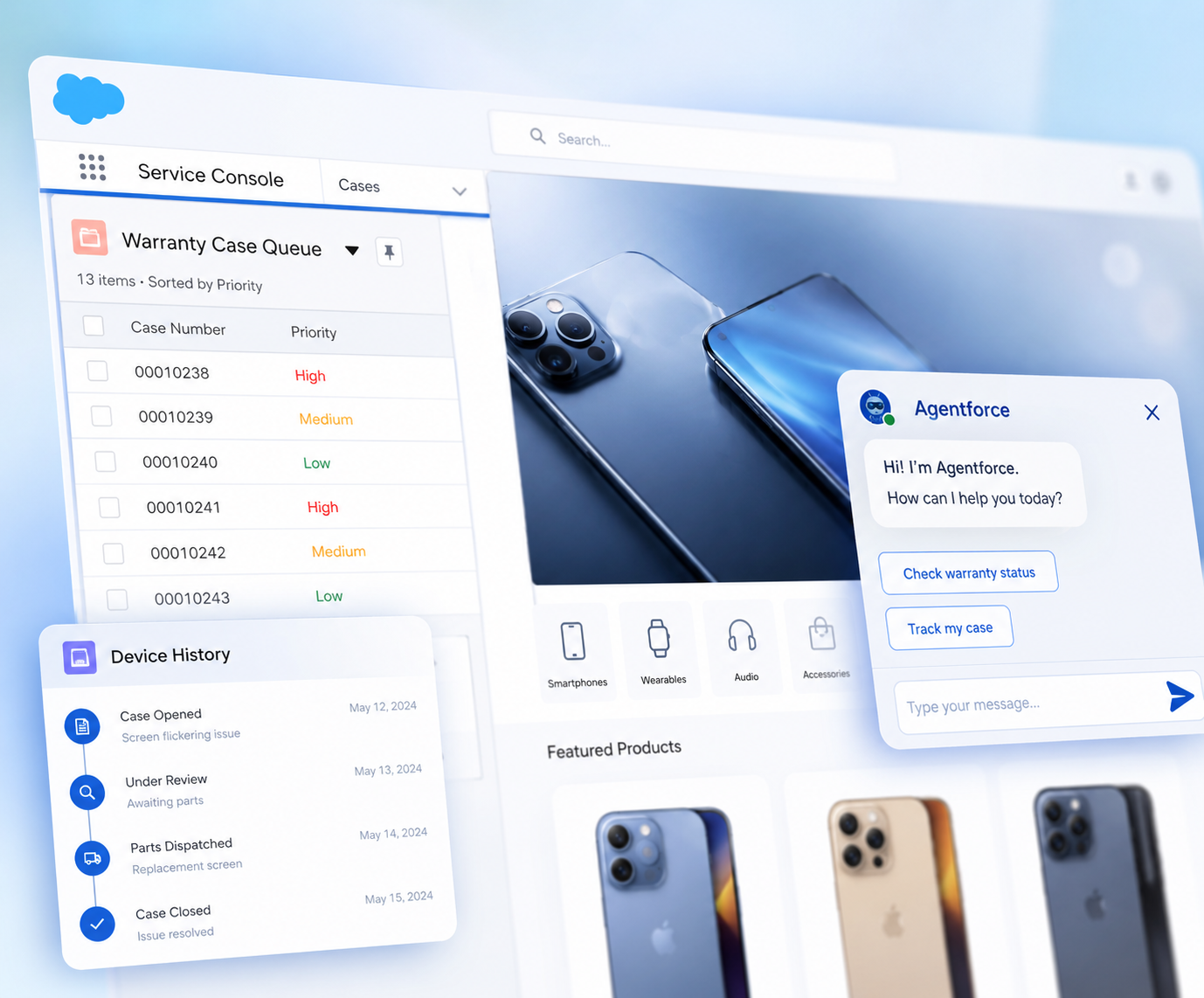
"Before this implementation, a customer calling about a warranty claim required our rep to check three systems before they could say a single word about eligibility. Now Service Cloud shows the device, the purchase date, the warranty tier, and every prior case — before the call even connects."— VP of Customer Experience, Consumer Electronics Retailer
The Business Challenge
Our client's systems were built for a simpler operation. As product lines expanded and marketplace volume grew, the gaps between systems became costly — in customer satisfaction, in B2B revenue visibility, and in the ability to detect product quality issues before they became crises.
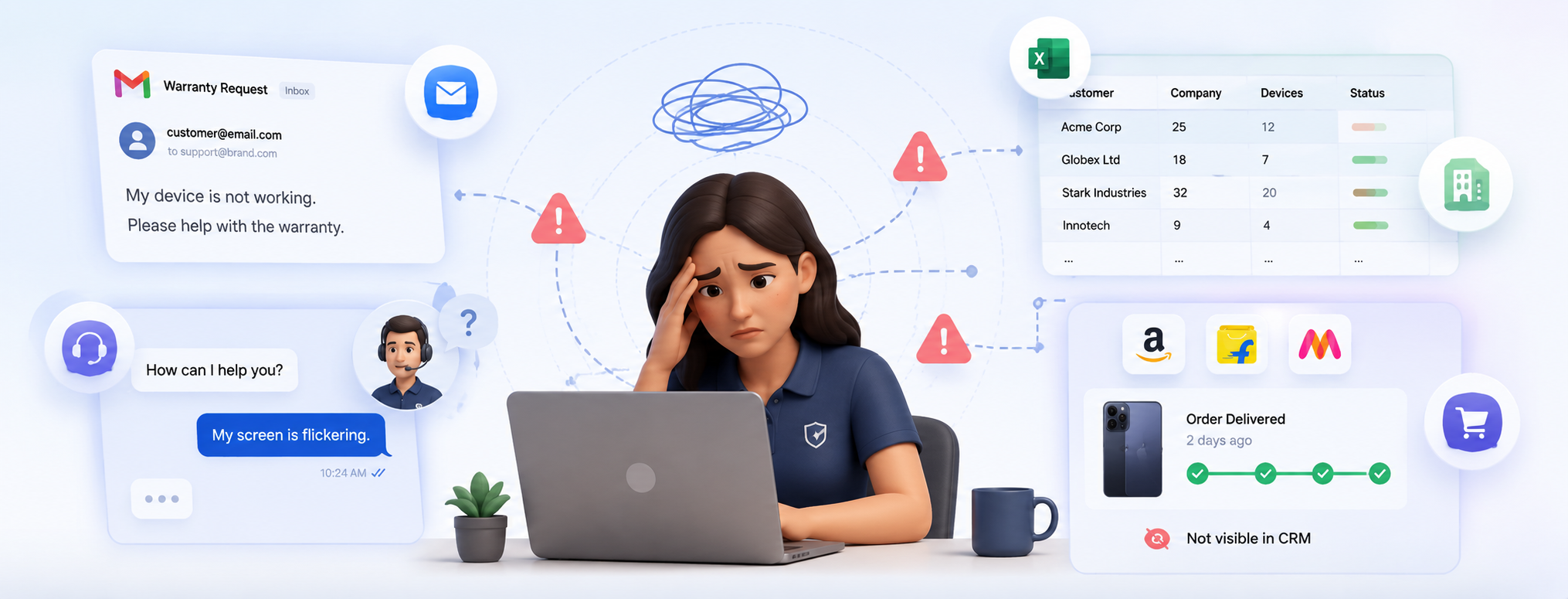
Customers filing warranty claims were asked to email a copy of their receipt or order confirmation. Drop-off rates were high — many customers abandoned the process rather than locate documentation from months or years prior — leaving device issues unresolved and generating negative reviews that damaged brand reputation.
When a customer called about a device fault, support reps had no access to what the customer had purchased, when, which warranty tier they held, or whether they had opened a previous case. Every interaction started from zero, frustrating both caller and agent, and extending average handle time significantly.
IT directors, school district procurement officers, and hospitality chain buyers purchasing devices in volume had no structured pipeline. Renewal timelines were tracked manually, quotes were emailed without version control, and there was no system to trigger follow-up before contract expiry — revenue from enterprise accounts was leaking through the gaps.
RMAs were approved or denied in isolation. No system connected return patterns to specific product SKUs, firmware versions, or production batches. Systematic defect issues remained invisible until return volume became impossible to ignore — often three to four months after the first customer reported the problem.
Product launch campaigns and promotional emails went to the entire customer list regardless of what any individual customer had actually purchased. Audio accessory buyers received laptop promotions. Smart home customers received mobile peripheral campaigns. Engagement rates were low and unsubscribe rates were climbing.
Orders from Amazon Electronics, Best Buy marketplace, B&H Photo, and Newegg were not synchronized into the CRM. A customer service rep handling a call from a marketplace buyer had no order to reference. Warranty registration was impossible for marketplace purchases without a manual process that almost no customer completed.
The Solution
Ashapura Softech designed a Salesforce platform built around the post-purchase customer journey. Every interaction after purchase — warranty registration, technical support, RMA processing, and repair tracking — flows through Service Cloud, with Agentforce handling the majority of first contacts autonomously.
Salesforce Service Cloud | Warranty Registration Object | RMA Authorization Workflow | Repair Job Tracking | Odoo ERP Integration
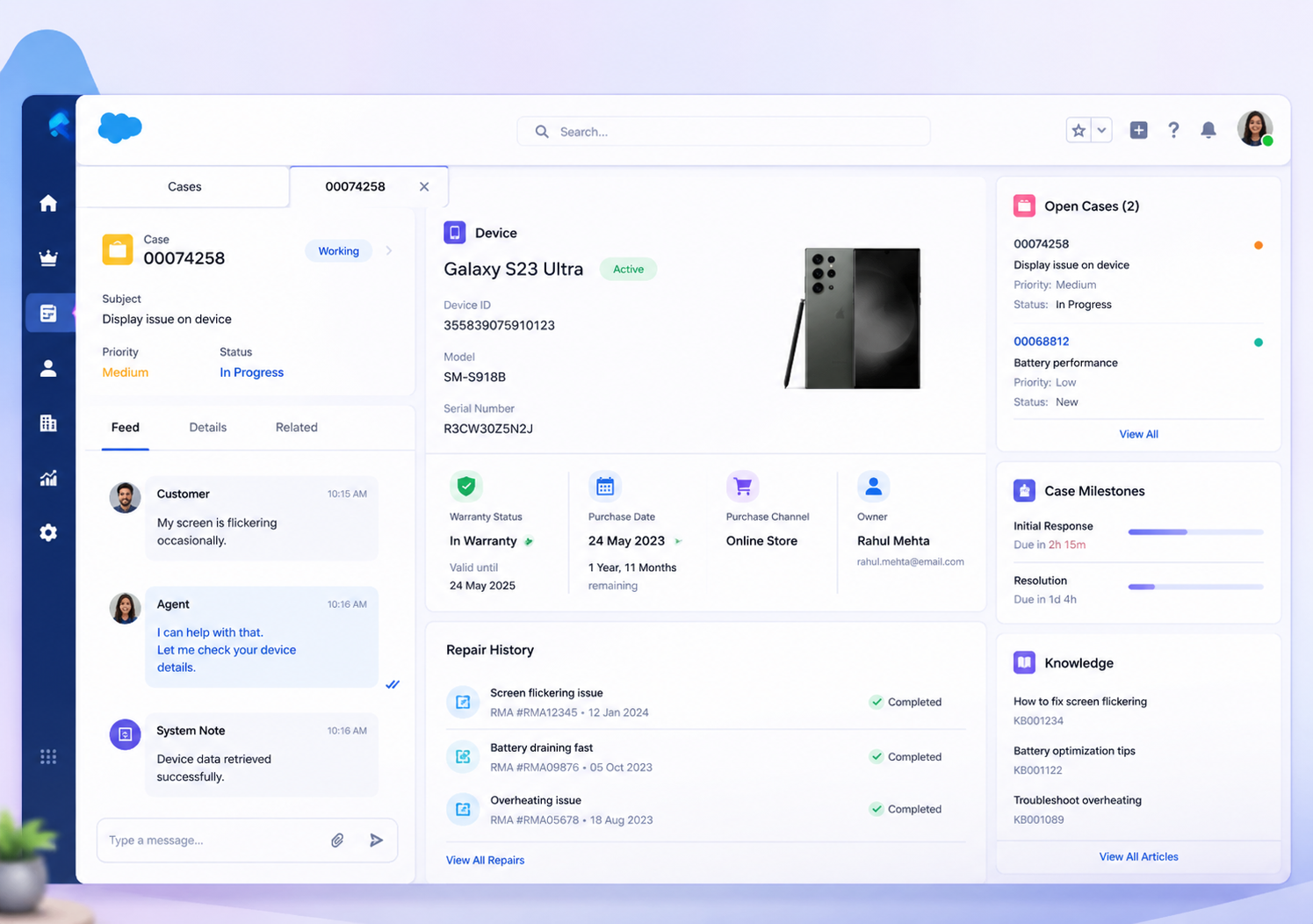
Service Cloud is configured as the complete post-purchase operations hub. Every product sold — whether direct through the Adobe Commerce storefront or through a marketplace channel — generates a linked warranty registration record in Salesforce at the time of purchase. This record attaches to the customer contact, the specific device SKU and serial number, and the originating order.
When a customer contacts support — by phone, chat, or any digital channel — the assigned rep sees the full device history before the conversation begins: purchase date, warranty tier and expiry, all prior cases, any open or closed repair jobs, and previous RMA records. The Odoo ERP integration surfaces real-time repair job status and parts inventory availability directly inside Service Cloud during calls — so reps know whether a replacement part is in stock before committing to a repair timeline.
Agentforce Service Chatbot | Adobe Commerce Storefront | RMA Self-Service | Troubleshooting Workflows | Agentforce Sales Coach | Amazon Transcribe
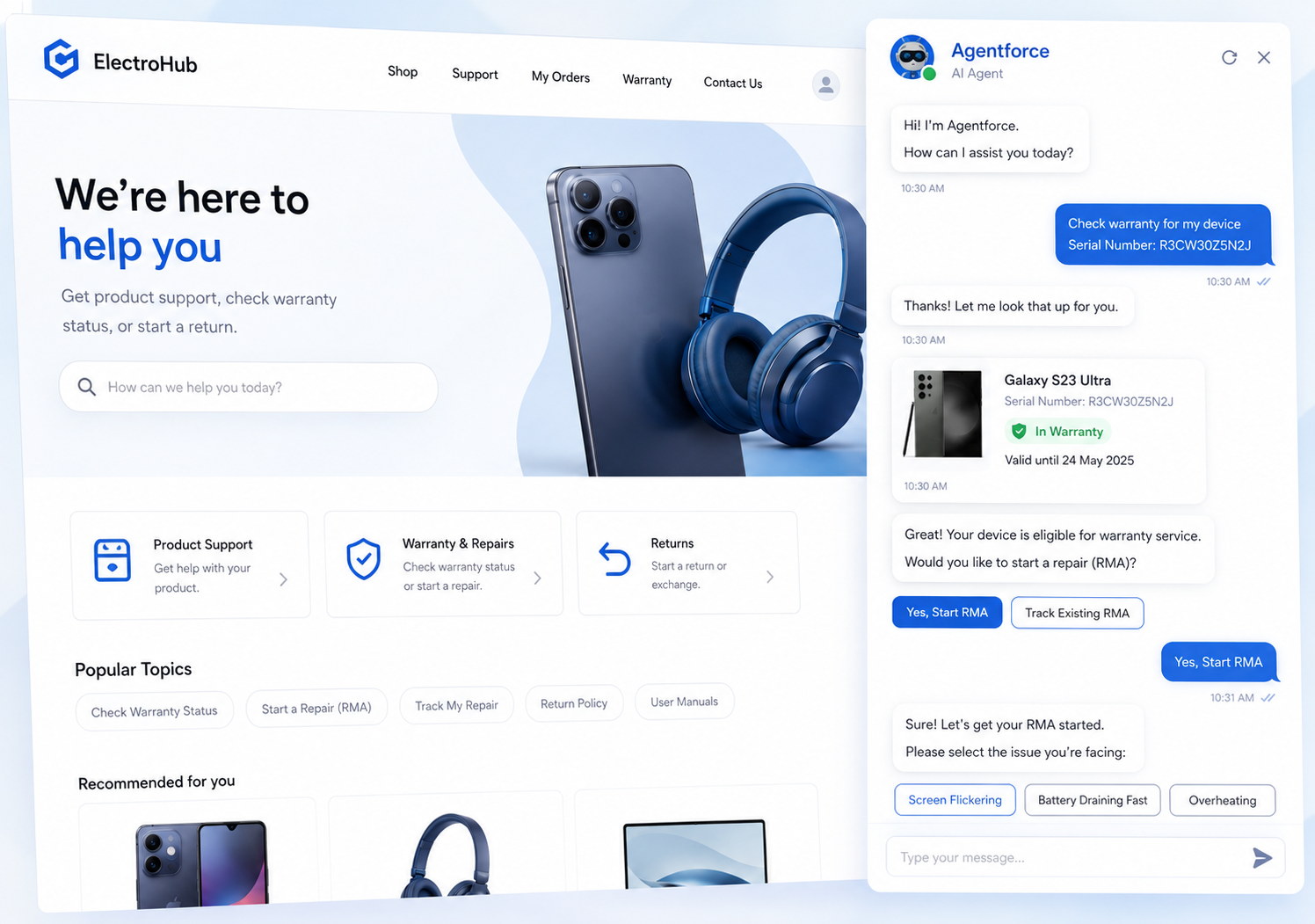
The Agentforce service chatbot is deployed on the Adobe Commerce storefront and dedicated support portal, serving as the first contact for all post-purchase queries. The chatbot resolves approximately 60% of all incoming support queries without transferring to a human agent — handling the full self-service flow for the most common cases.
Agentforce Sales Coach operates in parallel on the contact center side. Every technical support call is transcribed by Amazon Transcribe, and those transcripts are analyzed by Agentforce Sales Coach to detect recurring fault descriptions, cluster similar issues by SKU or symptom category, and generate coaching recommendations for reps. When a defect pattern emerges across multiple cases, the operations team receives an alert within days — not months.
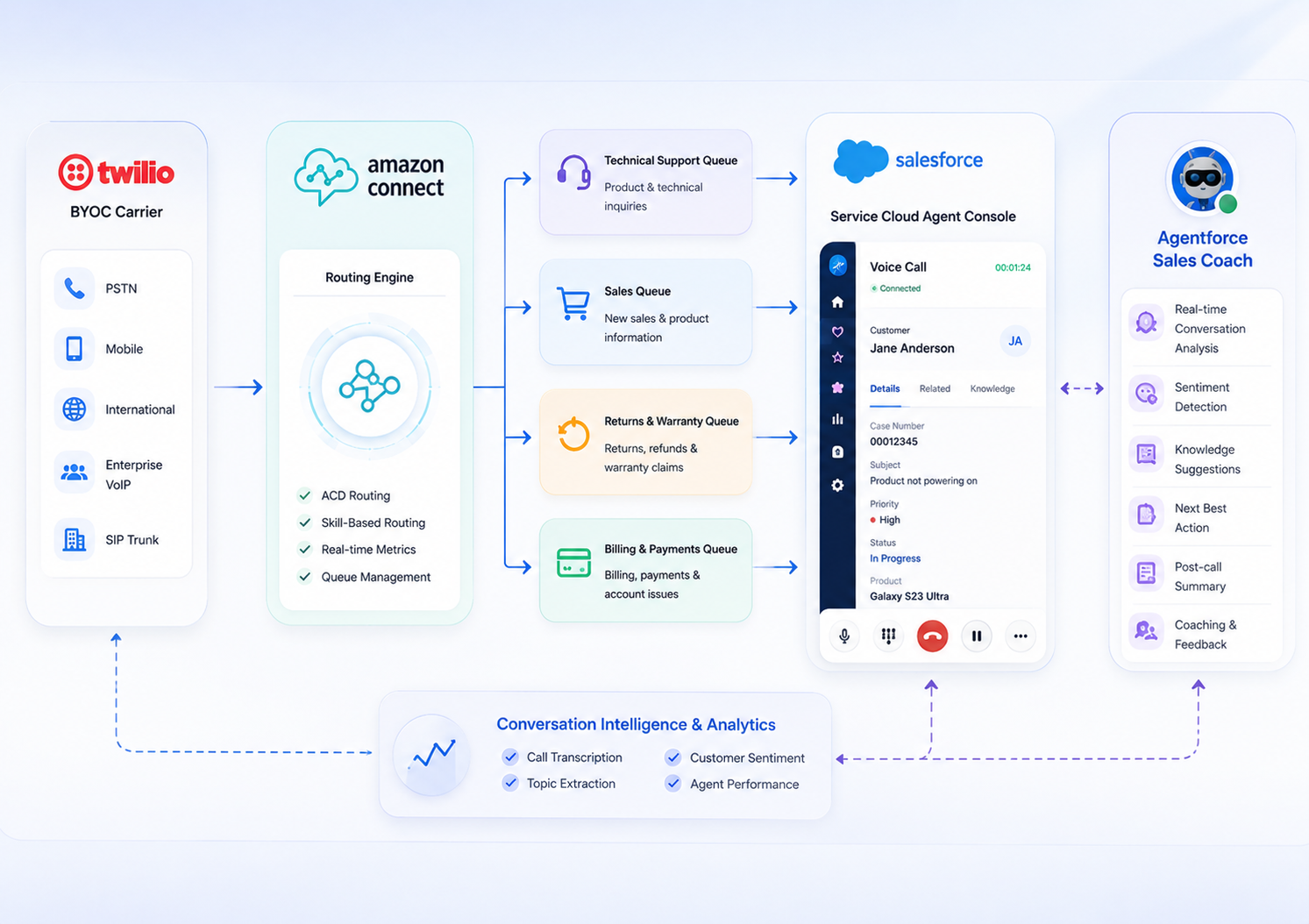
Salesforce Service Cloud Voice | Amazon Connect | Amazon Transcribe | Twilio BYOC | Intelligent Call Routing | Digital Engagement
The technical support center is built on a Bring Your Own Carrier (BYOC) architecture using Twilio as the carrier layer and Amazon Connect as the cloud contact center engine — giving the retailer a single phone number that handles inbound and outbound voice, SMS, and WhatsApp simultaneously.
Amazon Connect routes calls intelligently across four support queues: tier 1 general support, tier 2 technical escalation, warranty disputes, and business account support. Business account callers are identified by registered phone number and routed directly to a dedicated account rep without IVR friction.
All digital channels — web chat, email, Facebook, and Instagram — are unified through Salesforce Digital Engagement and route into the same Service Cloud case queue. Agents manage voice and digital channels from a single workspace, with full conversation history visible regardless of channel.
Salesforce Sales Cloud | CPQ | Enterprise Account Management | Device Bundle Configuration | Leasing Options | Renewal Automation
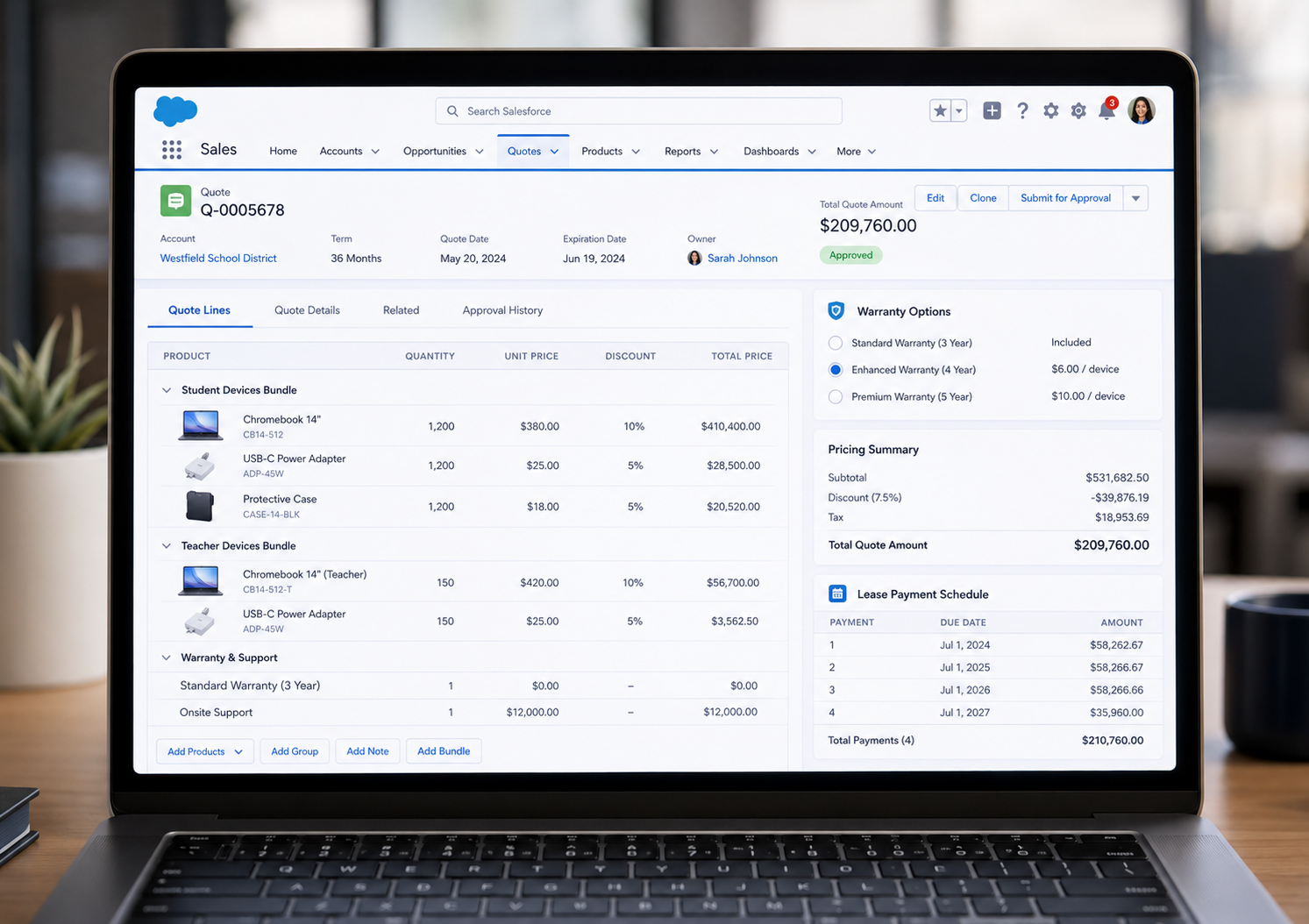
Enterprise B2B accounts — school districts purchasing classroom device sets, hospitality chains equipping guest rooms, and corporate IT departments refreshing hardware fleets — require a fundamentally different sales motion than direct-to-consumer transactions. These accounts involve multi-SKU configurations, volume pricing, bundled accessories and warranties, and frequently, structured leasing or installment payment arrangements.
Ashapura Softech implemented Sales Cloud with CPQ to replace the spreadsheet-based B2B pipeline entirely. The CPQ configuration allows account managers to build quotes combining device SKUs, compatible accessories, extended warranty tiers, and leasing terms — with volume discount rules and account-tier pricing applied automatically.
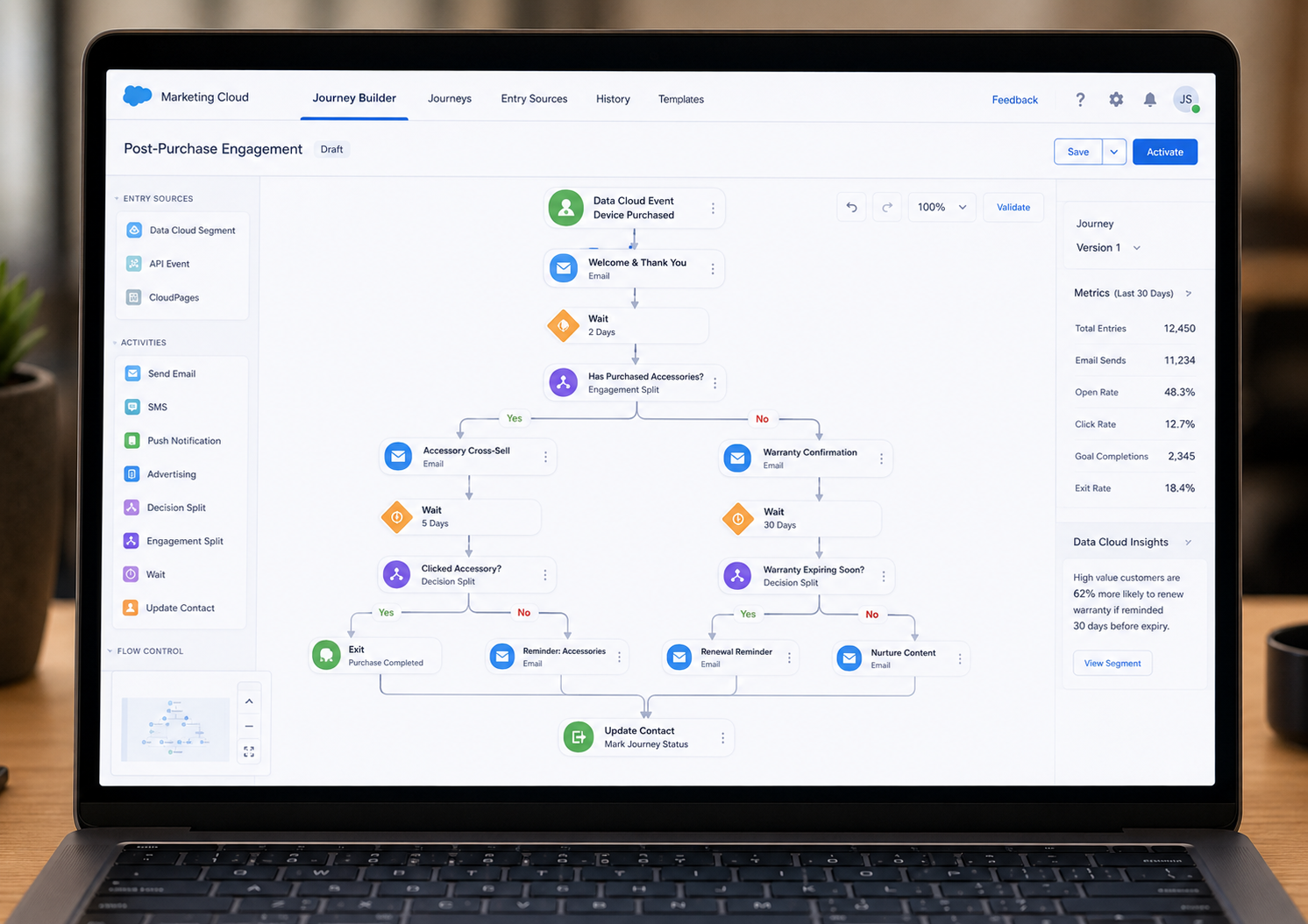
Salesforce Marketing Cloud | Data Cloud | Adobe Commerce | Journey Builder | Channel Engine | Marketplace Order Sync
Data Cloud serves as the unification layer — combining warranty registration records, support case history, purchase records from all channels, and Adobe Commerce website behavioral data into a single customer 360 profile. This unified profile is the foundation for all Marketing Cloud segmentation: customers are grouped by the devices they own, the categories they have purchased from, and where in the product lifecycle they sit.
Channel Engine synchronizes orders from Amazon Electronics, Best Buy marketplace, B&H Photo, and Newegg in near-real time — so marketplace buyers appear in Salesforce with full order history and are eligible for warranty registration and post-purchase marketing journeys exactly like direct buyers.
The Migration Challenge
Migrating from Zendesk, NetSuite ERP, standalone Magento, and spreadsheet B2B data into Salesforce required solving a relational data problem that standard migration tooling was not designed to handle: linking each of 95,000 RMA records to its originating order, its warranty registration, and the replacement shipment that followed.
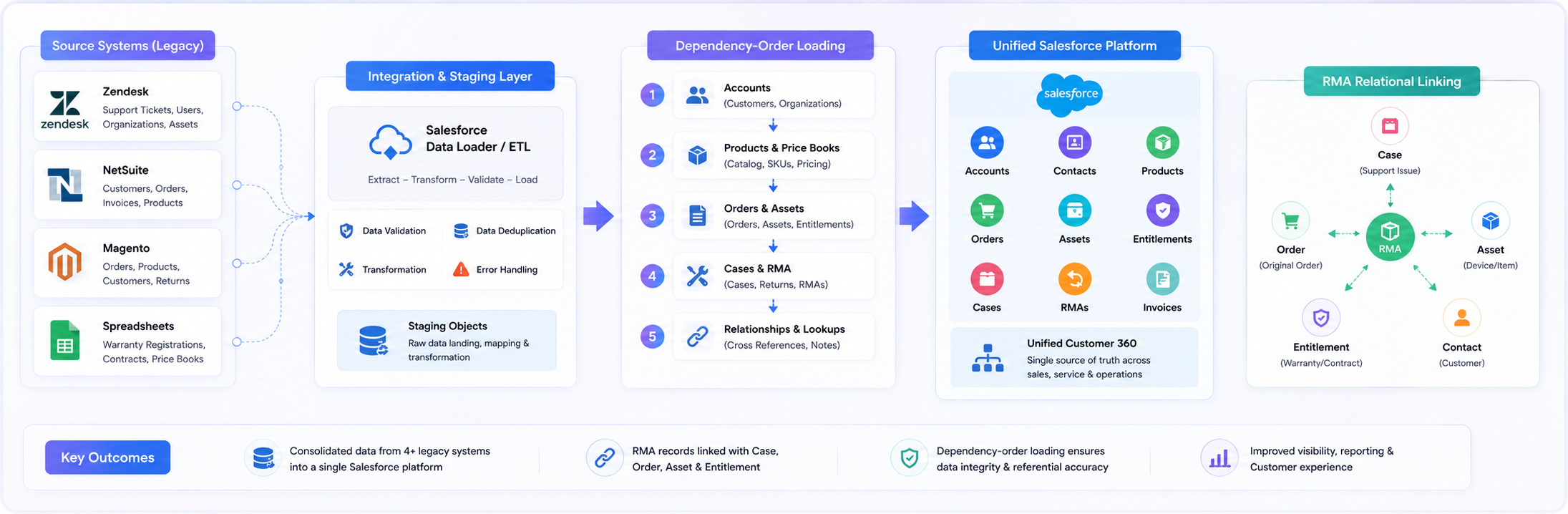
Each RMA record in the legacy system referenced a Magento order ID and a Zendesk ticket ID — neither of which existed as Salesforce record IDs after migration. Ashapura Softech built an external ID mapping table that translated legacy Magento order numbers and Zendesk ticket numbers to their corresponding Salesforce Order and Case IDs before the RMA import ran. A second pass linked approved RMA records to the replacement orders that had been generated in Magento post-approval — identifying replacements by matching RMA approval date and customer ID against orders placed within the eligible fulfillment window. This resolved 94,800 of 95,000 RMA records automatically; the remaining 200 were resolved through a targeted manual review and documented for the client's records team.
180,000 warranty registrations were stored in a standalone system referencing Magento order numbers, but the same customer had frequently registered products under multiple email addresses — creating duplicate contact records that would fragment the warranty history. Ashapura Softech ran deduplication prior to warranty import, merging duplicate contacts using a matching rule on name, shipping address, and registered device serial number. Warranty registrations were then loaded linked to the surviving contact records and their corresponding Salesforce orders. This ensured Service Cloud showed a unified warranty history per customer — not a fragmented view scattered across duplicate accounts.
220,000 Zendesk support tickets were migrated to Salesforce Service Cloud Cases, including full comment threads and file attachments. Ticket attachments — typically customer-submitted photos documenting device damage or screen defects — were extracted from Zendesk's attachment API before platform retirement and loaded as Salesforce File records linked to the corresponding Case. Tickets with no associated Salesforce contact were matched against the migrated contact database by email address. The small percentage with no match were created as Cases with a placeholder contact and flagged for post-go-live manual review, ensuring no case history was discarded.
12,000+ B2B accounts spread across multiple sales rep spreadsheets were standardized, deduplicated by company name and address, and loaded into Salesforce as Account records with full contact hierarchies. Historical order data from NetSuite was extracted and linked to the corresponding Account and Contact records, giving account managers immediate visibility into prior purchase history, volume totals, and contract timelines without requesting a report from finance. CPQ product configurations were rebuilt for the top 200 B2B account types based on historical quote patterns extracted from spreadsheet archives — reducing new quote build time to minutes for standard enterprise configurations.
Technology Architecture
| Salesforce Product / Integration | Role in the Implementation |
|---|---|
| Service Cloud | Post-purchase command center: warranty registration, repair job tracking, RMA authorization workflow, technical support case management, tier-based escalation routing, and repair-status visibility via Odoo ERP integration |
| Agentforce (Service Chatbot) | Autonomous first-contact for warranty eligibility checks, guided troubleshooting flows, RMA self-service initiation, product compatibility questions, and repair status lookups — resolves approximately 60% of all incoming queries without human escalation |
| Agentforce Sales Coach | Analyzes Amazon Transcribe call transcripts to identify recurring product fault patterns by SKU and symptom category, surfaces coaching recommendations for technical support reps, and alerts operations to systematic defect trends within days of pattern formation |
| Service Cloud Voice | Contact center infrastructure with real-time Amazon Transcribe transcript in the agent console; integrated with Amazon Connect for routing and Twilio BYOC for single-number voice, SMS, and WhatsApp support |
| Amazon Connect | Cloud contact center engine handling IVR scripting, intelligent queue routing across four support tiers, and agent capacity management; business account callers identified and routed by registered phone number |
| Amazon Transcribe | Real-time call transcription feeding the Service Cloud agent console during calls and the Agentforce Sales Coach analysis pipeline post-call |
| Twilio BYOC | Single carrier number supporting simultaneous inbound and outbound voice, SMS, and WhatsApp — one number for all customer-facing contact |
| Sales Cloud + CPQ | B2B enterprise pipeline management: opportunity tracking, device bundle configuration, volume pricing tiers, leasing and installment quote structures, and 90-day automated renewal reminders |
| Marketing Cloud | Behavioral journey automation: post-purchase accessory cross-sell, warranty renewal reminders personalized by device, trade-in program promotions by device age, and product launch campaigns segmented by purchase category |
| Data Cloud | Unified customer 360 profile combining warranty registrations, support case history, purchase records from all channels, and Adobe Commerce website behavioral data — the audience foundation for all Marketing Cloud journeys |
| Adobe Commerce (Magento) | eCommerce storefront integrated with Service Cloud for automatic warranty registration at purchase, Agentforce chatbot embedded for post-purchase support access, and behavioral data streamed to Data Cloud |
| Channel Engine | Near-real-time order sync from Amazon Electronics, Best Buy marketplace, B&H Photo, and Newegg into Salesforce — enabling warranty registration, Service Cloud case creation, and Marketing Cloud journey enrollment for marketplace buyers |
| Odoo ERP | Repair job status and parts inventory availability surfaced inside Service Cloud during technical support calls; replacement part ETA visible to agents before committing to a repair or replacement timeline |
| Digital Engagement | Omnichannel routing of web chat, email, Facebook, and Instagram contacts into Service Cloud case queues — agents manage all digital channels from a unified workspace with full conversation history |
Outcomes & Business Impact
The implementation changed the operational reality across every team that touches the customer — from the first post-purchase interaction through enterprise account renewal and product quality management.
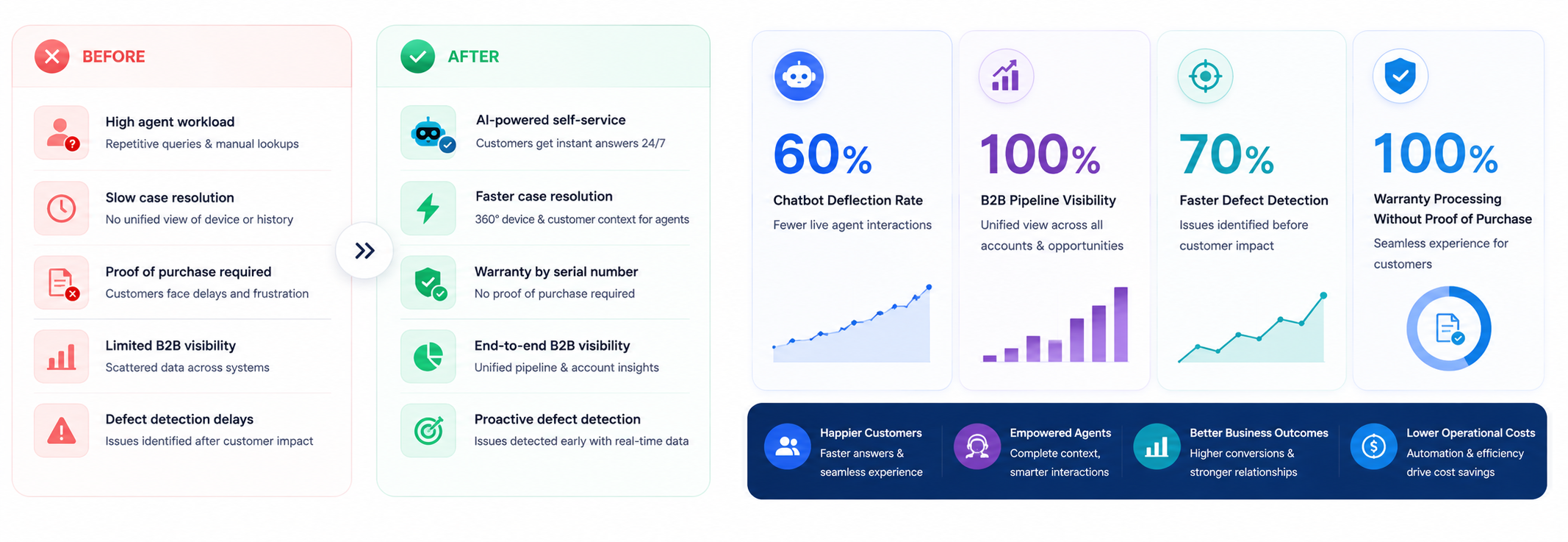
The Agentforce chatbot resolves warranty eligibility checks, RMA initiations, and guided troubleshooting flows without transferring to a live agent. Technical support reps now focus on cases that genuinely require human judgment — complex device faults, warranty disputes, and B2B account issues — while Agentforce manages routine post-purchase self-service continuously.
Technical support reps see device purchase date, warranty status and expiry, repair history, and all previous cases on the Service Cloud screen before saying hello. The three-system lookup that previously consumed the first minutes of every support call is gone — replaced by a single, unified record assembled from warranty registration, order history, and case history at the moment the call routes.
Enterprise accounts previously tracked across sales rep spreadsheets now exist as structured Salesforce Account records with full opportunity pipelines, CPQ quote history, and contract renewal tracking. Account managers receive automated alerts 90 days before contract expiry, transforming renewal management from a reactive scramble into a scheduled proactive motion with consistent follow-up.
Agentforce Sales Coach analyzes technical support transcripts continuously, identifying clusters of similar fault descriptions across cases by SKU, symptom, and product category. When a pattern forms — the same symptom reported by multiple customers about the same device or firmware version — the operations team receives an alert within days, well before return volume escalates into a quality crisis.
Channel Engine sync means that a customer who purchased on Amazon Electronics or Best Buy marketplace appears in Salesforce with a complete order record. They can register a warranty, open a support case through any channel, and receive targeted post-purchase marketing journeys — eliminating the invisible marketplace customer problem that previously affected a significant share of total sales volume.
Data Cloud's unified customer 360 enables Marketing Cloud to send post-purchase journeys based on the specific category and brand a customer has purchased. Accessory cross-sell campaigns are triggered by the device in the customer's warranty registration record. Warranty renewal reminders include the specific device model and the exact expiry date. Product launch campaigns reach only customers whose purchase history makes the launch relevant.
The Twilio BYOC and Amazon Connect architecture gives the technical support center a single number for voice, SMS, and WhatsApp. Callers are routed to the right tier before the agent picks up. Business account callers are identified and routed to dedicated reps by phone number. Every interaction — regardless of channel — is logged as a Service Cloud activity on the customer record, visible to any rep who handles a future contact.
The migration resolved the most structurally complex challenge in the project: linking 95,000 RMA records to their originating orders, warranty registrations, and replacement shipments across three legacy source systems. Post-migration, every RMA in Salesforce carries its full relationship chain — auditable, reportable, and visible to both support reps and operations for quality and returns analysis.
Frequently Asked Questions
Salesforce Service Cloud manages the full warranty lifecycle — from automatic registration at point of purchase through eligibility verification, repair tracking, RMA authorization, and replacement order creation. Warranty data is stored as a custom object linked to the specific device, originating order, and customer contact. When a customer contacts support, agents see purchase date, warranty tier, expiry date, repair history, and all prior cases in a single Service Cloud console. Agentforce can automate the eligibility check entirely — querying registration records by serial number and guiding the customer through RMA initiation without agent involvement. Integration with repair management systems such as Odoo ERP surfaces real-time repair job status and parts availability directly in the agent console during calls.
A consumer electronics retailer operating across B2C and B2B requires a layered Salesforce stack. Service Cloud is the post-purchase hub for warranty, technical support, and RMA. Sales Cloud with CPQ manages B2B enterprise accounts — school districts, hospitality chains, and corporate IT departments — with volume pricing, device bundles, warranty tiers, and leasing configurations. Marketing Cloud with Data Cloud drives post-purchase journeys based on what customers own: accessory cross-sell, warranty renewal reminders, and trade-in promotions. Service Cloud Voice with Amazon Connect and Twilio BYOC unifies the contact center across voice, SMS, and WhatsApp. Channel Engine syncs marketplace orders from Amazon, Best Buy, B&H Photo, and Newegg into Salesforce for complete order and warranty visibility across all sales channels.
An Agentforce service chatbot deployed on an Adobe Commerce storefront or support portal resolves the most common post-purchase queries without human involvement: warranty eligibility checks by device serial number or order number (no proof of purchase required from the customer), step-by-step troubleshooting flows for common product faults organized by category, RMA initiation including automated approval for in-warranty claims and shipping label generation, product compatibility questions answered from a structured knowledge base, and repair status lookups pulling from an integrated ERP system in real time. In a well-configured implementation, 55 to 65 percent of incoming support queries can be resolved by the chatbot without escalation to a live agent — measurably reducing contact center volume and allowing technical support reps to focus on cases that require genuine diagnostic expertise.
Salesforce CPQ (Configure, Price, Quote) allows account managers to build complex enterprise quotes combining device SKUs, compatible accessories, extended warranty packages, and financing or leasing options — with volume pricing tiers and account-level discount rules applied automatically. For a school district purchasing classroom devices, CPQ can be configured to bundle the required device, case, charger, and extended warranty as a single configurable product family, with pricing that adjusts by quantity tier. Contract renewal tracking automates reminders 90 days before expiry, routed to the account owner. All quotes, signed documents, and full order history are visible on the Account record in Sales Cloud — replacing the spreadsheet-based pipeline that typically manages these accounts in organizations without a formal CRM.
Migrating RMA records across multiple legacy systems requires building an external ID mapping table before the RMA import begins. Magento order IDs and Zendesk ticket numbers referenced in RMA records must be translated to their corresponding Salesforce Order and Case IDs, which are created during earlier migration phases. A dependency-ordered load sequence is critical: contacts and accounts first, then orders, then warranty registrations linked to orders by external ID, then support cases linked to contacts, and finally RMA records linked to warranty registrations, orders, and cases. Replacement orders created in Magento following approved RMAs are identified by matching RMA approval date and customer ID against orders placed within the eligible fulfillment window — and a lookup relationship is written back to the RMA record. Post-migration validation compares row counts between legacy export files and Salesforce SOQL queries to confirm completeness for every object type.
Ashapura Softech brings 12+ years of Salesforce implementation experience with deep specialization in retail, eCommerce, and ERP integration — including implementations involving Service Cloud warranty management, Agentforce chatbot deployment, Service Cloud Voice with Amazon Connect and Twilio BYOC, and complex multi-source data migrations involving Zendesk, Magento, NetSuite, and marketplace order systems. The team holds certifications across Sales Cloud, Service Cloud, Marketing Cloud, Agentforce, and Data Cloud, and has delivered integrations with Adobe Commerce, Odoo ERP, Channel Engine, and NetSuite for product-oriented businesses selling across direct and marketplace channels. The Irving + India delivery model provides senior U.S.-based consulting with cost-effective offshore execution — without compromising quality or responsiveness to project timelines.
About the Partner
Founded in 2012 and headquartered in Irving, Texas, Ashapura Softech is a certified implementation partner for Salesforce, Zoho, Microsoft, and Odoo — serving 100+ businesses across North America. Our team of certified consultants has handled every phase of digital transformation: from requirements discovery and solution architecture through data migration, custom development, user training, and long-term managed support.
Our Irving + India delivery model combines U.S.-based project management and senior solution architecture with cost-effective offshore execution — delivering enterprise-quality implementations without enterprise-level overhead, and without compromising accountability to project timelines.
Ready to Start?
Whether you need to unify warranty management and RMA tracking, deploy an Agentforce technical support chatbot, restructure your B2B enterprise pipeline, or migrate from Zendesk and Magento — let's have a 15-minute conversation about what the right Salesforce architecture looks like for your business.